Music History I Quiz #3 Study Guide
 Call Kai
 Learn
 Practice Test
 Spaced Repetition
 Match
 Flashcards
 Knowt Play
1/14

There's no tags or description
Looks like no tags are added yet.
15 Terms
The printing press and music printing changed how the music business functioned by leading to the creation if a new class of musicians.
a. Identify this new class of musicians.
b. As a result of music printing and publishing, music was no longer only a service. Music also became ________ [complete the sentence].
a. People who were less eduacated in music from all over could not play & practice.
b. A commodity
Define the term madrigal. Discuss the origins of madrigals, what they were intended for, and how madrigals developed over the course of the sixteenth century.
Madrigals are vernacular & secular, made for 2 or more parts. They were made for private performances, so they were often performed in homes. The madrigals were based on poems about love & sex.
There were five (5) main types of instruments music composed during the sixteenth century. Identify and describe three (3) of these forms. Extra points for additional IDs and descriptions.
Concerto - A major genre featuring a soloist or a small group of soloists interacting with a larger orchestra
Suite - A collection of dance-inspired instrumental movements grouped together in the same key
Tocatta - Solo virtuoso piece, usually for keyboard
Ricercare/Fugue - Composition, usually for keyboard, with initial subject developed with imitations.
Sonata - A piece for 1 or 2 solo instruments with basso continuo
Giovanni Gabrieli was an important composer of instrumental music during the end of the sixteenth century. Identify the city and building in which he worked and identify at least one of the genres in which he composed.
Giovanni worked in Venice as the head of the music program at the Church of St. Mark. He wrote polychoral motets, sonatas, and ensemble canzonas that were inspired by the Church’s architecture.
Name and describe at least three (3) musical instruments that were developed during the Renaissance. (3 points; extra points for additional names and descriptions.)
Lute - descendant of the oud
Viol de Gamba - like a cello/bass
Violin - string instrument
Vihuela - related to the guitar and lute
Crumhorn - similar to a bagpipe
Sackbut - ancestor of the trombone
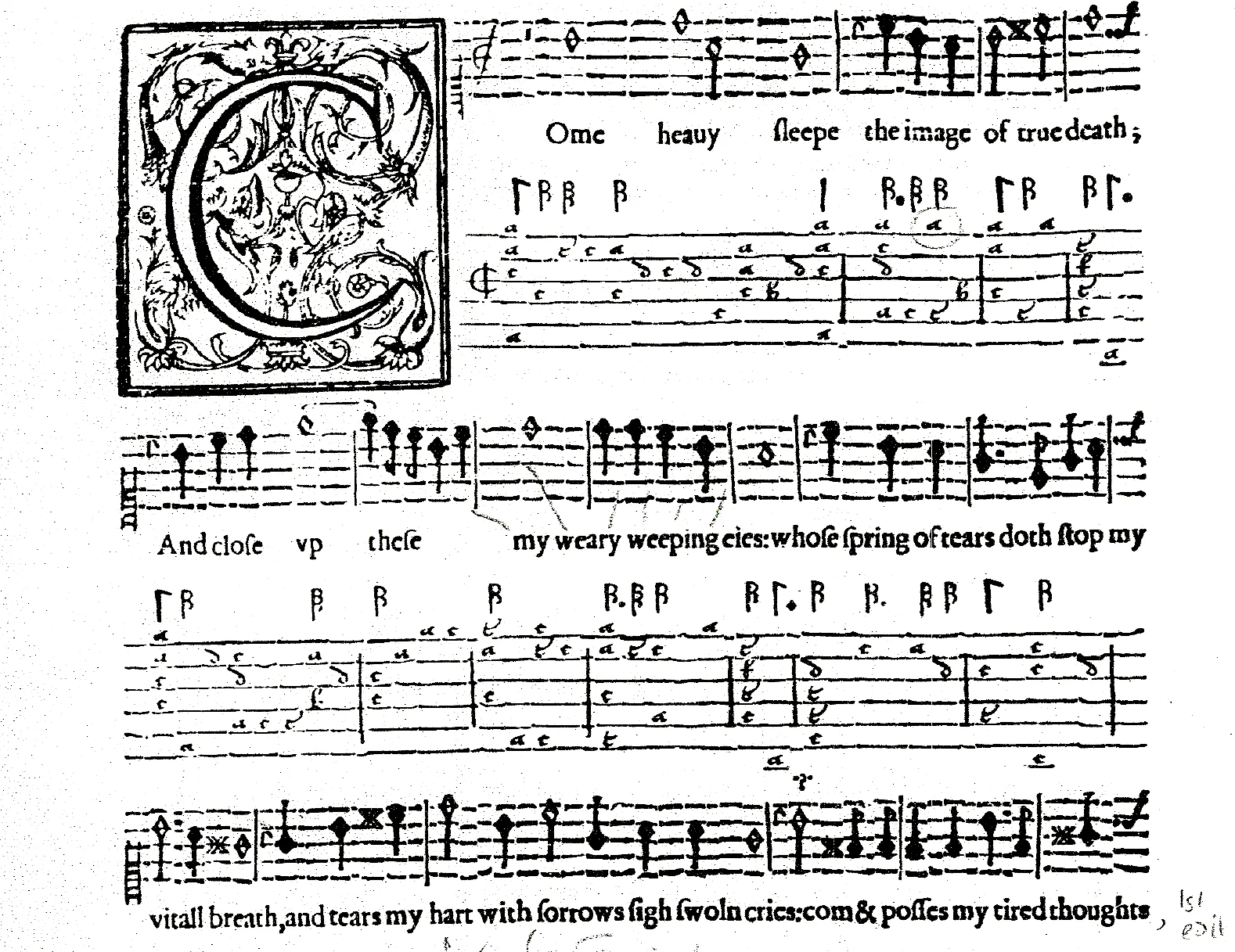
Here is a musical score.
a. Describe two different ways that this music can be read and performed
b. Identify the composer of this music
a.
1) A group can sit around the music and sing a part while all sharing one sheet
2) The tablature allows a lute player to be played with voice
b. John Dowland
What did the term “Baroque” originally mean and when was the Baroque era (span of dates)?
The term Baroque came from the Portuguese word borocco meaning “misshapen pearl” and was used as an insult to describe music & art of of the 17th to mid 18th century. Era: 1600-1750
Identify and describe two of the general characteristics of Baroque music. (4 points. Extra points if you contrast these characteristics with those of Renaissance music)
Baroque music allowed dissonances to be used more freely. It had rhythmic and metrical variety, allowed more chromaticism and had a large appearance of bar lines for the first time. This is different from the Renaissance because that music did not like to use dissonance and did not use any use indications such as bar lines, except for occasional ones under the staff.
The second practice controversy focused on what aspect of music? Who were the composers involved, and what were their positions in the controversy?
This was an argument between Artusi and Monteverdi about when dissonances should be allowed in music. Monteverdi was all for dissonance, but Artusi did not agree.

Here is an image.
a. Identify the instrument in the image.
b. Discuss the social aspect of this image and how it relates to our study of music history.
a. Theorbo
b. This image is significant because at this point in time, women were not allowed to play music or become musicians.
What are the origins of opera? In your answer, discuss two (2) of the factors and/or people that contributed to the first operas.
Opera came from the Italian Renaissance intermedio, which were half-time shows between the acts of the play. Monteverdi was one of the first people to write an opera. During plays, they often could not close any curtains so they used these acts as a distraction and filler.
Here is a musical score.
a. Describe what you see in the score, identifying at least one of the musical terms that we discussed in class.
b. How would this score be performed (identify instruments and how harmonies would be played)?
a. Basso continuo, figured bass #’s on the score, monody, aria
b. The numbers on the score are figured bass, which allows an instrumentalist, who perhaps plays a lute or theorbo, to create a realization of the harmony.
Women started to gain more recognition in musical performance during the sixteenth and seventeenth centuries. Discuss one of the genres in which women received recognition and discuss how it featured them. (4 points base, 2 extra points if you can identify additional genres.)
Madrigals are a genre that increased the recognition of women. Maddalena Casulana would write her own Madrigals and was one of the first women to do this.
Another genre is opera. Out of this came the operatic diva, who would be a woman, usually a soprano, singer whom many people would go to see. A lot of times, people would go just to see the diva perform. One woman who was an operatic diva was Renzi.
What is recitative? In your answer, use musical terminology from reading/class and identify the instruments involved.
A recitative is usually set to free verse and doesn’t have a discernible melody. A lot of times tthis is talk singing and playing by possibly a lute or harpsichord but there’s no strict tunes that comes out of it. It is mainly just chords and maybe some harmonies being played.
Identify the title and composer of a 1607 opera written for the court of Mantua.
L’orfero by Monteverdi