BIO Exam 2 - Central Dogma
 Call Kai
 Learn
 Practice Test
 Spaced Repetition
 Match
 Flashcards
 Knowt Play
1/108

There's no tags or description
Looks like no tags are added yet.
109 Terms
Soap can be derived from either animal fat or vegetable oils. We would expect soap from animal fat to have a more solid consistency than soap made from plant oils because animal fats are saturated: i.e., characterized by many double bonds in the hydrocarbon tail.
FALSE
Everything about this is true _ until the last statement. Saturated means that there are NOT double bonds. The double bonds form when the carbons in the tails are NOT saturated with hydrogens and these induce kinks or bends in the chains preventing tight packing.
The permeability barrier of membranes is established because membranes are organized with the hydrophobic parts of the layers of the phospholipids facing out and the hydrophilic parts facing in where they form hydrogen bonds with the hydrophilic parts of the other layer.
FALSE
This describes an inverted membrane. In reality it is the hydrophilic phosphate head groups that face out toward the water where they form hydrogen bonds.

This is true: Aldosterone has the structure shown below. Is this true: This molecule would be classified as a steroid based on its chemical structure.
TRUE
We can see the classic 4-ring structure of steroids and note that it is relatively hydrophobic – though with more oxygens than we’ve seen before, and hence more soluble in water.
If you needed to carry food for multiple days (think either a bucolic camping trip or an apocalyptic MadMax scenario as you choose), it would make sense to carry foods high in saturated fats instead of sugars because the saturated fats would contain more energy (calories) per pound than sugars because they have more nonpolar bonds.
TRUE
Everything about this is indeed true. Saturated fats are mostly C-C and C-H bonds, so equivalent electronegativities means nonpolar bonds, and nonpolar bonds are typically higher energy bonds. Sugars have some C-C and C-H nonpolar bonds, but there are also many C-O and O-H bonds which are polar (O is more electronegative) and therefore lower energy.
The term “genome” refers to the genetic material of an organism that is organized into chromosomes.
TRUE
Not much to say here. This is one of the core definitions that we quoted in class! The key is that it isn’t just the genes, but ALL the genetic material – genes + dark matter.
Most of the DNA sequence in an organism’s genome codes for the amino acid sequences of proteins.
FALSE
The key is the pie chart in the ppt showing dark matter. The “coding” part of the pie – the sequences that code for amino acids n proteins – is very small.
A chromosome in a eukaryotic cell is a linear, antiparallel, double helix DNA molecule that is tightly wrapped around proteins.
TRUE
Again, pretty much just the definition.
The translation step of the “Central Dogma” refers to process by which information that is written in a nucleic acid language is directly translated into either the amino acid language of proteins, the sugar language of carbohydrates, or the fatty acid language of lipids depending on the gene.
FALSE
This statement is true up through the description of translation into the amino acid language of proteins. BUT genes do not directly code for sugars or fatty acids. How do we make sugars and fatty acids, etc? Cells make these biomolecules using enzymes that are coded for by genes.
The two chromosomes in a “homologous pair” in a diploid organism would typically contain the same genes, although the DNA sequences might not be identical.
TRUE
Yes, again this is the definition of a homologous pair of chromosomes. Think about them as two editions of the same cookbook – same list of recipes but maybe a few differences in terms of ingredients or quantities within various recipes.
RNA molecules are more reactive and less stable than DNA molecules because they have a free hydroxyl group on their ribose sugars and the amine and/or carbonyl groups on their nitrogenous bases are free to hydrogen bond with other molecules and thus form other chemical structures.
TRUE
Yes, all of these points are true. RNA has the ribose sugar and many of the nitrogenous bases are not in a basepair, so their functional groups are free to react
The 5’ and 3’ ends in nucleic acids get their designations from the carbon positions in the ribose sugar – i.e., the 5’ end extends from the 5th carbon and the 3’ end is at the 3rd carbon.
TRUE
Not much to say here, this is just how the numbering scheme works.
If you separate the two strands of DNA using heat, one strand would be comprised solely of purines and the other strand would be comprised solely of pyrimidines because the two strands are antiparallel and a purine always pairs with a pyrimidine.
FALSE
A purine does pair with a pyrimidine, but both strands can have A and G (purines) and C and T (pyrimidines).
In DNA, the %A = %T and the %C = %G. This rule is also always true for RNA.
FALSE
This is true for DNA – Chargaff’s Rules that A forms a basepair with T and C forms a basepair with G. That’s how the double helix is formed. But RNA is largely single-stranded and thus there is no need for this rule to apply. (Also RNA has U instead of T.)
This is true: you can break down DNA into individual nucleotides using the enzyme DNase to perform the catabolic reaction in a test tube. Is this true: If we then removed the DNase from the test tube and added the enzyme DNA polymerase, you could rebuild the DNA polymer.
FALSE
When you break down DNA into nucleotides, the nucleotides are monophosphate versions (dAMP, dCTP, dGTP, dTTP) and you need the triphosphate version to provide the energy for the anabolic reaction.
tRNAs and rRNAs play important roles in protein synthesis in cells. tRNAs are small, mostly-doubled-stranded RNAs that act as translators between the language of nucleotides and amino acids, while rRNA is the enzyme (ribozyme) that builds the peptide bonds between amino acids.
TRUE
These are just factual statements, but I worry that they aren’t given enough attention, so I’m doubling down on them here.
The role of helicase, topoisomerase, and the single-stranded binding proteins is to open and untwist the DNA double helix so that RNA primase and DNA polymerase can act to replicate each strand of DNA.
TRUE
A lot of machinery is needed just to get the DNA template ready for replication.
If we looked at the DNA after one round of replication, one copy would have one strand of the original DNA template and a newly synthesized complementary strand, while the other copy would have the other strand of the original double helix and a newly synthesized complementary strand. This defines semi-conservative DNA replication.
TRUE
This is the definition of semi-conservative DNA replication.
RNA primase is only needed to help replicate the lagging strand.
FALSE
RNA primase is used more on the lagging strand, but DNA replication always needs a starting RNA primer
When DNA polymerase moves 3’ to 5’ on a template strand of DNA, we name that “leading strand” synthesis. When DNA polymerase moves 5’ to 3’ on a template strand of DNA, we name that “lagging strand” synthesis.
FALSE
DNA polymerase always moves 3’ to 5’ on a template strand. The difference between leading and lagging strands is whether the DNA polymerase is moving toward or away from the DNA replication fork.
A different DNA polymerase enzyme is needed for each different deoxyribonucleotide because of the specificity of the active site.
FALSE
DNA polymerase is very specific for accepting only triphosphate deoxyribonucleotides, but its active site fits all four nitrogenous bases.
Each strand of DNA can serve as a template strand because the rules of basepairing mean that the nitrogenous base on the template strand dictates which nitrogenous base will go opposite it on the newly synthesized strand and only the correct nucleotide maintains the perfect geometry of the DNA double helix.
TRUE
This is the result of Chargaff’s rules and the precise geometry of the DNA double helix.
Each eukaryotic chromosome starts replication at the 3’ end of each strand and adds one nucleotide at a time all the way down to the 5’ end of the strand.
FALSE
Remember that there are MANY start sites for DNA replication in a eukaryotic chromosome. We said this early on in class and you can see this visually on the slides.
Telomeres – the DNA sequences at the ends of chromosomes – require a special enzyme (telomerase) to be replicated. The enzyme is inactive in most human cells, leading to the shortening of our chromosomes over time – and our aging!
TRUE
Yep. Telomerase is sometimes called the “fountain of youth” enzyme!
A scientist pursues a line of investigation on the process of transcription. She focuses her attention on the gene that codes for amylase (our old friend!). In humans, amylase is made only by cells in the salivary gland and in the pancreas.
This is true: She knows that she can check for the presence of a DNA sequence in cells using PCR and that she can check for the presence of mRNA in cells using RT-PCR. (The “RT” stands for reverse transcriptase – meaning the technique first converts mRNA back into DNA and then does the PCR step to make lots of copies of the sequence.)
Is this true: She would expect cells all throughout the body to be positive for the amylase sequence by PCR, but only the cells in the salivary gland and pancreas to be positive for the amylase sequence by RT-PCR.
TRUE
This question gets at the difference between the genome (all cells in an organism have the same genome) and transcriptomes (cells with different functions have different patterns of gene expression – i.e., different transcriptomes and proteomes).
A scientist pursues a line of investigation on the process of transcription. She focuses her attention on the gene that codes for amylase (our old friend!). In humans, amylase is made only by cells in the salivary gland and in the pancreas.
She sets up an experiment to test whether a particular DNA sequence is a promoter sequence for the amylase gene in the human genome. She mixes the possible DNA promoter sequence with RNA polymerase in a test tube. She hypothesizes that if it is a promoter sequence, then RNA polymerase will bind on its own to the DNA. Is this a logical hypothesis based on our knowledge of promoters?
Yes = True, No = False.
FALSE
RNA polymerase only binds to a promoter sequence after transcription factors bind. This is what allows regulation.
A scientist pursues a line of investigation on the process of transcription. She focuses her attention on the gene that codes for amylase (our old friend!). In humans, amylase is made only by cells in the salivary gland and in the pancreas.
She moves on to test for the production of amylase in human cells. She wants to predict the size of the mRNA. She hypothesizes that the size of the mature mRNA will be the number of nucleotides found in exons. Is this a logical hypothesis based on our knowledge of promoters? Yes = True, No = False.
FALSE
Transcription starts at the promoter and ends shortly after the polyadenylation signal in the DNA. The “start” and “stop” codons are used only in translation. AND the mature mRNA would also have all of the introns spliced out.
There is no lagging strand in transcription of the amylase gene.
TRUE
RNA polymerase is only using one strand of DNA as a template, it moves 3’ to 5’ along the template (thus synthesizing the new strand antiparallel 5’ to 3’), and opens up the DNA as it moves along.
Because RNA polymerase does not proofread as well as DNA polymerase, transcription of the amylase gene may introduce mutations into the amylase gene sequence.
FALSE
RNA polymerase does not proofread, but this would only affect the sequence of the amylase mRNA, not the DNA.
The RNA polymerase moves along the template strand of DNA and builds an antiparallel complementary strand of RNA.
TRUE
RNA polymerase “reads” the template strand. RNA is also made 5’ to 3’ antiparallel to the template. The RNA strand is the same sequence as the coding strand (with the swap of U for T).
Q1. If we are interested in locating the amylase gene promoter, we know it will be straightforward because it will be just a few basepairs upstream of the translation start codon (the first exon).
FALSE
Promoters are often quite a distance (thousands of basepairs) upstream of the translation start codon. This results in the long 5’ UTR on mRNA transcripts. Other regulatory regions – enhancers and suppressors would be even farther away – and not always upstream!
Q2. We would expect that in cells of the salivary gland where the amylase gene is expressed that the DNA will be in a euchromatin structure with acetylated histones and non-methylated cytosines.
TRUE
This is an accurate statement. Transcriptionally active chromatin – unwound from histones – is called euchromatin. The acetylation of histones prevents the interaction between the positively charged lysines of histones and the negatively-charged phosphates of DNA. This helps unwind the DNA from the histones. The same is true of the lack of methyl group on cytosines.
Also, non-methylated cytosines in a promoter bind better to transcription factors.
Q3. We know that three different enzymes – amylase and lipase and lysozyme – are all made by the same cells in the salivary gland at the same time. One way that expression of these three genes might be coordinately regulated is if they have the same DNA regulatory sequences (e.g., promoters and enhancers) that would bind the same transcription factors. (It is true that in this course, we are OK with using the generic term “transcription factors” to refer generally to all proteins that bind to DNA regulatory sequences.)
TRUE
This is indeed one way in which genes are transcribed at the same time in cells. Having the same promoter sequence means that the same transcription factors will bind to them, so if one is turned on, the others would likely be, too.
Q4. During alternative splicing of amylase mRNA transcripts (it is true that amylase mRNA is alternatively spliced), we would expect to see the removal of different introns.
FALSE
All introns are always removed! Alternative splicing is when different exons are retained or removed, and the different exons mean that there are different amino acids in the protein being made.
Q5. Regulating gene expression at post-translational levels typically allows for a faster response to a signal than regulating gene expression at the level of chromatin packing.
TRUE
Post-translational regulation is all about protein modification (e.g., phosphorylation) which is quite rapid. Regulation at the level of chromatin packing then requires transcription and translation for a response.
Q7. Ribosomes are made of both protein and rRNA. The protein is the enzyme that builds the peptide bonds, while the rRNA was made by transcription and its nucleotide sequence codes for amylase.
FALSE
Ribosomes are made of both protein and rRNA, but it is the rRNA that acts as the enzyme (ribozyme) and the protein provides overall structure. It is the mRNA that arrives with the nucleic acid code for making amylase
Q8. The active site of ribosomes would contain space for the hydrolysis of ATP (this is the “A” site) to provide the energy for the anabolic reaction of building the peptide bond in the “P” site of the ribosome.
FALSE
It is true that building a protein is anabolic. BUT the energy for peptide bonds comes from the tRNA-amino acid bond that was created by tRNA synthetase. (That bond was originally created by using ATP as an energy source.) The “A” site of ribosomes is the site where a new charged tRNA enters and has nothing to do with ATP.
Q9. The 5’ cap and 3’ polyA tail on a mature amylase mRNA play three different functions: helping the mRNA leave the nucleus, preventing degradation, and binding the mRNA to the ribosome.
TRUE
These are the three functions of these “bookends” of a mature mRNA molecule.
Q10. Termination of translation happens because the “stop codon” codes for the C amino acid that is found at the C terminus of all proteins.
FALSE
Oh yikes… a bunch wrong here! Yes, the end of a protein is the “C terminus”, but that just stands for the carboxyl group on the last amino acid. The first amino acid of a protein is methionine, but the last amino acid differs between different proteins. The stop codon is actually a codon for which there is no tRNA with a complementary anticodon. So, instead a release factor enters the ribosome and cause it to release the finished protein an mRNA.
Q11. Let’s leave the world of humans for a minute and consider the humble amoeba. These cells, too, are carb-lovers and make amylase. It is true that some protists use a different genetic code, meaning that codons (triplets of nucleotides) code for different amino acids. Therefore, these organisms must have different tRNA synthetases than cells that use the normal genetic code to correctly pair up triplets of nucleotides on tRNA with amino acids.
TRUE
tRNA synthetases are the enzymes that provide the specificity of linking an amino acid to a particular tRNA with a specific anticodon sequence. So, a different nucleotide amino acid translation would require a different enzyme with an active site to hold the tRNA with a different amino acid.
Q13. A post-translational modification like phosphorylation always turns an enzyme into its active form.
FALSE
The clue should be the definitive “always”, which is hardly ever true in science. But nope, sometimes unphosphorylated means activated. Sometimes phosphorylated means activated. It just depends on the protein.
Q14. Not all mutations are equal, meaning it might not be a big deal if you mutate a serine to a threonine partially because their functional groups are similar and they can both be phosphorylated.
TRUE
Not all mutations are the end of the world for that little protein. Sometimes, a mutation when in the same family of amino acids (with similar functional groups) will have very little consequences. It is also true that both serine and threonine can both be phosphorylated.
Q15. Because ribosomes are responsible for translating cellular proteins, defects in ribosome structure or function can have widespread consequences for the cell. Therefore, cells have quality-control mechanisms that help ensure ribosomes are properly assembled and functional
TRUE
Quality control is an important idea within the cell, acting as regulation after production.
Q16. Ribosomes translate the ribosomal mRNA that codes for the protein part of a ribosome.
TRUE
It’s very meta, but yes. The protein part of ribosomes has to get translated, and this work must be done by ribosomes. (The rRNA part of the ribosomes doesn’t get translated, but this question doesn’t ask about that)
Q17. This is true: A gene sequence can be actively transcribed by RNA polymerase, and at the same time, the ribosome can begin working on translating that mRNA. Is this true? Simultaneous transcription and translation is possible in eukaryotic cells because ribosomes can access an mRNA while it is still being transcribed.
FALSE
This is true only in prokaryotic cells! Recall that in eukaryotic cells, transcription happens in the nucleus. Translation happens in the cytoplasm. You have to transport the mRNA out of the nucleus into the compartment where translation occurs (not to mention all the mRNA processing that has to happen too).
Q1. Mutations can be caused by DNA polymerase errors during the process of DNA replication that are not corrected by proofreading
TRUE
Although DNA polymerase does proofread by checking the physical geometric parameters of the DNA double-helix, it is imperfect. This is a significant source of errors in the genome.
Q2. The only enzymes that our cells have for repairing mutations in DNA is the proofreading ability of DNA polymerase. We can’t repair damage from other sources, such as UV light.
FALSE
We have a large number of repair enzymes that help the cell take the time to stop and fix mutations in the DNA.
Q3. A SNP in the amylase gene would always result in a change in the amino acid sequence of the amylase enzyme.
FALSE
SNPs might not even be in an exon (maybe it’s in the regulatory sequence or 5’ or 3’ UTRs or introns. But even if it is in an exon, it could be a silent mutation (no change).
Q4. Frameshift and nonsense mutations often have more significant impact on a protein sequence – and therefore on a phenotype – than do many missense mutations.
TRUE
Frameshift mutations can change the identity of all of the remaining amino acids in a protein by changing the clustering of nucleotides into triplets. Nonsense mutations result in the premature stoppage of protein synthesis. Missense mutations just alter the identity of a single amino acids which might – but doesn’t always – have any consequence on a protein’s function
Q5. The amylase gene copy number variant example from class is a demonstration that genetic variation can include the creation of entire extra copies of a gene which can in turn result in increased transcription and translation to change a phenotype of the organism
TRUE
Remember that the individuals with high starch diets – i.e., those who need more amylase – have a higher average number of copies of the amylase gene.
Q7. An individual who displays a dominant phenotype could have either a homozygous dominant or heterozygous genotype assuming simple Mendelian genetics.
TRUE
In simple Mendelian genetics, a dominant allele’s instructions override any instructions in a recessive allele so a single copy is sufficient for the dominant phenotype to appear.
Q8. Different alleles can be defined by differences in the promoter sequences.
TRUE
Really any mutation counts as a different allele. And changes to promoters can affect transcription and therefore phenotype.
Q9. A missense mutation that existed between the sequences of the gene for amylase found on the two chromosomes in a homologous pair in an individual (i.e., one gene has the mutation and the other does not) would be accurately termed two alleles and the individual would be heterozygous.
TRUE
This is really about nomenclature, and this is proper usage of the terms “homologous pair” (the two copies of a chromosome – one from mom and one from dad) and “heterozygous” (different alleles for a given gene).
Q10. Dominant alleles and dominant phenotypes are named “dominant” because they are more common in a population.
FALSE
Dominant and recessive have nothing to do with how common an allele or phenotype are in a population. As a good way to remember this, know that alleles for green pea color are recessive!
Q11. Individuals can have the same genotype but still display different phenotypes because of environmental influences.
TRUE
This is both about epigenetics and about simpler environmental influences like our example of hydrangea flower color.
Q12. A transcription factor is one example of a protein coded for by an epistatic gene since it directly affects the expression of other genes.
TRUE
Epistasis is the ability of one gene to affect the phenotype of another gene. Transcription factors that are made by 1 gene regulate transcription at other genes, so these are indeed good examples.
Q13. For any given gene (not on sex chromosomes), each diploid organism can have only two alleles, but there can be many more than two alleles for that gene in the population.
TRUE
Think about blood types. We each have two alleles, but there are three in the human population (IA, IB, and i). Often these many different variants differ by a single nucleotide. We call these SNPs (single nucleotide polymorphisms).
Q14. It is possible for two parents who can both digest lactose (lactose tolerant) to give birth to a child who is lactose intolerant.
TRUE
Two important principles are at play here.
• First, lactose tolerance is a dominant phenotype. This means that the parents could be homozygous dominant or heterozygous since even one copy of the allele that allows for lactase production in adults means the production of lactase will occur.
• And if both parents are heterozygous, they could each pass on a recessive allele to make a homozygous recessive child.
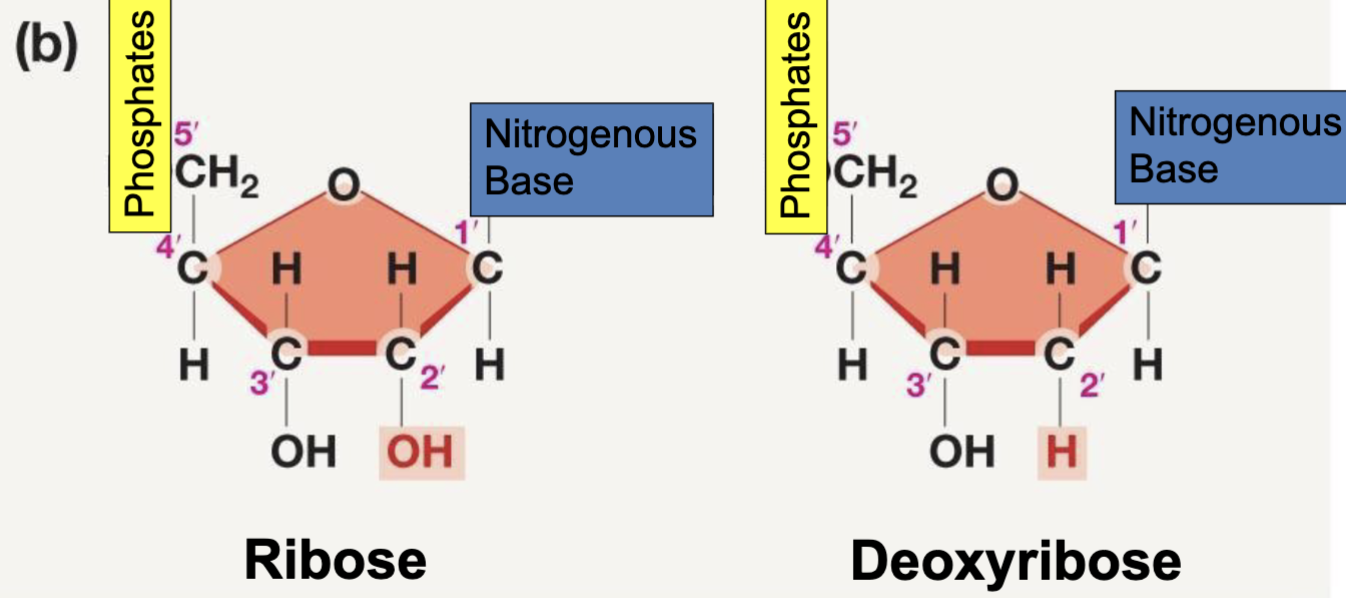
What is the difference between the sugars in DNA and the sugars in RNA?
Presence of a hydroxyl on C2 (RNA) or presence of just a hydrogen on C2 (DNA)

How is this difference (difference between the sugars in DNA and the sugars in RNA) reflected in the full name of DNA and RNA?
– Ribo Nucleic Acid
– Deoxyribo Nucleic Acid

What is the functional consequence of this difference (difference between the sugars in DNA and the sugars in RNA)?
RNA's extra 2′-OH makes it more reactive and structurally versatile, while DNA's missing 2′-OH makes it more chemically stable.

The nitrogenous base is bonded to which carbon on the sugar in a nucleotide?
C1

What about the phosphates?
C5

Why is the term ‘nitrogenous bases’ both appropriate and a bit redundant?
Nitrogens/Amine groups are basic

RNA is built with UTP monomers, while DNA is built with dTTP monomers.
– There are 2 differences between these monomers. What are they?
Sugar and nitrogenous base
If a cell were to replicate its DNA and then divide into two cells,
Each daughter cell would have chromosomes with an “original” and a “new” strand of DNA.
This is the essence of semi-conservative replication. To be clear, each daughter cell would receive the full complement of homologous pairs of chromosomes, each
How would you describe the active site of DNA polymerase? Think about its particular quirks as an enzyme…
DNA polymerase is ‘fussy’ about:
• Adding only dNTPs to a growing strand of DNA
– Deoxyribose sugars, triphosphates
• Proofreading
– Detecting the perfect shape of the double helix that results from A-T and C-G basepairing
– DNA polymerase is ‘lax’ about:
• Nitrogenous bases – all 4 nucleotides fit the active site.
– Specificity comes from the correct alignment with and basepairing to the nitrogenous base on the template strand.
• Adding to either a ribose or deoxyribose sugar
– Remember that it builds on the end of an RNA primer
Thinking along different lines to the same question…
• The active site probably has many amino acids with basic and/or polar R-groups to bind to the acidic and polar groups on the nucleotides.
• Although it performs an anabolic reaction, it does not need to separately catalyze an ATP hydrolysis reaction as do many other enzymes that mediate anabolic reactions. This is because the substrates (dNTPs) provide their own energy
What is the role of RNA primase? Why is it needed? Why is its function a problem?
– RNA primase builds a short piece of RNA (oligonucleotide or a primer).
• Complementary (base-paired) to the DNA template.
• Just one strand. Just 1-2 dozen nucleotides.
– It is needed because DNA polymerase III can only add nucleotides to an existing strand. It cannot start a new strand de novo.
– It is a problem because then the cells need to replace the RNA with DNA!
– Why prime with an RNA strand? Probably just a relic of evolution!
In what ways do you imagine the active site of DNA polymerase I to be similar to and different from the active site of DNA polymerase III?
Remember that DNApol1 has to both remove the ribonucleotides (cut the phosphodiester bond) and add the new deoxyribonucleotides!
For the two steps just described — replacement of RNA primers and ligation of the fragments – are they performed on
The leading and lagging strands: here are more RNA primers and therefore more
Okazaki fragments on the lagging strand, but both strands have RNA primers! And any time you have DNA polI removing a primer, you have a gap that needs a new phosphodiester bond created by ligase
A patient's cells replicate DNA normally, but sequencing reveals an enormous number of single-nucleotide mutations. Which part of the replication system might be malfunctioning?
DNA polymerase → specifically in the proofreading site!

Look closely at a “Replication Bubble.”
– Point to the replication forks.
– Now label the leading strand and the lagging strand.

Is there a correlation between genome size (complexity) and chromosome number?
Not really.. ferns.
Is there a correlation between genome size (complexity) and organismal complexity?
– Not really. Humans are technically more complicated than either ferns or amoeba, but the latter have much larger genomes.
– Eukaryotes have larger genomes than prokaryotes.
Are all organisms diploid?
Nope! Prokaryotes are typically haploid, and many plants are polyploid
For a particular organism, we talk about a single genome but use the plural for transcriptomes. Why?
We regulate transcription: different cells ‘turn on’ different genes at different points in time in response to different conditions.
Why do transcription at all? Why not just use DNA for translation?
– Protection of DNA: we can transcribe a gene once and reuse that mRNA transcript for multiple translations.
– Another opportunity to regulate.
Why use RNA as the intermediate?
– mRNA’s instability is good in this case because it will degrade and allow for a different pattern of genes to be expressed.
Can we explain why these transcription factors are necessary and the cells can’t just use RNA polymerase to initiate transcription?
Yes we can! The key is that this allows for regulation: only genes that have transcription factors binding to promoters will be expressed.
How do transcription factors “know” where to bind the DNA?
How is a promoter “recognized” by the transcription factors?
Specificity of chemical interaction between the functional groups of nitrogenous bases in the promoter region of DNA and the functional groups of R groups on the transcription factors.
What happens if there is a mutation in a promoter?
You might change the ability of the gene to be transcribed.
What is the relationship between the transcription start site and the translation start site?
None, really. Only that the transcription start site is “upstream” of the coding regions of the gene.
What determines which ribonucleotide is added to the growing mRNA polymer?
The nucleotide on the template strand – basepairing & geometry.
Why is the non-template strand of DNA also called the “coding” strand?
Its sequence is the same (as long as you swap T’s for U’s) as the mRNA sequence.
What is the source of energy for this endergonic, anabolic reaction?
The removal of two phosphates from the NTPs
RNA polymerase doesn’t proofread. How can cells survive in the face of these RNA errors?
Make an error, meh… Just go ahead and make a fresh mRNA. You haven’t changed the instructions.

Can you label the gene parts below?

• Concisely explain why histone acetylation alters chromatin structure.
• If you added a drug that blocked histone acetylation in a cell, what would the effect be on transcription?
– Blocking acetylation would leave the basic R groups on the lysines available to interact with the acidic phosphates on the DNA, forming heterochromatin.
– This would downregulate transcription
• Concisely explain why DNA methylation alerts transcription factor binding (& chromatin structure).
• If you added a drug that blocked DNA methylation in a cell, what would the effect be on transcription?
– Blocking methylation would allow the formation of euchromatin – looser packing. This would allow transcription to be upregulated.
– Also, the transcription factors would be more likely to be able to recognize the nitrogenous bases and bind to promoters
How can cells regulate gene expression at the level of transcription?
– Through the presence/absence of transcription factors.
– Also it can depend on whether or not the promoter is methylated.
The expression of some genes is coordinatel regulated. How would this happen?
These genes have the same regulatory DNA sequences. Thus, the same transcription factors can recruit RNA polymerases to both genes!
The presence of introns - and the need to remove them from mRNA - would seem to complicate life for eukaryotic cells. Can we explain what advantages introns bring to eukaryotic cells to counterbalance the complications?
– Proteins are typically made up of multiple functional domains/parts – think of an enzyme like RNA polymerase and all of its different functions!
– Functional domains/parts of proteins are often found on different exons.
– This makes alternative splicing a bit like creating structures with a box of legos!
What are the relative advantages of regulating gene expression at early stages (transcription) v. later stages (post-transcription)?
– Early regulation save energy and resources (e.g., monomers). It also allows for global regulation – one off switch can turn many genes off or on.
– Late regulation provides for a faster response and a more nuanced/local response because individual proteins in different regions of a cell can be differentially modified!
rRNA sequences are highly conserved across all three domains of life. Can we explain why this makes sense?
– rRNA sequences are all part of ribosomes. The job of ribosomes is to bind to mRNA and charged tRNAs and to catalyze the anabolic reaction of protein synthesis – building peptide bonds.
– The biomolecules that are part of this process are the same across all three domains of life (eukaryotes, prokaryotes, and archaea).
– So the machinery has stayed the same. The ribosome proteins are also very similar!
How can an RNA molecule act as an enzyme? What about its chemical properties would allow it to possess an active site?
– We need to think about active sites as being 3D spaces with very particular chemistry to hold on to molecules and facilitate chemical reactions.
– We can get that same 3D chemical specificity from rRNA because it folds up and basepairs with itself to become 3D and the nitrogenous bases provide the chemical specificity.
Why do we need a triplet code? Why not a 1:1 or a 2:1 or a 4:1 nucleotide:amino acid code?
– 1:1 would mean we could code for 4 amino acids
– 2:1 would mean we could code for 16 amino acids
– 3:1 would mean we could code for 64 amino acids
Why does it makes sense to call a tRNA with an attached amino acid “charged”?
– Charged energetically: It has the energy needed for peptide bond formation.
– Charged in terms of mission: It has the amino acid attached.
Why is it reasonable to think about the tRNA synthetase enzymes as being the actual translators between nucleotide and amino acid languages?
It is in their active site that the nucleotide triplet is paired with the correct amino acid.
What is the role of the mRNA in translation?
Provides the genetic information for the sequence of amino acids in a protein.
What is the role of the tRNA in translation?
Bring in the amino acids for protein synthesis and provide the energy for the synthesis reaction
What is the role of the rRNA in translation?
– Structure in the ribosome
– And also act as an enzyme (ribozyme) to actually build the peptide bond