Dyadic and Follower-Centric Approaches (10/7/2026)
 Call Kai
 Learn
 Practice Test
 Spaced Repetition
 Match
 Flashcards
 Knowt Play
1/33

There's no tags or description
Looks like no tags are added yet.
34 Terms
Leader-Member Exchange (LMX)
Conceptualizes leadership as a process that is centered on the interactions between leaders and followers; how leaders develop exchange relationships over time with different memebers

High-quality exchange relationships
High levels of support
Mutual respect
Mutual dependence
Loyalty
Commitment
High levels of trust
High LMX differentiation
More differentiation between the in-group and out-group
Low LMX differentation
Less differentiation between the in-group and out-group
Vertical dyad linkage
Kind of prototype of LMX, speaks to in-group and out-groups in relation to the leader. Members within the high-quality relationship group will have +3. Members outside the high-quality relationship group will have 0.
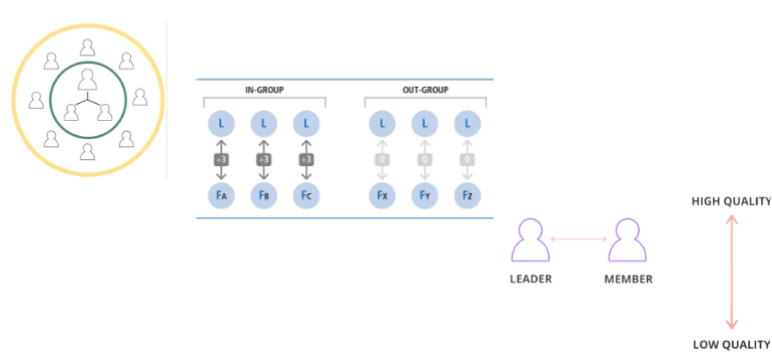
Differentiation is neither inherently good or bad in general because the effects depend on situational variables and personal resources
TRUE
LMX agreement
Match between leader and follower’s perception of LMX quality (p = .37)
Predictors of LMX Relationship Quality
Trust
Transformational leadership
Transparency
Psychological safety
High scores on extraversion and agreeableness for both leader and member
Member’s competence and performance
Congruence of values, attitudes and proactive personality
A positive work group climate and a people-oriented organizational culture
Affective events
Outcomes of High Quality LMX Quality
Job satisfaction
Citizenship behaviors
Better follower mental health
Lower organizational turnover intention
Less organizational deviance
Greater career success
Related to feelings of energy in employees, which in turn relates to greater involvement in creative work
Which of the four I’s from transformational leadership is most related to LMX exchange?
Individualized consideration
Implicit Leadership Theories (ILTs)
Beliefs and assumptions about qualities of effective leaders. Lay images of leadership, which are individually and socially determined. Prototypes or ideal instances of leadership. Used to classify individuals as leaders or non-leaders
Dimensions of ILT
Masculinity
Intelligence
Attractiveness
Strength
Sensitivity
Dedication
Charisma
Tyranny
When do ILTs become important?
When followers agree about them and identify strongly with their group or organization. Leader's who fit their followers’ ILTs are considered effective
Romance of leadership as an ILT example
A widely held ILT regarding the importance of leaders and leadership. Humans see leaders as capable of controlling and influencing the fate of organizations and people. Over-attributing company performance to leaders.
Power
Having the discretion and the means to enforce one’s will over entities
Broad types of power sources
Position and personal power (don’t take power personally)
Facets types of power sources
Legitimate power, reward power, coercive power, reference power, expert power, information power
Outcomes of power
Commitment, compliance, and resistance
Influence tactics
Impression management, political, and proactive
Impression management tactics
Trying to get people view us in a favorable light
Political tactics
Getting access to certain resources that may be off-limits or restricted
Proactive tactics
Check back later
The most effective influence tactics
Rational persuasion, inspirational appeal, consultation, collaboration, and apprising
The Art of Followership
“Followership is a process whereby an individual or individuals accept the influence of others to accomplish a common goal”
Leadership and followership are closely intertwined
Everyone - leaders included - is a follower at one time or another
An effective group has a leader and followers
Most of us are more often followers than leaders
Followership is the testing ground in preparation for leadership
Leader centric views vs. reversing-the-lens perspective
That followers can be change agents and that follower characteristics are related to ratings of leader behavior

Followers are _____ agents in the leadership process
active
Effective followers manage up
Consciously and deliberately developing a meaningful, task-related, mutually respectful relationship with direct superiors
Challenges of managing up
More interest in pleasing and keeping the boss happy
Little power and control in the relationship
Effective followers are far from powerless; in reality, have more power than they know
Follower Attributions
Followers judge leader intentions as well as leader competence
Followers usually attribute success or failure more to the leader’s personal qualities (e.g., expertise, initiative, creativity, dedication) than to situational factors beyond the control of the leader
Leaders perceived to be competent are likely to
Retain their position or be advanced to a higher position
Gain more power and have more discretion to make changes
Good follower characteristics
A make-it-happen attitude
More
What Followers Want in Leader
Honesty
Forward-thinking
Inspiring
Competence
How leaders enable the ideas and abilities of followers
Clarity of direction
Opportunities for growth