Chapter 12 - Genomic Organization
 Call Kai
 Learn
 Practice Test
 Spaced Repetition
 Match
 Flashcards
 Knowt Play
1/45

There's no tags or description
Looks like no tags are added yet.
46 Terms
Genetics: Topic Synthesis

Plan for the day
How do you fit a lot of DNA into a small space?
Insights gained from Viruses/bacteria
Viruses and bacteria use supercoiling to fit large amounts of nucleic acids into a small space.
Insights gained from eukaryotes
Eukaryotic DNA is condensed into highly ordered structure called chromatin.
Viral, Bacterial, and Eukaryotic genes are organized in very different ways.
Viruses and bacteria are very gene-dense
Eukaryotic genomes are much less transcriptionally dense than viruses or prokaryotes. They contain large amounts of repetitive sequences that are non-coding.
Eukaryotic chromosomes are organized in space into regions that are transcriptionally active
How this occurs in the polytene chromosome
How this occurs in the lampbrush chromosomes, and the emerging study of the loop-ome
No matter the size of the genome, you need to fit a lot of DNA into a small space. Let’s see how different organisms accomplish this

Viral genomes
Viral genomes show a greater range of genetic material, organization and coding ability than bacteria or eukaryotes

Genome packaging
Viruses tightly pack their genome in the capsid head

Viral genome packaging phase T2 (example of a DNA virus)
Genome is small (0.17 Mb) and encodes about 300 different proteins
Used in Hershey-Chase experiment
Genomic DNA fills the interior of the capsid head

RNA viruses: small genomes
Poliovirus
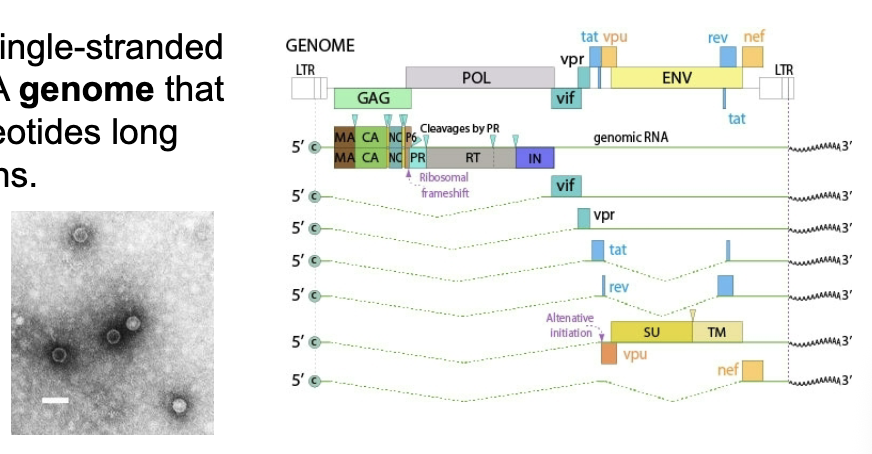
Poliovirus is composed of an RNA genome and a protein capsid.
The genome is a single-stranded positive-sense RNA genome that is about 7500 nucleotides long encoding 10 proteins.
Considered to be the simplest significant virus that affects human health.
RNA is translated into protein immediately upon entry into cells of the gastrointestinal tract
HIV
RNA genome (9.2 kb) with 9 genes encoding 19 proteins
RNA → DNA, integrates into our genome
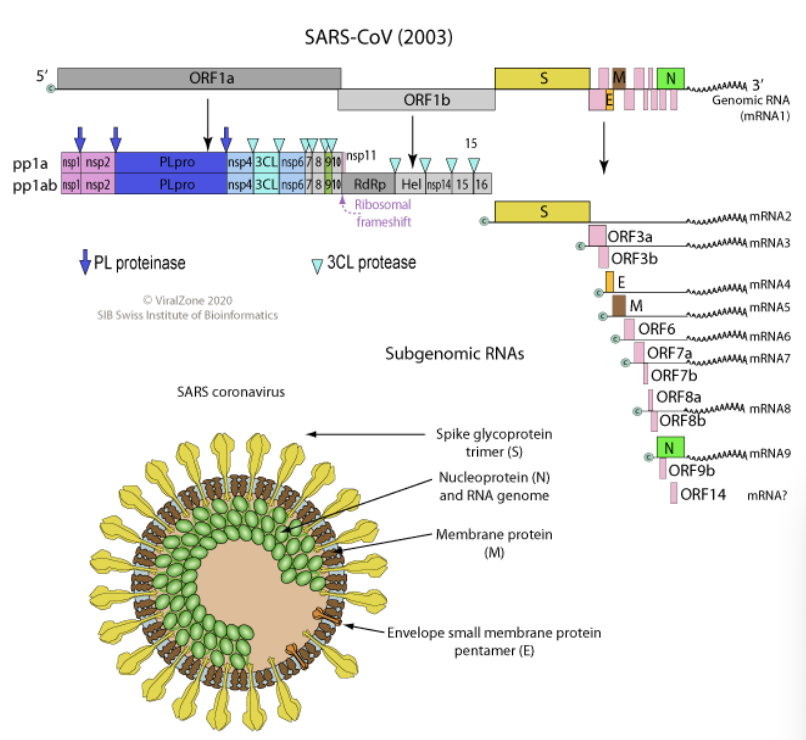
SARS-CoV-2 (aka the coronavirus)
Similarly, the SARS-CoV- 2 coronavirus has a ~30 Kb positive-sense single- stranded RNA genome
The ten open reading frames (ORFs are open- reading frames, aka “genes”) encode ~30 different gene products. There is no wasted space.
Viral genomes
Summarize
The genome can be RNA or DNA, single-stranded or double-stranded
The genome is tightly packed into a capsid for protection
Nearly every nucleotide is used as information
(don’t memorize these examples; know the general principles)
Bacterial genome
Bacterial chromosomes are double-stranded DNA and are compacted into a nucleoid (DNA + proteins).
Bacterial chromosomes are typically circular (there are a few exceptions).

Packing of the DNA
How does a 1200 μm long DNA molecule fit into a bacterium that is 2 x 0.5 μm?
In the picture on the right, osmotic shock broke the cell wall and plasma membrane, and the DNA spilled out.

Organization
Organization of the molecule can is necessary for access to allow replication, recombination, transcription, and repair.
Chromosome structural organization
A model for the structure of the bacterial chromosome.
(A) The unfolded, circular chromosome of E. coli depicted as a single line for simplicity (though, of course, it is a double-stranded helix).
(B) The DNA is folded into chromosomal domains by protein-DNA associations.
The proteins are depicted as the black circles, interacting with both the DNA and with each other. Six domains are shown, but the actual number for E. coli is about 50.
(C) Supercoiling and other interactions cause the chromosome to compact greatly.
Compaction requires the enzymatic activity of topoisomerases to supercoil

Supercoiling
Supercoiling compacts DNA.
Most closed circular DNA molecules in bacteria are slightly underwound and are supercoiled.
Topoisomerases cut one or both DNA strands, and then wind or unwind the helix before resealing (ligating) the ends back together.
DNA gyrase is a member of the topoisomerase family of enzymes

Prokaryotic (E. coli) genome organization
Bacterial genomes have densely packed information

Genome organization in bacteria
DNA is supercoiled and organized in the genome.
Genome is compacted to allow it to fit within the cell
DNA (with its associated genes) are arranged in “domains” by proteins
Supercoiling is necessary for replication and transcription to occur
Genes are tightly organized
There is very little space between genes
Coding regions (genes) are found on both DNA strands
Genes with the same function are typically organized in operons
Eukaryotic Chromosomes and Chromatin
Chromosomes are composed of DNA and proteins that carry the genetic information in a linear order and organize it.
Chromosomes are visible during mitosis and meiosis
Chromosomes are condensed
During interphase, the uncoiled chromosomes are called chromatin; chromatin is composed of DNA, RNA, and proteins (histone and non-histone)
Chromatin is the state in which most DNA functions occur:
This is transcriptionally active
DNA replication and repair occur
Eukaryotic DNA in chromatin
Different levels of compaction in eukaryotic DNA.
DNA
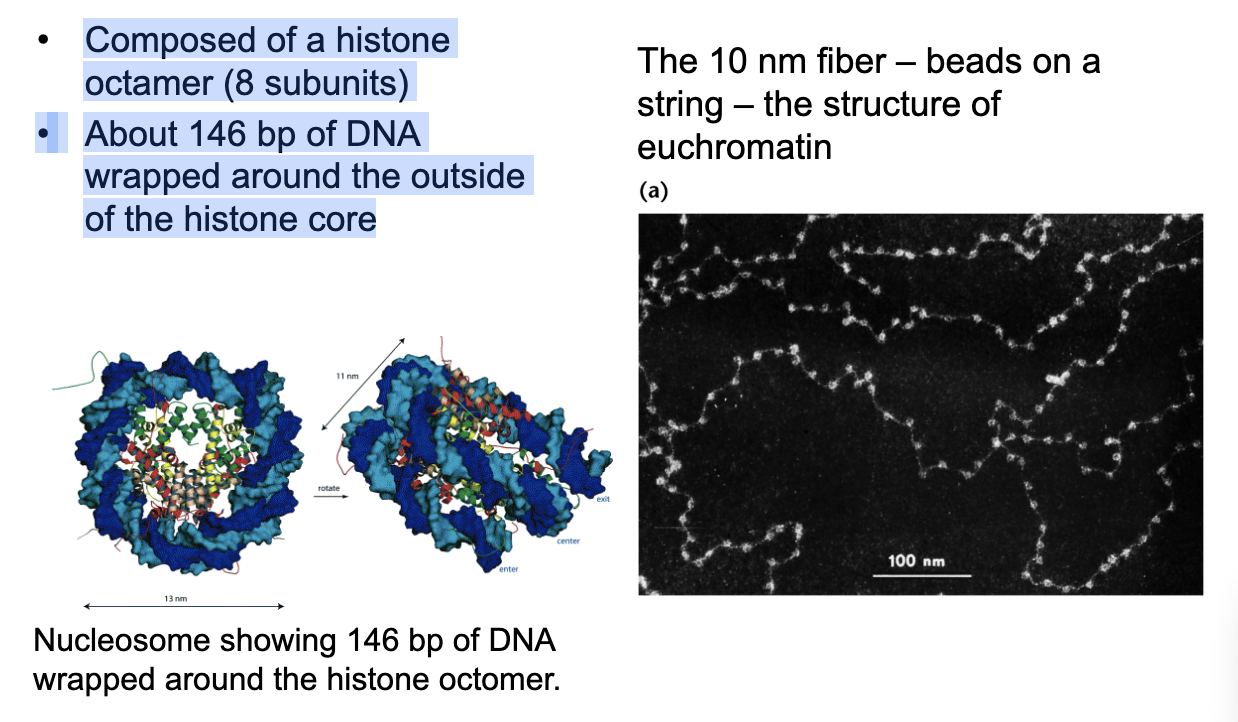
Nucleosomal DNA; beads on a string. This loose structure is euchromatin; 10-nm fiber.
Solenoid model for the 30- nm fiber. More condensed structure; thought to be heterochromatin.

Nucleosome
Composed of a histone octamer (8 subunits)
About 146 bp of DNA wrapped around the outside of the histone core
How are the higher order structures assembled?

Nucleosome
The nucleosome has N-terminal tails that extend out beyond the nucleosome core; these regions were unstructured in the crystal and thus were not seen.
Modifications on these tails determine if the nucleosome is found in euchromatin or heterochromatin

Nucleosomes N-terminal tails
The nucleosome has N-terminal tails that extend out beyond the nucleosome core; these regions were unstructured in the crystal and thus were not seen.
Modifications on these tails determine if the nucleosome is found in euchromatin or heterochromatin

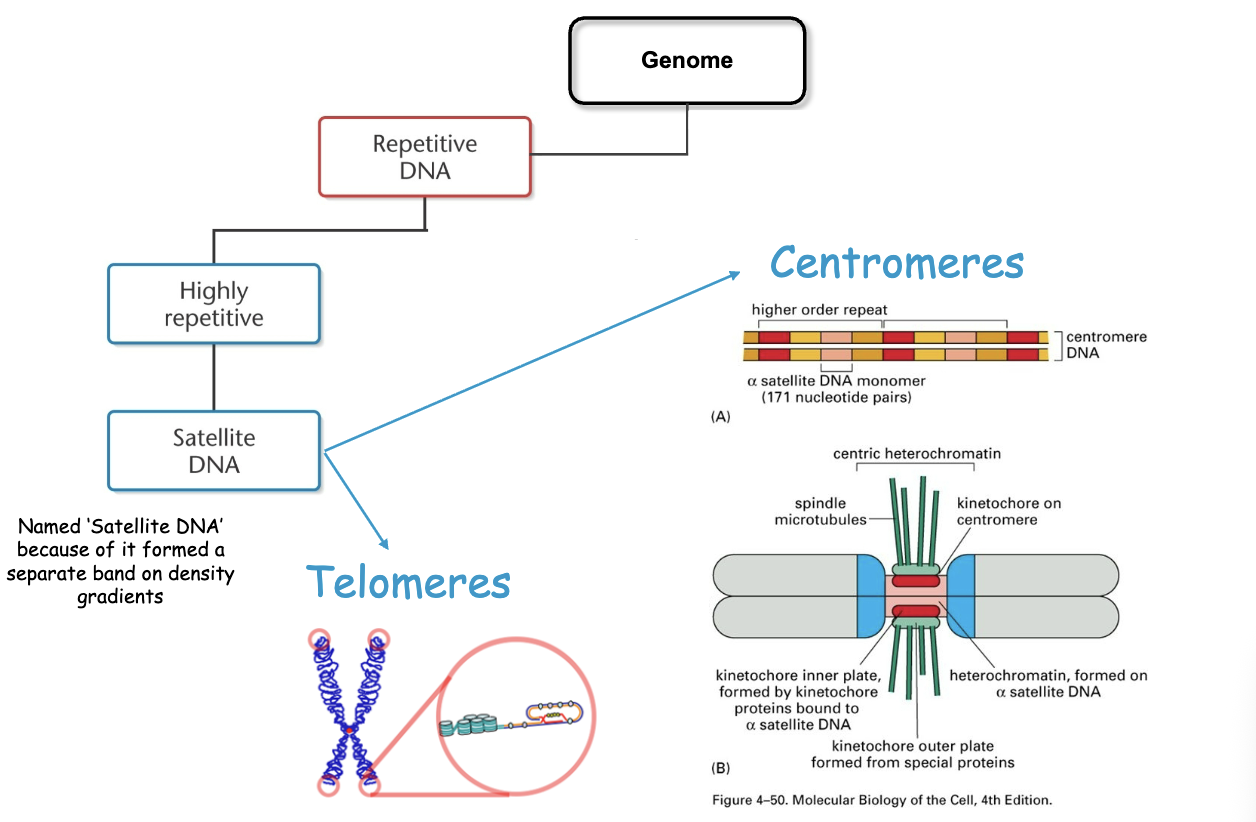
DNA sequences are unique and repetitive
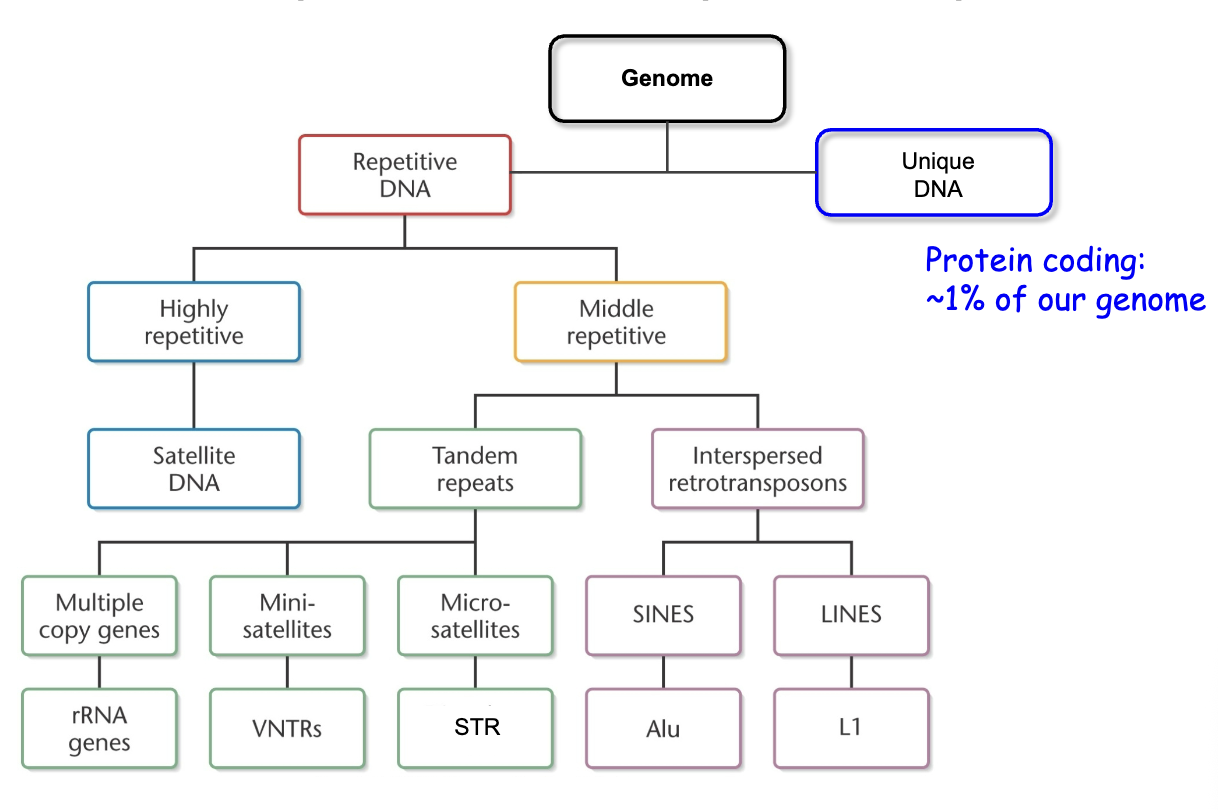
Genome → Unique DNA, protein coding: ~1% of our genome (less gene-rich)
Tandem Repeats

STRs are highly variable DNA sequences
DNA sequence that is highly variable between people.
Consider each repeat as an allele.
A short DNA sequence motif of 2 to 5 nucleotides in length is repeated in tandem
The number of the repeats vary
They are flanked by unique sequences that bind to primer for PCR amplification
A primer pairing set specifically amplifies each locus
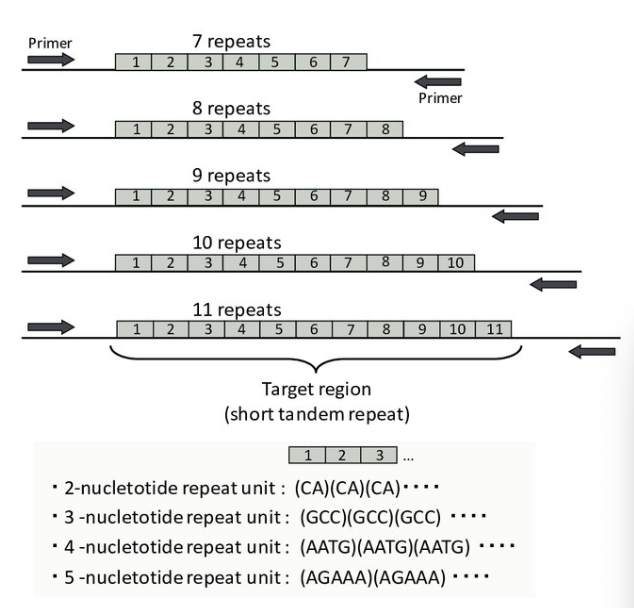
STRs are inherited like other alleles

STR sequences are used by the FBI in forensic analysis

Tandem repeats again

Much of our genome is transposable elements
Interspersed retrotransposons of middle repetitive DNA are “jumping genes” – transposable elements; these two (Alu, L1) comprise ~ 45% of our genome.
New mutations are associated with their movement in some patients.
They are linked with evolutionary changes as species diverged.

DNA sequences are unique and repetitive
Reminder, how the prokaryotic (E.coli) genome was organization
Bacterial genomes have densely packed information

Gene organization: example yeast
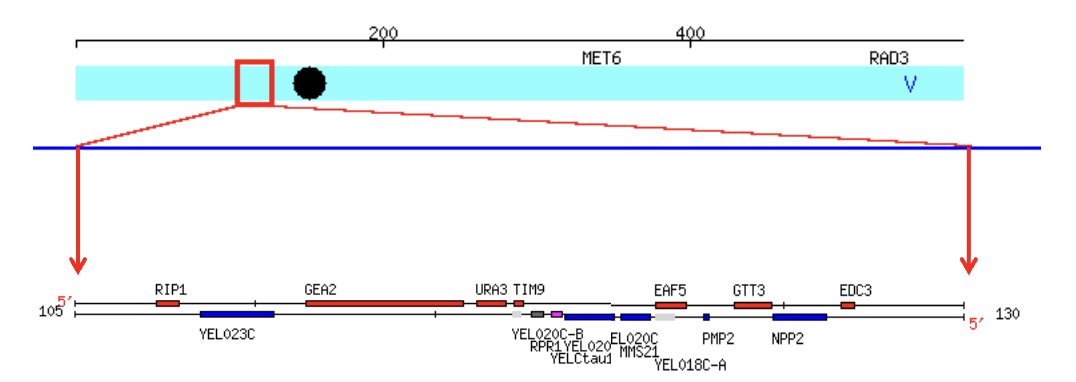
Genes are found on both strands of the genome, similar to prokaryotes; but genes are not organized in operons. The sense strands for the genes go from 5’ to 3’.
The genes in red go 5’ to 3’ from left to right, the ones in blue go 5’ to 3’ from right to left.
Notice the tight packing: less space between genes and almost no introns
Gene organization, animals: example human CFTR
the CFTR gene: has 24 exons in ~300,000 bp, spliced to 6,500 bp (~2% of original)

More example human CFTR

More example human CFTR

EUKARYOTIC CHROMOSOMES ARE ORGANIZED, AND THIS ORGANIZATION IS HIGHLY RELATED TO TRANSCRIPTION
Specialized (exceptional) chromosomes caused us to ask some really important questions about where and when transcription occurs in the chromosome
Exceptional chromosome #1: the Drosophila polytene chromosome
Polytene chromosomes have
distinctive banding patterns
these correspond to active transcription (light) and inactive regions (dark)
are paired homologs
they remain paired in a mitotic cell cycle
are composed of many DNA strands
thousands of DNA strands in a parallel array
are visible in a light microscope

Polytene chromosomes have puff reigions where the DNA has uncoiled to allow transcription

Exceptional chromosome #2 - lampbrush chromosomes
Lampbrush chromosomes are unusual meiotic chromosomes from amphibians and other animals (not mammals).
They are transcriptionally active during meiotic prophase I
They are large and have extensive DNA looping
The chromosome is decondensed to allow access to the DNA.
Interphase chromosomes are also organized in loops.

More lampbrush chromosomes
Lampbrush chromosomes helped us understand how genes that are undergoing transcription might be formed into loops of unpacked chromatin
Study of Lampbrush chromosomes helped us map the regions of chromosomes that were transcriptionally active

Insights from the puff regions of polytene chromosomes and the loops of lampbrush chromosomes
Chromatin is organized into loops that are transcription units

Summary of chapter concepts
1. Viruses have the greatest range of genome types
2. Bacterial chromosomes are relatively simple DNA molecules •
Supercoiling facilitates compaction of bacterial genomes into small spaces (true for eukaryotic genomes as well)
3. Eukaryotic chromosomes are more complex molecules than viral and bacterial chromosomes
Specialized chromosomes reveal variations in the organization of DNA
DNA Is organized into chromatin in eukaryotes
Heterochromatin and euchromatin differ in their packing and DNA accessibility
4. Chromosome banding differentiates regions along the mitotic chromosome
Eukaryotic chromosomes demonstrate complex organization characterized by repetitive DNA
5. The vast majority of a eukaryotic genome does not encode functional genes
There are different sequence classes: highly repetitive to unique
Transposable elements
In general:
Discovered by Barbara McClintock in maize
“Jumping genes”, mobile DNA elements • When they move, they can disrupt genes to cause new mutations.
Found in all domains of life (prokaryotes and eukaryotes)
~45% of the human genome is composed of transposable elements
Geneticists use them to cause mutations and then can screen for phenotypes, and can see where the transposon inserted itself.
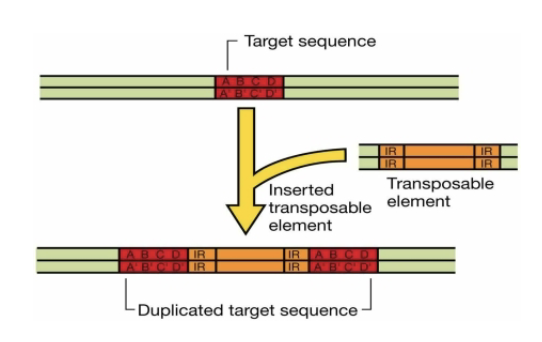
Line (L1) and SINE (Alu) elements in our genome
L1 and Alu elements are retrotransposon insertions in our genome, accounting for ~45% of our DNA
About 100 of the ~500K L1 elements are active, and ~1500 of the ~1.1M Alu elements are active: i.e., they are transcribed into RNA, copied into DNA, and then re-insert themselves into the genome.
Insertions alter gene expression, disrupt ORFs or splicing.
Because of their high number and homology, they are places where homologous recombination can occur – between different chromosomes.

Two of the many evolutionary consequences of Alu elements
Disease: hemophilia
Insertion of an Alu element in exon V of the factor VIII gene
Loss of tails
Disruption of TBXT led to loss of tails in some primates
