FRSC-4425: Skeletal Trauma
 Call Kai
 Learn
Learn Practice Test
 Spaced Repetition
 Match
Match Flashcards
 Knowt Play
1/104

Earn XP
Description and Tags
All lectures
Name | Mastery | Learn | Test | Matching | Spaced | Call with Kai | Chat |
|---|
No analytics yet
Send a link to your students to track their progress
105 Terms
What is the organic component in bone good for?
flexibility
what is the inorganic component of bone good for?
rigidity
What kind of tissue is the periosteum and endosteum?
osteogenic tissue
What do osteoblasts do?
form new bone
What do osteoclasts do?
break down bone
What do osteocytes do?
maintain bone tissue and communicate
What is woven bone?
immature bone that is laid down quickly and messy
What is lamellar bone?
mature bone
What is stress in biomechanics?
the load per unit area
What is strain in biomechanics?
the change in dimension of a loaded body
What is elastic deformation?
temporarily or not irreversibly deformed
What is plastic deformation?
permanent changes to bone structure
What is Young’s Modulus?
the measurement of a material’s resistance to deformation
How would the Young’s Modulus for cortical bone be described?
it can take more stress but less strain
How would the Young’s Modulus for trabecular bone be described?
it can take more strain but less stress
What is compression?
equal and opposite loads applied, pushing together
What is tension?
equal and opposite loads pulling bone apart
What is shearing?
a load applied parallel to the surface of the bone
What is bending?
combination of tensile, compressive, and shearing forces
What is torsion?
twisting around an axis making torque
What is isotropic stress?
stress from any direction equally
What is anisotropic stress?
stress from one direction
What is differential diagnosis?
systematic method to consider all possible lines of evidence when assessing trauma
Would micro-CT or X-ray be better for imaging skeletal fractures?
micro-CT because there is better resolution
What characterizes spina bifida?
median crest of the sacrum not fused all the way
What are enamel hypoplastic lesions due to?
stress in childhood which halts tooth growth

is this complete or incomplete?
complete
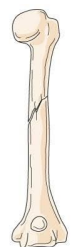
is this complete or incomplete?
incomplete
who are more susceptible to incomplete fractures and why?
children because they have higher levels of the organic component
What causes bone bruises?
trabecular bone microfracturing and causing blood to pool in marrow cavity or under periosteum
What kind of fractures are bone bruises?
incomplete
Who is more common to get a bow fracture?
non-adults
how do bow fractures usually happen?
from a fall, causes longitudinal compression or bending which then make microfractures
why does bow fractures cause bending in children?
the periosteum is very active which causes rapid bone repair and deformation
Why are bow fractures not often studied?
hard to identify, don’t show up on x-rays, no evidence of healing
What kind of fracture is a bow fracture?
incomplete

What fracture is this?
bow fracture
Who is more common to get a toddler’s fracture?
non-adults
what are the characteristics of a toddler’s fracture?
hairline, spiral fracture
Which area of the body typically gets a toddler’s fracture?
the leg (tibia)
How are toddler’s fractures usually caused?
twist or rotation during movement
What kind of fracture is a toddler’s fracture?
incomplete

What fracture is this?
toddler’s fracture
Who is more common to get a torus/buckling fracture?
non-adults
What are the characteristics of a torus/buckling fracture?
buckling of the bone cortex from compression by outward expansion of the cortical bone
Where do torus/buckling fractures happen most?
long bones, metaphysis/epiphysis junction
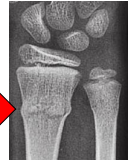
What fracture is this?
torus/buckling fracture
What kind of fracture is a torus/buckling fracture?
incomplete
who are most common to get a greenstick fracture?
non-adults
How are greenstick fractures caused?
bending and compression at the same time
What are the characteristics of a greenstick fracture?
transverse fracture from tensile side, fracture deviates vertically either proximally or distally

What fracture is this?
greenstick
what kind of fracture is a greenstick fracture?
incomplete
Where in the body are depressed fractures found most?
skull and the tibial plateau
How do depression fractures happen?
rapid accumulation of compressive forces which causes collapse of trabecular bone
What kind of fracture is a depression fracture?
incomplete

What kind of fracture is this?
depression fracture

What kind of fracture is this?
depression fracture
What are the 2 sub-categories of complete fractures?
closed/simple and open/compound
How are transverse fractures caused?
force perpendicular to the long axis causes angulation with compressive and tensile forces
What are the characteristics of a transverse fracture?
cross-cut right through the bone

What fracture is this?
transverse fracture

What fracture is this?
transverse fracture
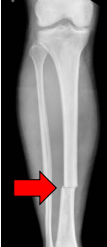
What fracture is this?
transverse fracture
What kind of fracture is a transverse fracture?
complete
What is the characteristic of an oblique fracture?
fracture diagonally across diaphysis
What causes an oblique fracture?
angulation and compressive forces being applied

What fractures are these?
oblique
What are the characteristics of a spiral fracture?
fracture circles the shaft and includes a vertical step
How are spiral fractures caused?
rotational forces
Which bone is most commonly affected by a spiral fracture?
tibia
what kind of fracture is a spiral fracture?
complete
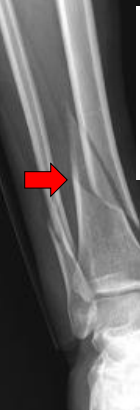
What fracture is this?
spiral fracture
What are the characteristics of a comminuted fracture?
3 or more fragments, typically there are 2 segments and a butterfly fragment
How are comminuted fractures caused?
combination of bending and compressive forces
what kind of fracture is a comminuted fracture?
complete

what fracture is this?
comminuted fracture
What are the characteristics of a segmental fracture?
bone broken in 2 distinct places, large segment separated proximally and distally
How are comminuted and segmental fractures different?
comminuted have multiple smaller fractures or shattered bone
what kind of fracture is a segmental fracture?
complete

What fracture is this?
segmental fracture
What are the 2 types of epiphyses?
pressure and traction
what are pressure epiphyses?
articular ends of bones
what are traction epiphyses?
insertion sites for muscles
Which zone of the growth plate is the weakest and why?
Zone 3 because cartilage cells are undergoing cell death and being replaced
Which type of Salter-Harris classification is most common?
type 2
When are epiphyseal fractures most common?
during periods of rapid growth (year 1 and adolescent growth spurt)
Why can epiphyseal fractures be problematic?
can cause premature closure of the growth plates if blood supply is interrupted causing limb length differences
What is direct trauma?
force hits the bone directly at the spot the break occurs
What is indirect trauma?
force through the body which causes a break at a different point
Where are Parry fractures found?
ulna
What is a Parry fracture?
an isolated fracture on the ulnar shaft
Why do Parry fractures occur?
a direct blow to the ulna when raising arm to protect the face
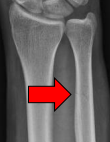
What fracture is this?
Parry fracture
What are some examples of direct trauma?
Parry and crush fractures
How do crush fractures happen?
large force over a large area of the body

What fracture is this?
crush fracture
Where do linear fractures usually happen?
the skull from blunt force trauma
What are the characteristics of a linear fracture?
thin straight break without displacement

What fracture is this?
linear fracture