Ch 11 - Socialization and Working in Groups
 Call Kai
 Learn
 Practice Test
 Spaced Repetition
 Match
 Flashcards
 Knowt Play
1/42

There's no tags or description
Looks like no tags are added yet.
43 Terms
group
two or more individuals engaged in social interaction to achieve some goal
team
interdependent workers w/ complementary skills working toward shared goal
roles
patterns of behavior that are adopted based on expectations a/b the functions of a position
group roles important b/c they provide some specific plan for behavior
role expectations
beliefs concerning the responsibilities and requirements of a particular role
in most work groups, members aware of various expectations w/ each position
role differentiation
the process by which group members learn to perform various roles
often created based on factors like position/formal job title, status within group, tasks to which member is assigned, or particular work skill/ability
workers can perform different functional roles at different times
work roles
group task roles
group building and maintenance roles
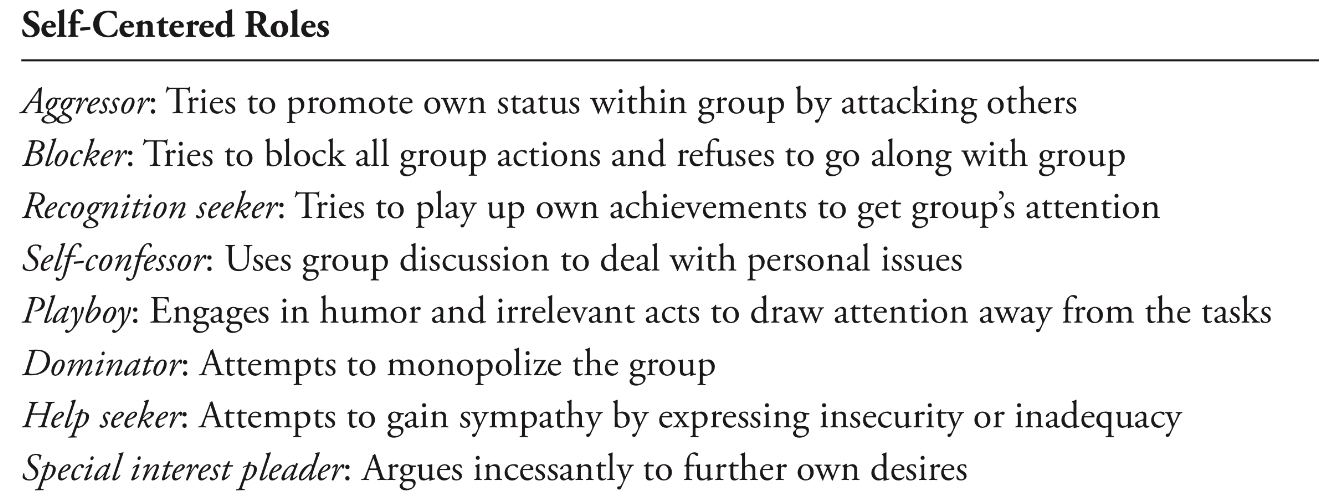
self-centered roles
group task roles
getting job done
initiating, seeking info, giving info, opinion giver, elaborator, coordinating, evaluating, energizer, procedural technician, recorder
ex: initiator → recommends new ideas a/b problem; coordinating → integrates info from group; evaluator → uses some set of standards to evaluate group’s accomplishments

group building and maintenance roles
maintenance of interpersonal relations
encouraging members through praise and acceptance harmonizing, encouraging participation, expressing standards, and following

self-centered role
satisfying personal goals, rather than group
blocking progress, seeking recognition, dominating, and avoiding involvement
role ambiguity
a sense of uncertainty over the requirements of a particular role
job ambiguity
a source of stress resulting from a lack of clearly defined jobs and/or work tasks
role conflict
conflict that results when the expectations associated w/ one role interfere w/ the expectations concerning another role
ex: work-family conflict
work-family conflict
cumulative stress that results from duties of work and family roles
norms
rules that groups adopt governing appropriate and inappropriate behavior for members
formed to help group survive
help increase predictability of member behavior
help provide structure and plan for group member behavior
regulate group activities and help group members achieve shared goals
provide some foundation for organizational culture
organizational socialization
the process by which new employees learn group roles and norms and develop specific work skills and abilities (become integrated into work groups)
AKA onboarding process
includes
development of specific work skills and abilities
acquisition of set of appropriate role behaviors
adjustment to work group’s norms and values
model for organizational socialization
3 stages
anticipatory socialization
develop set of realistic expectations a/b job and if it is right match for them
accommodation
learn a/b various roles and a/b their own specific roles in group
role management
make transition to regular members (insiders) and master tasks/roles
person-environment (P-E) fit
the match between a worker’s abilities, needs, and values and organizational demands, rewards, and values
positive correlation w/ organizational commitment and well-being; negative correlation w/ turnover
according to this approach…
mismatch → primary cause of worker stress
four Cs
cooperation
reciprocity rule
task interdependence
social loafing
competition
conflict
interindividual conflict
intragroup conflict
superordinate goal
cohesiveness
we-they feeling
reciprocity rule
the tendency for persons to pay back those to whom they are indebted for assistance
employees may go out of way to help each other b/c of this
task interdependence
the degree to which an individual’s task performance depends on the efforts or skills of others
element that helps increase cooperation among work group members
social loafing
the phenomenon whereby individuals working in groups exert less effort than when working alone; “slacking off” in a group
occurs most frequently when worker believes individual performance not measured and when working on simple, additive tasks
more likely to occur in groups low in cohesiveness
competition
the process whereby group members are pitted against one another to achieve individual goals
conflict
behavior by a person or group intended to inhibit the attainment of goals by another person or group
competitiveness of individual workers/work groups that becomes exposed
key element → conflicting parties have incompatible goals
interindividual conflict
conflict that occurs when two ppl are striving to attain their own goals, thus blocking the other’s achievement
Thomas-Kilhann model of conflict resolution
dominating (forcing)
accommodation
compromise
collaboration
avoidance
dominating
a conflict resolution strategy of persisting in a conflict until one party attains personal goals at the expense of the other’s
accommodation
a conflict resolution strategy of making a sacrifice to resolve a conflict
compromise
a conflict resolution strategy in which both parties give up some parts of their goals
collaboration
a conflict resolution strategy in which parties cooperate to reach a solution that satisfies both
avoidance
withdrawing from or avoiding a conflict situation
intragroup conflict
conflict that arises when a person or faction within a group attempts to achieve a goal that interferes w/ the group’s goal attainment
can be resolved w/ a superordinate goal
superordinate goal
a goal that two conflicting parties are willing to work on
cohesiveness
the degree of attraction among group members
social glue that holds ppl together; explains team spirit
we-they feeling
intragroup cohesiveness created by the existence of a common threat, which is typically another group
“we’re the good guys, they’re the bad guys”
integration
the amount and quality of collaboration among the divisions of an organization
ex: organizational socialization
six characteristics of effective groups
1. shared goals and know why group exists
2. support agreed upon decision-making guidelines and procedures
3. communicate freely among themselves
4. learned to help each other
5. learned to deal w/ intragroup conflict
6. learned to diagnose and improve individual and group processes
types of teams
group vs teams
functional teams
problem-solving teams
cross-functional teams
self-managed teams
teams
interdependent groups of workers w/ complementary skills working toward shared goals
functional teams
work together daily on cluster of ongoing and interdependent tasks
problem-solving teams
focus on specific issues, develop potential solutions, and often take action
cross-functional teams
bring together ppl from various work areas to identify and solve manual problems
self-managed teams
work together to produce entire product, major component, or service
ex: whole foods
stages of team development
forming
storming
norming
performing
adjourning
