NE102 Exam 3 Study Guide - Cellular Transport and Signaling
 Call Kai
 Learn
 Practice Test
 Spaced Repetition
 Match
 Flashcards
 Knowt Play
1/82

There's no tags or description
Looks like no tags are added yet.
83 Terms
What are the broad terms describing the inside of a membrane, outside of a membrane, and outside of a cell?
intracellular: ER lumen (inside ER) and cytosol (outside ER)
extracellular: extracellular fluid
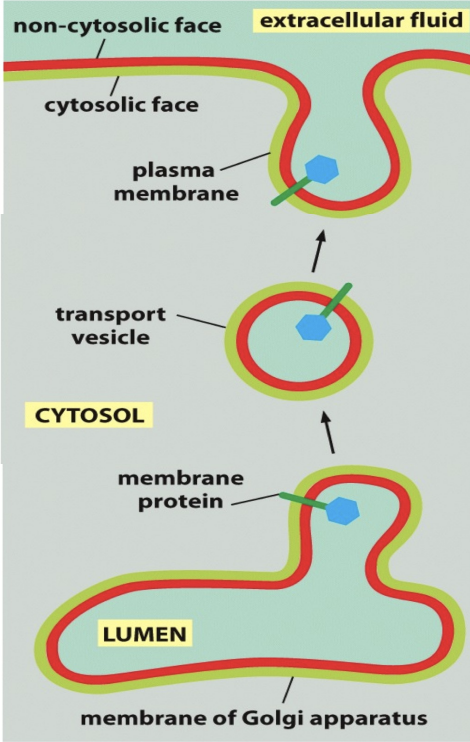
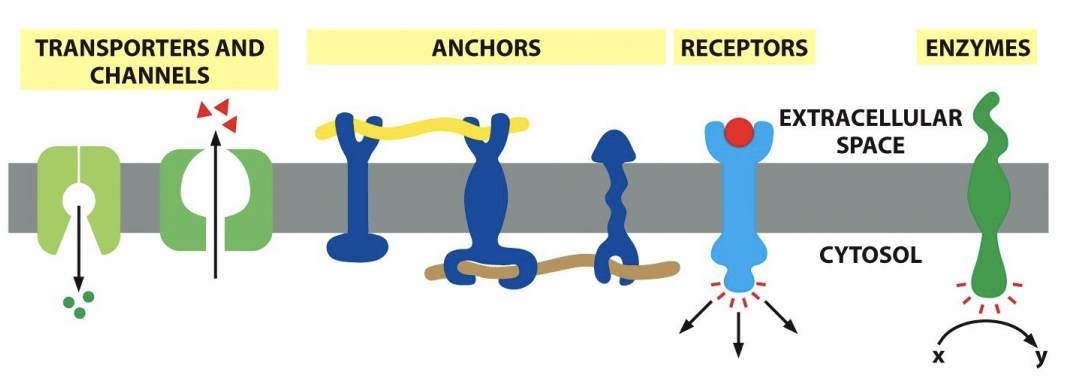
What are integral membrane proteins (i.e., transporters, channels, receptors, enzymes)?
alpha-helix protein structures intercalated in the lipid bilayer
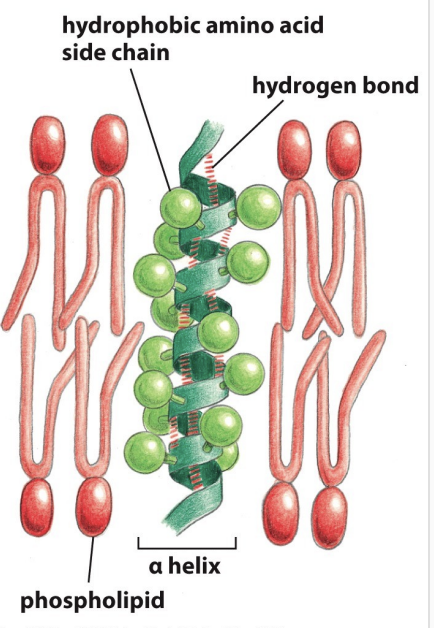
Why are integral membrane proteins in the bilayer oriented in an alpha helix?
the alpha helix structure allows the hydrophilic polypeptide chain to hide and the hydrophobic amino acid side chain to point outward (to the similar fatty acids in the membrane bilayer)
What are transporters?
a revolving door of lock + key conformational changes. can be ACTIVE requiring ATP to move molecules AGAINST their gradient or PASSIVE requiring no energy to activate and moving molecules WITH their gradient.
What are channels?
tunnels that discriminate by size and charge. can be voltage, mechanically, or ligand-gated.mechanical
What is the normal selectivity of the membrane to outside molecules?
allows small, nonpolar molecules in but rejects larger polar molecules and ions.
What is active transport?
requires energy (ATP) to move molecules “uphill” against their concentration gradient
What is passive transport?
requires no energy to move molecules “downhill” with their concentration gradient
How does glucose move passively across the membrane?
passively moves WITH concentration gradient as an uncharged molecule with transporter

What is the Na/K or ATPase pump?
it pumps out 3 Na+ for every 2K+ in, keeping the cell’s resting membrane potential negatively charges (around -65mV). every turn of this cycle uses one ATP → ADP

What is the gut glucose Na+ symport protein?
drives the import of glucose AGAINST its concentration gradient using the symport protein with TWO binding sites (Na and glucose) to pull glucose into the gut cell unidirectionally. here, the Na+, going with it’s concentration gradient, gives the energy to draw in the glucose to the gut.

What is the dopamine transporter (DAT)?
symport which uses one NaCl molecule and excess DA in the synapse to “drag” DA back into cell for reuptake
What is the glutamate transporter (EEAT)?
a type of antiport which cleans up synaptic glutamate by dragging in 3 Na+, 1 H+, and 1 glutamate while releasing 1 K+ out of the cell
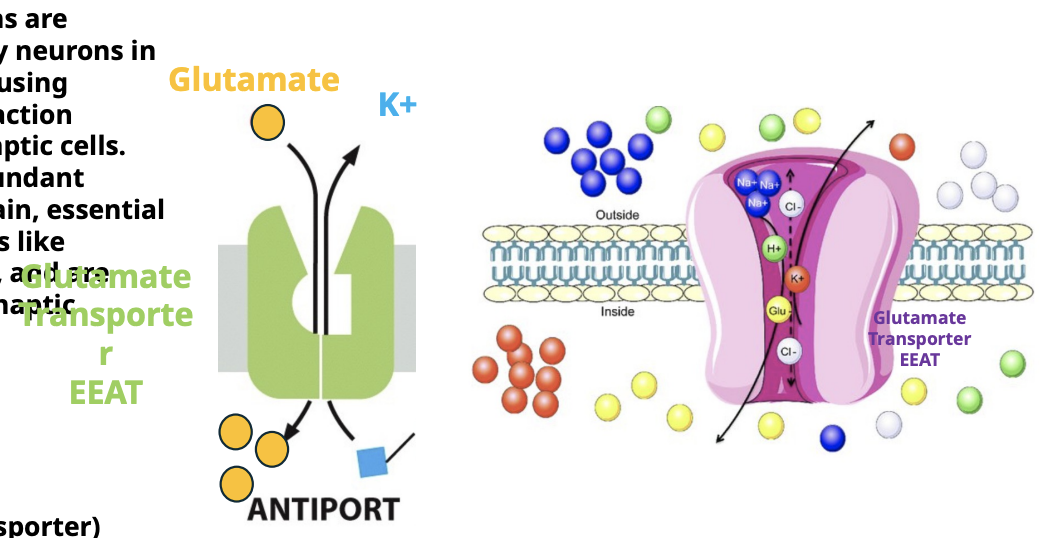
Where is the glutamate transporter (EEAT) found?
on astrocytes in the brain that “clean up” excess glutamate
What is symport?
a type of active membrane transport mechanism that moves two or more different molecules across a cell membrane simultaneously in the SAME direction

What is antiport?
a type of active membrane transport mechanism that moves two or more different molecules across a cell membrane simultaneously in OPPOSITE directions

What is uniport?
one molecule is transported in the same or opposite direction

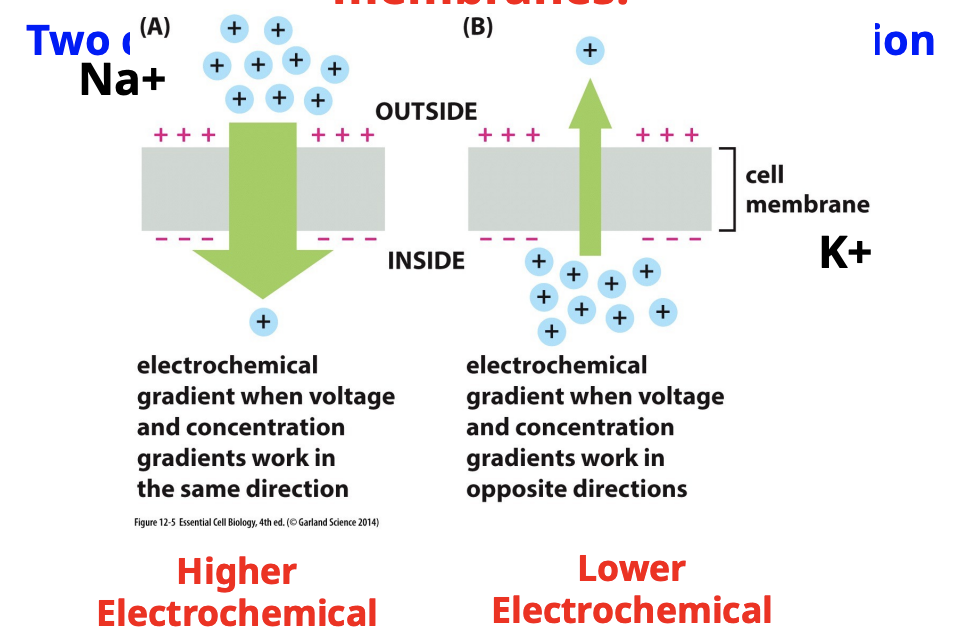
How do the electrochemical gradients for Na and K vary at the membrane’s resting potential?
at resting membrane potential, Na wants to move inside (favorable), and K wants to move outside (not favorable)
What is the process of an action potential?
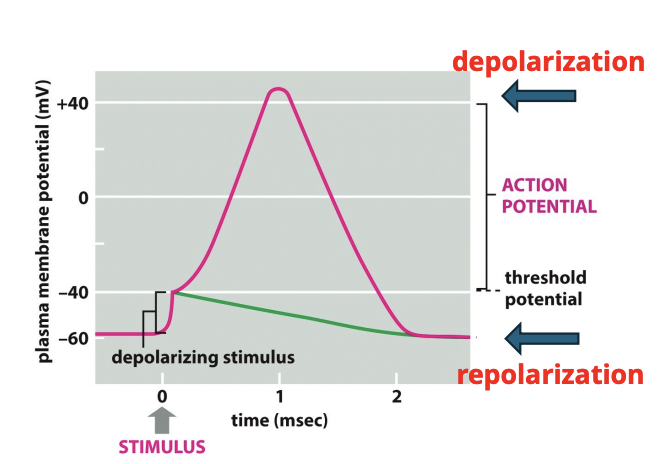
graded potentials are sent to a neuron at a threshold depolarizing stimulus to cause an opening of voltage-gated Na+ channels
Na+ floods into cell and depolarizes neuron
voltage-gated K+ begins to open afterward and K+ slowly leaves cell to compensate for this rush of depolarization
voltage-gated Na+ channels close at AP peak and K+ (slow to close) still rushes out of cell, causing a hyperpolarization
ATPase works to slowly bring membrane back to resting potential
What is necessary for biological changes to occur?
concentrations need to be broken and recreated for biological changes to occur. energy + protein changes = disturbed system and biological change
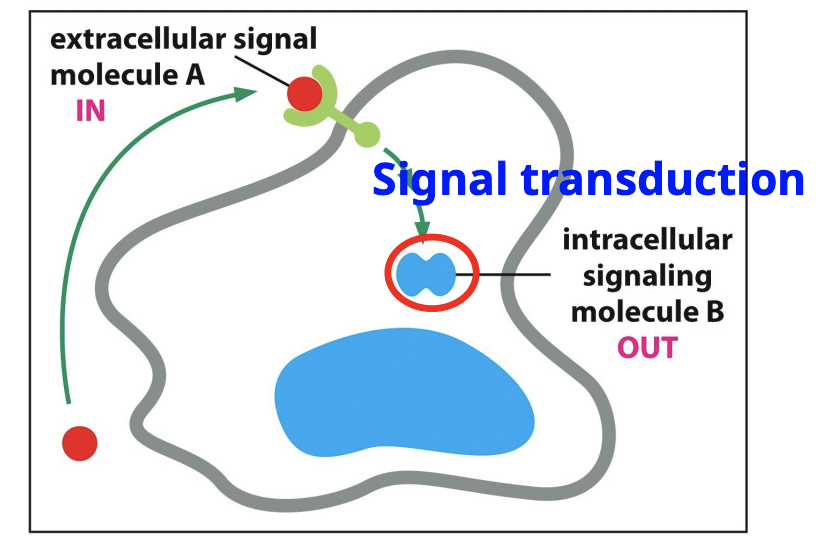
What is signal transduction?
how an extracellular chemical signal sent to a cell influences its response
How does the endocrine system release signals throughout the body?
through the bloodstream, where hormones eventually “find” and bind to target cell receptors
What determines which specific response a receiving cell will carry out?
the specific signal molecule used, the receptor involved, and the proteins activated
What are the effects of different combinatorial signal transductions?
survival
growth and division (growth factors, BDNF, alpha APPs)
differentiation
death/apoptosis (beta APPs)
What two things mediate signal transduction?
cell surface receptors or intracellular receptors
What are cell-surface receptors?
they sit on the outside of the cell and wait for and help hydrophilic molecules cross into the cell

Wha are intracellular receptors?
they sit on the inside of the cell and wait for hydrophobic molecules to come and bind after easily passing membrane

How do steroid hormones pass through the plasma membrane and interact with intracellular receptors?
they pass easily through the membrane and bind to a nuclear receptor protein and activate it, leading to its relocation into the nucleus and binding to regulatory genes steroid response element, influencing transcription

What do intracellular effectors do?
they can relay, amplify, and integrate the incoming signal
What are types of retrograde feedback from signaling?
positive or negative feedback, where amplification or phosphorylation can turn protein transcription on or off
What are scaffold proteins?
they sit in the intracellular space and, when triggered by a signal molecule, send a message to be amplified with small intracellular messenger molecules

What are the steps to intracellular signaling feedback?
signal → relay → amplification → integration → distribution

What are the three kinds of membrane receptors?
ion channel coupled, enzyme coupled, and g protein coupled
What are GCPRs?
g-protein coupled receptors that activate a g protein when an extracellular signaling molecule binds to the receptor and causes conformational changes
What are g proteins?
bind to GTP/GDP to change the conformation of the GPCR and turn activity on or off with secondary messengers. have intrinsic hydrolysis of GTP into GDP.
What is the inactive state of a g protein?
the alpha subunit is bound to GDP and the alpha, beta, and gamma subunits are all assembled

What is the active state of a g protein?
the activated g protein drops GDP and takes in GTP while the subunits separate into alpha/GTP and beta/gamma. the activated alpha subunit then binds to a target protein/enzyme.

How does the g protein not stay continually activated?
the alpha subunit has an intrinsic GTPase activity that hydrolyzes GTP to GDP and reassembles with the beta/gamma subunit to become inactive
What does the cholera toxin do to the alpha subunit?
it doesn’t allow for GTP hydrolysis, meaning permanent activation of GI cells
How do g proteins initiate direct responses?
through direct interactions with ion channels to open or close them
How do g proteins initiate indirect responses?
through activation of target enzymes and therefore secondary messengers
What is an example of slow extracellular signaling with GCPRs?
g proteins can activate the enzyme adenylyl cyclase to produce the secondary messenger cyclic AMP. cyclic AMP then activates protein kinase A (PKA), which activates transcription regulators in the nucleus.

What is an example of fast extracellular signaling with GCPRs?
when proteins already in the cytosol are changed. activated g protein stimulates phospholipase C which clips the membrane phospholipid into IP3 and DAG. IP3 increases Ca2+ in the ER lumen which meets with DAG to activate protein kinase C (PKC).

What are receptor tyrosine kinases (RTKs)?
usually exist as inactive monomers but can be dimerized (pulled together) with dimer signal molecule to activate phosphorylation docking points for intracellular signaling proteins

What is RTK cross-phosphorylation?
when two activated tyrosine kinase domains phosphorylate each other to create docking points for intracellular signaling proteins
Why are RTKs important?
they are powerful pathways of growth, survival, and proliferation
How do RTKs form a cross-linked matrix under the plasma membrane?
SH2 domains bind to phosphorylated tyrosines to build matrices of scaffolded messengers
How does Ras protein get activated and what does it do?
Ras-GEF binds to the RTK matrix and activates the Ras protein which activates MAP kinase kinase kinase → MAP kinase kinase → MAP kinase in MASSIVE CELLULAR COMMAND

How does BDNF activate downstream signaling pathways?
BDNF binds as a dimer to activate the TrkB receptor, triggering the RTK pathway of secondary messengers and CREB-dependent gene transcription

What is the mechanism of the paracrine system?
a signaling cell sends a local mediator (signal) to 2+ target cells
What is contact-dependent signaling?
signaling cell binds to the Notch protein of multiple target cells for cell specialization or lateral inhibition
How does Notch protein induce cell differentiation?
the delta signal protein from a developing cell binds to the Notch protein receptor of a neighboring cell, triggering a cleavage of the Notch tail. this cleaved tail then acts as a transcription regulator of notch-responsive genes.

How do proteins find their intracellular locations post-translation?
they have signal sequences of amino acids that determine transportation. all start at ribosome but some move from cytosol to ER
What does the Golgi apparatus do?
it modifies and prepares for delivery to organelles via vesicles
What are three types of protein transport?
transport through nuclear pores
transport across membranes (i.e. mitochondria, chloroplast)
transport by vesicles
What are nuclear pores?
mesh “holes” in the nuclear envelope dense with proteins and fibrils that selectively allow molecules in or out of the nucleus
How is the process of nuclear pore transport facilitated with the nuclear pore complex?
a protein with a nuclear localization signal attached to a nuclear import receptor and gets drawn in by the cytosolic fibrils until it clears the pore and detaches from the receptor

How do mitochondria help cells use oxygen?
the TOM family of trans locators regulate mitochondrial transport from the outside (TIMs on inside)
How is transport by vesicles made possible?
continual membrane building in the ER allows vesicles to be “pinched” off after protein translation is completed
How does protein synthesis find its way into the ER?
ribosomal subunits float in the cytosol until translation occurs. synthesis occurs in the N to C direction, with the signal sequence added to the N-terminal. protein eventually binds to ER proteins and synthesis finishes in the ER.

How do protein polypeptide chains anchor to the ER?
the ER signal sequence of a growing peptide chain binds to a signal recognition particle (SRP) and a SRP receptor and protein translocator. after the protein continues translation in the ER, the SRP is displaced and reused, and the peptide remains at the channel.

How is peptide synthesis and translation finished in the ER?
a peptide chain, being pulled through the protein translocator, has its ER signal sequence cut off by signal peptidase and the protein “falls” into the ER lumen.

What is the different mechanism of single-pass transmembrane proteins (APP, BACE, alpha secretase) and multiple-pass transmembrane proteins (gamma secretase) that allows them to stay in the ER membrane?
they have a short sequence of hydrophobic amino acids that allow the protein to stay in membrane for modifications

Where do vesicles pinched off the ER go to?
the golgi
What is endocytosis?
vesicles go back to endosomes from the plasma membrane

What is exocytosis?
vesicles merge with the plasma membrane and drop off proteins from golgi

What is the golgi apparatus?
a stack of flattened membrane enclosed sacs that transport vesicles
What is glycosylation?
it occurs in the ER and the Golgi, and it involves the addition of a polysaccharide (attracts water) which allows the protein stability from degradation and proper folding in the extracellular space

Where does glycosylation allow the protein to travel?
from the ER lumen to the cytosol to the extracellular space
Is APP a regulated or unregulated pathway of exocytosis?
unregulated exocytosis and constitutive secretion
Is BDNF a regulated or unregulated pathway of exocytosis?
regulated exocytosis and regulated secretion
What are coated proteins (COP)?
they give the force to form coated vesicles from the ER to the golgi and back
What are clathrin-coated vesicles?
form from golgi to plasma membrane and back to endosomes or golgi to endosomes
What is the process of clathrin-coated vesicle formation?
when cargo molecules bind to cargo receptors in the plasma membrane, adaptin binds to the receptor and clathrin helps pull into circular shape. when fully pinched by dynamin, clathrin falls off.

How does a naked vesicle identify its target membrane for exocytosis?
with a bound Rab protein, which binds at a tethering protein on the plasma membrane. then the v-SNARE pulls together with the t-SNARE on the membrane, tethering the vesicle and releasing the cargo.
What are microtubules?
part of the cytoskeleton that regulate trafficking and transport of vesicles
Where are microtubules formed?
from complexes of proteins extending from centrioles and organized by the centrosome
What are microtubules made of?
they are hollow tubes of alpha/beta heterodimers. one microtubule is 13 parallel protofilaments with a plus and minus end.

What is the dynamic instability of microtubules?
they grow based on GTP hydrolysis:
if tubulin dimers added faster than GTP hydrolysis → microtubule grows with GTP cap
if GTP hydrolysis is too fast and GDP is released to the cytosol → microtubule shrinks with broken GTP cap

What charge is the alpha end of the microtubule?
minus
What charge is the beta end of the microtubule?
plus
Which way do kinesins move?
toward beta plus end synaptic terminal for anterograde signaling
Which way do dynesins move?
toward the alpha minus end cell body for retrograde signaling