WPS 224 Cellulose
 Call Kai
 Learn
 Practice Test
 Spaced Repetition
 Match
 Flashcards
 Knowt Play
1/27

There's no tags or description
Looks like no tags are added yet.
28 Terms
Cellulose
Most abundant organic compound in world
Main structural component of plant cell walls, many forms of algae & the oomycetes
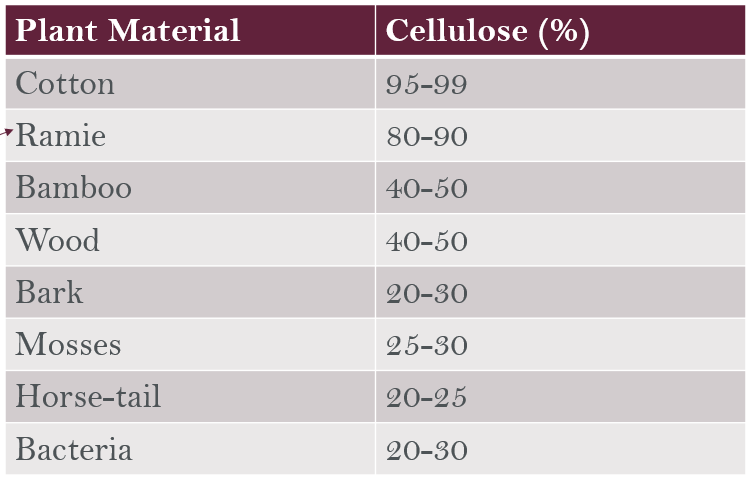
Cotton is 99% pure cellulose
Fine paper made of cellulosic fraction of wood
Not human food source, animals have cellulase.
Cellulose isolation & determination
Isolation of cellulose strongly influenced by accompanying components within cell wall
In cotton % ramie, this is easy as accompanying fats, protiens, waxes & pectin can be extracted with organic solvents
In wood cellulose is structurally linked to polyoses & lignin, so seperation requires intensive chemical treatment
Methods 1-3
Listed in wood analysis & composition
Photosynthesis
Process by which water & CO2 are combined in the presence of sunlight to form glucose (C6H12O6)
other simple sugars & oxygen
Cellulose & other sugars
Cellulose is polymer of glucose
Glucose is formed during photosynthesis
Glucose & fructose molecule form a sucrose - transported in plant
Sucrose ends up in processing centres (apical meristem, cambium)
Glucose molecules are linked together by removing water molecule between two glucose molecules
Cellulose molecular properties & chemical structure
Cellulose molecules are completely linear
Cellulose is a homopolysaccharide composed of β-D-glucose (glucopyranose) units, linked together by (1→4)-glycosidic bonds
Glycosidic bonds are formed after elimination of water from two adjacent glucose units between their hydroxyl groups at C-1 & C-4
Each second pyranose unit is rotated 180 degrees
Strictly speaking, cellobiose is repeating unit
OH groups at both ends of cellulose chain exhibit different behaviour (reducing & non-reducing ends)
The OH at C-1 is an aldehyde hydrate resulting from intramolecular, cyclic hemiacetal formation & is reducing
The OH at C-4 is an alcoholic hydroxyl & is non reducing

Cellulose chain linearity
Linear because:
β-glycosidic linkage: the β position of anomeric OH-group only allows a linear shape
α-OH & α glycosidic bond forms a helical molecular chain eg. amylose in starch
Pyranose conformation: the chair conformation has lowest energy
Ring conformation: OH groups or larger substituents in the equatorial position (conformation has lowest energy)

Cellulose in solution
Polymer properties of cellulose are usually studied in solution
On basis of solution properties, conclusion drawn regarding the average molecular weight, polydiversity, and conformation of polymer
Cellulose can be studied in solution after derivatisation into esters (eg. cellulose nitrate, cellulose acetate) & ethers (eg. methyl cellulose, carboxymethyl cellulose)
Cellulose nitrate

Cellulose acetate

Methyl cellulose

Carboxymethyl cellulose

Cellulose in solution contd.
Esters soluble in acetone & ethers soluble in water
Cellulose tricarbanilates also used to study cellulose behaviour
Cellulose is derivatised with methyl isocyante in pyridine or other solvents eg. DMSO, which makes tricarbanilates soluble in THF & can then be study molecular weight distribution via GPC
Cellulose can be directly dissolved in acid eg. trifluoroacetic acid (TFA)
Disadvantage: cellulose degradation & ester formation
Can also be dissolved in metal complexes eg. cadoxene, cuoxam, ect.
Cellulose tricarbanilates

Molecular weight & chain length
Molecular weight (molecular mass) of cellulose varies widely depending on origin of sample
Size of chain molecule usually specified as DP
DP = MM of cellulose / MM of one glucose unit
DP of plant cellulose is 7000 to 15000
Intensive chemical treatment such as pulping decreases DP below 1000
DP also decreases with time
Polydispersity
Polydispersity is calculated as weight average molecular weight divided by number average molecular weight
U = Pw/Pn
Polydispersity:
Decrease in DP not uniform
Resulting molecular chains vary in length
Polymer material denoted as polydisperse if its chain lengths vary over wide range of molecular masses
Important not only to measure DP, but also measure distribution of MM
Supramolecular structures
Supramolecular refers to chemical systems made up of discrete number of assembled molecular subunits or components
Formation of supramolecular structures originates from presence of functional groups (OH)
OH-groups are able to interact with each other because of H-bonds
Hydrogen bond
attractive interaction of hydrogen atom with an electronegative atom, eg N, O or F.
Occur between molecules, or within different parts of single molecule
Cellulose chains studded with OH groups
Intramolecular linkages formed through H bonding between OH groups & adjacent glucose molecules in same cellulose molecule
These linkages responsible for formation of supramolecular structures & chain stiffening
Intermolecular linkages formed through hydrogen bonding between OH groups of adjacent cellulose molecules
Hydrogen bonding contd.
Hydrogen bonds also exist between cellulose-OH & water-OH
Adsorption of water by cellulose depends on number of free OH groups
Entrance of water molecule into cellulosic structure results in swelling in structures
Reverse process of adsorption of water is removal of water & shrinkage of cellulose
Entrance of water into cellulosic structure means swelling of structure
Other solvents such as DMSO & pyridine can be linked to cellulose through H-bonding
Supramolecular structures contd.
supramolecular structure of cellulose results in its solubility in water & in most organic solvents
As result, all commercially available products are currently produced through reactions of cellulose in the solid or more or less swollen state (heterogeneous reactions)
Crystalline structure of water

Crystalline structure of cellulose

Crystal lattice of cellulose I
In solid state, regular distribution of intra- & intermolecular H-bonds creates an ordered system with crystal-like properties
3 different axes; one angle not 90 degrees
Alternative chain are counter running in longitudinal directions
Chains rotated around the rotational axis by 180 degrees

Supramolecular structures contd.
Crystal lattice planes: each plane produces peak in x-ray defractogram
Different cellulosic materials show different peak intesities in x-ray diffractograms
Mechanical, chemical and/or thermal treatment during processing changes structure of crystal lattice of cellulosic materials
Ball-milling completely destroys crystal lattice
Dissolving & precipitation changes structure of crystal lattice
Polymorphism of cellulose
Various crystalline forms (polymorphs) of cellulose obtained with various chemical treatments
Cellulose I, cellulose II, & Na-cellulose are of technical importance
Cellulose II results from treatment of cellulose I with alkali solution, mercerization, or recrystallisation from a solution
Alkali type concentration & temp determine extent of swelling
Most complete of cellulose I to cellulose II obtained by swelling NaOH
Crystal lattice widens as crystal planes shift
Spaces filled with water & OH groups are converted to ONa groups
Subsequent washing with water removes Na ions & cellulose II is formed
Crystallinity & size of crystalites
Chemical reaction rate of cellulose determined by supramolecular structure & selective reaction rate of OH-groups attached to glucose units
Reaction takes place easier in amorphous zone as it is more accessible
Degree of crystallinity determined by origin & isolation method of cellulose
Size of crystallites also vary according to material, test method (SEM, acid treatment, x-ray diffraction, IR spectroscopy, NMR, ect.)
Intensive mechanical treatment of cellulose reduces crystallinity

Internal structure of fibre
Structure of skeleton of wood cell wall is made up of cellulose fibrils
Elementary fibrils have diameter of 2-4nm; microfibrils 10-30nm
Interfibrillar spaces (1.2-5nm (wet); 1nm (dry))
Three basic principles are applied in fibrillar concepts/models;
Cellulose chains parallel & antiparallel arranged in longitudinal direction
Ordered & less ordered (amorphous) regions exist
Ordered regions are repeated regularly
Other properties of cellulose
Density:
Crystallinity & polymorphism indicates that cellulose has > 1 density value
Amorphous cellulose: 1.471 - 1.489 g/cm3
Crystalline cellulose: 1.590 - 1.630 g/cm3
Optical properties:
Cellulose fibres are fluorescent in UV light
Cotton has white/blue color
Bleached sulphite pulp is white