Lecture 10 slides- Physiology of Mastication and Deglutition
 Call Kai
 Learn
 Practice Test
 Spaced Repetition
 Match
 Flashcards
 Knowt Play
1/34

There's no tags or description
Looks like no tags are added yet.
35 Terms
Definitions:Mastication?
the process of preparing food for swallowing; chewing
Definitions: Deglutition?
processes of swallowing
Definitions: Bolus?
ball of food or liquid to be swallowed
Definitions: Dysphagia?
Difficulty moving food from the mouth to the stomach
Anatomy of Mastication and Deglutition: Over ____pairs of muscles involved in mastication and deglutition
55
Development of Swallowing: What forms the basis for development of the speech system?
Feeding skills
Gross & reflexive movements become refined and coordinated movements for speech and swallow
Development of Swallowing: Development of swallowing begins well before ___
Birth
Development of Swallowing: Newborns have reflexes to help them feed. What are the two reflexes?
Rooting Reflex: involves light tactile stimulation to the cheek area, which causes an infant to turn their head towards the stimulus and open their mouth
Sucking Reflex: elicited by soft contact with the inner margin of the lips, causing the infant to close their lips and protrusion and retraction of the infant’s tongue in preparation for receiving food from the mother’s breast
Adult vs Infant Oral-Pharyngeal Structures: What are the four infant structures?
Oral cavity smaller
Larynx & hyoid are elevated at birth as compared with the adult
Velum is relatively larger as compared to the pharynx
No teeth
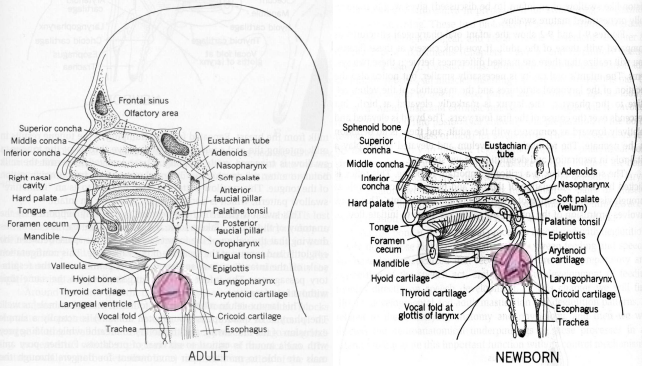
Stages of Mastication & Deglutition: 4 Stages of Mastication & Deglutition?
Oral Stage (mastication)
Preparatory
Transport
Pharyngeal Stage (pharyngeal swallow)
Esophageal Stage (esophageal transit)
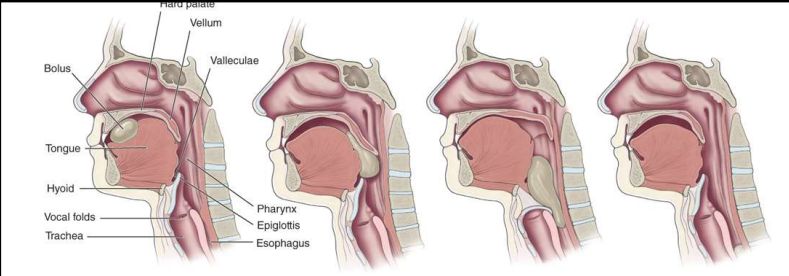
Stages of Mastication & Deglutition: Oral Preparatory
Food is prepared for swallowing
Tongue forms the liquid or solid into a cohesive bolus after the solid has been chewed and mixed with saliva. •
Bolus is held as a cohesive unit against the hard palate and tongue.
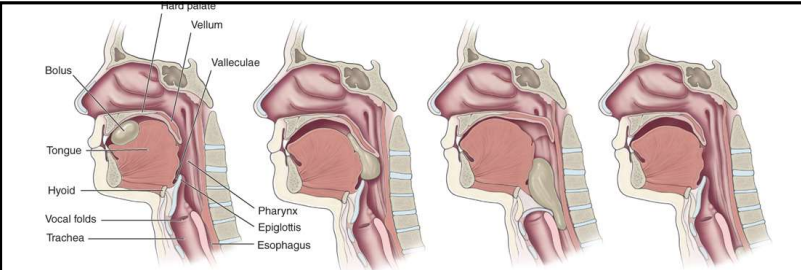
Oral Stage: Oral Preparatory: What muscles are used?
Facial muscles, tongue muscles, Mandibular muscles, soft palate muscles
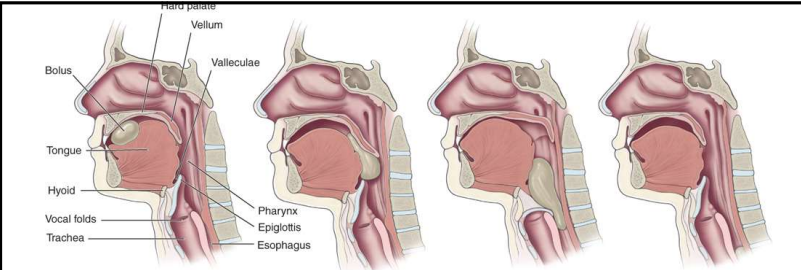
Oral Stage: Transport:
Lips seal and tongue moves bolus back toward the oropharynx
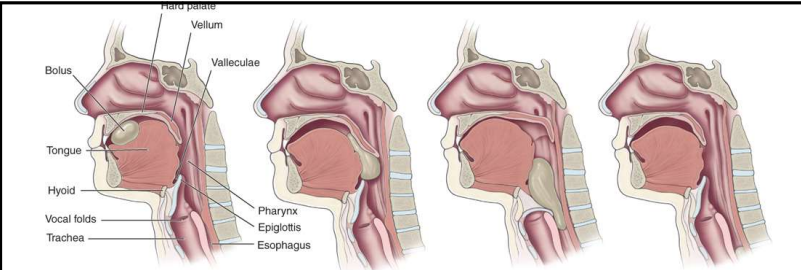
Oral Stage: Transport: Muscles used
Mandibular muscles and Tongue muscles
Elevate mandible

Pharyngeal Stage: When does the pharyngeal stage begin, and what happens during this stage?
Swallow response is triggered causing several physiologic activities to occur simultaneously and pushing food from the pharynx into the esophagus.

Pharyngeal Stage: What muscles are used during this stage?
Tongue Muscles, Pharyngeal constrictors(contrsit pharynx, elevate pharynx and larynx), soft palate muscles, laryngeal muscles

Esophageal Stage: What happens during the esophageal stage, and when does it begin?
Food passes, by peristaltic action and gravity, through the esophagus to the stomach.

Esophageal Stage: How does the bolus travel through the esophagus and enter the stomach?
Esophageal peristaltic motion and gravity carry the bolus through the esophagus.
The lower esophageal sphincter opens to allow the bolus into the stomach.
Esophageal Peristaltic and Sphincter: Esophageal Peristaltic
Successive waves of involuntary contraction passing along the walls of the esophagus and forcing the bolus onward

Esophageal Peristaltic and Sphincter: Esophageal Sphincter
A ring of muscle that contracts to close an opening

Prepost: What is the correct order of the different phases of a normal swallow from first to last?
. Oral preparatory → Oral transit → Pharyngeal → Esophageal
In what stage does the lower esophageal sphincter open, allowing the bolus to enter into the stomach?
E. esophageal
During the esophageal stage, the bolus travels down the esophagus through peristaltic contractions. The lower esophageal sphincter (LES) relaxes and opens, allowing the bolus to enter the stomach.
PrePost: In what stage does the tongue elevate and squeeze the bolus posteriorly toward the faucial pillars?
D.oral transit
During the oral transit stage, the tongue elevates and presses against the hard palate, pushing the bolus backward toward the faucial pillars and into the pharynx.
PrePost: In which stage does the velum elevate to separate the oral and nasal cavities?
A.pharyngeal

Oral preparatory → A. Lips sealed, rotary jaw motion, velum depressed.
Oral transit → B. This stage ends when the bolus reaches the faucial pillars.
Pharyngeal → D. Vocal folds are closed and respiration ceases.
Esophageal → C. Bolus enters the esophagus and is moved by peristalsis.
Sensation Associated with Mastication and Deglutition:
Numerous types of stimulus receptors are critical for completion of the chewing, sucking and swallowing (CSS) elements associated with mastication and deglutition
Senses involved in chewing and swallowing : ___
taste (gustation)
smell (olfaction)
touch (tactile sense)
temperature (thermal sense)
pain (nociception)
muscle stretch & tension
Gustation (Taste): Taste receptors (taste buds, taste cells) consist of a class of sensors known as ____ , that respond when____
Found in papillae (prominences) on ___ of tongue
Taste receptors (taste buds, taste cells) consist of a class of sensors known as chemoreceptors, that respond when specific chemicals come in contact with them
Surface, epiglottis, pharynx, esophageal entrance, palate
Taste: 5 main types of taste receptors
Sweet
Salt
Sour
Bitter
Umami (taste of monosodium glutamate (MSG), which tastes “meaty,” or protein-like)

Taste: All are found throughout tongue, but there is some truth in the idea that ___
certain taste sensors are concentrated in different regions

Olfaction (Smell): Smell plays a vital role ___
Olfactory sensors located in ___
Salivation:____
Gagging, vomiting: triggered by ___
in appetite and taste
posterior nasal cavity
triggered by pleasant food odors
Gagging, vomiting: triggered by unpleasant odors

Mastication → D. Chewing
Deglutition → A. Swallowing
Olfaction → C. Smelling
Dysphagia → B. Difficulty moving food from the mouth to the stomach
Gustation → E. Tasting
Reflexes: Chewing Reflex
Triggered by deep pressure on the roof of the mouth (palate)
Alternating left-right contraction of mandibular elevators (masseter and medial pterygoid muscles) causes rotary motion of the mandible
Reflexes: Rooting & Sucking Reflexes
Rooting triggered by tactile stimulation to the cheeks or lips and causes infants to turn toward stimulus and open their mouths
Sucking triggered by contact with inner margin of lips and causes infants to close lips and alternating protrusion & retraction of tongue
During which stage does the lower esophageal sphincter open, allowing the bolus to enter into
the stomach?
a) pharyngeal
b) oral preparatory
c) gastrointestinal
d) esophageal
e) oral transi
During the esophageal stage, the lower esophageal sphincter (LES) relaxes and opens, allowing the bolus to enter the stomach.
During which phase of swallowing does the velum elevate to separate the oral and nasal cavities?
a) oral transit
b) esophageal
c) nasal
d) pharyngeal
e) oral preparatory
During the pharyngeal phase, the velum (soft palate) elevates to close off the nasal cavity, preventing food or liquid from entering the nose.