lecture 13 - brain: diencephalon & cerebrum
 Call Kai
 Learn
Learn Practice Test
 Spaced Repetition
 Match
Match Flashcards
 Knowt Play
1/127

There's no tags or description
Looks like no tags are added yet.
Name | Mastery | Learn | Test | Matching | Spaced | Call with Kai | Chat |
|---|
No analytics yet
Send a link to your students to track their progress
128 Terms
Diencephalon
Region of the brain found deep within the brain; between the brainstem and cerebrum; must cut the brain along a sagittal section to visualize its structures

Four main components of the diencephalon
Thalamus; subthalamus; epithalamus; hypothalamus
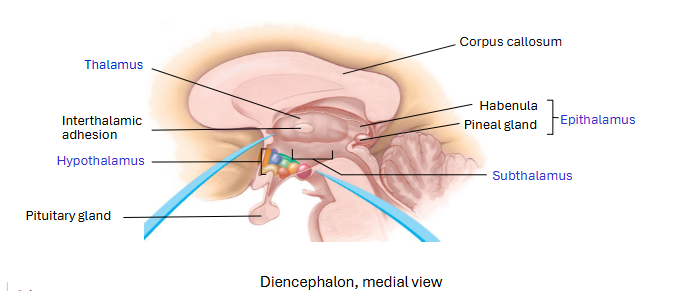
Thalamus
largest portion of the diencephalon
2 oval-shaped masses of gray matter
superior portion

Interthalamic adhesion
Gray matter connection b/w the R and L sides of the thalamus

Subthalamus
directly below the thalamus

Epithalamus
made up of the habenula and pineal gland
posterior to the thalamus

Habenula
More superior portion of the epithalamus

Pineal gland
inferior portion of the epithalamus
pine cone shaped
size of a pea

Hypothalamus
most inferior portion of the diencephalon
connects to the pituitary gland

the _________ and ______ _____ act as the connection between the nervous system and endocrine system
hypothalamus, pituitary gland

Corpus callosum
section of cerebrum that connects the R and L hemispheres
white C-shaped structure located just above the diencephalon
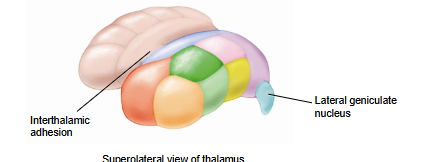
Thalamus structure
Two paired oval masses of gray matter connected by the interthalamic adhesion

Thalamic nuclei
gray matter regions containing nuclei
different regions of nuclei have different roles
nuclei within regions have very similar functions

Geniculate
“bent knee”
describes the appearance of the medial and lateral geniculate nuclei

Medial geniculate nucleus
small projection off edge of thalamus
involved in auditory impulses

Lateral geniculate nucleus
small projection off edge of thalamus
involved in visual input
Location of medial and lateral geniculate nuclei
Inferior posterior side of the thalamus
medial geniculate nucleus → back of the thalamus
lateral geniculate nucleus is lateral to it

Third ventricle runs around the ______; cerebrospinal fluid moves in and around the ______ and between the mounds
thalamus, thalamus
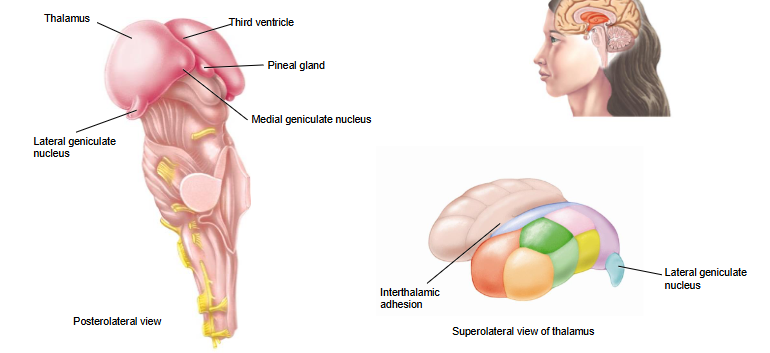
The __________ _______ is a gray matter connection between the paired thalamic masses; this is the region where cerebrospinal fluid could not be seen
interthalamic adhesion
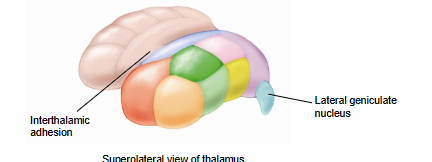
the ________ receives all sensory information except smell; sensory information synapses at the ______ before being sent to the _______ _____
thalamus, thalamus, cerebral cortex

the ______ receives sensory information, filters much of it, and sends it to the ______ _____
thalamus, cerebral cortex

the _______ helps filter sensory information so that not all sensory information has to be integrated or interpreted at the level of the cerebral cortex
thalamus

Medial geniculate nucleus function
auditory impulses
takes info from inner ear to primary auditory area of the cerebral cortex in the temporal lobe

Lateral geniculate nucleus function
Involved in visual input; gathers information from the retina and takes it to the primary visual area of the cerebral cortex in the occipital lobe
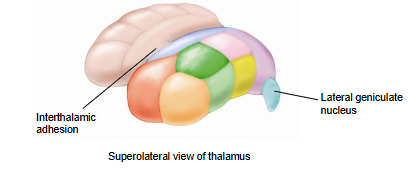
Sensory information from the inner ear or eye first synapses in the _______ before being sent to the ______ _____
thalamus, cerebral cortex

Subthalamus location
inferior to the thalamus
b/w the thalamus and hypothalamus

Subthalamus composition
primarily white matter

Subthalamus white matter contains
many axons moving through the area because the thalamus receives the majority of sensory information

Subthalamic nuclei
gray matter areas within the subthalamus
involved in controlling motor function with other areas and the cerebrum

Epithalamus location
Posterior superior region relative to the thalamus

Two portions of the epithalamus
Habenular nuclei or habenula; pineal gland

Habenula location
Superior portion of the epithalamus

Pineal gland location
Inferior portion of the epithalamus

Habenula function
Involved in:
emotional control of behavior
linking behaviors involving rewards
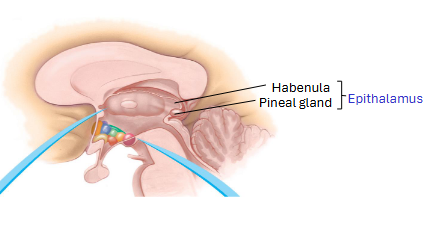
the ______ in the epithalamus plays a critical role in regulating motivational states and decision making
habenula

the ________ in the epithalamus is involved in integrating sensory, cognitive, and emotional information
habenula

the ______ in the epithalamus encodes both rewarding and aversive aspects of stimuli, which influence behavior
habenula

the ______ in the epithalamus is linked to conditions such as depression, addiction, and schizophrenia
habenula

Pineal gland shape and size
Pine cone shaped; about the size of a pea

the _____ ____ in the epithalamus is thought to play a role as the body's biological clock; believed to be linked to timing and growth and development, such as onset of puberty
pineal gland

Researchers believe the _____ _____ may secrete chemicals that signal other cascades of events to bring on physiological changes associated with puberty and later-life changes such as menopause
pineal gland
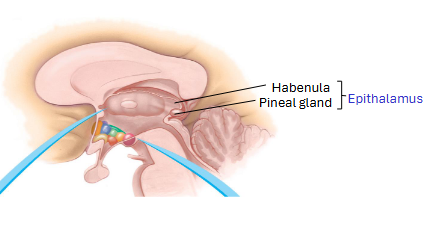
______ is a chemical believed to be secreted by the pineal gland; promotes sleepiness
melatonin

Melatonin is linked to the ____-____ cycle; ____ amounts are produced when asleep and help keep you asleep
sleep-wake, large

Melatonin is light sensitive; when exposed to light, melatonin levels ____
drop
Sleeping in a dark room helps keep melatonin levels ____
high
Turning on lights in the middle of the night _____ melatonin levels and can make it harder to fall back asleep
reduces
Hypothalamus location
most inferior portion of diencephalon
located on the anterior side

Infundibulum
A stalk in the hypothalamus that connects it to the pituitary gland
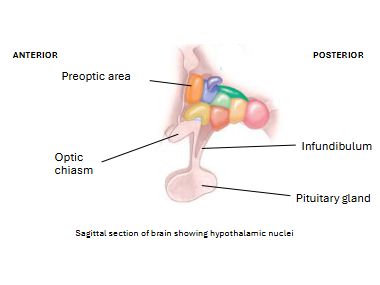
Pituitary gland
master gland of the body
responsible for secreting hormones involved in metabolism, reproduction, response to stress, and urine production

Infundibulum composition
white matter
connective tissue

Infundibulum function
Creates a link between the nervous system and endocrine system

Endocrine system
System that releases hormones into the body, typically via glands
Hypothalamic nuclei
more than 12 different nuclei
involved in a variety of functions including those important for homeostasis

the _________ controls things such as heart rate, blood pressure, respiration, digestion, hunger, thirst, body temperature, moods, emotions, and sex drive
hypothalamus

Preoptic area
region of hypothalamus involved in thermoregulation

the hypothalamus is located close to the ____ _____; this is where visual information from the two eyes comes together in the brain
optic chiasm

Nuclei of the ________ are densely packed and closely related; stimulation of one area can affect neighboring areas
hypothalamus

Close neural connections between _________ nuclei can help explain why emotions can interfere with hunger or thirst
hypothalamic

Along with olfactory and memory regions, the ________ is thought to play a role in visceral and emotional responses to odors
hypothalamus

Visceral
Refers to anything internal or inside the body
Visceral and emotional responses to odors
Taking in a smell from the environment and producing an emotional or visceral response
Example of an emotional response to an odor
Smelling a perfume or cologne associated with a person can cause increased heartbeat, feeling flustered, and excitement
Example of a positive emotional response to an odor
Smelling a favourite meal can cause feelings of happiness, comfort, and feeling at home
Example of a visceral response to an odor
Smelling tequila after a negative past experience can cause nausea, feeling sick, or gagging
Cerebrum
Largest portion of the brain; typically the region people think of when talking about the brain

Cerebrum functions
conscious processes and intellectual functions
higher-level processing including planning
reasoning
organizing thoughts
accessing and storing memories
interpreting sensory information
eliciting motor responses

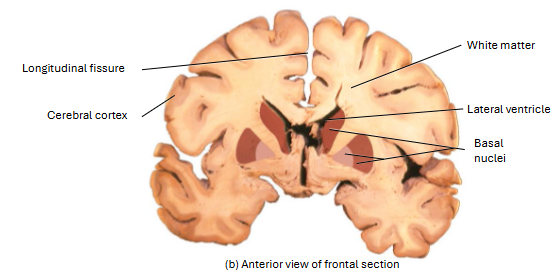
Three general regions of matter in the cerebrum
Cerebral cortex (outer gray matter)
Deep clusters of nuclei (gray matter)
Cerebral medulla in between (white matter)

Cerebral cortex
Outer layer of gray matter in the cerebrum
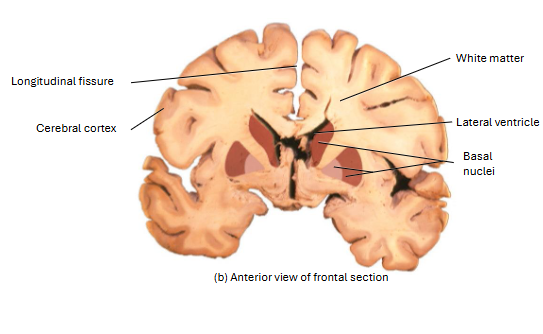
Basal nuclei
collections of gray matter deep within the cerebrum
involved primarily in motor functions

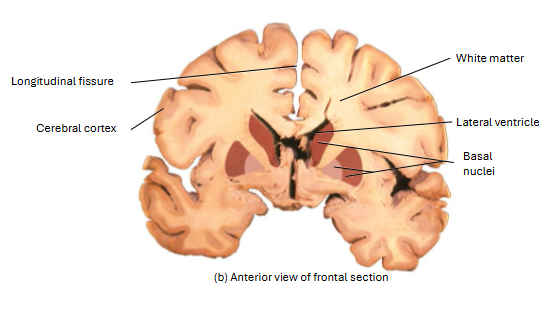
Cerebral medulla
White matter region between the cerebral cortex and deep nuclei; consists of myelinated axon pathways
Cerebral medulla function
Myelinated axon pathways connect different gray matter regions within the cerebrum and connect the cerebrum to other regions of the brain

Lateral ventricles
Spaces within the cerebrum

Longitudinal fissure
Deep groove separating the right and left sides of the cerebrum

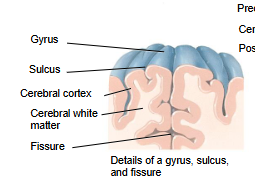
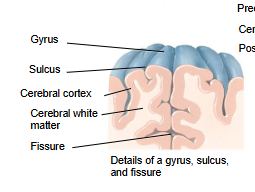
Gyri
Upward folds of the cerebral cortex

Gyrus
Singular form of gyri; an upward fold of the cerebral cortex
Sulci
Shallow grooves formed by folds of the cerebral cortex

Sulcus
Singular form of sulci; a shallow groove formed by folds of the cerebral cortex

Fissures
Deeper grooves in the cerebral cortex
Right and left cerebral hemispheres
Two halves of the cerebrum separated by the longitudinal fissure

Central sulcus
groove running across the brain
separates the frontal and parietal lobes

Frontal lobe location
Anterior to the central sulcus

Parietal lobe location
Posterior to the central sulcus
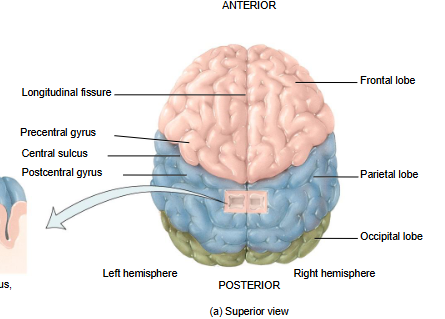
Precentral gyrus
region just anterior to the central sulcus
contains the primary motor cortex
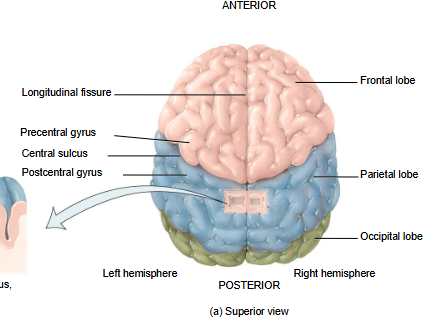
Primary motor cortex
located in the precentral gyrus
gray matter region that initiates most motor responses

Postcentral gyrus
region just posterior to the central sulcus
contains the primary somatosensory cortex

Primary somatosensory cortex
located in the postcentral gyrus
most sensory information is sent here for interpretation

Special sensory information not interpreted in the primary somatosensory cortex (in the postcentral gyrus)
vision
hearing
smell

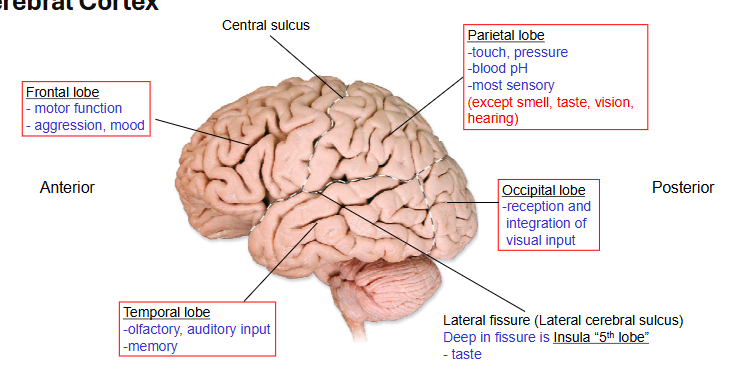
Four main lobes of the cerebrum
Frontal lobe; parietal lobe; occipital lobe; temporal lobe

Cerebral lobes naming
Lobes are named after the bones that overlie them

Cerebral lobes arrangement
Four lobes on each cerebrum; paired in each of the two hemispheres

Frontal lobe functions
motor functions
aggression
mood

Frontal lobe motor function area
Precentral gyrus or primary motor cortex

Parietal lobe roles
majority of sensory information from the body is brought here for interpretation

Sensory information that does not go to the parietal lobe
Smell; taste; vision; hearing

Parietal lobe sensory example
Touch and pressure information coming from the skin

the ______ _____ is involved in monitoring and maintaining blood pH
parietal lobe

Parietal lobe primary sensory area
the primary somatosensory cortex (in the postcentral gyrus)
Parietoccipital sulcus
Separates the parietal lobe from the occipital lobe

Occipital lobe
involved in perception and integration of visual input

Light information turned into an electrical signal in the retina; travels on the optic nerve, goes to the ______, then moves to the _______ lobe
thalamus, occipital
