Male Reproductive - Unit 6 1/4
 Call Kai
 Learn
 Practice Test
 Spaced Repetition
 Match
 Flashcards
 Knowt Play
1/43

There's no tags or description
Looks like no tags are added yet.
44 Terms
Tasks shared across male and female reproduction
Formation of gametes
Secretion of hormones
Copulation
Fertilization
Meiosis is the division of the ______ and _______ _______ to produce _______ _________
meiosis is the division of the nucleus and genetic material to produce haploid gametes
The male gonads are the _______ and the male gametes are the __________. The gametogenesis process for males is called ________________.
testes; gametes are spermatozoa; spermatogenesis
The gonads are _______ glands. What are its exocrine and endocrine functions?
mixed glands; endocrine is producing sex hormone. exocrine is producing gametes (sperm).
the testes primarily secrete __________, while the ovaries secrete estrogen and ______________.
testes secrete testosterone; ovaries secrete estrogen and progesterone.
Sex hormones are ______ hormones that are vital in the development and function of reproductive organs, non-reproductive organs and tissues, sex behaviors and drives.
steroid
adrenal glands secrete _______ and ___________ in males and females.
ovaries secrete some ________, and the testes produce some ____________.
estrogen and testosterone are secreted by adrenal glands in males and females!
ovaries secrete some androgens, and the testes produce some estrogens.
the HPG Axis:
1. ________ released by hypothalamus
2. GnRH travels to _______ _________, causing the release of gonadotropins _____ and ____ there.
GnRH released, then travels to anterior pituitary, releasing FSH and LH from the anterior pituitary.
the HPG Axis:
1. GnRH released by hypothalamus
2. GnRH travels to anterior pituitary gland, causing the release of gonadotropins FSH and LH from the area.
3. LH and FSH stimulate the release of ______ __________ from gonads
4. Test and Est/Prog act upon their _____ _______
LSH and FSH stim release of sex hormones from gonads, then those sex hormones act upon their target tissues.
Once hormone levels are high enough in the HPG Axis, sex hormones exert _______ feedback on the __________ and ________ ________.
Gonads secrete inhibin which also exerts ________ feedback on release of F8H from anterior pituitary.
Sex hormones exert negative feedback on the hypothalamus and anterior pituitary.
Gonads secrete inhibin which is also negative feedback on release of F8H.
Before puberty, levels of circulating sex hormones are low, which suppresses secretion of ______ from the hypothalamus
GnRH
The line that divides the scrotum is the
midline septum
the smooth muscle layer in the superficial fascia that contracts to wrinkle skin when cold
dartos
the band of skeletal muscle in the spermatic cord that contract to elevate testes when cold and relax when warm
cremaster
testes, the male gonad, produce ______ and _____ _________
sperm and sex hormones
the 2 layers (tunics) of the testes
tunica albuginea (inner, fibrous capsule)
tunica vaginalis (outer, peritoneum)
these divide each testis into about 250 lobules and each contain 1-4 seminiferous tubules
septa
where sperm production occurs
seminiferous tubules
what are seminiferous tubules composed of and what is the lumen filled with?
thick stratified ET; fluid-filled lumen
[Histology of the Testes]
Large columnar cells that assist in nourishment/support of developing sperm:
Surrounded by sustentocytes, general term, give rise to functional sperm:
Smooth-muscle like cells around seminiferous tubules, contract to squeeze sperm through:
Endocrine cells, produce androgens and some estrogen
Large columnar cells that assist in nourishment/support of developing sperm: Sustentocytes
Surrounded by sustentocytes, general term, give rise to functional sperm: Spermatogenic
Smooth-muscle like cells around seminiferous tubules, contract to squeeze sperm through: Myoid
Endocrine cells, produce androgens and some estrogen: Interstitial

The testes contain a series of ducts that convey sperm to the _________, where it will be stored until ejaculation.
epididymus (study picture of this)
The Blood-Testis Barrier (BTB) is a physical barrier formed by _____ junctions between sustentacular cells in the seminiferous tubules.
It prevents harmful substances in the blood from reaching developing sperm cells. It shields sperm from the ________ system
3 Main Benefits: compartmentalize ________ tubules, protective from _______, support for _______________
BTB formed by tight junctions.
Shields sperm from the immune system.
3 main benefits: compartmentalize seminiferous tubules, protect from immune, support for spermatogenesis
this encloses the nerve fibers, blood vessels, and lymphatics that supply the testes as well as the ductus deferens
spermatic cord
these arise from the abdominal aorta and are inside the spermaticcord
testicular arteries (damn lots of pictures in this unit will have to study these separately)
these arise from a specialized venous plexus that help keep the testes cool
testicular veins
location where sperm mature and are stored until ejac
epididymis
sperm entering the epididymis are ___________. During ejaculation, the epididymis contracts, expelling the sperm into the ______ _________
non-motile. During ejac, the epididymis contracts, expelling sperm into the ductus deferens
sperm can be stored for ______ months. If stored longer, they will be __________ by the immune system.
can be stored for several months
phagocytized
this transports sperm from epididymis to ejac duct (one per testis)
ductus (vans deferens)
the vas deferens transports sperm through the epididymis, inguinal, pelvic, anteriorly to the pubis, over the bladder, then joins with the duct of the
seminal gland (posterior to bladder)
the enlarged distal end of the ductus deferens is called the
ampulla
where the duct of the seminal vesicle meets with the ampulla of the ductus deferens. how many are there?
ejac duct. there’s two

the ejac duct empties into the
prostatic urethra

[3 Regions of the Urethra]
The prostatic urethra is located just _______ to the bladder and is surrounded by the _______ gland.
The membranous urethra is in the middle and located within the ___________ diaphragm.
The ________ urethra runs the length of the penis and opens at the external urethral orifice.
PMS
Prostatic urethra is inferior to the bladder and surrounded by prostate gland.
Membranous is located within the urogential diaphragm.
The external opens at urethral orifice
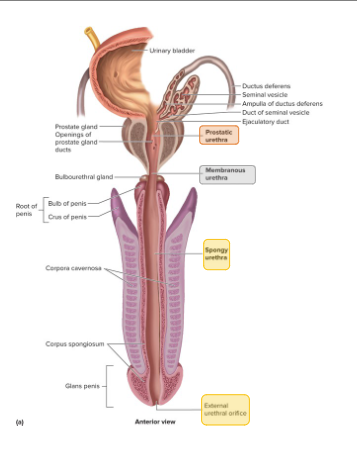
What is made with smooth muscle and contracts during ejac?
Seminal vesicles (two)
These produce about 70% of seminal fluid (viscous and alkaline)
seminal vesicles
The prostate is a ______ gland that encircles the urethra just inferior to the bladder. It is about the size of a _______ ____.
single; peach pit
This contains smooth muscle that contracts during ejac; produces about 1/3 of seminal fluid which plays role in sperm activation.
Prostate
these are pea-sized glands located inferiorly to the prostate (in the urogenital diaphragm). They produce a tiny amount of seminal fluid that neutralizes ______.
Bulbourethral; neutralizes acids

The two subcategories of erectile tissue are __________ and __________.
Which one keeps the urethra open during erection?
Which one is located on the dorsal side, made of paired erectile bodies, and forms the proximal crus?
Erectile tissue - spongiosum and cavernosa.
Spongiosum keeps urethra open during erection.
Cavernosa is dorsal, forms proximal crus, paired bodies
Order of secretions that add to semen
SPB - seminal, prostate, bulbourethral
these provide nourishment for development of sperm cells
sustentacular cells
which process converts a spermatid to a mature sperm cell?
spermiogenesis