Kin 147 Exam 1
 Call Kai
 Learn
Learn Practice Test
 Spaced Repetition
 Match
Match Flashcards
 Knowt Play
1/84

There's no tags or description
Looks like no tags are added yet.
Name | Mastery | Learn | Test | Matching | Spaced | Call with Kai | Chat |
|---|
No analytics yet
Send a link to your students to track their progress
85 Terms
Module 0
Intro and Review
What is anatomical reference position?
Erect standing position with all body parts facing _____;
considered the ______ ______ for all body segment movements
forward; starting point
Which plane do forward and backward movements occur?
Sagittal
Which plane do lateral movements occur?
Frontal
Which plane do rotational movements occur?
Transverse
What movements occur in the sagittal plane?
flexion, extension, hyperextension, dorsiflexion, plantar flexion
What movements occur in the frontal plane?
abduction, adduction, lateral flexion, elevation, depression, inversion, eversion, radial and ulnar deviation
What is inversion//eversion?
Inversion (turns foot toward midline in the frontal plane)
Eversion (turns foot away from midline in the frontal plane)
What is radial//ulnar deviation?
Ab/adduction at wrist
What is elevation and depression?
elevation: raising a body part
depression: lowering a body part
What movements occur in the transverse plane?
medial rotation, lateral rotation pronation, supination, horizontal adduction//abduction
Module 1
Dynamometry and Goniometry
What is muscle function?
- contractibility
- responsible for movement
What are 4 ways to assess muscle function?
- strength testing
- Manual Muscle Testing
- Dynamometry
- Electromyography
What is MMT (manual muscle testing)?
- used to determine the extent of muscular weakness as the result of disuse, injury, or disease
- can be used to aid diagnosis and plan therapeutic exercises when a strength deficit exists
MMT is generally an ___________ test, but can also test through ________ __ __________.
Isometric
range of motion
How does the examiner grade the muscle contraction during MMT?
- using the MMT Grading scale after they try to "break" the participant by moving them away from their isometric hold
Where should the participant be placed for MMT?
Muscle is generally placed at optimum muscle length-tension relationship
)exact position varies per muscle group)
What is the length-tension relationship?
relationship between the muscle length and the force the muscle can produce at that length.
Why is the length-tension relationship important?
we want to be able to test at the optimal strength length
How can you maximize your mechanical advantage when performing MMT?
Patient positioning and examiner positioning
How could you modify MMT if the patient cannot lift their leg into the optimal position?
Gravity eliminated test
Which describes isokinetic strength test?
push against resistance at constant speed
In order to resist the patient isometrically, the amount of __________ you apply must _________ the amount of _______ the patient applies.
torque, match, torque
What is the equation for torque?
Torque = Force x movement arm
What happens when you increase the movement arm of your resistance force?
maximize your leverage
What are the two types of dynamometers?
hand held and isokinetic
What does isometric mean?
push against immobile resistance
What does concentric mean?
push against resistance; speed not constant
- you win
What does eccentric mean?
push against resistance; resistance wins
What does isokinetic mean?
push against resistance at constant speed
What can you measure with dynamometry?
- peak force
- average force
- power = (force / time)
- time to force peak or decline (fatigue)
What are the pros of using a handheld dynamometer?
- cheap
- easy to use
- quick in clinic
What are the pros of using an isokinetic dynamometer?
- insanely accurate
- can compare between subjects
- multiple measurement modes
- can measure any joint
- not reliant on tester strength
What are the two ways to measure ROM/flexibility?
- stretching test
- goniometry
What can limit ROM?
- muscle tightness
- tendon stiffness
- ligament stiffness
- other issues (fascia, retinaculum)
- injury
What is passive goniometry testing?
you move the patient to their end range
What is active goniometry testing?
patient moves to the end of range
The MMT grading scale ranges from:
0-5
Module 2
Excel Refresher
What is the type function on excel to find standard deviation?
=STDEV
What is the typed function on excel to find the range within the data set?
=MAX(of data set) - MIN(of data set)
Mean
Average
Median
the central number
Mode
The value that occurs most frequently in a given data set.
Standard deviation
a measure of variability that describes an average distance of every score from the mean
Module 3
2D Motion Capture and Analysis
What are clinical angles?
anatomical position is the ____ _____ position, and ____ ____ are 0 in anatomical position
standard reference
joint angles
Walking Gait Cycle
What percent of the gait cycle is the stance phase?
Heel strike / initial contact:
Loading response: 20%
Mid stance:
Toe off:
What percent of the gait cycle is the swing phase?
Mid swing:
Terminal swing:
60%
Heel strike / initial contact: 0%
Loading response 20%
Mid stance: 30%
Toe off: 60%
40%
80%
100%
Running Gait Cycle
What percent of the gait cycle is the stance phase?
Heel strike / initial contact:
Loading response: 10%
Mid stance:
Toe off:
What percent of the gait cycle is the swing phase?
Mid swing:
Terminal swing:
40%
Heel strike/ initial contact: 0%
Loading response: 10%
Mid stance: 20%
Toe off: 40%
60%
Mid swing: 80
Terminal swing: 100%
The running gait cycle is the _________ __________ of the gait cycle percentages.
exact inverse
What is stride?
heel strike to heel strike of same foot
(1 gait cycle)
What is step?
heel strike on one side to heel strike on the opposite side
How is step width measured?
Horizontal distance between the middle of one foot and the middle of the opposite foot
What are some things to consider when using 2D motion capture? (3 things)
- Camera position
- camera image quality
- Frame rate = minimum of 30 Hz
Do goniometry apps report the clinical angles?
False
What is the minimum frame rate recommended in lecture?
30 Hz
Where do we find normative data from?
- own data
- normative data base
- publications
Only with stride we can get width of walking gait.
False
Module 4
3D Motion Capture
How many minimum cameras are needed for 3D motion capture?
2
What is capture volume?
- area of interest
- the coverage area of the 3D motion capture cameras w/in lab
What are the system calibration steps?
1. Turn on system
2. Examine cameras
3. Determine capture volume
4. Masking (manual and system)
5. Wand calibration (make an omelette)
6. Define origins
How many markers are necessary for each body segment?
3
How to measure leg length?
- ASIS to medial malleolus (prone position)
- greater trochanter to medial malleolus (standing)
How many reflective markers are used in the plug-in-gait?
16
What extra step does plug-in-gait require?
anthropometric data
-height
-weight
-leg length
-knee width
-ankle width
Which model did we use in Lab for 3D motion capture?
Lower Body Plug-in Gait
Define the origins
x -
y -
z-
sagittal plane
frontal plane
transverse plane
Within Vicon, the model output indicates the frames taken per second. (example 100 model output = 100 frames per second)
True
Which segments would be used to form the following angles?
1. Ankle
• Which segments?
2. Knee
• Which segments?
3. Hip
• Which segments?
Ankle - foot and tibia /shank
Knee - tibia/ shank and femur
Hip - femur and pelvis
Module 5
3D Motion Analysis
Where in the gait cycle do we have absorption?
Heel Strike (initial contact)
Where in the gait cycle do we have generation?
Toe off
What are the two most common overuse injuries?
Patellofemoral Pain (PFP) and IliotibialBand Syndrome (ITBS)
What are extrinsic risk factors for injury?
footwear and fatigue
What are intrinsic risk factors for injury?
age, gender, mass, running technique, muscular weakness, previous injury, anatomical structure, flexibility
What's dynamic knee valgus?
increased knee _____, knee ____rotation, hip ____, and hip _____rotation
adduction, internal , adduction, internal
What does RROI stand for?
Running
Related
Overuse
Injuries
ACL injuries
Mostly non-contact
Occurs in landing and cutting
Interpreting
• For our purpose, we will use the Gait Cycle as our reference to speak
• _________ starting point
-
• Our endpoint is _______
– what percent
• We have to be able to read graphs
Initial contact
0%
terminal swing
100%
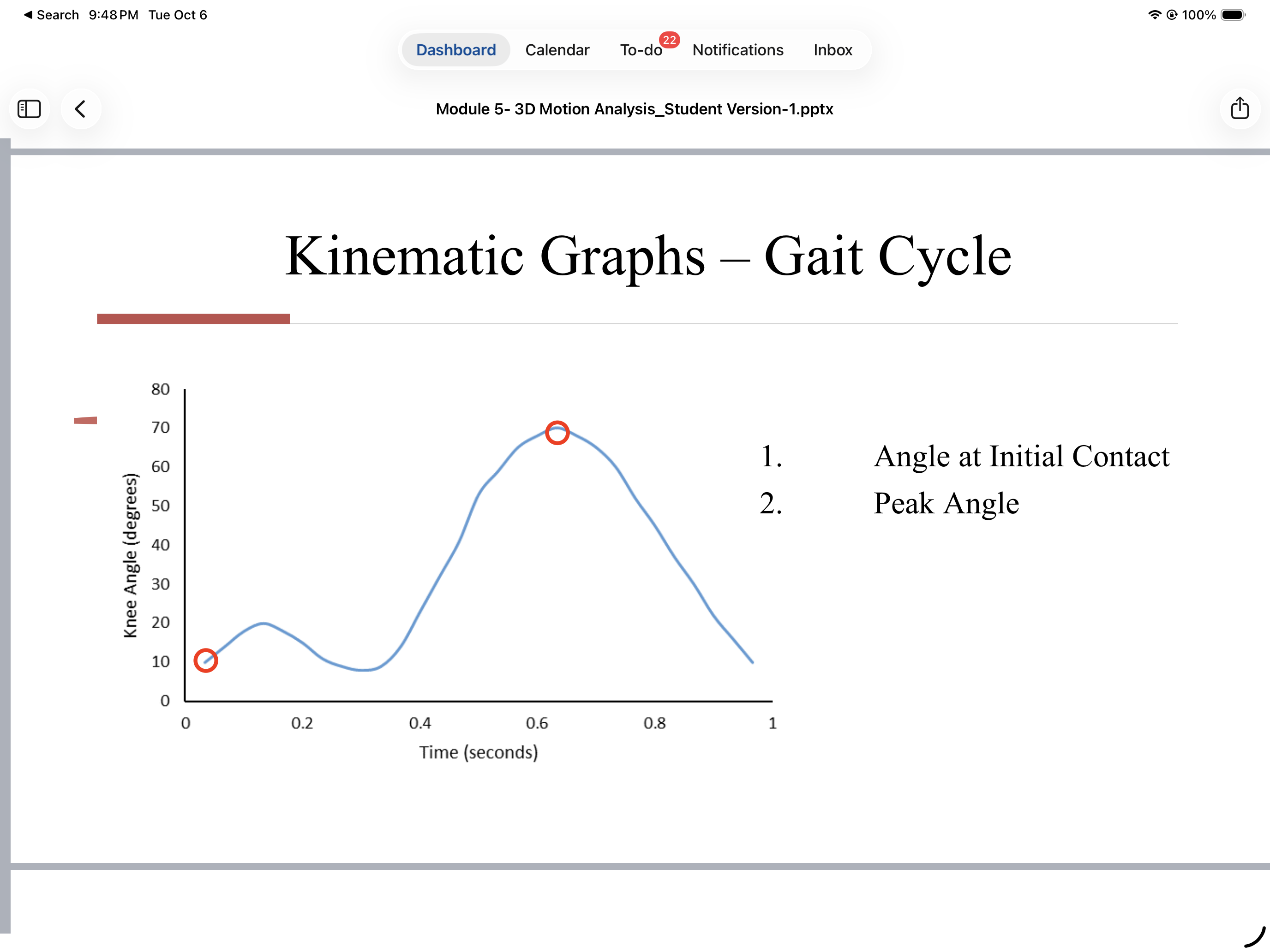
Angle at Initial Contact
Peak angle
10 degrees (Knee angle)
70 degrees

Angle at Initial contact
Peak angle
Angle at toe off
Angular excursion
6 degrees of hip adduction
10 degrees of hip adduction
6 degrees of hip abduction
10-(-6) = 16 degrees

Angle at Initial Contact
Peak angle
Angle at toe-off
Angular excursion
Mid stance
6 degrees of hip internal rotation
12 degrees of hip external rotation
10 degrees of hip external rotation
16 degrees
6 degrees of hip ER because its at 50%
Plug-in Gait Placement
Lower Limb:
1.R/L
2.R/L
3.R/L
4.R/L
5. R/L
6. R/L
Pelvis:
R/L:
R/L:
Thigh
Knee
Tibia
Toe
Ankle
Heel
Anterior superior iliac
Posterior superior iliac
Sacral