Communication + Predator-Prey Interactions
 Call Kai
 Learn
Learn Practice Test
 Spaced Repetition
 Match
Match Flashcards
 Knowt Play
1/102

There's no tags or description
Looks like no tags are added yet.
Name | Mastery | Learn | Test | Matching | Spaced | Call with Kai | Chat |
|---|
No analytics yet
Send a link to your students to track their progress
103 Terms
When does communication occur?
Communication occurs when a specialized signal from one individual influences behavior of another
Signal
An evolved trait that is selected for its effect on the behavior of a receiver (release of pheromones, aggressive dance); Signals are stimuli that affect behavior of a receiver
Cue
Unintentional info or a natural environmental feature that an observer happens to use to guide their behavior (scavenger following trail of another to find food)
Alarm calls
Signal to promote a defensive or evasive posture; used by many social species
What three conditions must be met to indicate that a signal is real?
-The fitness interests of the signaler and receiver are similar or the same (bees signaling food or mating calls)
-The signal cannot be faked (indication of size based on bark)
-Behavior is costly to upkeep or create (large horns on beetles)
Aposematic coloration
Brightly colored morphology in a species that stands out from the environment and is associated with noxious chemicals/poisons that make individuals dangerous or unpalatable
Types of Inaccurate Signaling
Batesian mimicry: Resemblance of a palatable mimic to an unpalatable model to predators have to learn to avoid (Butterflies)
Aggressive mimicry: a situation in which a predator mimics a nonthreatening model
S e x u a l deceptive hypothesis
Males will produce deceptive signals in order to enhance their own reproduction; males will make fake predator warnings to females attempting to leave their territory
Extended Phenotype signal
Signal expressed beyond the body of an individual that often includes modification of the environment
Communication Network
A system involving a signaler, receiver, and at least one bystander
Bystander
A third-party individual that detects a signal transmitted between a signaler and a receiver
Audience effect
Presence of a bystander influences the behavior of the signaler
Dear Enemy Hypothesis
Territory owners will show reduced aggressive interactions towards terrestrial neighbors compared to strangers, as territory owners become familiar with one another
Cryptic coloration
Morphological coloration that matches color of enticement to reduce diction by predators; differs from Batesian mimicry, as this morphology allows animals to blend in while Batesian makes them stand out
Vigilance behavior
A behavior in which an individual scans the environment for predators; reduces chances of being killed by a predator
Social group
A set of individuals that lie near and associate with one another
Dilution effect
Reduction in death probability because of association with others
Selfish herd behavior
Species will put other individuals between themselves and predators
Difference between Dilution Effect and Selfish Herd Hypothesis
Dilution is effective grouping and not an active choice, but a result of large numbers; selfish herd is how you position yourself to give yourself a better chance to eat
Predator harassment
Interaction with a predator to deter attack such as behavior involved in rapid movements, loud vocalization, throwing/kicking objects at the predator
Mobbing Behavior
Harassment of predator by two or more individuals
Alarm signal hypothesis
Hypothesis that advertisement behavior functions to warn nearby individuals of danger
Pursuit-deterrence hypothesis
Advertisement behavior informs a predator that has been detected and so pursuit is not likely to be successful
Move-on Hypothesis
Predator harassment function to cause a predator to abandon an area
Optimal diet model
Predicts food types an animal should include in its diet; 3 assumptions
-Foragers maximize fitness by maximizing energy intake rate
-Food items are encountered one at a time and in proportion to their abundance
-All food items in the environment can be ranked according to their profitability
Optimal foraging theory
Assumes that natural selection has favored feeding behaviors that maximize fitness
Handling time
Time it takes to manipulate a food item for eating
Specialist
Forager that has a narrow diet
Generalists
Forager that consumes a wide variety of items in its diet in proportion to their availability
Optimal patch-use model
Predicts how long a forager should exploit a food patch; 4 assumptions
-Foragers attempt to maximize energy intake rate
-All patches are identical
-Travel time between patches is constant
-As a forager depletes a patch, it has diminishing returns
Giving up density (GUD)
Density of food items in a food patch after being exploited by a forager; how much food is left
Producer
An individual in a group that searches for food
Scrounger
Individuals in a group that exploits the food discovered by others
Kleptoparasites
Organism that obtains (steals) food from another individual
Anisogamy
Males produce many small, motile gametes (sperm); females produce larger, nutrient rich, nonmotile gametes (egg)
Primary sexual characteristics
Differences in male and female genitals
Secondary sexual characteristics
Differences in male and females that are not tied to reproduction (plumage)
Sexual Selection
Advantages certain individuals have over others solely in respect of reproduction
Bateman’s Hypothesis
Female reproductive success is most strongly limited by number and success of eggs; male reproductive success is limited by number of mates he obtains
Parental investment theory
Predicts that the sex that pays the higher cost of parental investment should be choosier
Sex role-reversed species
Male selection can be a primary driver of secondary characteristics in females if males provide high levels of parental care
Sensory bias hypothesis
Female mating preferences are a byproduct of preexisting biases in a female’s sensory systems
Mating benefits
-Nuptial gifts: direct; passing nutrients to females or providing safe territory
-Good genes: indirect
Postcopulatory competition
Females mate with more than one male and the sperm of different males can compete to fertilize egg
Mate guarding
Male remains close to mate to prevent her from mating with rivals
Cryptic female choice
Species with internal fertilization females can mate with multiple males and then choose which sperm fertilizes her eggs
Which of the following is an example of an extended phenotype signal?
-Pheromone mimicry
-Aposematic coloration
-Waggle dance
-Mating nest
Mating nest
You discover a new species of spider, it has a large red hourglass on its abdomen, but you find out it has absolutely no venom and is nontoxic to eat (don’t ask). This new species is an example of all the following except:
-Batesian mimicry
-Aposematic coloration
-Dishonest communicator
-Signaler
Aposematic coloration
A common method of intraspecific communication that revolves around the use of varying sounds to warn others in your species are called…
Verlet alarm calls
What distinguishes a signal from a cue?
Signals have evolved to increase the fitness of their provider
When a predator mimics a nonthreatening model to lure in prey, it is called…
Aggressive mimicry
Which statement about vigilance behavior is TRUE?
-Animals exhibiting vigilant behavior in groups mate and feed as normal
-Vigilant behavior is decreased in the presence of predators
-Animals increase their vigilant behavior in larger group sizes
-Vigilant behavior comes as adaptive trade-offs with other behaviors
Vigilant behavior comes as adaptive trade-offs with other behaviors
Scientists classify animal behavior where they make distinct calls to warn one another with the…
Alarm signal hypothesis
Each of the following hypotheses can result from predator harassment behavior EXCEPT…
-Pursuit deterrence hypothesis
-Flash Disappearance hypothesis
-Move-on hypothesis
-Alarm signal hypothesis
Flash Disappearance hypothesis
Individuals in social groups…
-Decrease the chance they’ll be preyed upon by dilution effect
-Use mobbing behavior to remove other conspecifics from the group
-Feed more readily when on the outskirts of groups
-Increase their vigilant behavior
Decrease the chance they’ll be preyed upon by dilution effect
Cryptic coloration is distinguished from Batesian mimicry in that…
Batesian mimicry relies on the animal standing out to work
The selfish herd hypothesis finds that…
Animals often position themselves with other conspecifics closer to the predator
What assumption is shared by the optimal diet and patch-use models?
Animals make decisions to maximize their feeding efficiently (nutrients/time)
Which of the following does NOT affect handling time?
-Amount of nutrients made available by a food
-Amount of effort to open or consume food
-Animals learning a search image to locate food
-Animal’s ability to choose between two foods
Animal’s ability to choose between two foods
The Optimal Patch hypothesis states that…
Animals abandon food patches that still contain food because of decreased optimal diet through diminishing returns
A species of organisms that steals food from another species is known as a …
Kleptoparasite
Which of the following is NOT associated with the energetic costs of foraging?
-Handling Time
-Metabolic Rates
-Travel Time
-Scrounger Rates
Scrounger Rates
Bateman’s hypothesis predicts…
Relative parental investment leads to selectivity of mates in animals
Post copulation sexual selection does NOT include…
-Males guarding females to stop her from mating again
-Fighting of females within a harem for access to male’s territory
-Female spiders biasing the fertility of her eggs towards a higher quality male
-Males mating with females excessively to swamp the sperm of rival males
Fighting of females within a harem for access to male’s territory
The Sensory Bias Hypothesis states…
Mate choice feature preferences evolved from natural biases in animal’s senses towards similar stimuli
Mate Choice Copying…
Is advantageous because it allows inexperienced females to have a higher chance of choosing a high quality male with good genes
Which of the following does NOT constitute a direct benefit from mate choice?
-A nuptial gift packet
-Access to territory
-Good genes for offspring
-Access to food
Good genes for offspring
What is Giving Up-Density (GUD)?
The density of food items in a food patch after being exploited by a forager (how much is left)
How do relative environmental conditions affect the GUD of animals under the optimal patch theory?
Animals are actively assessing risk of predation/stressors in environment. Less stressful (warm environment, lack of predators) = lower GUD since they eat at location longer

What does this table say about the presence of predators and the effect of fear on GUD?
Animals respond to presence of predators by being cautious and will do so even if there is no predator signal
In a review of empirical work, Sih and Christensen (2001) found that the optimal
diet model better predicted the diets of animals that searched for immobile prey
like seeds or clams compared to the diets of animals that hunted mobile prey. What
assumptions of the model might best explain this finding?
Animals hunting mobile prey are not guaranteed to find/catch them, making foraging suboptimal; they need to eat something less efficient or easily available
Optimal diet: You record the diet selection of black-chinned hummingbirds in a
meadow for several weeks. Ten species of flowers are common in this field, but
hummingbirds only feed on seven of them and ignore the other three. After a
rainstorm, the abundance of one of the ignored flowers increases dramatically, and
the abundance of all the other flowers is severely lowered. Using the optimal diet
model, how do you think this change will affect the diet selection of the
hummingbirds?
They will begin to eat the previously ignored flower when necessary but will attempt to feed on the old ones in same proportions

Explain the optimal patch-use model and what the figure shows
Animals abandon food patch that still have food because of diminishing returns over time the more you eat, the less food there is. Animals consider energy required to find food and how much there is
What is the difference between a scrounger and a kleptoparasite? How do they
each affect food availability in an environment and the fitness of the community at
large?
Scroungers take food from producer, do not forage; Kleptoparasites are different species, stealing food from a larger species; have less of an effect on fitness of producers
The selfish herd hypothesis finds that…
Animals often position themselves with other conspecifics closer to the predator to decrease the chance of being preyed upon. This allows them to spend more energy on foraging or mating, instead of vigilance behavior
How is the selfish herd hypothesis different from the dilution effect?
The dilution effect is not an active choice but simply a decrease in the chance they’ll be preyed upon. It is a passive property of large groups while the selfish herd hypothesis is the choice of animals to increase their own survivability at the expense of others
When the size of a group often increases after a predator is spotted. What of the
above best explains this observation?
This is best explained by the dilution effect but if behaviors that require interaction with the predator are shown, it could instead be a defensive behavior (such as mobbing or predator harassment
As travel time between food patches increases…
Animals will spend more time eating before leaving the initial patch.
How does the amount of food items an animal eats affects its feeding efficiency?
Being a specialist decreases handling time, but increases search time; while being a generalist decreases search time and increases handling time
How do we know that animals use multiple sensory systems to enhance their foraging efficiency?
Animals which have particular senses removed will not be able to find food or do so slower. When experiments are conducted that include cues from different systems, (smell, color) animals increase speed at which they find food, and with more senses, the time increases.
What do scientists believe ties sensory systems and The Sensory Bias Hypothesis together?
Mate choice preferences evolved from natural biases in an animal’s senses toward a similar stimuli
The primary mechanisms of sexual selection come from…
-Mate competition
-Mate choice
-Post-mating behaviors (Mate guarding, cryptic female choice)
How does the difference in gametes produced by males and females cascade into
behavioral and secondary sexual characteristic differences?
Males invest less energy but increase their fitness by mating with lots of females. Females usually invest more by producing nutrient rich eggs, so their reproductive success is limited by quality of mates. These differences can create dimorphic traits.
Under what circumstances would you expect sexual selection to be more intense on females than on males?
Males are usually under more pressure, because females are the ones that are choosy. If it were the opposite, females would be the ones in competition. An example of this would be seahorses/pipefish where males choose the females; the male takes the eggs from the female and provides care for them. Females may exemplify mating dances or special features to attract males.
How is female mate choice copying evolutionary advantageous (which sex is it
advantageous for)?
Inexperienced females have a higher chance of choosing high-quality males with good genes by copying choice of another female. It is also advantageous for high-quality males since their fitness will be higher as they will fertilize many eggs.
How do mate guarding and cryptic female choice increase the fitness of their respective sex?
Mate guarding increases likelihood females will bare young of male, increasing his fitness and decreases chance he will have an extra child. This would decrease his fitness by not passing on his genes and raising a child that is not his.
Cryptic female choice is a bias for fertilization of eggs towards a particular male, increasing likelihood that her eggs get the sperm of a good male. Allows offspring to be more fit and increases her fitness overall.
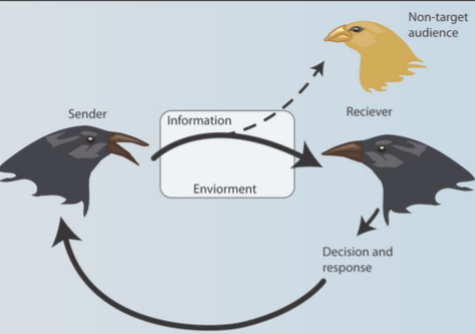
Why is this diagram known as a communication network?
Communication between individuals is often picked up by bystander species. This could be info gathering, or predators detecting prey; it is a network because multiple receivers listen for the signalers call.
What do the bystander and audience effect say about animals in communication networks?
Animals have evolved to be aware of presence of individuals that might be listening to their signals. Audience effect changes behavior of individual.
What do the non-target audience organisms get out of eavesdropping?
Predators pick up on presence of prey, and other species gather info such as cues about food or predators.
Why does the relationship between the signaler and receiver matter in
communications systems?
It determines fitness of each organism, and whether they agree or disagree. Also determines if communication should be honest or dishonest; predator-prey likely dishonest, within species = honest.
During the rainy season, a particular flower opens at night and releases the smell
of rotten meat. This draws in flies which feed off the nectar of the flower while also
pollinating the plant. Is this scent a signal or cue? Why? (What distinguishes a signal
from a cue?)
Signal; behavior of fly is what is being evolved to illicit by the signaler (plant). Signals have evolved to increase fitness of provider. Were it to be a cue, it would be unintentional information that the observer uses to guide their behavior.
Why are verlet alarm calls an honest signal indicator? What makes it being dishonest not evolutionary fit?
Communication and social interacts within a species happen many times and generally do not result in death of an animal. Dishonest communication is likely to be discovered over time, learned and then ignored. Rarely happens because fitness of both the signaler and receiver are in line survive the predator or find a mate.
Types of Honest and Dishonest signals
*Messages between receivers and signalers within the same fitness goals are more likely to be honest

What is the similarity and difference between Aposematic coloration and Batesian
Mimicry?
Similarity: They are both visual indicators sent by prey species to predators.
Difference: One of them is an honest indicator (aposematic) that tells a predator that you can die from eating me. The other is a dishonest signal (mimic) attempting to tell a predator they are harmful when they are otherwise delicious.
What are the two broad ways that prey animals avoid predation?
1) They camouflage and avoid moving to hide from predators (camouflage, mimicry, not moving)
2) they interact with predators to decrease their chance of being predated on (mobbing behavior, harassment of predators)
You find that a group of birds making calls and flapping their wings, possibly to a
predator. How could you tell which of the hypotheses from this chapter could help us
understand this behavior? How would you test these hypotheses?
We would need to place a fake predator to see if their responses are consistent towards something that is threatening (find the stimuli). You will need to survey the area and record behaviors to determine the source. It could be merely social.
-Alarm signal: There should be consistent vocalizations only around others of the species and when the predator is visible.
-Pursuit-deterrence: Looking at the predator to establish it’s been spotted. Movement around the placement of the predator.
-Move-on: Harassment and movement of the individual or group towards the predator. Behavior is only shown in the presence of a threat.
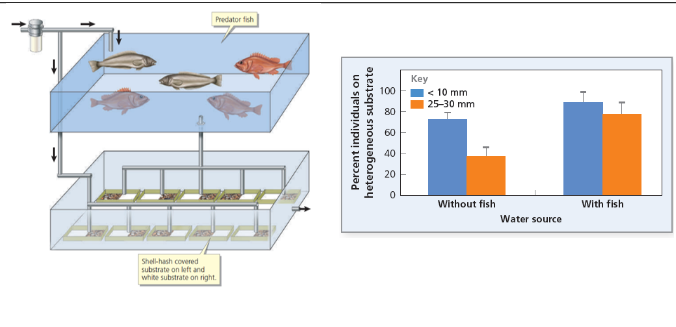
What do the experiment and figure say about the behavior of cryptic prey in the presence of predators and what does it say about the effect of prey size?
Cryptic prey are aware of the type of material they blend in with. In the presence of a signal of a predator, they will hide amongst their matching substrate in an attempt to hide. Larger organisms which are less likely to be predated on are more likely to remain in the open. Smaller animals may hide even if there is no signal of predators because other things might eat them, cautious.
Explain how frequency-dependent selection would act on a Batesian mimic
Batesian mimicry is an inaccurate signal which means that it is based on deception. Predators learn to find cryptic and misleading prey over time, if there are more Batesian mimics, frequency increases. Fitness will decrease and ability of mimic to survive; predator will learn to distinguish real threats from mimic
Why are signals, such as horns, more likely to be honest indicators than inaccurate?
They are expensive and require energy and resources to maintain, hinting that the organism is of high quality. High energy traits are hard to maintain, so they are hard to fake.
Identify the conditions that can favor the evolution of inaccurate signals
Inaccurate signals evolve when the signaler and receiver have different fitness goals, such as predator and prey. Deception evolves to allow survival of the prey (Batesian mimic) or the capture of prey by the predator (aggressive mimicry).