MAE 570 Intermediate Thermodynamics Exam 2 Concept Review
 Call Kai
 Learn
Learn Practice Test
 Spaced Repetition
 Match
Match Flashcards
 Knowt Play
1/47

There's no tags or description
Looks like no tags are added yet.
Name | Mastery | Learn | Test | Matching | Spaced | Call with Kai | Chat |
|---|
No analytics yet
Send a link to your students to track their progress
48 Terms
Carnot Vapor Cycle
Most efficient cycle operating between two specified temperature limits
Isothermal heat addition in boiler: limited heat transfer processes to two-phase systems severely limits max temp in cycle
Isentropic expansion in turbine: cannot handle steam with high moisture content
Isentropic compression: not practical for two phases

Rankine Cycle
1 → 2 Isentropic compression in pump
2 → 3 Isobaric heat addition in boiler
3 → 4 Isentropic expansion in turbine
4 → 1 Isobaric heat rejection in condenser

Rankine Cycle Benefits
Superheats steam in boiler, completely condensed in condenser
Ideal for vapor power plants
No internal irreversibilities
Eliminates impracticalities associated with Carnot cycle
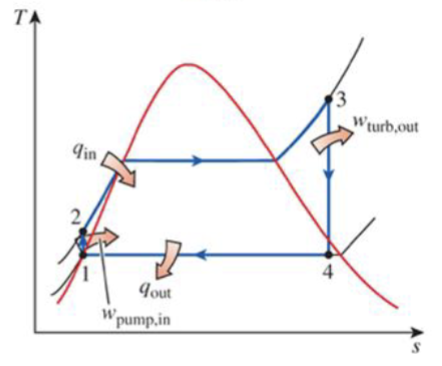
Efficiency of Ideal Rankine Cycle
ηRankine = wnet/qin = 1 - (qout)/(qin)
Isentropic Efficiency of Pump
η_p = w_s/w_a = (h2s - h1)/(h2a-h1)
Isentropic Efficiency of Turbine
η_t = w_a/w_s = (h3-h4a)/(h3 - h4s)
Ideal Rankine vs. with Irreversibilities
For the same system with isentropic efficiencies added: quality of the steam @ turbine exit increases, net work done per unit mass decreases, thermal efficiency decreases, and steam mass flow rate increases
Ways to Increase Rankine Cycle Efficiency
Increase the average temperature at which heat is transferred to the working fluid in the boiler
Decrease the average temperature at which heat is rejected form the working fluid in the condenser
Lower the pressure of the condenser (increases moisture content of the steam in the turbine though)
Superheating steam in the boiler (limited by metallurgical considerations)
Increasing pressure of the boiler (increases moisture content of the steam in the turbine though)
Turbine moisture can be corrected by reheating steam
Operate at supercritical pressure (P > 22.06 MPa)

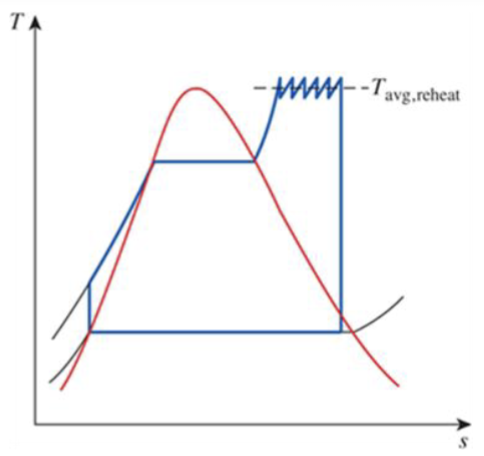
Ideal Reheat Rankine cycle
Superheat steam to very high temperatures (limited metallurgically)
Expand the steam in the turbine in two stages with reheating in between
ηRankine = wnet/qin = 1 - (qout)/(qin)
Single reheat in a modern power plant can improve efficiency by 4-5%

Multi-Stage Reheat Rankine Cycle
Increases average temperature during reheat process
Impractical to use more than 2 reheat stages
Theoretical efficiency from second reheat = ½ of that of single reheat
Ideal Regenerative Rankine Cycle
Steam extracted from turbine at various points to heat feedwater
Feedwater heater (FWH) or regenerator heats feedwater
FWH = HX where heat is transferred from steam to feedwater by mixing two fluid streams (open FWH) or without mixing them (closed FWH)


Open Feedwater Heater (FWH)
Mixing chamber that mixes steam extracted from the turbine with feedwater exiting the pump
Ideally, mixture leaves the heater as a saturated liquid at the heater pressure

Open Feedwater Heater (FWH) Performance
y = ṁ6/ṁ5
qin = h5 - h4
qout = (1-y)(h7-h1)
wt = (h5 - h6) + (1-y)(h6 - h7)
wp = [(1-y)(h2 - h1)]pump 1 + (h4 - h3)pump 2
![<ul><li><p>y = ṁ<sub>6</sub>/ṁ<sub>5</sub></p></li><li><p>q<sub>in </sub>= h<sub>5</sub> - h<sub>4</sub></p></li><li><p>q<sub>out</sub> = (1-y)(h<sub>7</sub>-h<sub>1</sub>)</p></li><li><p>w<sub>t</sub> = (h<sub>5</sub> - h<sub>6</sub>) + (1-y)(h<sub>6</sub> - h<sub>7</sub>)</p></li><li><p>w<sub>p</sub> = [(1-y)(h<sub>2</sub> - h<sub>1</sub>)]<sub>pump 1</sub> + (h<sub>4</sub> - h<sub>3</sub>)<sub>pump 2</sub></p></li></ul><p></p>](https://assets.knowt.com/user-attachments/910f58aa-2d7e-420d-9fef-511a428185cd.png)

Closed Feedwater Heater (FWH)
Heat transferred from extracted stream to feedwater with no mixing taking place
Streams can be at different prssures, since they do not mix

Closed Feedwater Heater (FWH) Performance
y = ṁ7/ṁ6
qout = h6 - h5
qout = (1-y)(h8-h1)
wt = (h6 - h7) + (1-y)(h7 - h8)
wp = [(1-y)(h2 - h1)]pump 1 + [(y)(h4 - h3)]pump 2
![<ul><li><p>y = ṁ<sub>7</sub>/ṁ<sub>6</sub></p></li><li><p>q<sub>out</sub> = h<sub>6</sub> - h<sub>5</sub></p></li><li><p>q<sub>out</sub> = (1-y)(h<sub>8</sub>-h<sub>1</sub>)</p></li><li><p>w<sub>t</sub> = (h<sub>6</sub> - h<sub>7</sub>) + (1-y)(h<sub>7</sub> - h<sub>8</sub>)</p></li><li><p>w<sub>p</sub> = [(1-y)(h<sub>2</sub> - h<sub>1</sub>)]<sub>pump 1</sub> + [(y)(h<sub>4</sub> - h<sub>3</sub>)]<sub>pump 2</sub></p></li></ul><p></p>](https://assets.knowt.com/user-attachments/33a7a699-b9ab-4c53-a4d9-48baeac44d34.png)
Combining Open and Closed FWH

Process Heat
A type of heat input required by industries. Process heat usually supplied by steam at 5 to 7 atm and 150 to 200ºC. Energy typically transferred to steam by burning coal, oil, natural gas, or another fuel in a furnace.
Cogeneration
Produces more than one useful form of energy (i.e. process heat and electric power) from the same energy source
Utilizes already-existing work potential to produce power (rather than wasting it)
Produces electricity while meeting process-heat requirements of certain industrial processes

Utilization Factor
εu = (Ẇnet + Q̇P)/Q̇in
For ideal steam-turbine cogeneration plant: 100%
Actual plants have εu up to 80%
Cogeneration Energy Balance
Q̇in = ṁ3(h4 - h3) (heat supplied in boiler)
Q̇out = ṁ7(h7 - h1) (heat rejected in condenser)
Q̇P = ṁ5h5 + ṁ6h6 - ṁ8h8 (processed heat)
Ẇnet = (ṁ4 - ṁ5)(h4 - h6) + ṁ7(h6 - h7) (work done by turbine)


Combined Gas-Vapor Cycle
Combines Brayton and Rankine cycles, resulting in a higher thermal efficiency than either of the cycles individually
Uses high-temperature exhaust gases from gas turbine as energy source for bottoming cycle
Increases efficiency without significant increases in initiial cost
Recent turbine developments made combine cycle much more economically attractive

Clausius Statement
Heat cannot flow spontaneously from a colder body to a warmer body without external work
Implication: a refrigerator cannot operate unless its compressor is driven by an external power source (i.e. electric motor)
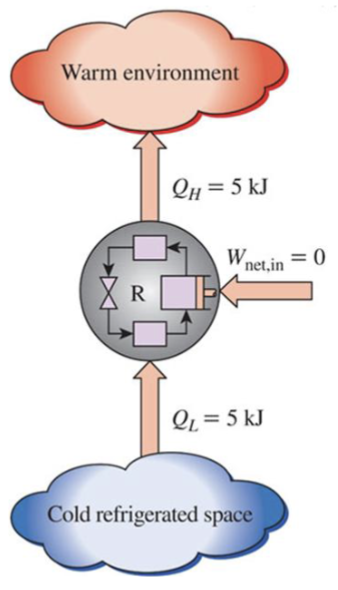
Refrigerator
The transfer of heat from lower-temperature regions to higher temperature ones

Heat pump
Type of refrigerator that is used to heat a space by transferring heat from a cooler medium

Coefficient of Performance (COP)
Quantifies performance of refrigerators and heat pumps
COPHP = COPR + 1
Refrigerator COP
COPR = (desired output)/(required input) = (cooling effect)/(work input) = QL / Wnet
Heat Pump COP
COPHP = (desired output)/(required input) = (heating effect)/(work input) = QH / Wnet
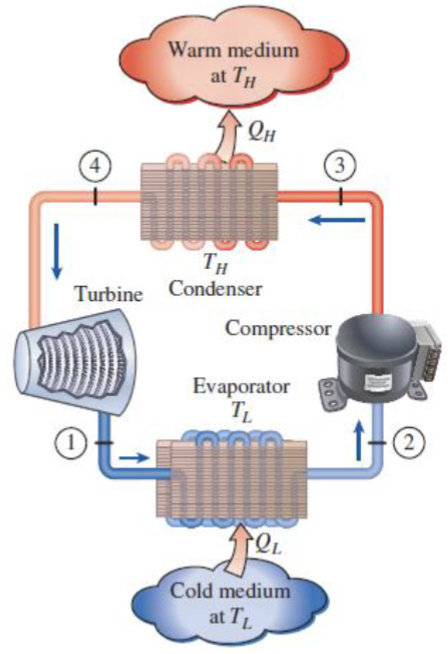
Reversed Carnot Cycle
Reverses order of regular Carnot cycle, including directions and heat/work interactions
Counterclockwise on T-s diagram
Most efficient refrigeration Cycle Operating between TL and TH, but not a suitable model in reality
2 → 3 involves the compression of a liquid-vapor mixture (two phase compressor needed)
4 → 1 involves the expansion of a high-moisture content refrigerant in a turbine
COP of Carnot refrigerator: COPR = (QL)/(QH - QL) = (TL)/(TH - TL)

Ideal Vapor-Compression Refrigeration Cycle Traits
Vaporizes refrigerant completely before compressing
Replaces turbine with throttling device (i.e. expansion valve or capillary tube)
Most widely used cycle for refrigerators, AC, and heat pumps
Ideal Vapor-Compression Refrigeration Cycle
1 → 2 Isentropic compression (compressor)
2 → 3 Isobaric heat rejection (condenser)
3 → 4 Isenthalpic Throttling (expansion device)
4 → 1 Isobaric heat absorption (evaporator)
COP of Vapor Compression Cycle
qL = h1 - h4
qH = h2 - h3
wnet = h2 - h1
COPR = qL/wnet = (h1 - h4)/(h2 - h1)
COPHP = qH/wnet = (h2 - h3)/(h2 - h1)

Actual Vapor Compression Cycle (Irreversibilities)
Non-isentropic compression
Superheated vapor at evaporator exit
Subcooled liquid at condenser exit
Pressure drops in condenser and evaporator

Ideal Vapor Compression vs. with Irreversibilities
For the same system with isentropic efficiencies added: more heat absorbed in evaporator, more heat rejected in condenser, more net work done per unit mass of refrigerant, lower COP, (slightly) lower refrigerant mass flow rate
Selecting a Refrigerant
Typically chlorofluorocarbons (CFCs), HFCs, HCFCs, ammonia, hydrocarbons, carbon dioxide, air, or even water
Need to consider temperature of refrigerated space and environment
Ammonia very low on global warming potential (GWP) and ozone depletion potential (ODP) but is very toxic
Ozone Depletion Potential (ODP)
Relative amount of degradation to the ozone layer that it can cause, R-11 fixed at an ODP of 1.0
Global Warming Potential (GWP)
Measure of how much heat a greenhouse gas traps in the atmosphere over a specific time period, relative to carbon dioxide (CO2)
Heat Pump Systems
Energy source usually atmospheric air (air-to-air system)
Higher COP, but more expensive to install: Water-source systems (well water) or ground-source (geothermal)
Capacity and efficiency of heat pumps falls significantly at low temperatures, so usually a supplementary heating system rewuired
Heat pumps most competitive in areas that have a large cooling load during the cooling season and a relatively small heating load during the heating season (i.e. Arizona)


Cascade Refrigeration System
Moderately low temperatures required for some industrial applications, temp range may be too large for a simple vapor-compression cycle
Improves COP of refrigeration system
Up to 3-4 systems of cascading


Multistage Compression System
When the fluid throughout the cascade refrigeration system is the same
Heat exchanger replaced by mixing chamber (or flash chamber)
Better heat transfer characteristics

Energy Balance in Cascading Systems
Q̇L= ṁB(h1 - h4) (heat absorbed in evaporator)
Q̇H = ṁA(h6 - h7) (heat rejected in condenser)
Q̇tr = ṁB(h2 - h3) = ṁA(h5 - h8) (heat transferred in HX)
Ẇnet = ṁB(h2 - h1) + ṁA(h6 - h5) (total work input)
COPR = Q̇L/Ẇnet

Energy Balance in Multistage Compression System
Q̇L= (1 - y)(h1 - h8) (heat absorbed in evaporator)
Q̇H = (h4 - h5) (heat rejected in condenser)
h6 = y(h3) + (1 - y)h7
h9 = y(h3) + (1 - y)h2
Ẇnet = (1 - y)(h2 - h1) + (h4 - h9) (total work input)
COPR = Q̇L/Ẇnet


Multipurpose Refrigeration System
Allows for refrigeration at more than one temperature
Routes all exit streams from evaporators to a single compressor to let it handle the compression process for the entire system

Energy Balance in Multipurpose Refrigeration System
Q̇L= Q̇L,R + Q̇L,F = (h5 - h4) + (h1 - h6) (heat absorbed in refrigerator and freezer)
Q̇H = h2 - h3 (heat rejected in condenser)
Ẇnet = h2 - h1 (total work input)
COPR = Q̇L/Ẇnet

Gas Refrigeration Cycle
Also known as reversed Brayton cycle
Lower COPs relative to the vapor compression refrigeration cycles or reversed Carnot cycle
Involve simpler, lighter components, suitable for aircraft cooling
Can also incorporate regeneration
COPR = qL/wnet = (h1 - h4)/[(h2 - h1) - (h3 - h4)]
![<ul><li><p>Also known as reversed Brayton cycle</p></li><li><p>Lower COPs relative to the vapor compression refrigeration cycles or reversed Carnot cycle</p></li><li><p>Involve simpler, lighter components, suitable for aircraft cooling</p></li><li><p>Can also incorporate regeneration</p></li><li><p>COP<sub>R</sub> = q<sub>L</sub>/w<sub>net</sub> = (h<sub>1</sub> - h<sub>4</sub>)/[(h<sub>2</sub> - h<sub>1</sub>) - (h<sub>3</sub> - h<sub>4</sub>)]</p></li></ul><p></p>](https://assets.knowt.com/user-attachments/953c531a-5b8d-47af-92ce-8ae0d97149d6.png)

Gas Refrigeration Cycle with Regeneration
Can decrease the lowest temperature of the cycle, achieving extremely low temperatures
Further cools high-pressure gas to T4 before expanding in the turbine

Absorption Refrigeration
Economic when there is a source of inexpensive thermal energy at a temp of 100-200ºC
Can use geothermal energy, solar energy, and waste heat from cogeneration or process
Involve the absorption of a refrigerant by a transport medium (commonly ammonia and water)
Liquid is compressed instead of a vapor, resulting in negligible work input for the cycle
Complicated, large, much less efficient, more difficult to service
Only considered for large industrial/commercial applications where the unit cost of thermal energy is low relative to electricity
COPmax = (1 - T0/Ts)*[TL/(T0 - TL)]
![<ul><li><p>Economic when there is a source of inexpensive thermal energy at a temp of 100-200ºC</p></li><li><p>Can use geothermal energy, solar energy, and waste heat from cogeneration or process</p></li><li><p>Involve the absorption of a refrigerant by a transport medium (commonly ammonia and water)</p></li><li><p>Liquid is compressed instead of a vapor, resulting in negligible work input for the cycle</p></li><li><p>Complicated, large, much less efficient, more difficult to service</p></li><li><p>Only considered for large industrial/commercial applications where the unit cost of thermal energy is low relative to electricity</p></li><li><p>COP<sub>max</sub> = (1 - T<sub>0</sub>/T<sub>s</sub>)*[T<sub>L</sub>/(T<sub>0</sub> - T<sub>L</sub>)]</p></li></ul><p></p>](https://assets.knowt.com/user-attachments/7155dadb-7f4f-4e47-8d92-4a260d5659c5.png)
Compressed Liquid Approximation
For compressed liquid @ pressure P & temperature T:
h ≈ h_f @ T
Formula for Compressed Liquid Enthalpy Value Through a Pump
h2 = h1 + v2(P2 - P1)