Biology Chapter 15 review (2)
 Call Kai
 Learn
 Practice Test
 Spaced Repetition
 Match
 Flashcards
 Knowt Play
1/66

Earn XP
Description and Tags
Genes & Proteins
67 Terms
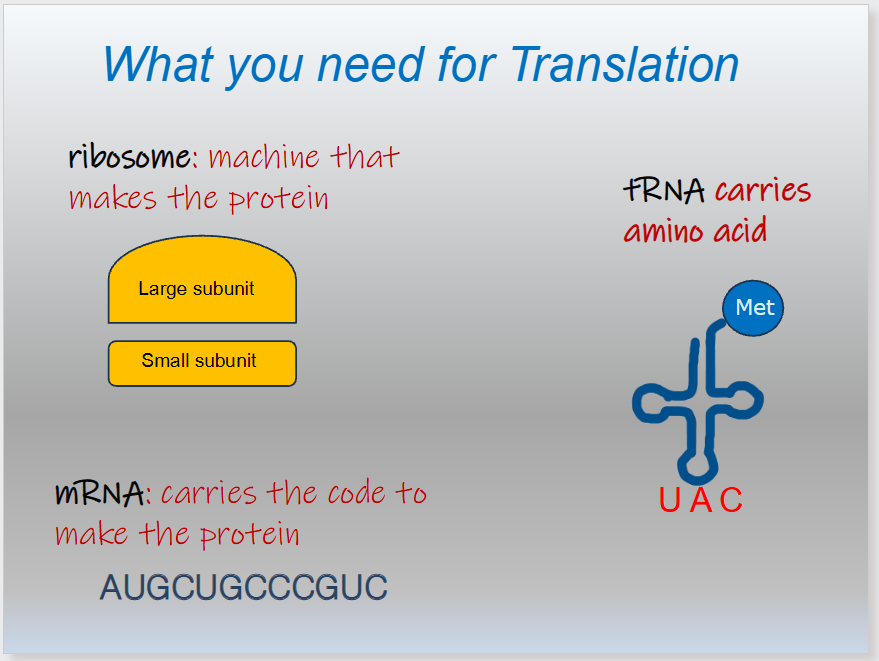
What you need for Translation
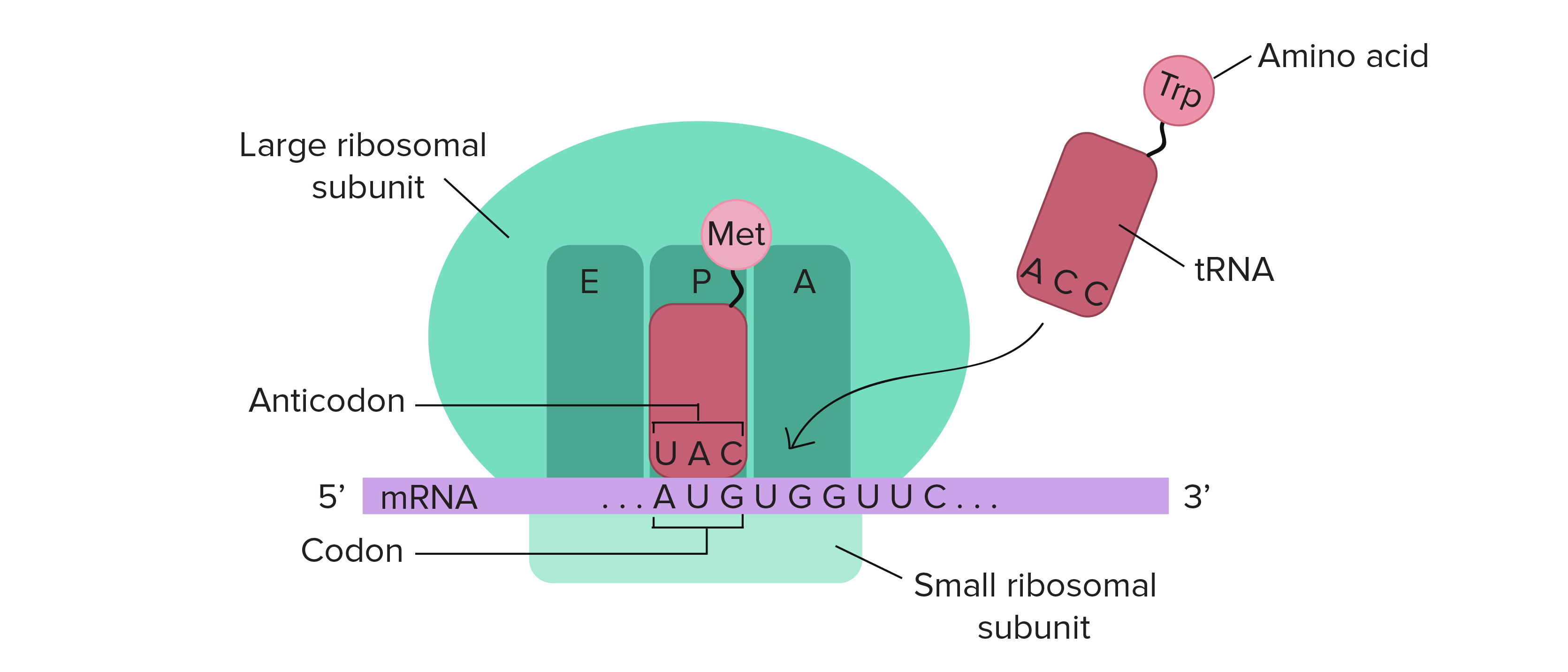
Ribosome: machine that makes the protein (large and small subunit)
mRNA: carries the code (codon) to make the protein
tRNA: carries amino acid

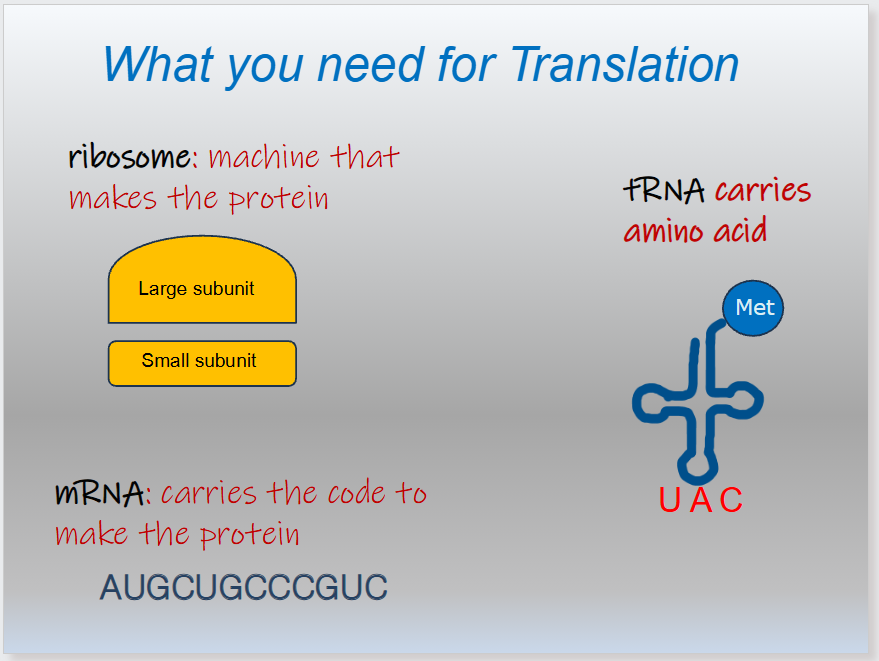
What you need for translation
Ribosome: machine that makes the protein (large and small subunit)
mRNA: carries the code (codon) to make the protein
tRNA: carries amino acid
What you need for Translation
Translation is the process of decoding an mRNA (messenger RNA) sequence into a polypeptide chain (protein)
mRNA Template: the single-stranded message transcribed from DNA that contains the triplet codon sequence (read in 5'→ 3' direction). It begins with the start codon AUG (methionine) and ends with a stop codon (UAA, UAG, or UGA)
Ribosomes: macromolecular machines composed of rRNA (ribosomal RNA) and proteins. They consist of a small subunit (which binds the mRNA) and a large subunit (which catalyzes peptide bond formation). Ribosomes contain three active tRNA-binding sites:
Transfer RNA (tRNA): Adaptor molecules that bridge nucleic acids to amino acids. Each tRNA has:
An anticodon loop (3'→ 5' triplet) complementary to the mRNA codon (5'→ 3')
An amino acid attachment site at the 3' end
Ribosome: machine that makes the protein (large and small subunit)
mRNA: carries the code (codon) to make the protein
tRNA: carries amino acid

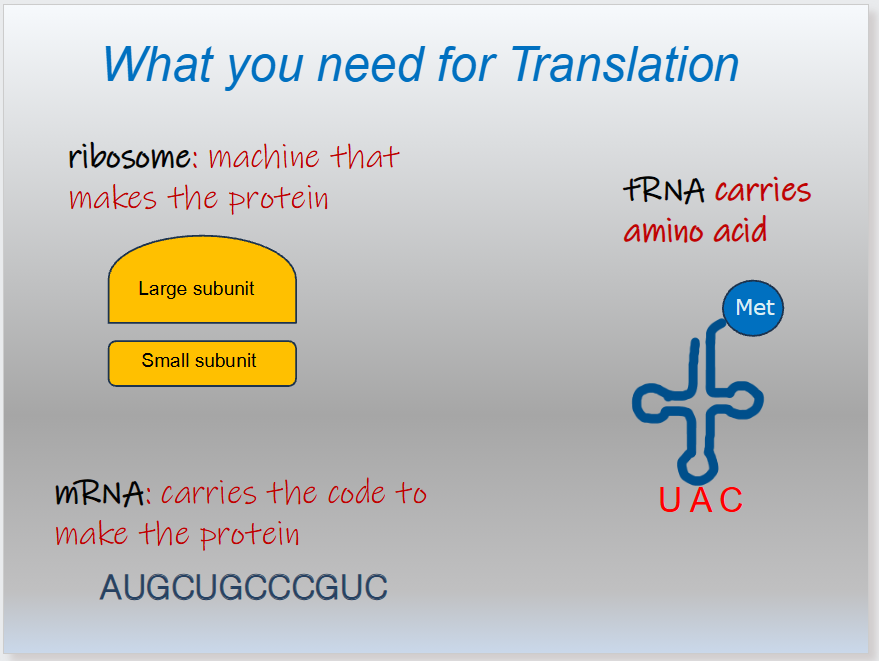
What you need for Translation:
Translation is the process by which a cell's ribosomes read the nucleotide sequence of a messenger RNA (mRNA) molecule and assemble a corresponding polypeptide (protein) chain of amino acids
mRNA (Messenger RNA) Template: the single-stranded transcript containing the coded genetic message read in triplet codons
Ribosomes: macromolecular machines composed of ribosomal RNA (rRNA) and proteins, divided into a small subunit (which binds mRNA) and a large subunit (which catalyzes peptide bond formation). They contain three critical active sites
tRNA (Transfer RNA) Molecules: adaptor molecules featuring a 3-nucleotide anticodon complementary to an mRNA codon on one end and a specific amino acid attachment site on the other
Ribosome: machine that makes the protein (large and small subunit)
mRNA: carries the code (codon) to make the protein
tRNA: carries amino acid
What you need for translation:
Translation is the process by which a cell's ribosomes read the nucleotide sequence of a messenger RNA (mRNA) molecule and assemble a corresponding polypeptide (protein) chain of amino acids
Specific molecular components, energy, and a set of sequential steps to convert an mRNA template into a polypeptide chain
mRNA (Messenger RNA): the template carrying the genetic code read in triplet sequences called codons (starting with the start codon
AUG, which codes for methionine)Ribosomes: macromolecular complexes made of rRNA (ribosomal RNA) and proteins, consisting of a small and large subunit
tRNA (Transfer RNA): adaptor molecules that have a 3-nucleotide anticodon complementary to an mRNA codon on one end and a specific amino acid attached to the other
Ribosome
A non-membrane-bound molecular complex composed of ribosomal RNA (rRNA) and proteins. It serves as the physical site of translation in both prokaryotic and eukaryotic cells, decoding messenger RNA (mRNA) sequences into polypeptide (protein) chains
A non-membrane-bound molecular complex composed of ribosomal RNA (rRNA) and proteins that serves as the site of protein synthesis in all living cells
Ribosomes: machines that make the protein
A ribosome is a non-membrane-bound cellular structure composed of ribosomal RNA (rRNA) and proteins that serves as the molecular machine for translation
Structure: Consists of two distinct subunits (a large subunit and a small subunit) that assemble around an mRNA strand
Prokaryotes: 70S ribosomes
Eukaryotes: 80S ribosomes
Contains three vital tRNA-binding slots:
A site (Aminoacyl): receives the incoming charged tRNA
P site (Peptidyl): holds the tRNA carrying the growing polypeptide chain
E site (Exit): where the uncharged (empty) tRNA exits the ribosome

Ribosome
A non-membrane-bound molecular complex composed of ribosomal RNA (rRNA) and proteins. It serves as the physical site of translation in both prokaryotic and eukaryotic cells, decoding messenger RNA (mRNA) sequences into polypeptide (protein) chains
Ribosomes: machines that make the protein
A ribosome is a non-membrane-bound cellular structure composed of ribosomal RNA (rRNA) and proteins that serves as the molecular machine for translation
Structure: Consists of two distinct subunits (a large subunit and a small subunit) that assemble around an mRNA strand
Prokaryotes: 70S ribosomes
Eukaryotes: 80S ribosomes
Contains three vital tRNA-binding slots:
A site (Aminoacyl): receives the incoming charged tRNA
P site (Peptidyl): holds the tRNA carrying the growing polypeptide chain
E site (Exit): where the uncharged (empty) tRNA exits the ribosome

Large ribosomal subunit
The larger half of a ribosome responsible for catalyzing peptide bond formation during protein synthesis (translation). Made of ribosomal RNA (rRNA) and proteins, it joins with the small ribosomal subunit around a strand of messenger RNA (mRNA) to build polypeptide chains
the larger half of a ribosome responsible for joining amino acids together into a polypeptide chain during protein synthesis (translation). Made of ribosomal RNA (rRNA) and proteins, it acts as a ribozyme (an RNA enzyme) by catalyzing the formation of covalent peptide bonds
the large ribosomal subunit is the bigger of the two ribonucleoprotein complexes that make up a ribosome. Its primary role during translation is to catalyze the formation of peptide bonds between amino acids to build a polypeptide chain

Large ribosomal subunit
The larger half of a ribosome responsible for catalyzing peptide bond formation during protein synthesis (translation). Made of ribosomal RNA (rRNA) and proteins, it joins with the small ribosomal subunit around a strand of messenger RNA (mRNA) to build polypeptide chains
the larger half of a ribosome responsible for joining amino acids together into a polypeptide chain during protein synthesis (translation). Made of ribosomal RNA (rRNA) and proteins, it acts as a ribozyme (an RNA enzyme) by catalyzing the formation of covalent peptide bonds
the larger of the two macromolecular complexes that form a functional ribosome, composed of ribosomal RNA (rRNA) and proteins. Its primary role during protein synthesis (translation) is to catalyze the formation of peptide bonds between adjacent amino acids to build a polypeptide chain

Small ribosomal subunit
The smaller of the two molecular complexes—composed of ribosomal RNA (rRNA) and proteins—that make up a functional ribosome. Its primary role during protein synthesis (translation) is to bind to messenger RNA (mRNA) and decode its genetic sequence so that the correct amino acids are assembled
the smaller of the two molecular complexes—composed of ribosomal RNA (rRNA) and proteins—that make up a functional ribosome. Its primary role during protein synthesis (translation) is to bind messenger RNA (mRNA) and decode the genetic message by ensuring accurate base-pairing between mRNA codons and transfer RNA (tRNA) anticodons
Initiation of Translation: the small subunit is the first component to bind to the mRNA transcript. It scans the mRNA (or uses specific rRNA-mRNA interactions in prokaryotes) to locate the start codon (AUG) and establish the correct reading frame
Decoding Genetic Information: once the initiator tRNA binds to the start codon and the large subunit joins to form a complete ribosome, the small subunit acts as the "decoding center". It verifies that each incoming tRNA anticodon matches the exposed mRNA codon before a peptide bond is formed

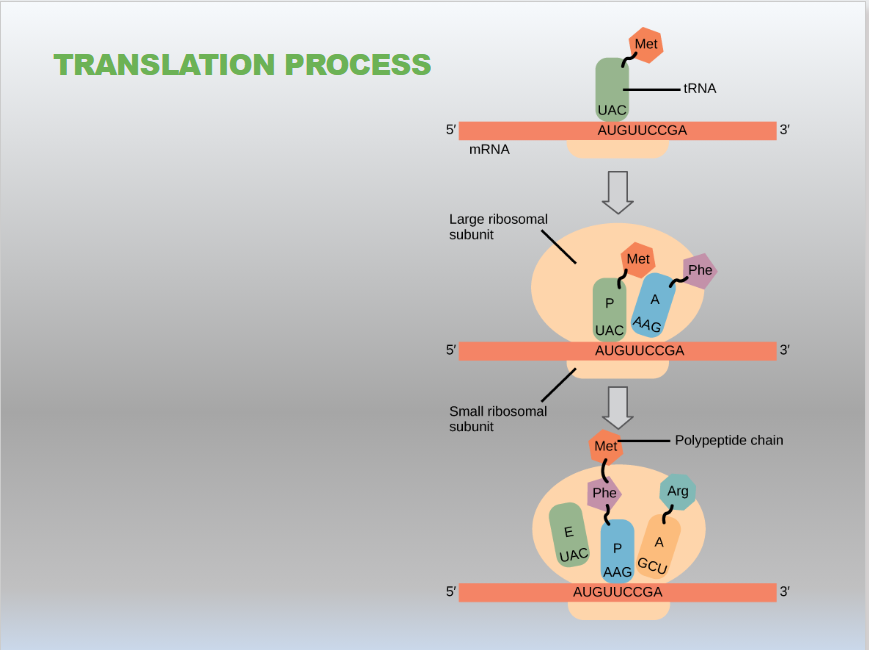
Ribosome tRNA binding sites
During protein translation, the ribosome contains three tRNA-binding sites located in the large subunit that coordinate the delivery of amino acids and the growth of a polypeptide chain
A site (Aminoacyl site): the entry point where an incoming charged tRNA (aminoacyl-tRNA) first binds, matching its anticodon to the current mRNA codon
P site (Peptidyl site): the location holding the peptidyl-tRNA, which is the tRNA attached to the growing polypeptide chain. Here, a peptide bond forms between the new amino acid in the A site and the existing chain
E site (Exit site): the final site where the empty (uncharged) tRNA resides briefly before it detaches from the ribosome and returns to the cytoplasm to pick up another amino acid

Ribosome tRNA binding sites
During translation in protein synthesis, the ribosome contains three tRNA binding sites located on the large subunit that coordinate the movement of transfer RNA (tRNA) and the growth of the polypeptide chain
During protein translation, the ribosome contains three tRNA-binding sites located in the large subunit that coordinate the delivery of amino acids and the growth of a polypeptide chain
A site (Aminoacyl site): the entry point where an incoming charged tRNA (aminoacyl-tRNA) first binds, matching its anticodon to the current mRNA codon
P site (Peptidyl site): the location holding the peptidyl-tRNA, which is the tRNA attached to the growing polypeptide chain. Here, a peptide bond forms between the new amino acid in the A site and the existing chain
E site (Exit site): the final site where the empty (uncharged) tRNA resides briefly before it detaches from the ribosome and returns to the cytoplasm to pick up another amino acid
Large vs. Small ribosomal subunit
Ribosomes are made of two main parts: a small ribosomal subunit and a large ribosomal subunit. They work together to turn messenger RNA (mRNA) into proteins during a process called translation
Small Ribosomal Subunit
Primary Role: decodes the genetic message by reading the mRNA codons and matching them with the right transfer RNA (tRNA) anticodons
Prokaryotes (Bacteria & Archaea): known as the 30S subunit
Eukaryotes: known as the 40S subunit
Large Ribosomal Subunit
Primary Role: Acts as the catalytic center that forms peptide bonds between amino acids to build a growing protein chain.
Prokaryotes (Bacteria & Archaea): known as the 50S subunit
Eukaryotes: known as the 60S subunit

Large vs. Small ribosomal subunit
A ribosome consists of two separate subunits (a large and a small subunit) made of ribosomal RNA (rRNA) and proteins that lock together during translation to synthesize proteins
Ribosomes are made of two main parts: a small ribosomal subunit and a large ribosomal subunit. They work together to turn messenger RNA (mRNA) into proteins during a process called translation
Small Ribosomal Subunit
Primary Function: acts as the decoding unit. It binds to the mRNA template and matches mRNA codons with the correct incoming tRNA anticodons to ensure accurate genetic information flow
Eukaryotes: 40S subunit
Prokaryotes: 30S subunit
Large Ribosomal Subunit
Primary Function: acts as the catalytic unit. It holds the tRNA molecules and contains the peptidyl transferase center (acting as a ribozyme) to catalyze peptide bond formation, linking amino acids into a growing polypeptide chain. It also features the A, P, and E sites for tRNA movement
Eukaryotes: 60S subunit (combines with 40S to form an 80S ribosome)
Prokaryotes: 50S subunit (combines with 30S to form a 70S ribosome)
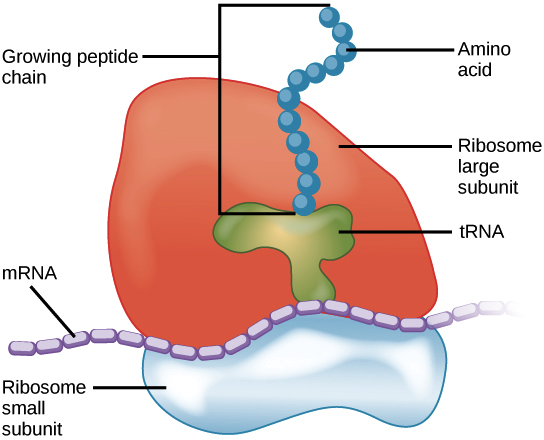
Large vs. Small ribosomal subunit
A ribosome consists of two separate subunits (a large and a small subunit) made of ribosomal RNA (rRNA) and proteins that lock together during translation to synthesize proteins
Ribosomes are made of two main parts: a small ribosomal subunit and a large ribosomal subunit. They work together to turn messenger RNA (mRNA) into proteins during a process called translation
Small Ribosomal Subunit
Primary Function: acts as the decoding unit. It binds to the mRNA template and matches mRNA codons with the correct incoming tRNA anticodons to ensure accurate genetic information flow
Eukaryotes: 40S subunit
Prokaryotes: 30S subunit
Large Ribosomal Subunit
Primary Function: acts as the catalytic unit. It holds the tRNA molecules and contains the peptidyl transferase center (acting as a ribozyme) to catalyze peptide bond formation, linking amino acids into a growing polypeptide chain. It also features the A, P, and E sites for tRNA movement
Eukaryotes: 60S subunit (combines with 40S to form an 80S ribosome)
Prokaryotes: 50S subunit (combines with 30S to form a 70S ribosome)

mRNA
A single-stranded RNA molecule that is transcribed from a DNA template and carries genetic information out of the nucleus to the ribosome in the cytoplasm, where its sequence of codons is translated into a polypeptide chain
mRNA: carries the code to make the protein
a single-stranded RNA molecule transcribed from a DNA template that carries genetic instructions out of the nucleus to a ribosome for protein synthesis
Codons: the nucleotide sequence is read by ribosomes in non-overlapping, 3-letter units called codons, where each codon specifies a particular amino acid
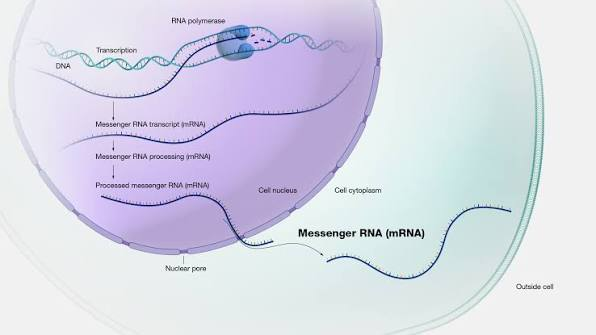
mRNA
A single-stranded RNA molecule that is transcribed from a DNA template and carries genetic information out of the nucleus to the ribosome in the cytoplasm, where its sequence of codons is translated into a polypeptide chain
mRNA: carries the code to make the protein
a single-stranded RNA molecule transcribed from a DNA template that carries genetic instructions out of the nucleus to a ribosome for protein synthesis
Codons: the nucleotide sequence is read by ribosomes in non-overlapping, 3-letter units called codons, where each codon specifies a particular amino acid

Messenger RNA (mRNA)
A single-stranded RNA molecule transcribed from a DNA template during transcription that carries genetic protein-building instructions from the nucleus out to the ribosomes in the cytoplasm for translation
Structure: single-stranded nucleic acid containing ribose sugar, a phosphate backbone, and four nitrogenous bases (adenine, cytosine, guanine, and uracil instead of thymine)
Central Dogma Role: acts as the mobile intermediary in the flow of genetic information: DNA → mRNA → Protein
Eukaryotic Processing: In eukaryotes, raw pre-mRNA undergoes post-transcriptional modifications before leaving the nucleus—including adding a 5' cap, a poly-A tail, and splicing out non-coding introns while keeping coding exons
Codons: read by the ribosome in non-overlapping, 3-nucleotide sequences called codons, which correspond to specific amino acids
mRNA: carries the code to make the protein
a single-stranded RNA molecule transcribed from a DNA template that carries genetic instructions out of the nucleus to a ribosome for protein synthesis

tRNA
A small RNA molecule that acts as a molecular "adapter" or "translator" during protein synthesis (translation). It connects the nucleotide language of messenger RNA (mRNA) to the amino acid language of proteins
Anticodon: a specific three-nucleotide sequence at one end of the tRNA that base-pairs with a complementary codon on the mRNA strand
Amino Acid Attachment Site: the opposite end of the tRNA molecule carries the specific amino acid that corresponds to its anticodon
Shape: It forms a classic cloverleaf secondary structure that folds into a compact 3D L-shape
Charging Enzyme: the enzyme aminoacyl-tRNA synthetase links each tRNA to its correct amino acid
tRNA carries the amino acid
a small, folded RNA molecule that acts as an adapter/translator during protein synthesis (translation) by linking messenger RNA (mRNA) codons to specific amino acids
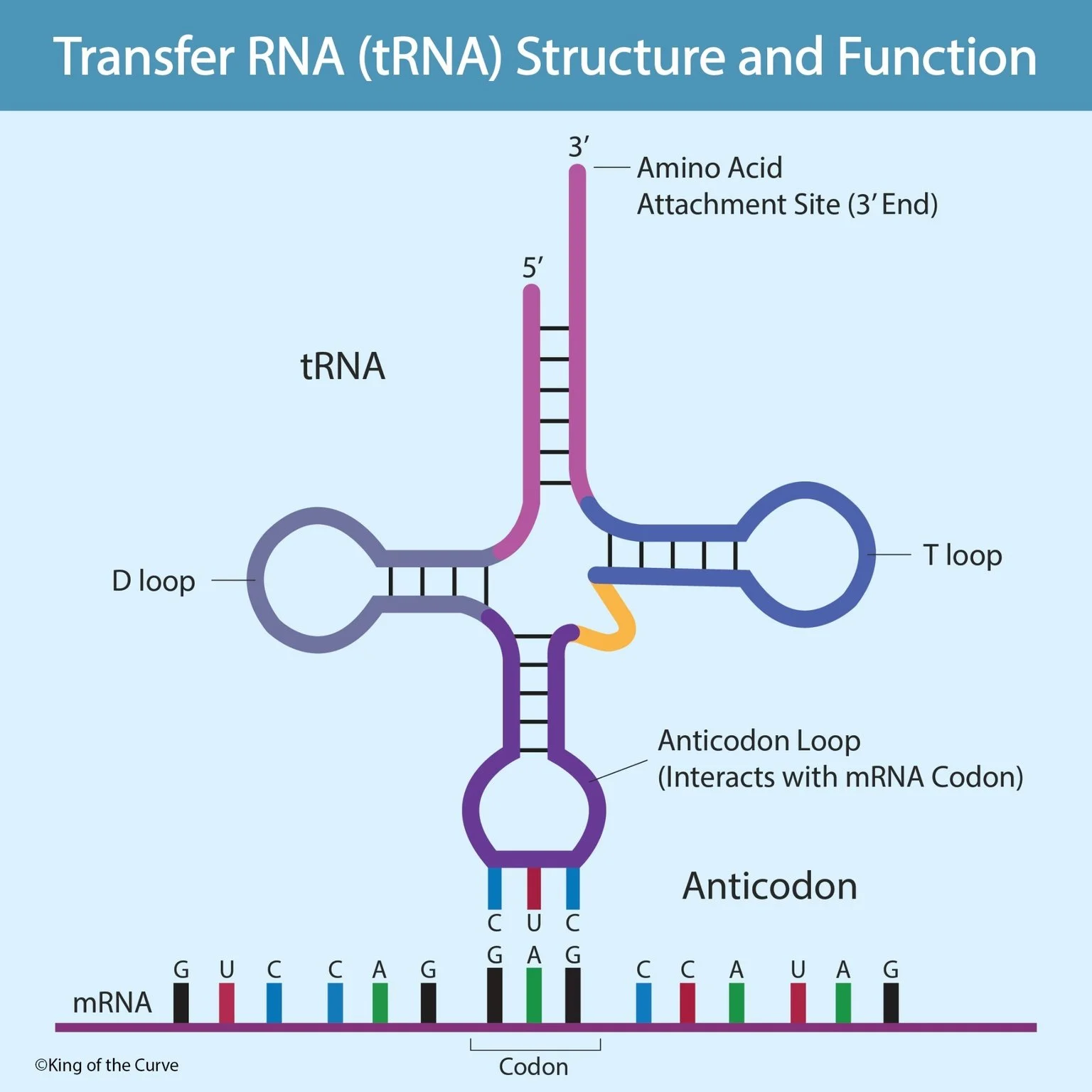
Transfer RNA (tRNA)
A small, functional RNA molecule that acts as a molecular "adaptor" or "translator" during protein synthesis (translation). It bridges the gap between the nucleotide sequence of messenger RNA (mRNA) and the amino acid sequence of a growing polypeptide chain
tRNA carries the amino acid
Dual Function: tRNA has two crucial sites that allow it to translate the genetic code
Anticodon Loop: a specific sequence of three unpaired nucleotides that base-pairs with a complementary mRNA codon (triplet) at the ribosome
Amino Acid Attachment Site: the 3' end (always terminating in the sequence CCA) which binds a specific amino acid corresponding to that anticodon
Structure:
Forms a characteristic cloverleaf shape in two dimensions due to internal base-pairing

transfer RNA (tRNA)
A small RNA molecule that acts as a molecular "adapter" or "translator" during protein synthesis (translation). It connects the nucleotide language of messenger RNA (mRNA) to the amino acid language of proteins
Anticodon: a specific three-nucleotide sequence at one end of the tRNA that base-pairs with a complementary codon on the mRNA strand
Amino Acid Attachment Site: the opposite end of the tRNA molecule carries the specific amino acid that corresponds to its anticodon
Shape: It forms a classic cloverleaf secondary structure that folds into a compact 3D L-shape
Charging Enzyme: the enzyme aminoacyl-tRNA synthetase links each tRNA to its correct amino acid
tRNA carries the amino acid
a small, folded RNA molecule that acts as an adapter/translator during protein synthesis (translation) by linking messenger RNA (mRNA) codons to specific amino acids

Anticodon
An anticodon is a sequence of three adjacent nucleotides on a transfer RNA (tRNA) molecule that base-pairs with a complementary three-nucleotide sequence—called a codon—on a messenger RNA (mRNA) strand during translation
Location: located on the anticodon loop of a tRNA molecule, while the matching codon is located on the mRNA strand at the ribosome
Function: acts as the physical and molecular "adapter" or bridge that ensures the correct amino acid is delivered and added to the growing polypeptide chain
Base Pairing: follows standard complementary rules (A pairs with U, C pairs with G) via hydrogen bonds. For example, if the mRNA codon is
5'-AUG-3', the complementary tRNA anticodon is3'-UAC-5'Always use the mRNA codon—never the tRNA anticodon—when reading a genetic code / codon chart to determine amino acid sequences. Looking up an anticodon directly on a standard mRNA codon chart will yield the wrong amino acid

Anticodon
A sequence of three nucleotides located on a transfer RNA (tRNA) molecule that binds to a complementary codon on a messenger RNA (mRNA) strand during translation
a sequence of three adjacent nucleotides on a transfer RNA (tRNA) molecule that binds to a complementary codon on a messenger RNA (mRNA) strand during translation
Location: found on the loop of a tRNA molecule, while the matching codon is on the mRNA molecule
Function: acts as the physical and molecular bridge ensuring translation fidelity by delivering the specific amino acid corresponding to the mRNA instruction
Base-Pairing Rules: follows complementary base pairing (A pairs with U, C pairs with G) in an antiparallel orientation (5' → 3' vs. 3' → 5')
When determining which amino acid is added to the polypeptide chain using a codon chart, you must always look up the mRNA codon, never the tRNA anticodon

Anticodon
An anticodon is a sequence of three adjacent nucleotides on a transfer RNA (tRNA) molecule that base-pairs with a complementary three-nucleotide sequence—called a codon—on a messenger RNA (mRNA) strand during translation
Location: located on the anticodon loop of a tRNA molecule, while the matching codon is located on the mRNA strand at the ribosome
Function: acts as the physical and molecular "adapter" or bridge that ensures the correct amino acid is delivered and added to the growing polypeptide chain
Base Pairing: follows standard complementary rules (A pairs with U, C pairs with G) via hydrogen bonds. For example, if the mRNA codon is
5'-AUG-3', the complementary tRNA anticodon is3'-UAC-5'Always use the mRNA codon—never the tRNA anticodon—when reading a genetic code / codon chart to determine amino acid sequences. Looking up an anticodon directly on a standard mRNA codon chart will yield the wrong amino acid

Anticodon on tRNA
A sequence of three nucleotides on a transfer RNA (tRNA) molecule that is complementary to a specific codon on messenger RNA (mRNA). During translation at the ribosome, the anticodon base-pairs with the mRNA codon to ensure that the correct amino acid is added to the growing polypeptide chain
An anticodon is a sequence of three adjacent nucleotides on a transfer RNA (tRNA) molecule that base-pairs with a complementary three-nucleotide sequence—called a codon—on a messenger RNA (mRNA) strand during translation
Structure and Location: a tRNA molecule folds into a cloverleaf-like shape with two functional ends. The anticodon loop sits at one end, while the amino acid attachment site sits at the opposite 3' end
Antiparallel Base Pairing: codons and anticodons bind in an antiparallel orientation. The ribosome reads the mRNA codon in the 5' to 3' direction, so the complementary tRNA anticodon aligns in the 3' to 5' direction. RNA base-pairing rules apply, meaning adenine (A) pairs with uracil (U) and cytosine (C) pairs with guanine (G)
Translation Example. If an mRNA strand has the start codon 5'-AUG-3', the matching tRNA carries the anticodon 3'-UAC-5' and delivers the amino acid methionine

Codon
A sequence of three consecutive nucleotides in messenger RNA (mRNA)—or DNA—that specifies a particular amino acid, a start signal, or a stop signal during protein synthesis
The Triplet Code: the genetic code is read in non-overlapping, continuous groups of three bases (ex; 5'-AUG-CCU-GAA-3'), known as a triplet code
Start Codon:
AUGis the universal start codon. It establishes the reading frame and codes for the amino acid methionine (thoughAUGlater in a sequence just adds methionine)Stop Codons:
UAA,UAG, andUGAsignal the termination of translation. They do not code for any amino acid and are recognized by release factors rather than tRNANumber and Redundancy: There are 4^3 = 64 possible codon combinations:
61 codons code for the 20 standard amino acids
3 codons are stop signals
The code is redundant (degenerate)—meaning multiple different codons can specify the same amino acid—which can help protect against silent mutations

Codon vs. Anticodon
Codon vs. Anticodon
Codon: a sequence of three nucleotides on mRNA (messenger RNA) that codes for a specific amino acid or a stop signal during translation
Anticodon: a complementary sequence of three nucleotides on tRNA (transfer RNA) that binds to the mRNA codon and delivers the corresponding amino acid
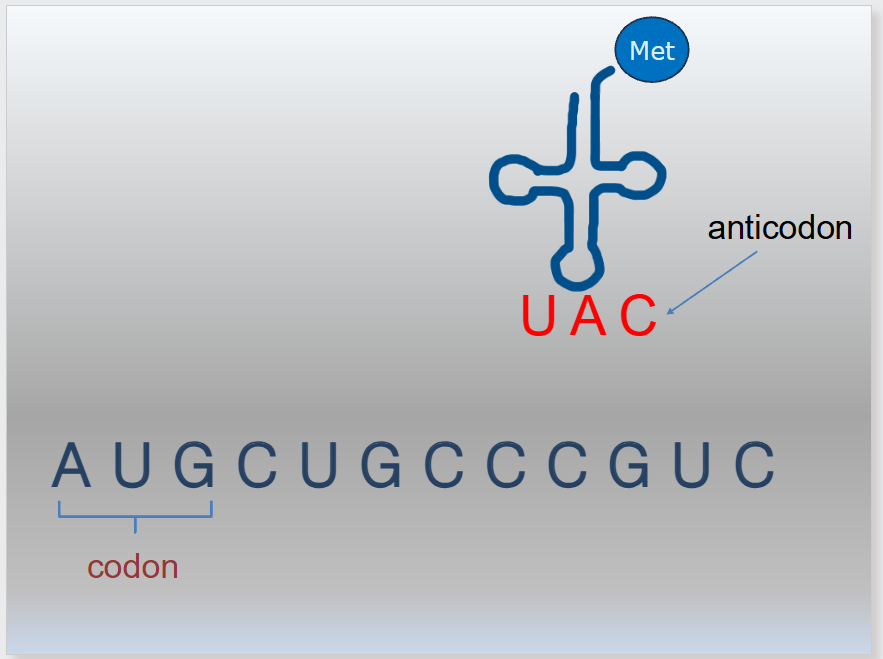
Codon
A sequence of three consecutive nucleotides in messenger RNA (mRNA)—or DNA—that specifies a particular amino acid, a start signal, or a stop signal during protein synthesis
a sequence of three consecutive nucleotides on a messenger RNA (mRNA) molecule that specifies a particular amino acid or a stop signal during translation
The Triplet Code: the genetic code is read by the ribosome three nucleotides at a time
Directionality: mRNA codons are read by the ribosome in the 5' to 3' direction
Start Codon: AUG is the universal start codon. It codes for the amino acid methionine and establishes the reading frame for translation
Stop Codons: UAA, UAG, and UGA signal the termination of translation. They do not code for amino acids or bind to tRNAs; instead, release factors bind to them to release the polypeptide chain
Redundancy (Degeneracy): there are 64 possible unique codons (4³), but only 20 standard amino acids. This means multiple codons can code for the same amino acid, which can protect against silent mutations

Anticodon
A sequence of three nucleotides on a tRNA (transfer RNA) molecule that is complementary and antiparallel to a specific codon on an mRNA (messenger RNA) strand
a sequence of three nucleotides on a tRNA (transfer RNA) molecule that is complementary and antiparallel to a specific codon on an mRNA (messenger RNA) strand
Location: found on a specific loop (the anticodon loop) of a tRNA molecule

Translation
The process in gene expression where the nucleotide sequence of a messenger RNA (mRNA) molecule is decoded by a ribosome to assemble a specific sequence of amino acids, forming a polypeptide chain (protein)
the biological process in which a ribosome reads the nucleotide sequence of messenger RNA (mRNA) in triplet units called codons to assemble a corresponding chain of amino acids (a polypeptide)
It represents the "protein synthesis" stage of the Central Dogma (
DNA → RNA → Protein) and occurs at the ribosome in the cytoplasm or rough endoplasmic reticulum
The Three Main Stages:
Initiation: the ribosome assembles around the target mRNA, meeting the
AUGstart codonElongation: tRNAs deliver amino acids matching each codon; peptide bonds form between them as the ribosome shifts (translocates) along the mRNA
Termination: a stop codon is reached, a release factor binds, and the completed polypeptide chain is freed
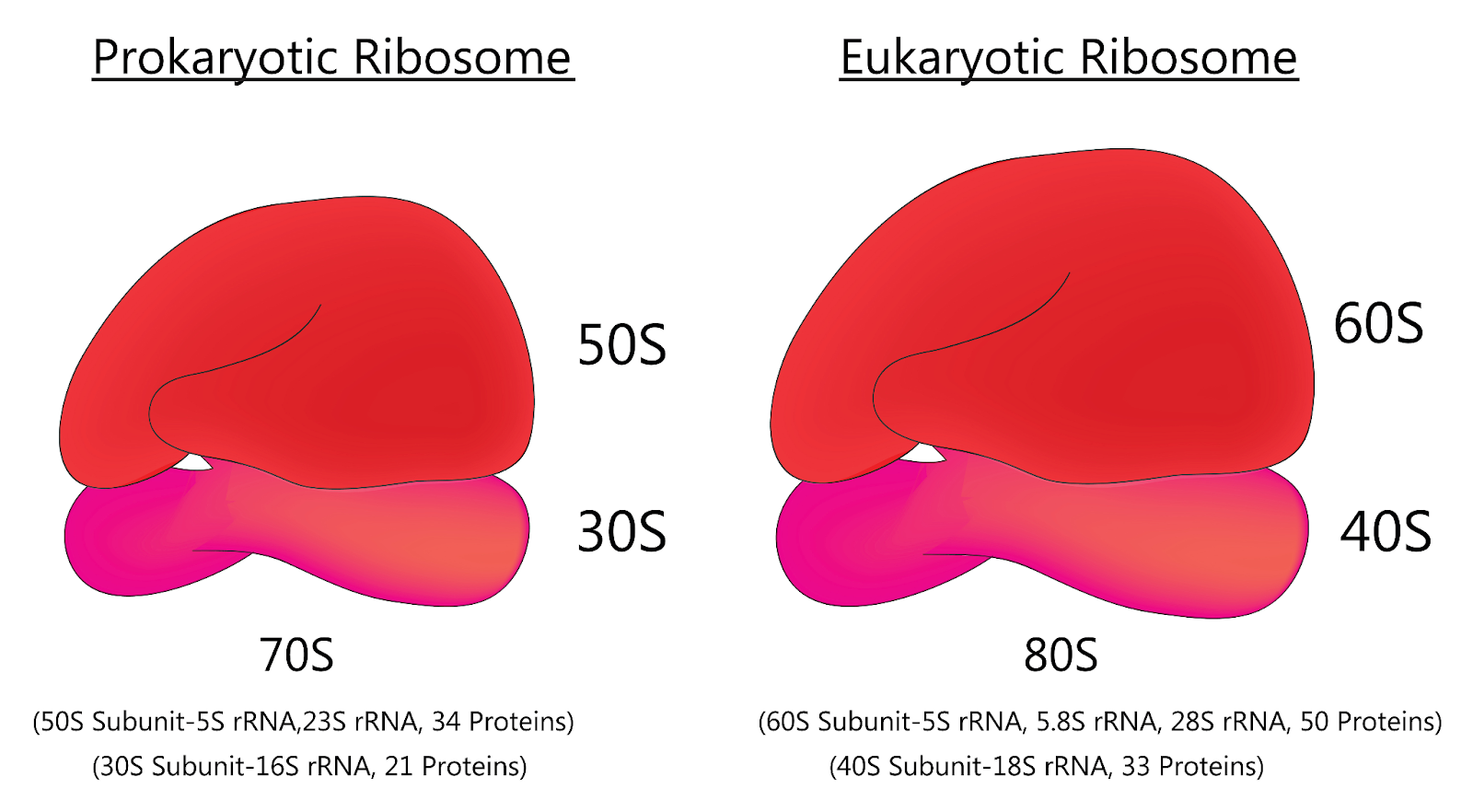
Types of Ribosomes in eukaryotes vs. porkaryotes
Ribosomes are non-membranous, RNA-protein complexes found in all living cells that translate mRNA into polypeptide chains
Prokaryotic Ribosomes (70S)
Size/Type: 70S ribosomes (measured by Svedberg units of sedimentation rate).
Subunits: consist of a large 50S subunit and a small 30S subunit
Location: free-floating in the cytoplasm
Eukaryotic Ribosomes (80S)
Size/Type: 80S ribosomes
Subunits: consist of a large 60S subunit and a small 40S subunit
Location & Functional Types:
Free ribosomes: suspended in the cytosol; synthesize proteins that function inside the cytosol
Bound (or fixed) ribosomes: attached to the outside of the rough endoplasmic reticulum (rough ER) or the nuclear envelope; synthesize proteins destined for insertion into membranes, packaging into organelles (like lysosomes), or export/secretion from the cell
Types of Ribosomes eukaryotes vs. prokaryotes
Ribosomes are non-membranous, RNA-protein complexes found in all living cells that translate mRNA into polypeptide chains
Prokaryotic Ribosomes (70S)
Size/Type: 70S ribosomes (measured by Svedberg units of sedimentation rate).
Subunits: consist of a large 50S subunit and a small 30S subunit
Location: free-floating in the cytoplasm
Eukaryotic Ribosomes (80S)
Size/Type: 80S ribosomes
Subunits: consist of a large 60S subunit and a small 40S subunit
Location & Functional Types:
Free ribosomes: suspended in the cytosol; synthesize proteins that function inside the cytosol
Bound (or fixed) ribosomes: attached to the outside of the rough endoplasmic reticulum (rough ER) or the nuclear envelope; synthesize proteins destined for insertion into membranes, packaging into organelles (like lysosomes), or export/secretion from the cell

Types of ribosomes in Eukaryotes
Eukaryotic ribosomes are classified based on their size/structure and their cellular location
1. Classification by Size and Structure (80S vs. 70S)
Eukaryotic Cytosolic Ribosomes (80S):
Found in the cytosol and on the rough endoplasmic reticulum (RER)
Composed of a 40S small subunit and a 60S large subunit (totaling 80S in Svedberg units)
Endosymbiotic / Organellar Ribosomes (70S):
Found inside mitochondria and chloroplasts
Structurally smaller (a 30S small subunit and a 50S large subunit, totaling 70S) and more closely resemble prokaryotic ribosomes, which serves as key evidence for the endosymbiotic theory

Types of ribosomes in Prokaryotes
Prokaryotes contain 70S ribosomes in their cytoplasm, which are smaller than the 80S ribosomes found in eukaryotes
Structure of Prokaryotic (70S) Ribosomes
Whole Ribosome: 70S (Svedberg units measure sedimentation rate/size)
Large Subunit: 50S subunit, which contains 5S and 23S rRNA molecules plus about 31 protein subunits. It houses the peptidyl transferase activity that forms peptide bonds
Small Subunit: 30S subunit, which contains a 16S rRNA molecule plus about 21 protein subunits. It binds and decodes the mRNA sequence

Types of ribosomes prokaryotes vs. eukaryotes
Ribosomes are non-membranous, RNA-protein complexes responsible for protein synthesis (translation) in all living cells. The primary distinction between prokaryotic and eukaryotic ribosomes lies in their size, sedimentation rate (measured in Svedberg units, S), and subunit composition
Prokaryotic Ribosomes (70S)
Size & Type: 70S ribosomes
Subunits: composed of a 50S large subunit and a 30S small subunit
Location: freely dispersed throughout the cytoplasm (cytosol)
Eukaryotic Ribosomes (80S)
Size & Type: 80S ribosomes
Subunits: composed of a 60S large subunit and a 40S small subunit
Location & Function:
Free ribosomes: floating in the cytosol; synthesize proteins that function inside the cytosol
Bound ribosomes: attached to the exterior of the rough endoplasmic reticulum (rough ER); synthesize proteins destined for insertion into membranes, packaging into organelles (like lysosomes), or export (secretion) from the cell

Location of translation
Translation takes place on ribosomes in the cell cytoplasm (either floating freely or attached to the rough endoplasmic reticulum)
Key distinctions by cell type:
Eukaryotes: transcription occurs inside the nucleus, and the messenger RNA (mRNA) must leave the nucleus to undergo translation on ribosomes in the cytoplasm or on the surface of the rough endoplasmic reticulum
Prokaryotes (Bacteria): because prokaryotes lack a nucleus, transcription and translation happen simultaneously in the cytoplasm

Location of translation
Translation takes place on ribosomes in the cell cytoplasm (either floating freely or attached to the rough endoplasmic reticulum)
Key Location Details by Cell Type:
Eukaryotes (plants, animals, fungi): translation occurs in the cytoplasm or on the membrane of the rough endoplasmic reticulum (rough ER), after the mRNA has been transcribed in the nucleus and exported out
Proteins made by free ribosomes generally function inside the cytosol
Proteins made by bound ribosomes on the rough ER are typically packaged for the endomembrane system, cell membrane secretion, or lysosomes
Prokaryotes (bacteria): translation occurs in the cytoplasm. Because prokaryotes lack a nucleus, transcription and translation can happen simultaneously on the same mRNA strand

Location of translation
Translation takes place on ribosomes in the cell cytoplasm (either floating freely or attached to the rough endoplasmic reticulum)
Key distinctions by cell type:
Eukaryotes: transcription occurs inside the nucleus, and the messenger RNA (mRNA) must leave the nucleus to undergo translation on ribosomes in the cytoplasm or on the surface of the rough endoplasmic reticulum
Prokaryotes (Bacteria): because prokaryotes lack a nucleus, transcription and translation happen simultaneously in the cytoplasm

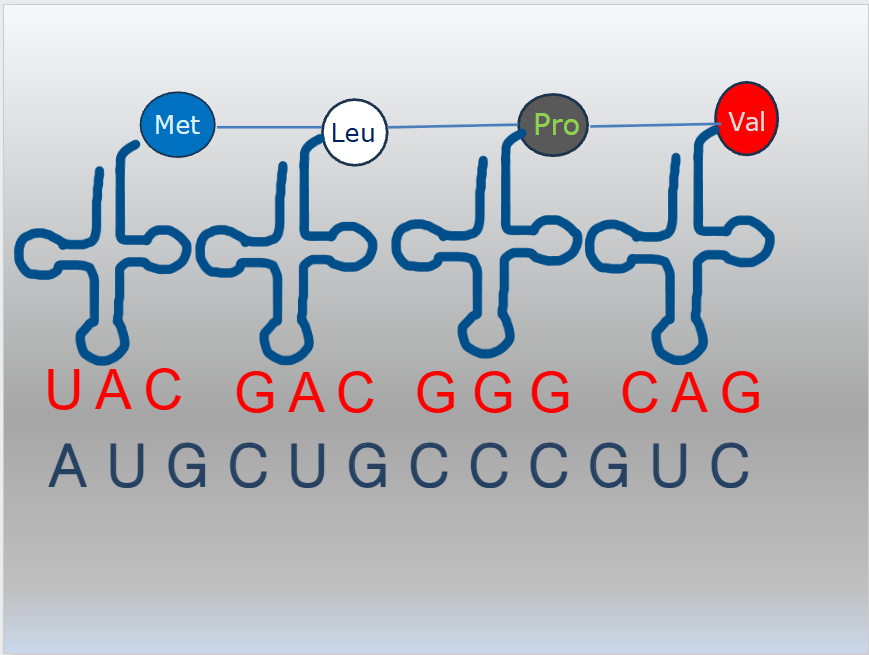
Translation diagram
The diagram illustrates translation. During this process, a ribosome reads an mRNA sequence to assmeble a specific chain of amino acids into a polypeptide
Key Components:
mRNA strand (bottom letters): the continous sequence (AUG CUG CCC GUC) is messenger RNA (mRNA). It is read by ribosomes in groups of three nucleotides called codons, moving in the 5’ → 3’ direction
tRNA molecules (blue cloverleaf shapes): transfer RNA (tRNA) molecules act as molecular adapters. Each tRNA carries a specific amino acid on one end and displays a three-base anticodon (shown in red) on the other
Anticodons (red letters): the seuqences UAC, GAC, GGG, and CAG pair with complementary mRNA codons using standard RNA base pairing rules (A pairs with U, and C pairs with G)
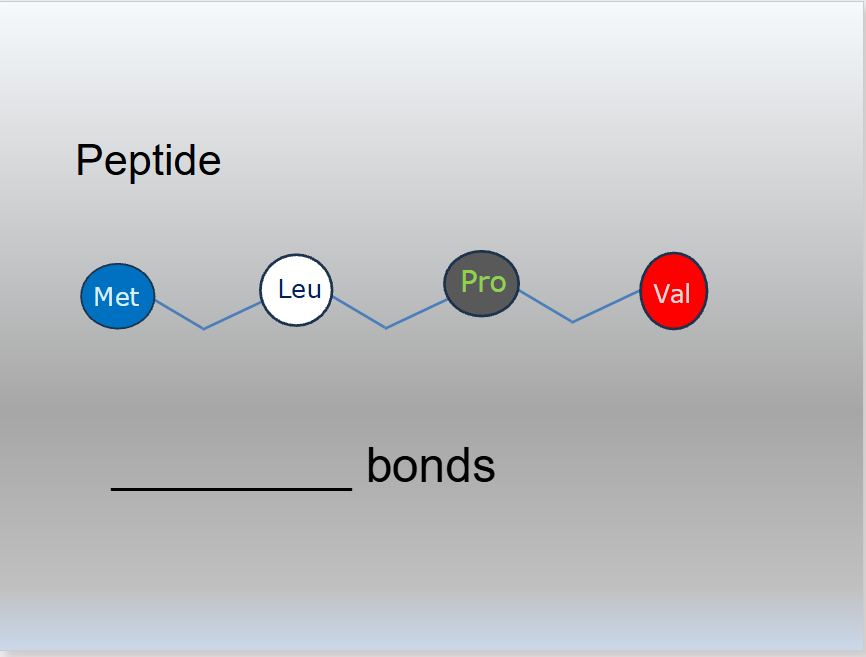
Growing polypeptide chain (top circles): the linked circles represent amino acids (Met - Leu - Pro - Val) joined together by covalent peptide bonds to form a primary protein structure
Translation diagram
The diagram illustrates translation. During this process, a ribosome reads an mRNA sequence to assmeble a specific chain of amino acids into a polypeptide
Key Components:
mRNA strand (bottom letters): the continous sequence (AUG CUG CCC GUC) is messenger RNA (mRNA). It is read by ribosomes in groups of three nucleotides called codons, moving in the 5’ → 3’ direction
tRNA molecules (blue cloverleaf shapes): transfer RNA (tRNA) molecules act as molecular adapters. Each tRNA carries a specific amino acid on one end and displays a three-base anticodon (shown in red) on the other
Anticodons (red letters): the seuqences UAC, GAC, GGG, and CAG pair with complementary mRNA codons using standard RNA base pairing rules (A pairs with U, and C pairs with G)
Growing polypeptide chain (top circles): the linked circles represent amino acids (Met - Leu - Pro - Val) joined together by covalent peptide bonds to form a primary protein structure

Translation diagram
The diagram illustrates translation. During this process, a ribosome reads an mRNA sequence to assmeble a specific chain of amino acids into a polypeptide
The diagram depicts translation, the second major stage of protein synthesis. During this process, a cell decodes a messenger RNA (mRNA) sequence to assemble a specific chain of amino acids that will fold into a functional protein
Key Components:
mRNA strand (bottom letters): the continous sequence (AUG CUG CCC GUC) is messenger RNA (mRNA). It is read by ribosomes in groups of three nucleotides called codons, moving in the 5’ → 3’ direction
tRNA molecules (blue cloverleaf shapes): transfer RNA (tRNA) molecules act as molecular adapters. Each tRNA carries a specific amino acid on one end and displays a three-base anticodon (shown in red) on the other
Anticodons (red letters): the seuqences UAC, GAC, GGG, and CAG pair with complementary mRNA codons using standard RNA base pairing rules (A pairs with U, and C pairs with G)
Growing polypeptide chain (top circles): the linked circles represent amino acids (Met - Leu - Pro - Val) joined together by covalent peptide bonds to form a primary protein structure

Translation diagram
The diagram shows translation (protein synthesis). Translation is the process where a ribosome reads an mRNA sequence to build a polypeptide (protein) chain using tRNA molecules
Key Components:
mRNA strand (bottom row): the continous seuquence AUG CUG CCC GUC represents messenger RNA (mRNA). It is read in groups of three bases called codons
tRNA anticodons (middle row in red): the triplets UAC, GAC, GGG, and CAG represents transfer RNA (tRNA) anticodons. Each anticodon pairs with its complementary mRNA codon (A pairs with U, and C pairs with G)
Polypeptide chain (top connected circles): the linked circles labeled Met - Leu - Pro - Val represents amino acids joined together by peptide bonds to form a growing protein chain

Peptide bonds
A peptide bond is a covalent chemical bond that links two amino acids together during protein synthesis
A strong covalent bond formed between the carboxyl group (-COOH) of one amino acid and the amino group (-NH2) of an adjacent amino acid
Formation (Dehydration Synthesis / Condensation): the reaction releases a molecule of water (H2O) as a hydroxyl group (-OH) is removed from the carboxyl group and a hydrogen atom (-H) is removed from the amino group
Breakdown (Hydrolysis): the reverse reaction breaks the peptide bond by consuming a water molecule, a process typically catalyzed by enzymes
Protein Structure:
Linear chains of amino acids connected by peptide bonds form the primary structure of a protein

Peptide bonds
A peptide bond is a covalent chemical bond that links two amino acids together during protein synthesis
a covalent chemical bond that links two amino acids together to form a protein's primary structure
A strong covalent bond formed between the carboxyl group (-COOH) of one amino acid and the amino group (-NH2) of an adjacent amino acid
Formation (Dehydration Synthesis / Condensation): the reaction releases a molecule of water (H2O) as a hydroxyl group (-OH) is removed from the carboxyl group and a hydrogen atom (-H) is removed from the amino group
Breakdown (Hydrolysis): the reverse reaction breaks the peptide bond by consuming a water molecule, a process typically catalyzed by enzymes
Protein Structure:
Linear chains of amino acids connected by peptide bonds form the primary structure of a protein
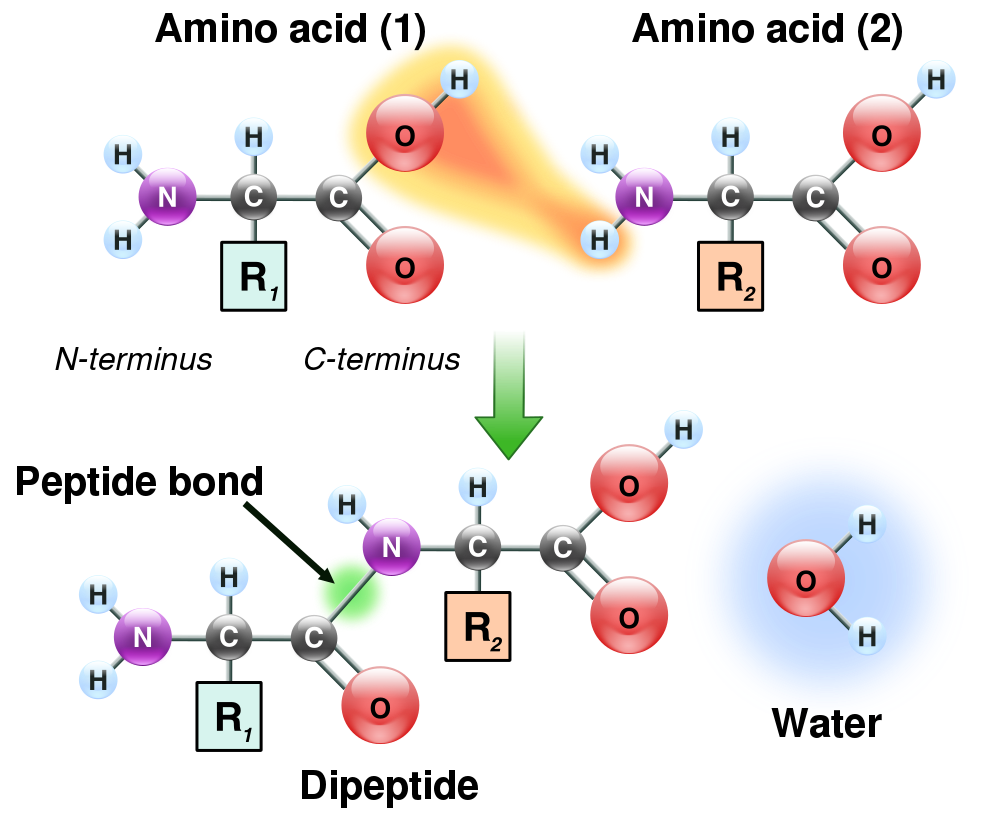
Peptide bond
A peptide bond is a covalent chemical bond that links two amino acids together during protein synthesis
a covalent chemical bond that links two amino acids together to form a protein's primary structure
A strong covalent bond formed between the carboxyl group (-COOH) of one amino acid and the amino group (-NH2) of an adjacent amino acid
Formation (Dehydration Synthesis/ Condensation): the reaction releases a molecule of water (H2O) as a hydroxyl group (-OH) is removed from the carboxyl group and a hydrogen atom (-H) is removed from the amino group
Breakdown (Hydrolysis): the reverse reaction breaks the peptide bond by consuming a water molecule, a process typically catalyzed by enzymes
Protein Structure:
Linear chains of amino acids connected by peptide bonds form the primary structure of a protein

What type of bond links amino acids?
Amino acids are linked together by peptide bonds, which are a specific type of covalent bond
A peptide bond is a strong covalent bond (specifically an amide linkage) that joins the carboxyl group (-COOH) of one amino acid to the amino group (-NH2) of an adjacent amino acid
Key Details:
How they form: they are created through a dehydration synthesis (or condensation) reaction
Which groups react: the carboxyl group (–COOH) of one amino acid reacts with the amino group (–NH₂) of another, releasing a molecule of water (H2O)
Protein level: peptide bonds form the primary structure (the linear sequence) of a polypeptide chain or protein

Amino acids
An amino acid is the organic monomer (building block) used to construct proteins
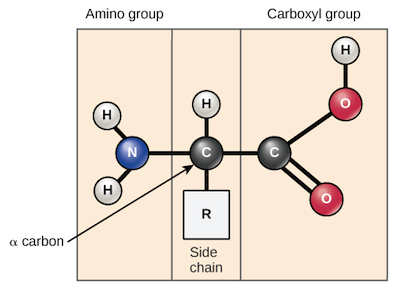
Every standard amino acid shares a common backbone bonded to a central alpha (α) carbon
A hydrogen atom (-H)
An amino group (-NH₂)
A carboxyl group (-COOH)
A variable R group (side chain) that gives each amino acid its unique chemical identity
The 20 Common Amino Acids: Cells use 20 different amino acids encoded by genetic information
R Group Properties: amino acids differ only in their R groups, which dictate their chemical behavior
Peptide Bonds: amino acids join together via dehydration synthesis (condensation reactions), forming covalent peptide bonds between the carboxyl group of one amino acid and the amino group of the next
Polypeptide chain
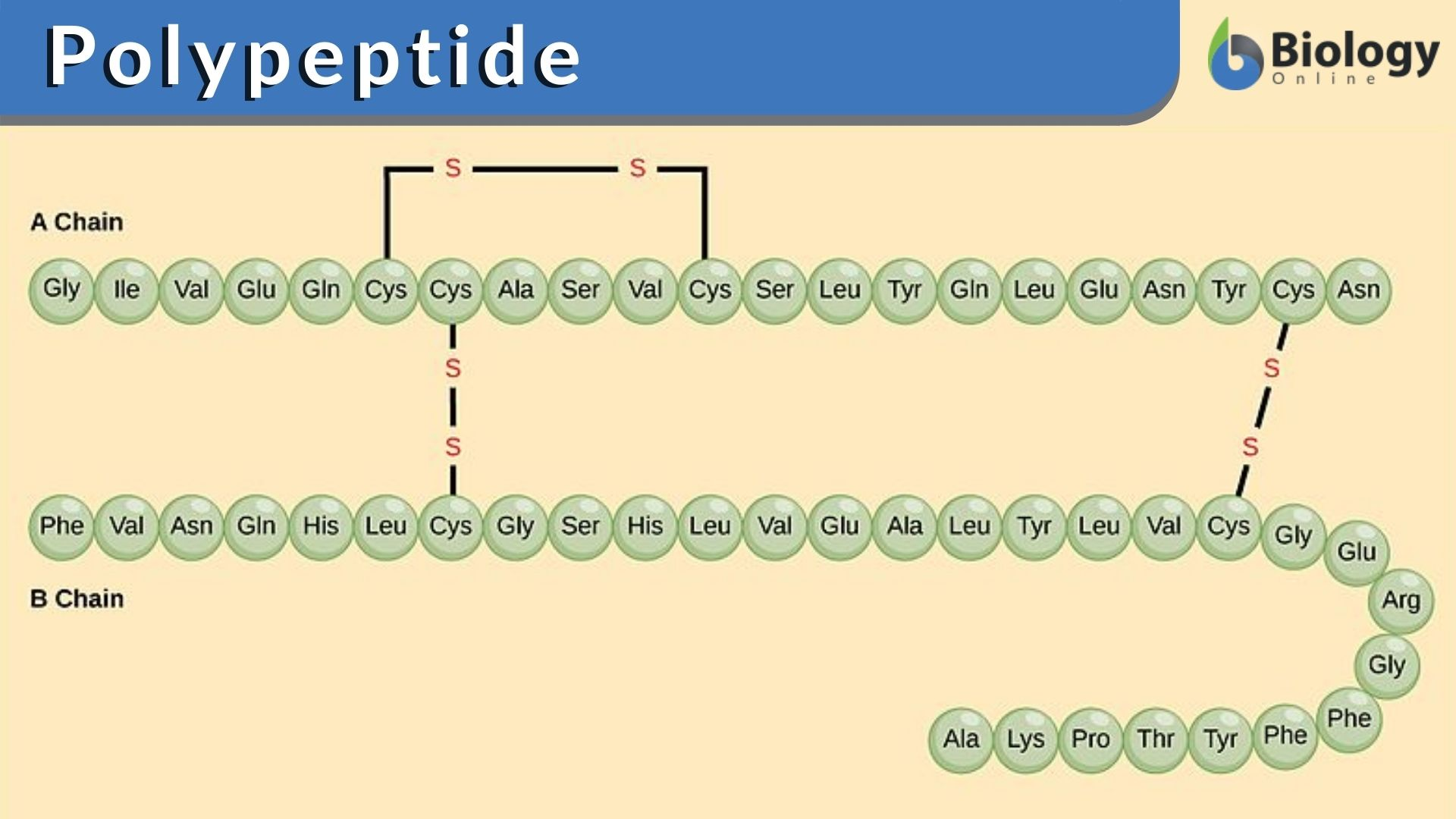
A polypeptide chain is a continuous, unbranched polymer of amino acids linked together by covalent peptide bonds
Monomers: the building blocks are amino acids, each containing an amino group (-NH₂), a carboxyl group (-COOH), a hydrogen atom, and a variable side chain (R group) attached to a central alpha (α) carbon
Peptide Bond Formation: chains are built via dehydration synthesis (condensation reactions) driven by ribosomes during translation. The carboxyl group of one amino acid joins the amino group of the next, releasing a molecule of water
A polypeptide chain is a continuous, unbranched linear polymer of amino acids joined together by covalent peptide bonds
Polypeptide chain
A polypeptide chain is a continuous, unbranched polymer of amino acids linked together by covalent peptide bonds
Monomers: the building blocks are amino acids, each containing an amino group (-NH₂), a carboxyl group (-COOH), a hydrogen atom, and a variable side chain (R group) attached to a central alpha (α) carbon
Peptide Bond Formation: chains are built via dehydration synthesis (condensation reactions) driven by ribosomes during translation. The carboxyl group of one amino acid joins the amino group of the next, releasing a molecule of water
A polypeptide chain is a continuous, unbranched linear polymer of amino acids joined together by covalent peptide bonds

Polypeptide
Alinear, unbranched polymer consisting of many amino acids linked together by covalent peptide bonds. It serves as the building block or precursor of a functional protein
A polypeptide is a linear, unbranched polymer consisting of many amino acids linked together by covalent peptide bonds
Monomers: the building blocks of polypeptides are amino acids. Each amino acid contains a central carbon attached to an amino group (-NH₂), a carboxyl group (-COOH), a hydrogen atom, and a variable R group (side chain)
Formation (Dehydration Synthesis): peptide bonds form between the carboxyl group of one amino acid and the amino group of the next through a dehydration synthesis (condensation) reaction that releases a water molecule. This is carried out by ribosomes during translation
Primary protein structure
The primary structure of a protein is the unique, linear sequence of amino acids in a polypeptide chain
The primary structure of a protein is its unique, linear sequence of amino acids linked together in a polypeptide chain
Monomers & Building Blocks: proteins are polymers made of amino acid monomers. Each amino acid has a central (alpha) carbon attached to an amino group (-NH2), a carboxyl group (-COOH)), a hydrogen atom, and a variable side chain (R-group)
Bond Type: amino acids are joined by peptide bonds, which are strong covalent bonds formed via dehydration synthesis (condensation reactions) between the carboxyl group of one amino acid and the amino group of the next
During the initiation phase of translation, the ribosome assembles around the messenger RNA (mRNA) to establish the correct reading frame before protein synthesis begins
Key Steps of Initiation
Small Subunit & mRNA Binding: the small ribosomal subunit binds to the mRNA molecule
Eukaryotes: the ribosome recognizes and binds to the 5′ cap of the mRNA and scans downstream until it finds the start codon
Prokaryotes: the ribosome binds directly to a specific sequence upstream of the start codon called the Shine-Dalgarno sequence
Start Codon Recognition: the ribosome locates the start codon AUG, which codes for the amino acid methionine
Initiator tRNA: a transfer RNA (tRNA) carrying methionine and possessing the complementary anticodon binds to the AUG start codon in the P-site of the ribosome
Large Subunit Assembly: the large ribosomal subunit joins the complex, completing the functional ribosome setup (initiation complex) so elongation can begin

Translation - initiation
During the initiation phase of translation, the cell assembles the molecular machinery required to read the messenger RNA (mRNA) and start building a polypeptide chain
the ribosome assembles around the messenger RNA (mRNA) molecule and the first transfer RNA (tRNA) to establish the correct reading frame before synthesis begins
Key Steps in Initiation
Ribosome Assembly: the small ribosomal subunit binds to the mRNA molecule
Start Codon Recognition: the ribosome locates and aligns with the start codon AUG on the mRNA, which codes for the amino acid methionine
Initiator tRNA: a specialized transfer RNA (tRNA) carrying methionine (with the complementary anticodon UAC) binds to the start codon in the ribosome's P site
Large Subunit Joins: the large ribosomal subunit locks into place on top of the small subunit, completing the functional translation initiation complex (ready for elongation)

Initiation - Translation
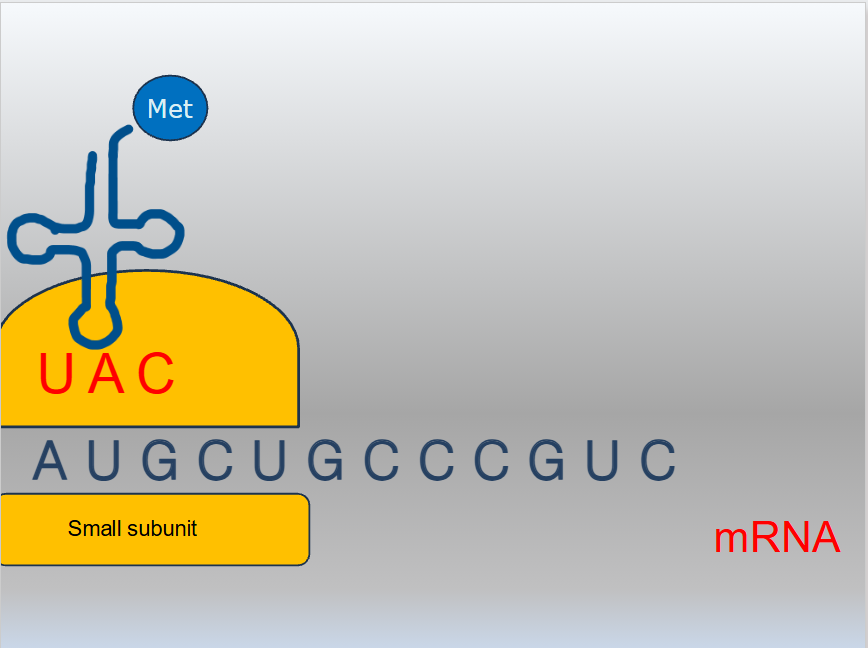
The first stage of protein synthesis where the ribosome assembles around the target messenger RNA (mRNA) and establishes the reading frame to start building a polypeptide
Key Components:
mRNA Strand: the messenger RNA (mRNA) carries the genetic code in three-base sequences called codons, starting with the sequence AUG
Ribosomal Subunits: the small ribosomal subunits bind to the mRNA first, followed by the attachment of the large ribosomal subunit to form a functional ribosome
Initiator tRNA: a transfer RNA (tRNA) molecule with the complementary anticodon UAC pairs with the start codon AUG on the mRNA
Amino Acid (Met): the initiator tRNA carries the amino acid methionine (Met), which serves as the first amino acid in the growing polypeptide chain
Initiation - Translation
The first stage of protein synthesis where the ribosome assembles around the target messenger RNA (mRNA) and establishes the reading frame to start building a polypeptide
Key Components:
mRNA Strand: the messenger RNA (mRNA) carries the genetic code in three-base sequences called codons, starting with the sequence AUG
Ribosomal Subunits: the small ribosomal subunits bind to the mRNA first, followed by the attachment of the large ribosomal subunit to form a functional ribosome
Initiator tRNA: a transfer RNA (tRNA) molecule with the complementary anticodon UAC pairs with the start codon AUG on the mRNA
Amino Acid (Met): the initiator tRNA carries the amino acid methionine (Met), which serves as the first amino acid in the growing polypeptide chain

Initiation
The first stage of translation, where the ribosome assembles around the messenger RNA (mRNA) molecule and prepares to read the genetic code to build a polypeptide chain
the first phase of translation (protein synthesis), where the ribosome, messenger RNA (mRNA), and the first transfer RNA (tRNA) assemble together to establish the correct reading frame
Key Events of Initiation
Ribosome Assembly: the small ribosomal subunit binds to the mRNA strand
Start Codon Recognition: the ribosome scans the mRNA until it reaches the start codon (
AUG), which sets the correct reading frame for the rest of the sequenceInitiator tRNA Binding: a special initiator transfer RNA (tRNA) carrying the amino acid methionine (with the anticodon
UAC) pairs with theAUGstart codon in the ribosome's P-siteLarge Subunit Joining: the large ribosomal subunit locks into place over the small subunit, completing the functional initiation complex ready for elongation
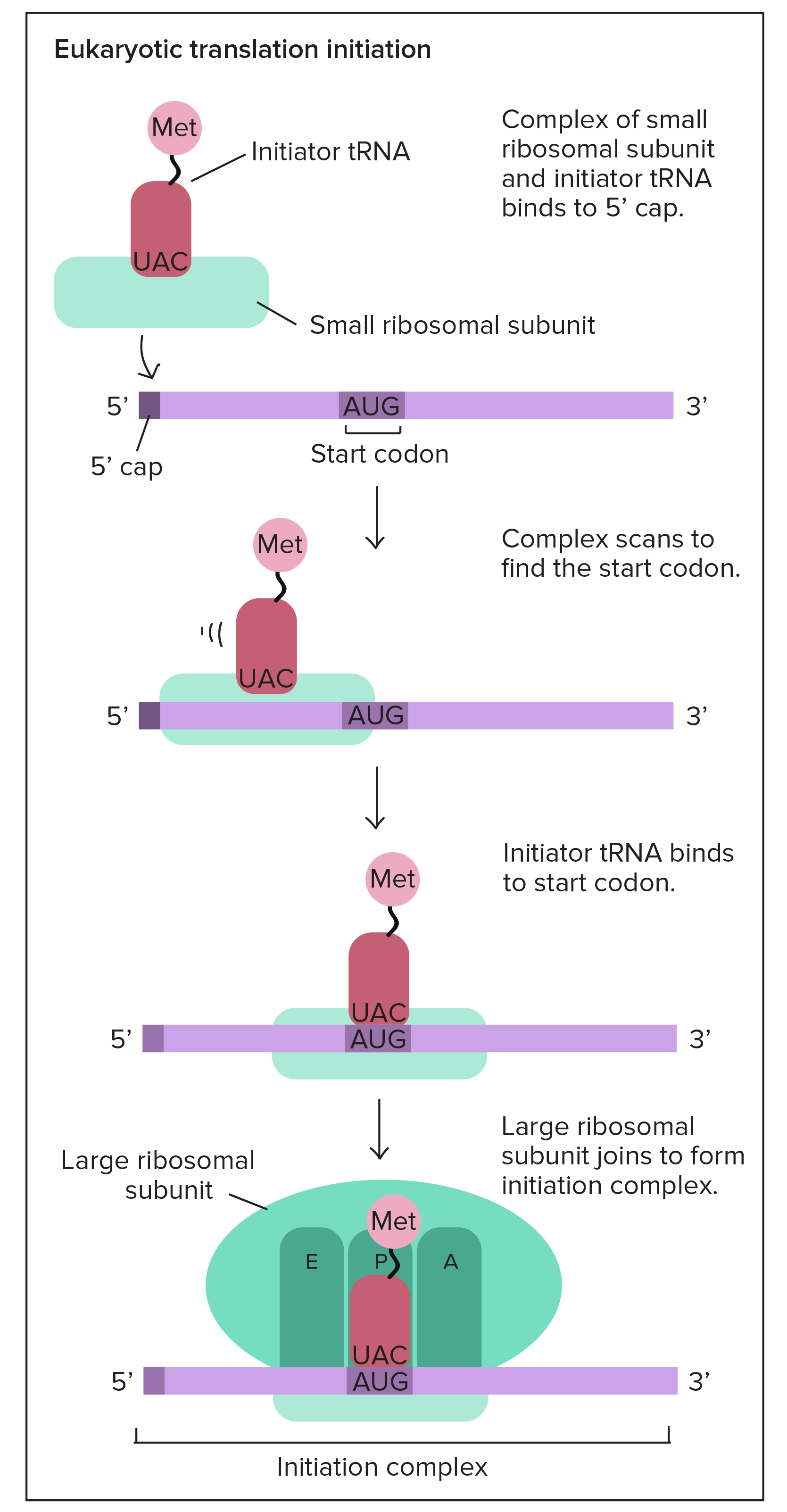
Initiation - translation
The first stage of translation, the process where a ribosome builds a polypeptide (protein) using the genetic instructions carried by an mRNA (messenger RNA) molecule
Key Events
Small Ribosomal Subunit Binding: the small ribosomal subunit binds to the mRNA molecule
Start Codon Recognition: the ribosome scans the mRNA until it locates the start codon, which is AUG
Initiator tRNA Arrival: an initiator transfer RNA (tRNA) carrying the amino acid methionine (which pairs with the AUG codon via its complementary anticodon, UAC) binds to the start codon
Large Subunit Assembly: the large ribosomal subunit joins the small subunit and the mRNA, placing the initiator tRNA into the P-site of the ribosome and completing the functional translation initiation complex

Translation-initiation complex
The assembled molecular structure that marks the starting point of protein synthesis, formed when the mRNA template, the small ribosomal subunit, the initiator tRNA, and ribosomal/initiation factor proteins come together at the start codon before elongation begins
mRNA (Messenger RNA): provides the genetic code, specifically containing the start codon AUG (which codes for methionine)
Small Ribosomal Subunit: scans the mRNA strand (in eukaryotes) or binds via the Shine-Dalgarno sequence (in prokaryotes) to locate the start codon
Initiator tRNA: carries the first amino acid, methionine (or formylmethionine in bacteria), and binds directly to the AUG start codon via its anticodon (UAC) at the ribosome's P site
Initiation Factors & GTP: protein helpers and GTP (energy source) that assist in bringing the components together and driving the attachment of the large ribosomal subunit to complete the functional ribosome

Transition-initiation complex
