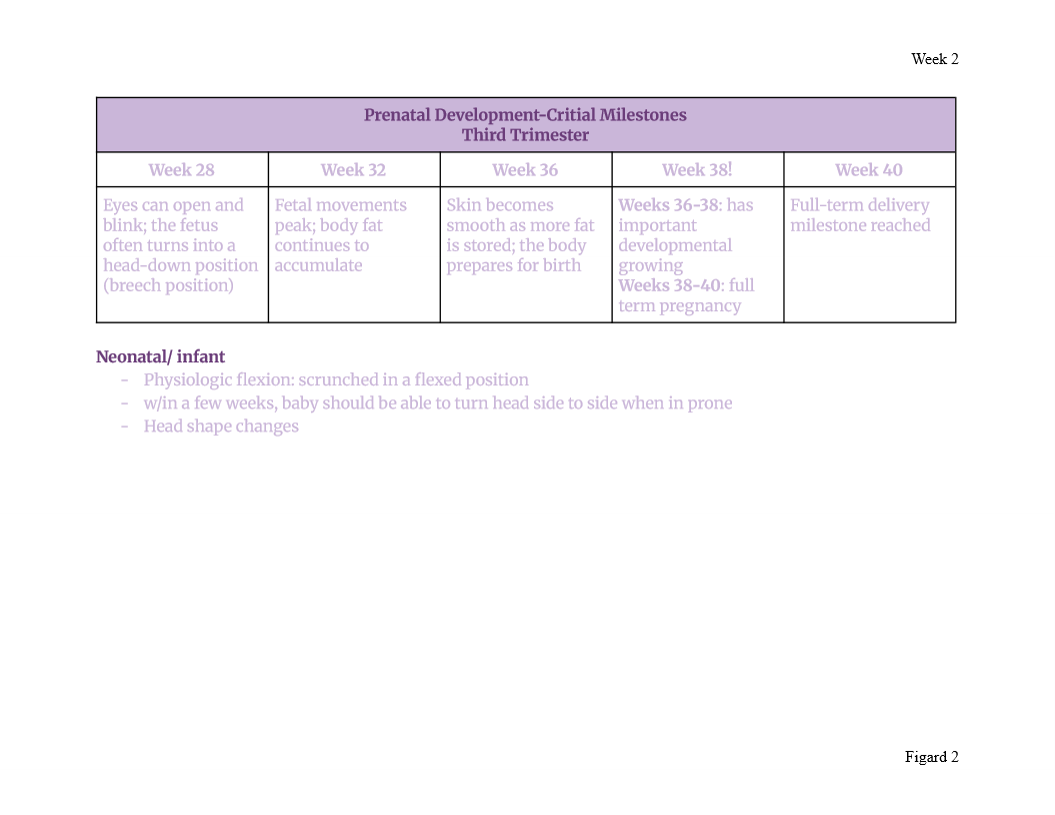
My developmental chart
 Call Kai
 Learn
Learn Practice Test
 Spaced Repetition
 Match
Match Flashcards
 Knowt Play
1/43

There's no tags or description
Looks like no tags are added yet.
Name | Mastery | Learn | Test | Matching | Spaced | Call with Kai | Chat |
|---|
No analytics yet
Send a link to your students to track their progress
44 Terms
Prone progression
Position / Skill | 1 mo | 2-3 mo | 4-5 mo | 6-7 mo | 8-9 mo | 9-10 mo | 10-12 mo |
Prone | Slight head elevation Rotate head to side
| Elbows in line with shoulders Forearm support Lateral weight shifts Lifts head/neck ~45°
| Weight shifting Reaching w/ 1 arm Pivot in prone
| Push up on extended arms Rocking on hands & knees Pushes self backwards on belly Arm crawls | Transition in/out of: quadruped, sitting, prone Pulls to stand w/ support
| Pulls to stand via half kneel | Stands through squat
|
Supine | Reciprocal & symmetrical kicking and arm swinging | Feet to mouth
| Rolls back → belly Push self to sit | Raises self to sit | Transitions out of supine easily & quickly | ||
Sitting | Forward flexed posture Head in line with trunk | Propped sitting w/ support Some head lag w/ pull to sit | No head lag Sits w/ support Lateral shifts | Sits independent when placed (no support) Plays with toy in sit | Protective reactions emerge Transitions into sitting |
| Pivots on bottom Plays independently with toys
|
Supine progression
Position / Skill | 1 mo | 2-3 mo | 4-5 mo | 6-7 mo | 8-9 mo | 9-10 mo | 10-12 mo |
Prone | Slight head elevation Rotate head to side
| Elbows in line with shoulders Forearm support Lateral weight shifts Lifts head/neck ~45°
| Weight shifting Reaching w/ 1 arm Pivot in prone
| Push up on extended arms Rocking on hands & knees Pushes self backwards on belly Arm crawls | Transition in/out of: quadruped, sitting, prone Pulls to stand w/ support
| Pulls to stand via half kneel | Stands through squat
|
Supine | Reciprocal & symmetrical kicking and arm swinging | Feet to mouth
| Rolls back → belly Push self to sit | Raises self to sit | Transitions out of supine easily & quickly | ||
Sitting | Forward flexed posture Head in line with trunk | Propped sitting w/ support Some head lag w/ pull to sit | No head lag Sits w/ support Lateral shifts | Sits independent when placed (no support) Plays with toy in sit | Protective reactions emerge Transitions into sitting |
| Pivots on bottom Plays independently with toys
|
Sitting progression
Position / Skill | 1 mo | 2-3 mo | 4-5 mo | 6-7 mo | 8-9 mo | 9-10 mo | 10-12 mo |
Prone | Slight head elevation Rotate head to side
| Elbows in line with shoulders Forearm support Lateral weight shifts Lifts head/neck ~45°
| Weight shifting Reaching w/ 1 arm Pivot in prone
| Push up on extended arms Rocking on hands & knees Pushes self backwards on belly Arm crawls | Transition in/out of: quadruped, sitting, prone Pulls to stand w/ support
| Pulls to stand via half kneel | Stands through squat
|
Supine | Reciprocal & symmetrical kicking and arm swinging | Feet to mouth
| Rolls back → belly Push self to sit | Raises self to sit | Transitions out of supine easily & quickly | ||
Sitting | Forward flexed posture Head in line with trunk | Propped sitting w/ support Some head lag w/ pull to sit | No head lag Sits w/ support Lateral shifts | Sits independent when placed (no support) Plays with toy in sit | Protective reactions emerge Transitions into sitting |
| Pivots on bottom Plays independently with toys
|
Summary of mobility
3-5 months
| 1-3 mo | 3-5 mo | 6-7 mo | 8-9 mo | 10-12 mo |
Summary of mobility |
| Pivoting in prone Rock in quadruped Push self backwards | Rolling both ways Forward motion Army crawl | Crawls Creeps Pulls to stand Walks w/ assist | Cruises Stands alone Walks with one hand held Walks independently |
Summary of mobility
6-7 months
| 1-3 mo | 3-5 mo | 6-7 mo | 8-9 mo | 10-12 mo |
Summary of mobility |
| Pivoting in prone Rock in quadruped Push self backwards | Rolling both ways Forward motion Army crawl | Crawls Creeps Pulls to stand Walks w/ assist | Cruises Stands alone Walks with one hand held Walks independently |
Summary of mobility
8-9 months
| 1-3 mo | 3-5 mo | 6-7 mo | 8-9 mo | 10-12 mo |
Summary of mobility |
| Pivoting in prone Rock in quadruped Push self backwards | Rolling both ways Forward motion Army crawl | Crawls Creeps Pulls to stand Walks w/ assist | Cruises Stands alone Walks with one hand held Walks independently |
Summary of mobility
10-12 months
| 1-3 mo | 3-5 mo | 6-7 mo | 8-9 mo | 10-12 mo |
Summary of mobility |
| Pivoting in prone Rock in quadruped Push self backwards | Rolling both ways Forward motion Army crawl | Crawls Creeps Pulls to stand Walks w/ assist | Cruises Stands alone Walks with one hand held Walks independently |
Manipulation of objects
Step 1-10

Types of grasp

Bipedal development (steps 1-7)
Bipedal Development
Stepping reflex: up to 2 months
Stepping reflex disappears
Stepping reflex reappears: 9-12 months
Assisted locomotion: 9-12 months
High guard: 10-15 months
Low guard: 10-12 wks after initiation of gait
Head & trunk erect: 2+ years
Galant

Primitive walking/stepping

Palmar grasp

Plantar grasp

Moro/startle

Sucking/swallow

Rooting

ATNR

STNR

TLR
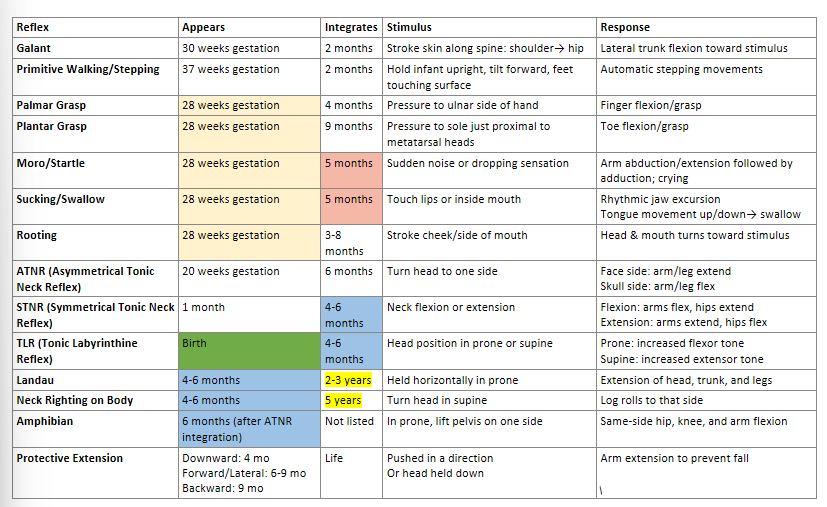
Landau

Neck Righting on Body

Amphibian

Protective extension

Running

Jump

Galloping

Hoppin g

Skipping

Stairs

whats the hardest

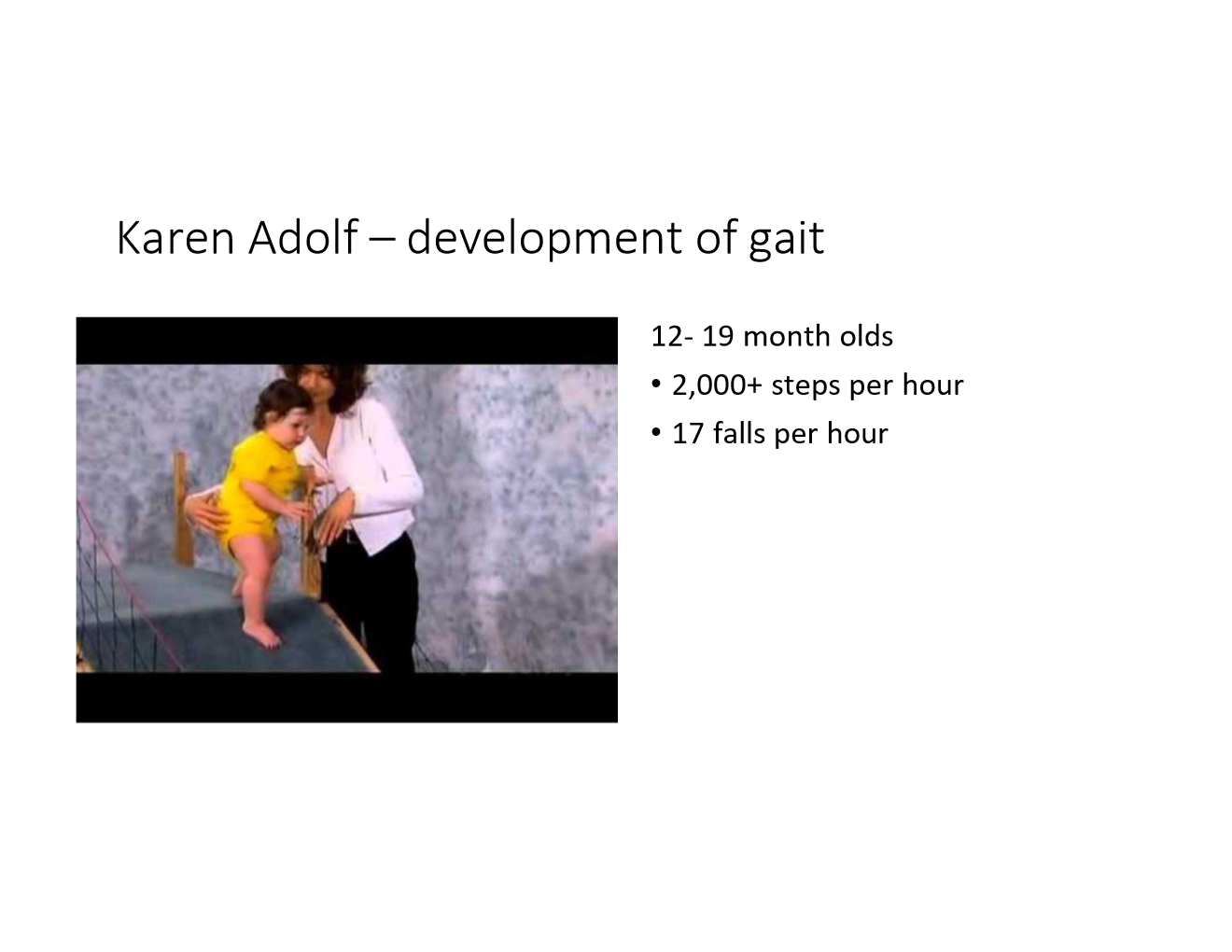
Refinement of skill
occurs over __ years following walking as advanced motor skills develop
Walking looks like and adult and has the ratio of an adult by what age?
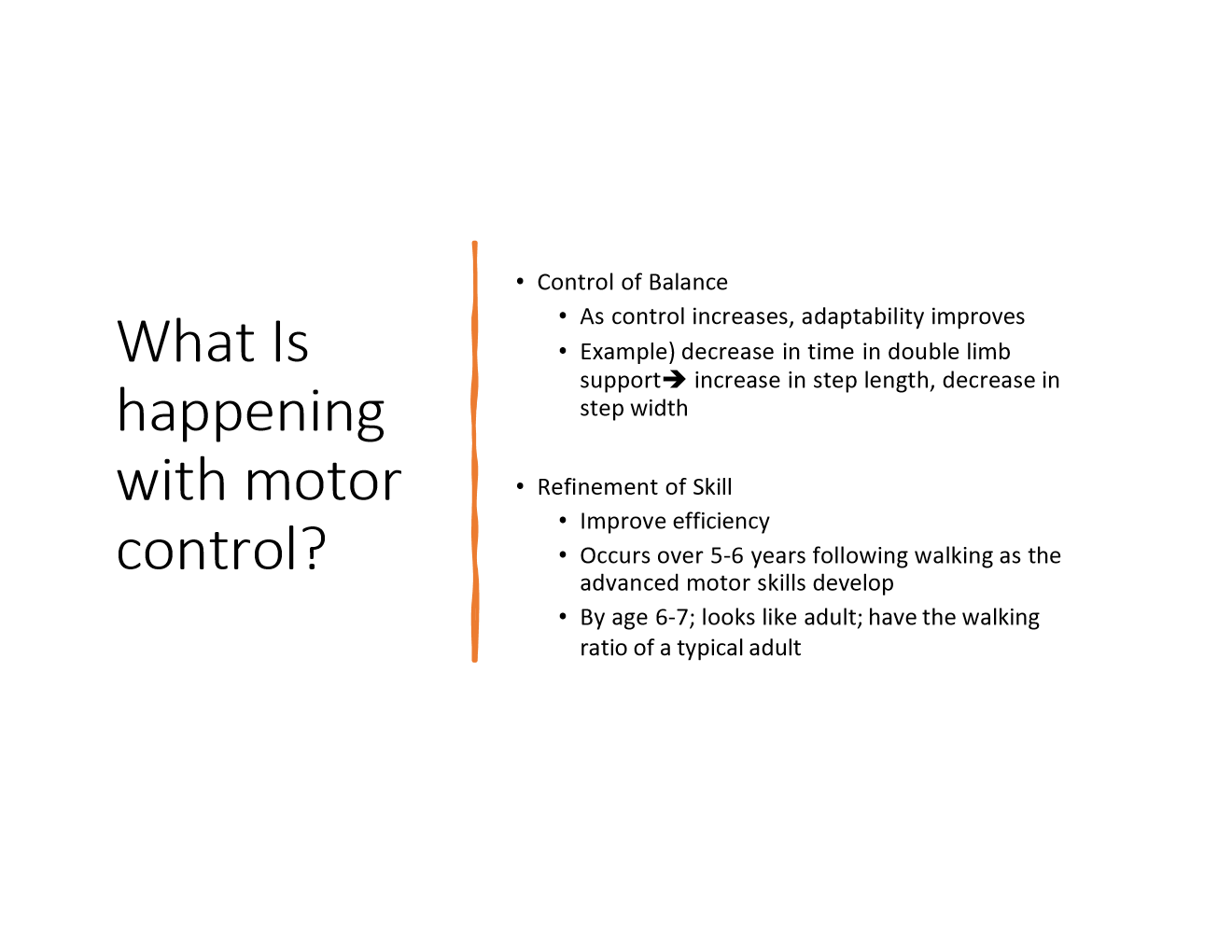
Karen adoloph
age
how many falls per hour
Why is walking so hard

Input depends on

Reach and grasp
starts around:
refinement period

Observation of functional skill
Observation of functional skills
Advantages
No equipment
Useful for infants/children that can't follow directions
Looks at real life function
Disadvantages
Not a direct strength measurement
Subjective
Best for
Infant/very young children
Cognitive/behavioral challenges
MMT
MMT ("break")
Advantages
No equipment
Test for specific muscles
Reliable for weaker muscle grades
Disadvantages
Less accurate for strong muscles
Only tests in one position, not whole range
Best for
3+
Can follow directions
Ortho injures/surgeries
handheld Dynamometry
Handheld Dynamometry ("make")
Advantages
Actual #
Detects small changes in strength
Can be used 28+ months
Normative data
Disadvantages
Requires training/standardized procedures
Costly equipment
Needs recalibrated
Best for
Follow directions
Post-surgical/ortho
Annual strength monitoring
Isokinetic dynamometry
Isokinetic Dynamometry (entire ROM)
Advantages
Strength through entire ROM
Measures concentric & eccentric strength
Can measure power
Disadvantage
Expensive, large equipment
Specialized training
Impractical
Best for
Labs
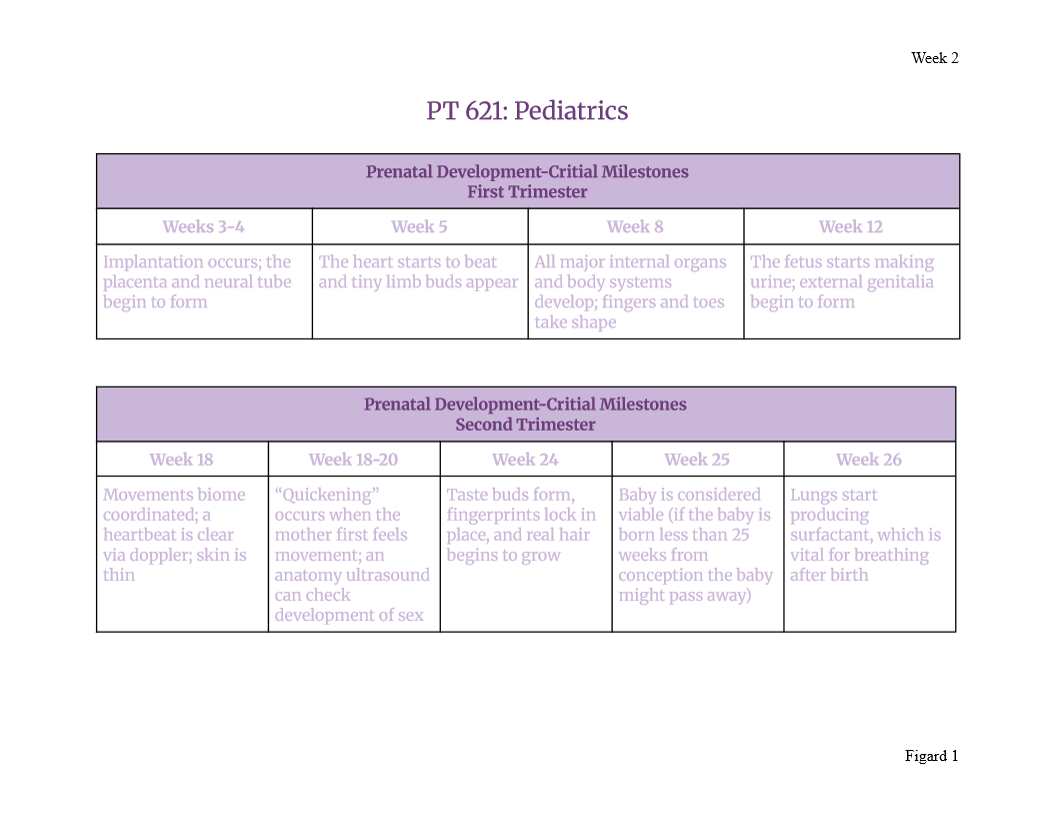
First trimester

Second trimester
Third trimester