Efficient Market Hypothesis
 Call Kai
 Learn
 Practice Test
 Spaced Repetition
 Match
 Flashcards
 Knowt Play
1/4

Earn XP
Description and Tags
5 Terms
Weak-Form Efficiency
A form of market efficiency where current share prices reflect all past market data, such as historical prices and trading volumes. This means investors cannot consistently earn abnormal returns by analysing past price movements alone.
Key implication: Past price patterns cannot consistently predict future returns.
Technical analysis: Cannot consistently generate abnormal returns.
Random walk: Future price movements are unpredictable from past prices alone.
Important distinction: New information can still cause share prices to change.
Example: An investor cannot consistently beat the market simply by studying historical share price charts.
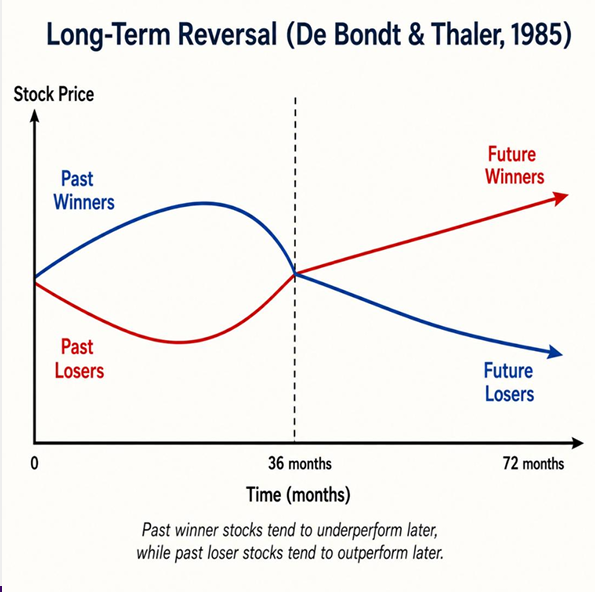
Pattern : Reversal
very long-term losers have sometimes subsequently outperformed winners.
De Bondt and Thaler (1985) sorted stocks according to their performance over the past 36 months
Pattern : Momentum
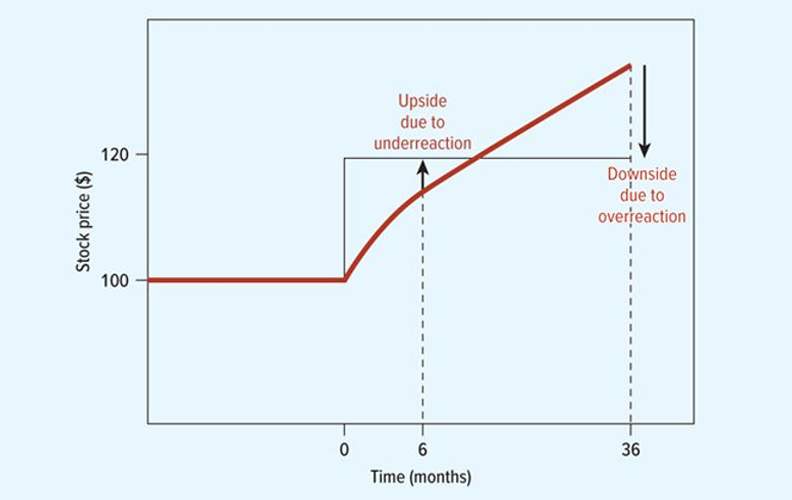
Jegadeesh and Titman (1993) focus on stock performance over the past 6 months, not 36 months
The market underreacts in the short term but overreacts in the long term.
The crossover point is unclear
Semi-strong form efficiency
Semi-strong form efficiency is a form of market efficiency where share prices reflect all publicly available information, including historical prices, company accounts and news.
Key implication: Investors cannot consistently earn abnormal returns using public information.
Technical analysis: Cannot consistently generate abnormal returns.
Fundamental analysis: Cannot consistently outperform the market using public information alone.
New information: Prices adjust rapidly when new public information becomes available.
Example: An investor cannot consistently beat the market by analysing published company financial statements.
Strong Form Efficiency
Strong-form efficiency is a form of market efficiency where share prices reflect all available information, both public and private (inside information).
Key implication: No investor can consistently earn abnormal returns using any information.
Public information: Includes company accounts, news and historical prices.
Private information: Includes confidential, non-public company information.
Insider trading: Even insiders would not consistently gain an advantage under this theoretical model.
Example: An investor with confidential knowledge of a future takeover could not consistently earn abnormal returns if the market were strong-form efficient.