GEN CHEM - CH 1-3
 Call Kai
 Learn
 Practice Test
 Spaced Repetition
 Match
 Flashcards
 Knowt Play
1/25

There's no tags or description
Looks like no tags are added yet.
26 Terms
What is an ‘atom’?
The smallest particle of an element that cannot be divided into smaller particles
What is an ‘element’?
The simplest form of matter — a pure substance that cannot be seperated into simpler substances
What is a ‘compound’?
A pure substance of 2 or more different elements that are chemically bonded in a fixed proportion
What is a ‘molecule’?
The result of 2 atoms of the same element chemically bonding together
How do you write out a chemical/molecular formula?
A notation that uses an element symbol and a numerical subscript to show how many atoms of that element are present.
EX) O2 → there are 2 Oxygen atoms
“2 parts Oxygen”
How do you write a structural formula?
A representation of a compound that uses short lines to connect the different atoms to their bonds.

How do you define the subject of ‘chemistry’?
The study of composition, structure, and properties of matter and of the energy consumed/given off when matter undergoes change

A) Energy is absorbed
B) Energy is released
C) Sublimation
D) Melting
E) Vaporization
F) Condensation
G) Freezing
H) Deposition
What is the formula for density?
d = m/v
Accuracy v. Precision
Accuracy: how close measurements are to the desired result
Precision: related to the reproducibility of the measurements
Exact v. Inexact qualities
Exact: counted; has infinite number of variables between values (measured)
Inexact: qualities
What are the rules for sig figs?
Zeros at the beginning don’t count → 0.0592
Zeros after a decimal point AND a non-zero digit count → 3. 00 × 108
Zeros at the end of a # w/out a decimal point CAN be counted→46,5 00
zeros between significant digits ARE counted → 1 0 1.3
What is a proton/neutron?
Proton: a positively charged particle
Neutron: a particle with no charge
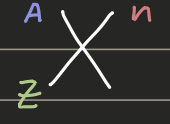
What does each variable represent?
X = the chemical symbol of the element
A = atomic mass (protons + neutrons)
Z = atomic number (protons)
N = charge (protons - electrons) → usually the same amount of protons (except when there is a viable +/ - charge)

What elements fall under metals/nonmetals/metalloids?
Metals: yellow
Nonmetals: blue
Metalloids: green

What elements fall under the main group/transition metals/radioactive elements?
Boxed in blue/columns 1-2, 13-18: main groups
Boxed in green/columns 3-12: transition metals
Boxed in red: radioactive metals
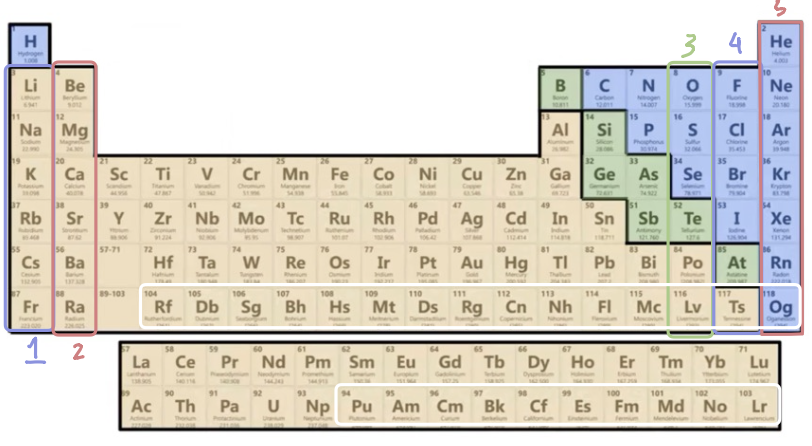
What does each highlighted column represent?
Alkali Metals
Alkaline earth metals
Chalcogens
Halogens
Nobel Gases
What is the formula to calculate the average atomic mass of a single element?
mx= a1m1 + a2m2 + a3m3….
a = mass
m = the % of natural abundance (divide it by 100 before multiplying it w/ the mass)
What is the dfference between a cation and an anion?
Cation: fewer electrons than a neautral atom so it has a positive charge
Ex) K+, Mg2+
Anion: more electrons than a neutral atom so it has a negative charge
Ex) S2-, Cl-
What is the symbol for Automic Mass? (You only need to memorize the variable, not the actual converstion value)
1u = 1.66054 × 10⁻²⁷ kg
(Can also be written as: g mol-1)
How do you find the atomic mass of a compound?
Add up the individual masses (multiply them by how many moles of said element there are, if necessary) and add them up to get the compound’s atomic mass.
Ex) C3H6O → (3 x C mass) + (6 x H mass) + (1 x O mass)
(3 × 12.011u) + (6 × 1.008u) + (1 × 15.999u) = 58.080 u / g mol-1
What is the formula for finding the total number of atoms using molecular mass?
total # of atoms = total mass of all atoms / average mass of 1 atom
By using the term ‘1 dozen is equal to 12 eggs’, how many moles are there of each element in one mole of C6H12O6?
There are 6 moles of C and O, respectively, and 12 moles of H.
What are the wavelengths of a frequency that has a lower rate, versus one that has a higher frequency?
A wavelength of a lower frequency would have a longer wavelength, in comparison to a much shorter wavelength of a frequency which is higher.
What is frequency measured in?
v (nu) is measured using s-1, which is also equal to Hz
1 Hz = 1 s-1
Convert 532 nm to m in order to make it a measurable wavelength.
1 nm = 10-9m
532 nm x 10-9m / 1 nm = 532 × 10-9m