Proteins & enzymes
 Call Kai
 Learn
 Practice Test
 Spaced Repetition
 Match
 Flashcards
 Knowt Play
1/22

There's no tags or description
Looks like no tags are added yet.
23 Terms
What are some functions of proteins?
Structural (e.g. collagen)
Enzymes (e.g. amylase)
Transport (e.g. haemoglobin)
Hormones (e.g. insulin, glucagon)
What are proteins made of?
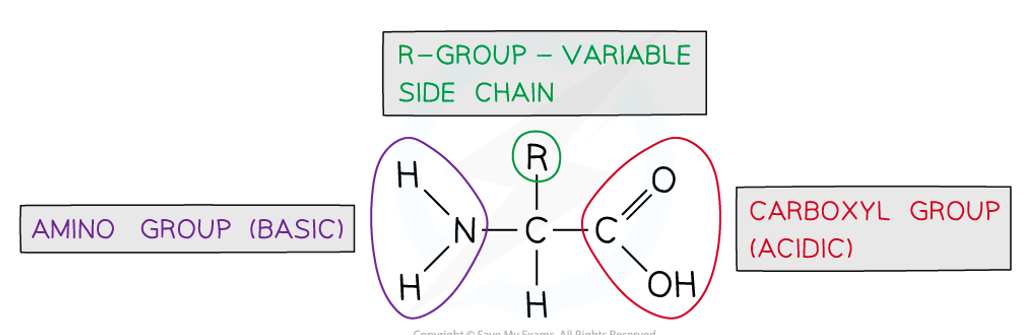
Amino acids:
a hydrogen atom
a basic amino group
an acidic carboxyl group
a variable “R group”
How are polypeptides formed?
When multiple amino acids are joined together by peptide bonds in a condensation reaction, resulting in molecules of water being formed as well

What is the primary structure of a protein?
The specific sequence of amino acids in the polypeptide chain
What is the secondary structure of a protein?
The folding of the primary structure into an alpha-helix or beta-pleated sheet due to the formation of hydrogen bonds
What is meant by alpha-helix?
The polypeptide chain is wound round to form a helix & is held together by hydrogen bonds running parallel with the long helical axis
There are many hydrogen bonds → very stable & strong structure

What is meant by beta-pleated sheet?
The polypeptide chain zig-zags backwards & forwards, forming a sheet of anti-parallel strands & is held together by hydrogen bonds

What is the tertiary structure of a protein?
The 3D folding of a protein, held together by hydrogen bonds, ionic bonds or disulphide bonds between R groups
Polar amino acids on outside & non-polar on inside
What is the quaternary structure of a protein?
The folding of more than one polypeptide chain
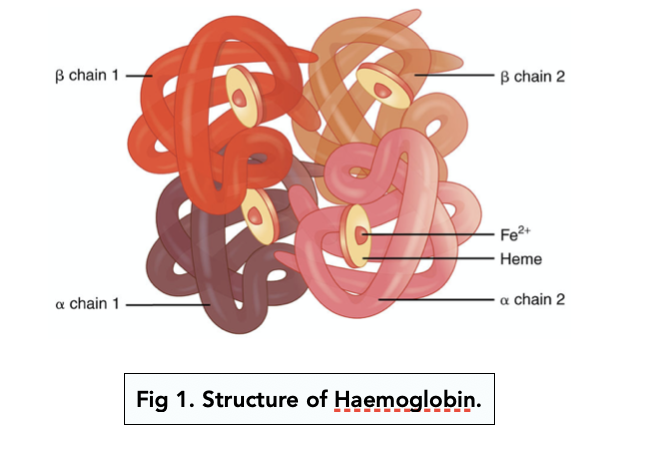
What are globular proteins & give an example?
Have a tertiary & quaternary structure, held together by hydrogen/ionic bonds & disulphide bridges → hydrophilic on the outside & hydrophobic on the inside
Haemoglobin is composed of four globular (2 alpha & 2 beta) polypeptide chains (globins). Each chain contains a prosthetic haem group, with Fe2+ in the centre
What are fibrous proteins & give an example?
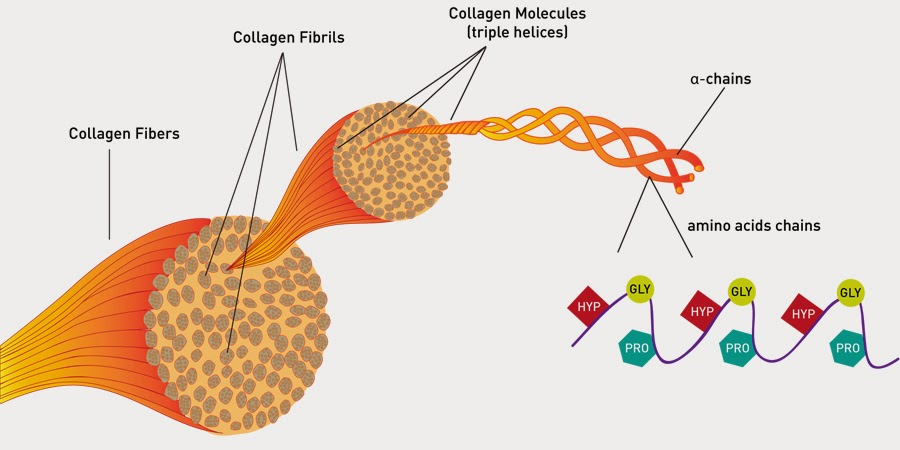
Long, thin insoluble polypeptide chains that form structural components:
e.g. collagen → 3 polypeptide chains that form a triple helix, held together by hydrogen bonds (many triple helices joined together)
What is denaturation?
If the hydrogen bonds break in the secondary, tertiary & quaternary structure, then the protein loses its 3D structure
The polypeptide chain just folds into a random coil & the protein loses its function (happens at very high temperatures or at very low/high pH)
covalent bonds aren’t broken however, so the primary structure remains intact
What are intracellular & extracellular enzymes?
Intracellular enzymes: catalyse all metabolic reactions inside cells & organelles (e.g. respiration & protein synthesis)
Extracellular enzymes: synthesised inside cells but then are exported & catalyse reactions outside the cell (e.g. digestive enzymes)
What is the lock-and-key model?
The shape of an enzyme’s active site is complementary to the shape of the substrate molecule
So, the substrate molecule binds to the active site & the product is released

What is the induced-fit model?
The active site’s shape is not directly complementary, so changes shape slightly to accommodate the substrate to form an ES complex → puts strain on substrate bonds, lowering activation energy
When products have been made & leave, the active site returns to its original shape

How does temperature affect the rate of enzyme reactions?
Up to optimum temperature, rate of reaction increases as enzyme & substrate molecules have more kinetic energy → collide more often & also have energy to overcome activation energy
Above optimum temperature, hydrogen bonds holding secondary, tertiary & quaternary structures of enzyme together are broken → enzyme loses its specific shape, becoming a random coil → substrate can no longer bind
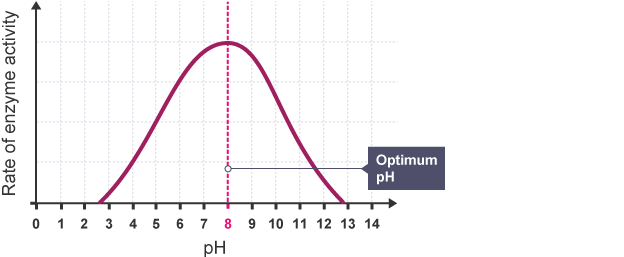
How does pH affect the rate of enzyme reactions?
The pH affects the charge of the R-groups of the amino acids at the active site
The enzyme & substrate could adopt the same positive (low pH: too many H+ ions) or negative (high pH: too many OH- ions) electrical charge, causing electrostatic repulsion, so ES complexes cannot form
How does enzyme concentration affect the rate of enzyme reactions?
As enzyme concentration increases, the rate of reaction also increases as there are more enzyme molecules available to catalyse the reaction
At very high enzyme concentrations, the substrate concentration becomes the limiting factor → rate of reaction plateaus
How does substrate concentration affect the rate of enzyme reactions?
As substrate concentration increases, the rate of reaction also increases as more substrate molecules can collide with enzyme molecules → more ES complexes formed
At higher substrate concentrations, the enzyme active sites become saturated with substrates, so enzyme concentration becomes the limiting factor → graph plateaus
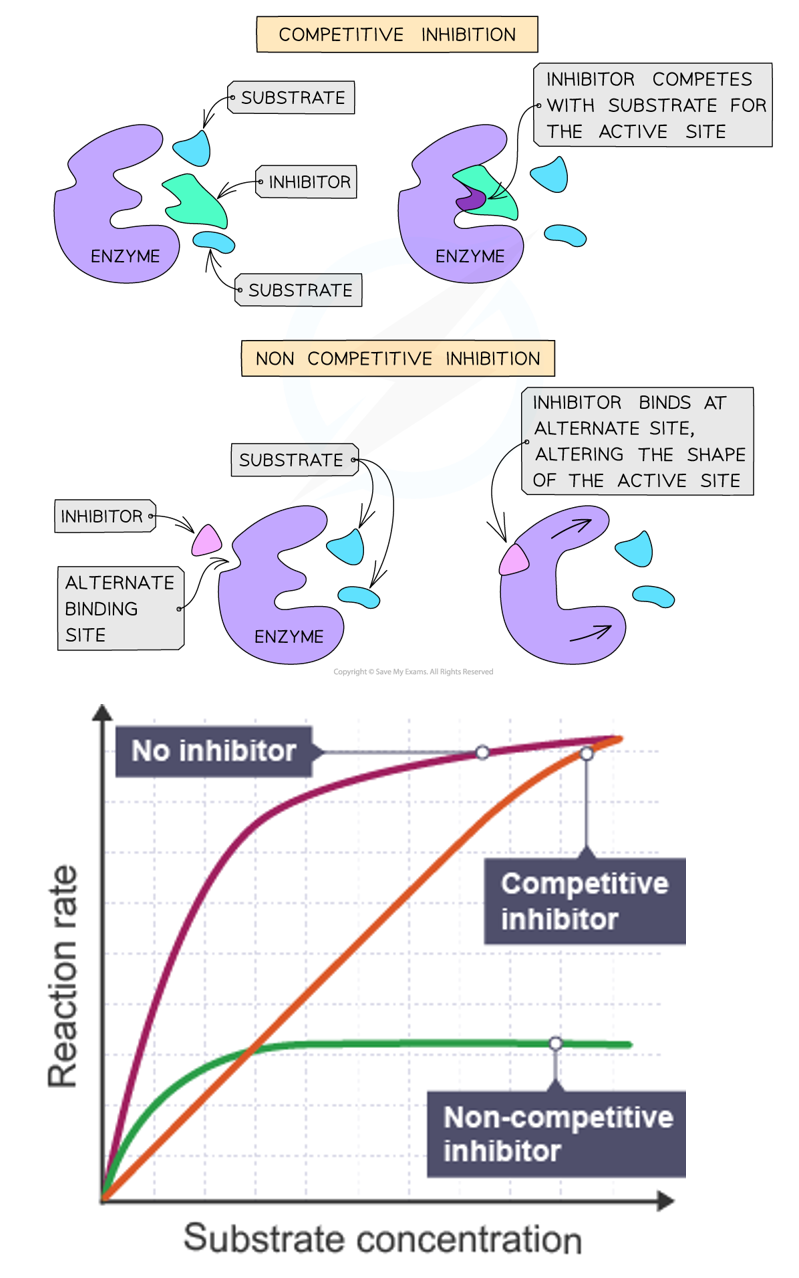
What are competitive inhibitors?
Molecules with a similar structure to the normal substrate molecule & can fit into the active site of the enzyme
They compete with the substrate for the active site, so the reaction is slower
However, if the substrate concentration is increased high enough, it will out-compete the competitive inhibitor & the rate can approach a normal rate

What are non-competitive inhibitors?
Molecules with a different structure from the substrate molecule & do not fit into the active site
They bind to the allosteric site on the enzyme & change the active site, so that the substrate molecules can no longer bind
Increasing the substrate concentration has no effect because the amount of active enzymes are reduced
Outline the process of end-product inhibition
When the final product of a metabolic pathway reaches a high concentration, it binds to the first enzyme in the pathway at an allosteric site
This causes a conformational change in the enzyme, altering the 3D shape of the active site
This means the substrate is unable to bind effectively, reducing the rate of ES complex formation & slowing the pathway

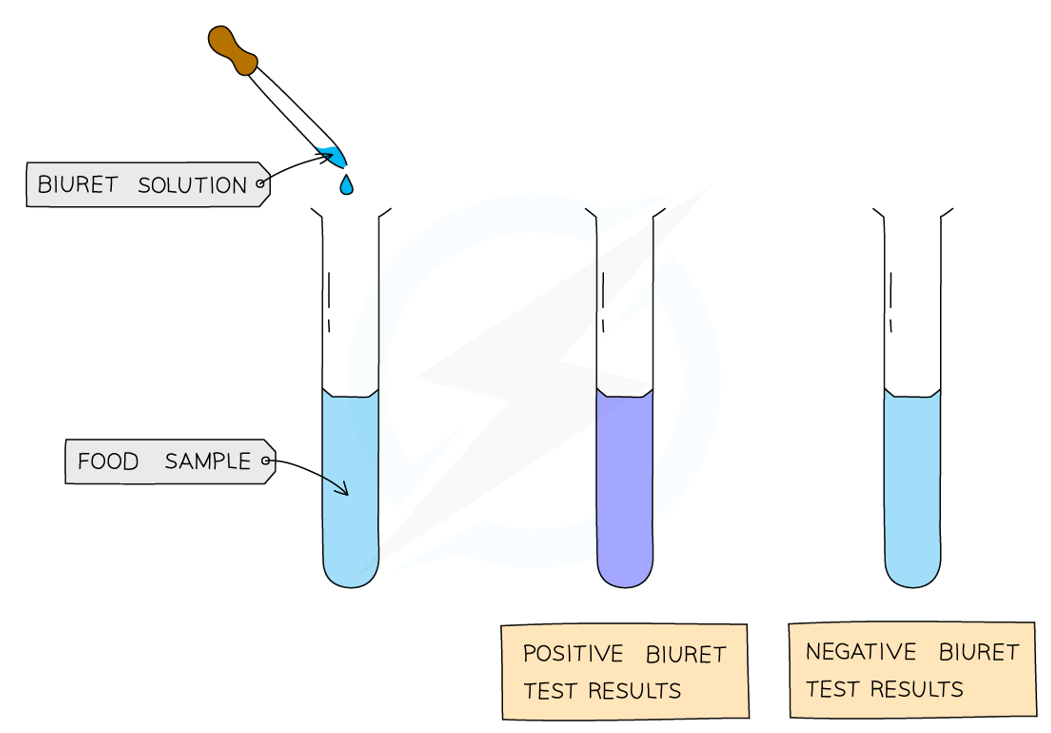
What is the biochemical test for proteins?
Biuret test:
Add few drops of sodium/potassium hydroxide & then add copper sulphate
If proteins are present, solution will change from blue to purple