UW Madison Biochem 501 - Exam 3
 Call Kai
 Learn
 Practice Test
 Spaced Repetition
 Match
 Flashcards
 Knowt Play
1/128

There's no tags or description
Looks like no tags are added yet.
129 Terms
Fast combustion
Direct reaction of oxygen with C-C and C-H bonds to form CO2 and H2O. A lot of energy is released as this is going from less to more stable bonds
Goal of metabolism is
To harvest a portion of energy
It is thermodynamically impossible for cells to get all of the energy
Keq is equal to
[products]/[reactants]
Thermodynamics
How much energy is released as a reaction proceeds towards equilibrium
ΔG
Gibbs free energy
Negative ΔG
If a rxn occurs, will proceeds reactants (left) -> products (right)
- Formation of products is favored
Positive ΔG
if a rxn occurs, will proceeds products (right) -> reactants (left)
- Formation of reactants is favored
Exergonic
Negative ΔG
Endergonic
Positive ΔG
If ΔG is 0 then
Reaction is at equilibrium
ΔH
Change in enthalpy
Difference in bond energies between reactants and products
ΔS
- Change in entropy
- Randomness
- Favorable ΔG (negative) if this is more positive
Exothermic
- Heat is released
- -ΔH
- More stable bonds are formed and heat is released
- Favorable ΔG (negative)
I.E. a candle burning
Endothermic
- Heat is absorbed
- +ΔH
- Less stable bonds are formed and heat is absorbed
ΔG°
Energy change from standard conditions to equilibrium
Standard Conditions
- Can calculate ΔG° at these and determine actual ΔG at any concentration of reactant and products
Larger the negative value is for ΔG means
More energy was released, it was more energetically favorable, and concentrations of products at equilibrium is high
Enzymes
Increase the reaction rate by lowering the activation energy
ATP
The universal energy carrier
Coupled rxn
You need an ATP step where there is a reaction with ATP and a second reaction where ATP is released
Glycolysis
- Has two stages
Preparatory and Payoff
- Net gain of
2ATP and 2 NADH
Glycolysis preparatory phase
ATP is used up to get the pathway going
1. Hexokinase Reaction
2. Phosphohexose Isomerase
3. Phosphofructokinase (PFK-1)
4. Aldolase
5. Triose Phosphate Isomerase (TPI)
Glycolysis payoff stage
ATP is generated
6. Oxidation of Glyceraldehyde-3-P
7. Phosphoglycerate Kinase (First Payoff)
8. Phosphoglycerate Mutase
9. Formation of Phosphoenolpyruvate
10. ATP from PEP: Pyruvate Kinase (Second Payoff)
Stages of Glycolysis
1. Hexokinase Reaction
2. Phosphohexose Isomerase
3. Phosphofructokinase (PFK-1)
4. Aldolase
5. Triose Phosphate Isomerase (TPI)
6. Oxidation of Glyceraldehyde-3-P
7. Phosphoglycerate Kinase (First Payoff)
8. Phosphoglycerate Mutase
9. Formation of Phosphoenolpyruvate
10. ATP from PEP: Pyruvate Kinase (Second Payoff)
Hexokinase Reaction
- A phosphate from ATP ends up in the 6th position of Glucose-6-P
- ΔG° = -16.7, a favorable reaction because the glucose phosphorylation is coupled to ATP breakdown
Phosphohexose Isomerase
- Enzyme isomerizing glucose-6-P to Fructose-6-P
- ΔG° = +1.7kJ/mol

Phosphofructokinase (PFK1)
- Another phosphate is added to for Fru-1,6-bisP + ADP, very favorable reaction due to ATP breakdown
- ΔG° = -14.2 kJ/mol
Aldolase
- Cleavage of fructose-1,6-biphosphate into 2 3-carbon sugars
- ΔG° = +23.8 kJ/mol

Triose Phosphate Isomerase (TPI)
- Isomerase interconverts Dihydroxyacetone phosphate and Glyceraldehyde-3-phosphate
- ΔG° = +7.5 kJ/mol

Oxidation of Glyceraldehyde-3-P
- Oxidation reaction of Glyceraldehyde-3-phosphate catalyzed by dehydrogenases
- Oxidation results in a carbon-oxygen bond to a phosphate
- Only redox reaction in glycolysis
- Hydrogen that is pulled off forms NADH
- ΔG° = +6.3 kJ/mol
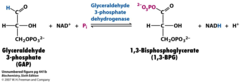
Phosphoglycerate Kinase
- First payoff
- Product of the dehydrogenase reaction is 1,3-biphosphate-glycerate
- Phosphoglycerate kinase can catalyze the transfer of the phosphate to ADP to form ATP
- Product is 3-PGA
- ΔG° = -18.5, indicative of how much higher energy the phosphate bond in 1,3-biphosphate-glycerate is than the final bond in ATP
Phosphoglycerate Mutase
- This step is to rearrange the molecule so phosphate is in a high-energy state
- 3PGA to 2PGA
- ΔG° = +4.4 kJ/mol
Formation of Phosphoenolpyruvate
- This step is to rearrange the molecule so phosphate is in a high-energy state
- Water molecule is removed from 2PGA to form Phosphoenolpyruvate (has a C-C DB)
- ΔG° = +7.5 kJ/mol
ATP from PEP: Pyruvate Kinase
- Second payoff
- Phosphate can be transferred to ADP to form ATP
- ΔG° = -31.4 kJ/mol, very favorable in formation of ATP

Kinase
Addition of a phosphate
Adding a free phosphate to glucose is
an uphill reaction, positive free energy change
Losing a phosphate from ATP is
a downhill reaction, a favorable reaction
ATP is a substrate for phosphofructokinase, yet ATP inhibits enzyme activity. A possible model for this is
ATP binds to both the active site of the enzyme and to a separate allosteric site
- Levels of ATP that inhibit are much higher than levels needed for the reaction at the enzyme active site
- If ATP levels rise, you do not need as much glycolysis. So as levels rise, there is a separate site tuned by evolution to recognize the high levels of ATP and inhibit the enzyme
when a pathway is "operating" actual ΔG are
Negative
Oxidation reaction
Electrons are pulled off
Phosphofructokinase regulation
- Fru-6-P + ATP -> Fru-1,6-bisP + ADP
- Regulated by energy balance and also by alternate fuels
- High ATP and free fatty acids inhibit the enzyme
- High AMP, ADP activates the enzyme
Steps 1,3, and 10 of glycolysis are irreversible. Which of the following statements regarding glycolysis is incorrect
The standard free energy changes for steps 1, 3, and 10 are large and positive
How many pyruvate molecules are formed from one molecule of glucose
2
Oxidation of what bonds produce the largest amount of energy
C-C and C-H bonds
The symbol of ΔG° represents ____ while ΔG represents ____
A standard reference point; actual conditions
Which of the following statements regarding Gibbs free energy is correct
If a reaction has a large and negative free energy change ( ΔG°), product formation will be favored in actual conditions unless the ratio of products to reactants is high enough to drive the reaction in the reverse direction
Consider the reaction A -> B. If at equilibrium, the concentration of B is greater than the concentration of A, is the change in standard free energy (ΔG°) of the reaction
Negative
Fates of Pyruvate
1. Fermentation (Anaerobic)
2. Aerobic Respiration
Fermentation products
2 lactate
2 Ethanol
2 ATPs
Aerobic respiration products
2 Acetyl-CoA + O2 = CO2 and H2O
30 ATPs
Fermentation
Ways to anaerobically regenerate NAD+ from NADH to maintain glyclosis
Redox Reactions
transfer of electrons
Mitochondria is the site of what
Pyruvate Dehydrogenase
Citric Acid Cycle
Pyruvate Dehydrogenase Complex Inhibition
High energy such as
NADH
ATP
Acetyl-CoA
Pyruvate Dehydrogenase Complex Stimulation
Low energy such as
NAD+
AMP
CoA
Lipoic Acid
Acyl and Redox carrier

Reduced form of Lipoic Acid
Carrying elections

Acylated form of Lipoic Acid
Carrying substrate
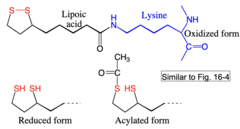
Pyruvate Dehydrogenase Mechanism 1
E1 reaction
Decarboxylation
Decarboxylation
C-C bond converted to C-H bond and CO2 was released
Pyruvate Dehydrogenase Mechanism 2
E2 reaction
oxidation
Lipoic acid becomes reduced after oxidation
Acetyl-CoA carries away substrate
Pyruvate Dehydrogenase Mechanism 3
E3 reaction
Shuttling electrons to a carrier (NAD+) and enabling PDH to "Go another round"
Pyruvate Dehydrogenase Reaction Overview
ΔG° = -33/4 kJ/mol
Thiamine is necessary for pyruvate dehydrogenase activity. In a thiamine deficient person, which of the following compounds might you expect to be elevated
Pyruvate, since pyruvate dehydrogenase cannot catalyze the reaction, the pyruvate levels would be high.
Citric Acid Cycle importance
Central energy-yielding path
In the mitochondria
Intermediates are recycled, thus "cycle"
Citric Acid Cycle Input
Acetate of acetyl-CoA (2 Cs and 4 reduced bonds)
Citric Acid Cycle output
3 NADH, FADH, 2 CO2, and GTP
Citrate Synthase
1st step of CAC
Regulated step
ΔG° = -32.2kJ/mol
CoA is recycled
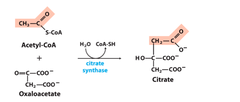
Aconitase
2nd step of CAC
Rearrangement
ΔG°= +13.3kJ/mol
Dehydrogenases
Catalyze progressive oxidations in "clockwise" direction of citric acid cycle
Isocitrate Dehydrogenase
3rd step of CAC
Energy is harvested
Oxidative decarboxylation: 6C -> 5C
ΔG° = -20.9 kJ/mol
alpha-ketoglutarate Dehydrogenase Complex
4th step of CAC
Oxidative decarboxylation: 5C -> 4C
ΔG° = -33.5 kJ/mol
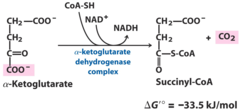
The e# subunit can be the same in PDH and alpha-keto DH because
The substrates for E3 are identical in both reactions
Succinyl CoA synthetase
5th step of CAC
"harvest" energy of thioester
Succinate Dehydrogenase
6th step of CAC
Desaturation (7 "oxidizable" bonds to 6)

Fumarase (Fumarate Hydratase)
7th step of CAC
Hydration reaction, H2O added across the double C-C bond

Malate Dehydrogenase
8th step of CAC
Highly endergonic ΔG°= +29.7
The conversion of malate to oxaloacetate (coupled to the formation of NADH) has a large and positive standard ΔG°= +29.7 kJ/mol. When the citric acid cycle is running, the concentration of oxaloacetate must be
Quite low relative to malate so that the actual ΔG is negative
Citric Acid Cycle Overview, combustion
Glucose + O2 -> CO2 + H2O
Citric Acid Cycle Overview, metabolism
Glucose + NAD+ & FAD + H2O + ADP -> CO2 + NADH & FADH + ATP
Approximate Energy Yield from Glucose Oxidation
4 CO2 and 36 ATP
Regulation of the Citric Acid Cycle, Inhibition
ATP, Acetyl-CoA, NADH, fatty acids
Regulation of the Citric Acid Cycle, Stimulation
Low energy
AMP, COA, NAD+, Ca2+
Anapleroctic
Reaction that put Cs back into the CAC
Lipids
A general term which includes membrane components, hormones, vitamins, etc.
Triacyglycerols
Type of lipid used for energy storage
Bile Salts
break up fats which increases the SA for lipases to digest fats
Lipases
Hydrolysis to fatty acids which are the form transported across the plasma membrane
Fatty acid oxidation steps
1. Activation
2. Transport
3. Beta-Oxidation (4 step process)
Fatt acid oxidation, Activation step
Fatty acid joined to Coenzyme A
- Enzyme on outer mitochondrial membrane
- Once inside the cell, fatty acids are "activated" by acyl-CoA synthetases on the outer membrane of the mitochondria
- 2 high energy P bonds are broken
Fatty acid oxidation, transport step
Across the inner mitochondrial membrane into the mitochondrial matrix
- Carnitine carrier system separates cytosolic and mitochondrial pools
-
Fatty acid oxidation, beta-oxidation step
Conversion of fatty acid into acetyl-CoA units into mitochondrial matrix
Fatty acid entry into mitochondria
Once here, fatty acids are destined for breakdown.
In cytosol, fatty acids and triacylglycerol synthesis occurs when there is excess carbohydrate
Knoop Experiment
- Step-wise breakdown by 2 C units
Which of the following types of enzymes typically catalyzes redox reactions
Dehydrogenases
Beta-oxidation 1st step
Dehydrogenation
- Beta Hydrogen gets oxidized and forms double C-C bond
- Fatty acyl-CoA dehydrogenases

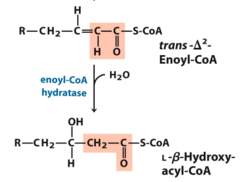
Beta-oxidation 2nd step
Hydration
- H2O is added across the double C-C bond
- Enoyl-CoA-hydratase
Beta-oxidation 3rd step
Dehydrogenation
- Beta-hydroxyacyl-CoA dehydrogenase

Beta-oxidation 4th step
Cleavage
- CoASH splits molecule
- Thiolase (acyl-CoA transferase)

Carbs and fats "burn clean" which means
They are completely converted into CO2 and H2O in metabolism due to C-C/C-H/fully oxidized bonds