CMI 354 - TEST 2
 Call Kai
 Learn
Learn Practice Test
 Spaced Repetition
 Match
Match Flashcards
 Knowt Play
1/46

There's no tags or description
Looks like no tags are added yet.
Name | Mastery | Learn | Test | Matching | Spaced | Call with Kai | Chat |
|---|
No analytics yet
Send a link to your students to track their progress
47 Terms
What is the angle of insonation for a lower extremity arterial exam, extracranial carotid exam, transcranial doppler
60 or less
45-60
0
What is a carotid body tumor?
Rare
1-1.5mm mass of vascular tissue located in the adventitia of the carotid bifurcation
controls blood pressure and pH
blood supply comes from ECA
What is the circle of Willis, and what does it connect?
intracranial communication channel
connects the anterior and posterior circulatory systems
TIA?
Stroke in evolution?
RIND?
Completed stroke?
Brain death?
transient ischemic attack symptoms last from a few minutes to hours; 6% stroke risk; usually caused from heart or carotid artery emboli
symptoms come and go; unstable
last longer than TIA slightly longer than 24hr recovery; brain tissue is damaged but there is complete recovery
no progression or resolution of symptoms; considered stable
increasing pulsatility with end diastole reaching zero; reverberatory flow where forward and reverse flow are equal
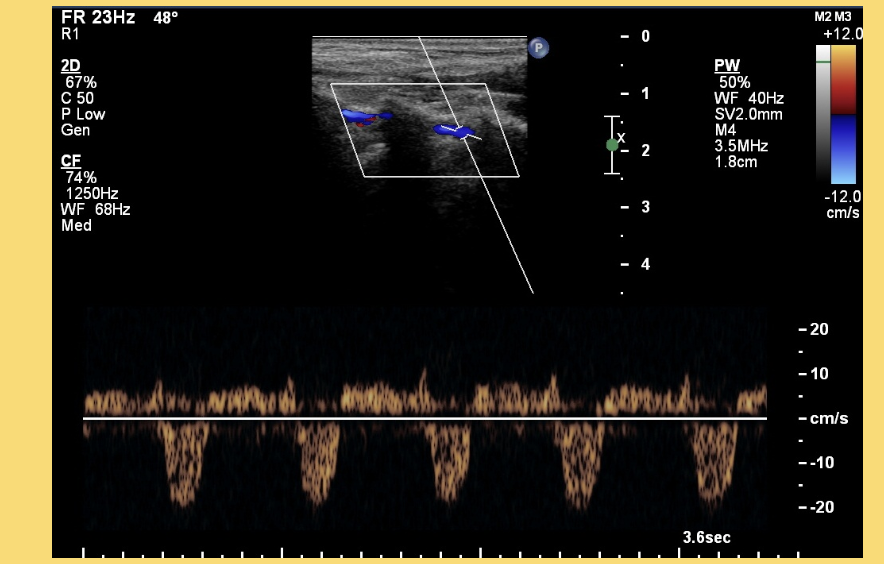
Know the difference between normal vertebral artery vs retrograde vertebral artery
retrograde
vertebral artery

Where would you commonly find a pseudoaneurysm?
right common femoral artery

Label
transorbital
transtemporal
transcervical
transforaminal
What vessels can you see in these windows?
transorbital, transtemporal, transcervical, transforaminal
Ophthalmic artery and carotid siphon
MCA,TICA,ACA,PCA
CCA,ECA,ICA
vertebral and basilar arteries
Where direction does MCA go to transducer?
toward
Where direction does TICA go to transducer?
toward
What direction does ACA go to transducer?
away
What direction does PCA(p1) go to transducer?
toward
What direction does PCA(P2) go to transducer?
away
What direction does OA go to transducer?
toward
What direction does carotid siphon go to transducer?
toward
What direction does ICA go to transducer?
away
What direction does VA go to transducer?
away
What direction does BA go to transducer?
away
What are the characteristics of the ICA?
higher pitched and more continuous than ECA
less pulsatile with increased diastolic flow
does not touch baseline
low resistance
tri,bi,monophasic are not used to decribe cerebral vasculature
normal: <125cm/s; no visible plaque or intimal thickening
ICA/CCA ratio <2.0
What are the characteristics of the ECA?
lower pitched
more pulsatile than ICA
touches the baseline
high resistance
branch usually seen
Is the normal flow of the vertebral artery suppose to be antregrade or retrograde?
antregrade flow
What is the blood pressure in the subclavian steal?
>15-20mmHg pressure gradient in systolic pressure compared to contralateral side
Subclavian steal can ?
cause reversed flow in ipsilateral verterbral artery - subclavian “steals” from the vertebral artery

Label
anterior communicating artery
circle of willis
posterior communicating artery
basilar artery
left internal carotid artery
left vertebral artery
left subclavian artery
left common carotid artery
aortic arch
brachiocephalic artery
right subclavian artery
right vertebral artery
right common carotid artery
right internal carotid artery
posterior cerebral artery
opthalmic artery
middle cerebral artery
anterior cerebral artery
What is an aneurysm?
abnormal bulge, swelling, or ballooning in the weakened wall of an artery
vessel dilation >3cm
What makes up a true aneurysm vs a pseudoaneurysm?
true- dilation of all three layers of arterial wall
pseudo- pulsating hematoma; hole in arterial wall allows blood to escape under pressure into a contained area
What are the characteristics of the CCA?
waveform is a combo of ICA and ECA
filling in of spectral window is consistent with multiple frequencies and turbulent flow
What are the characteristics of vertebral arteries?
same characteristics as ICA - low resistance and antegrade flow
stenosis generally occurs at the vessel origin at the subclavian artery
normal PSV =30-50cm/s
What is a subclavian steal
severe stenosis or occulusion of the subclavian art prox to the origin of the vertebral art
most common on left side
patients are asymptomatic
flow resistance in the vertebral artery increases because its feeding a higher resistane bed of the upper extremity
What is the first major branches of the ICA and ECA?
ophthalmic artery
superior thyroid artery
What does the ICA and ECA supply blood to?
anterior brain, eyes, forehead, and nose; 70-80% of blood in the ICA comes from CCA
neck,face,and scalp
What risk factors are there for cerebrovascular disease?
hypertension
hyperchloesterolemia
diabetes
What is a temporal tap and what does it identify?
a technique where the superficial temporal artery is tapped while using doppler ultrasound
ECA
What is takayasu’s arteritis and temporal arteritis?
chronic inflammation that results in narrowing of the arteries; known as the pulse less disease
inflammation of the distal superficial temporal artery; servere headache and/or sudden unilateral blindness
What is a transcranial doppler?
low frequency pulsed doppler transducer with spectral analysis and M-mode to evaluate intracranial vessels
Cerebrovascular disease may be overestimated when?
artifact is mistaken for plaque
accelerated flow is mistakenly attributed to stenosis
inappropriate doppler angle used
Cerebrovascular disease may be underestimated when?
fails to appreciate very low-level echoes of soft plaque
missed accelerated flow
high bifurcation-harder to thoroughly evaluate ICA
inappropriate doppler angle used
When they clean out a artery what is it called?
angioplasty
hollow tube is threaded through a blood vessel
small balloon on the tip of the catheter it is inflated to push the plaque to the side of the vessel so blood flow can resume
What is turbulent flow and what are other causes than plaque buildup?
disorganized blood flow with multiple velocities and frequencies causing spectral broadening on doppler ultrasound
vessel tortuosity
sharp bends
branching or bifurcations
increased blood flow velocity
% stenosis: normal 1-15%, 16-49%
PSV=<125CM/S
EDV= N/A
% stenosis: 50-79%
PSV=>125cm/s
EDV= <140cm/s
% stenosis 80-99%
PSV=>125cm/s
EDV=>140cm/s
Where does the right CCA, left CCA, vertebral arteries arise from?
brachiocephalic artery
aortic arch
subclavian arteries
What does the CCA bifurcate into?
ECA and ICA
What happens to the ECA waveform during a temporal tap?
a sawtooth pattern appears on the doppler waveform

Antegrade flow or retrograde flow?
antegrade flow

Antegrade flow or retrograde flow?
retrograde flow