Psychotherapy Exam 2
 Call Kai
 Learn
Learn Practice Test
 Spaced Repetition
 Match
Match Flashcards
 Knowt Play
1/67

There's no tags or description
Looks like no tags are added yet.
Name | Mastery | Learn | Test | Matching | Spaced | Call with Kai | Chat |
|---|
No analytics yet
Send a link to your students to track their progress
68 Terms
Behavioral Background
Based in learning theory
Behavior in response to environmental stimuli
Ivan Pavlov & J.B. Watson (earliest behavioral psychologists)
classical conditioning (automatic associations that we learn between stimuli)
B.F. Skinner
operant conditioning (reinforcemnt & punishment processes)
Albert Bandura (bobo doll experience)
modeling (learn behaviors by observing others)
Classsical Conditioning
Learning acquired through paired associations between an UCS & a CS to produce a CR
Starts w/a neutral stimulus
Process in which a neutral stimulus acquires capacity to produce response that originally came from a diff stimulus
Before conditioning events just a neutral stimulus, produces no response
After conditioning events is a conditioned stimulus, produces a conditioned response
Ex: Post-traumatic stress response after a car accident
Unconditioned Stimulus: loud noise
Unconditioned Response: startle response
Conditioned Stimulus: traffic noises
Conditioned Response: startle response
Behavioral Theory
Generalization
Spreading of a learned association to a new stimulus or situation
to similar stimuli
often time stimuli thats inappropriate or doesn’t warrent the reaction its producing
Behavioral Theory
Operant Conditioning
“Target Behavior”
More intentional, not an automatic association
Reinforcement: Increases a behavior
Punishment: Decreases a behavior
Positive: Adding a stimulus
Negative: Removing a stimulus
Pos reinforcement: if client attends session, receives praise
Neg reinforcement: if client does deep breathing, anxiety symptoms stop
Pos punishment: if client makes sexual advances, receives a warning
Neg punishment: if client becomes aggressive, therapy session stops
Behavioral Theory
Modeling
Learning behavior from observing others
Observer sees a specific behavior performed by a role model & repeats that behavior
Developed & maintained via reinforcement (pos or neg)
Ex: Intergenerational Abuse (relevent for how psychopathology developed; strong familial link) (big enviornmental component)
Aggressive behavior modeled by parents
Survivors of abuse learn aggressive behaviors are a way to obtain needs or wants
Behavioral Sources of Psychopathology
Aligned w/DSM diagnoses
Applied to most types of psychopathology
bc developed to target specfic diagnosis/psychopathology
Learning a problematic behavior
Adaptive vs. Unadaptive behaviors
Adaptive: promote well being
Unadaptive: determental to our well being
Context dependent
behaviors interact w/environment youre in)
Developed from learning history through classical conditioning, operant conditioning, or modeling
Inappropriate stimulus generalization
Factors that predispose, trigger, strengthen, or maintain a problematic behavior
Behavioral Focus of Therapy
Assessing & understanding target behaviors (adaptive & unadaptive)
Changing learning around target behaviors
break up classically asscoiated stimuli
use operant conditioning to increase or decrease a target behavior
Approach
Directive (therapist leading the show)
Goal-focused (come up w/really specific goals of what want to accomplish)
Skills-based (to apply in day to day life)
Therapeutic relationship de-emphasized (but not unimportant)
not as central
Manualized treatment options
Standardized approach
Session-by-session guides
Brief, usually less than 20 sessions
Behavioral Therapy Techniques
1st wave
Psychoeducation on target behaviors & therapy
education on psychology; educating client on their specifc probs
Exposure
Developing new learning to replace feared associations (Inhibitory learning)
Functional analysis
Understanding target behavior & factors controlling it
Behavioral Activation
Increasing pos reinforcement through rewarding activities
Exposure
Exposure for anxiety provoking situations
Graduated
Anxiety hierarchy
Types:
Imaginal
In-vivo
Interoceptive
Subjective units of Distress (SUDs)
Repeated exposure leads to inhibitory learning
To be effective exposures should:
Be within client’s control/predictable (but less over time)
Be long enough in duration for learning to occur
Provoke high, but manageable anxiety
Be repeated w/no long gaps
Occur in multiple contexts
Have client focus on feared stimuli
Safety behaviors-Ways to avoid feared stimulus
Distractions
Comfort objects or “safety signals”
Coupled w/“response prevention”
Functional Analysis
S-O-R-C Model
Stimulus: antecedent aka what comes before target behavior
bad living conditions
move apartments
Organism: variables unique to individual that will inform the behavior
poor emotional regulation
self-regulation skills
Response: the behavior of interest
eating cat food
relaxation exercise (alternative behaviors: replace the unadaptive behaviors)
Consequence: punishment or reinforcement resulting from the behavior
falling asleep easily
feeling rested

Classical Conditioning Fear
aquire anxiety over time
things elicit anxious response that they didn'tt have before
ex: fear of spiders
Pain from being bitten (body’s automatically gonna do)
Panic behaviors: response to pain
Seeing spider: now has conditioned property to it
Panic behavior: after seeing spider bc of previous learning
Spider transformed from neurtal stimulus to CS which now ellicit CR, panic behavior
Behavioral Activation
Addresses Depressive Disorders through improving mood & anhedonia
(lack of pleasure when experiencing something typically reinforcing to you)
Focused on pos reinforcement
Increasing reward & pleasure
Primary components:
Activity monitoring & scheduling (focus on social activities)
Increasing mastery & pleasure experiences
contribute to long-term goals
Decreasing avoidance behaviors
Goal setting
Role playing / social skills training
deal w/cons of social withdrawal
Treatment Mechanisms
Change in reinforcement contingencies
Reinforcement of more adaptive, varied alternative behaviors
Increased behavioral repertoire for increase flexibility in how ppl respond to situations
Inhibitory learning
Cognitive changes
New beliefs that feared situations aren’t dangerous
Increased tolerance of neg emotions
Cognitive-Behavioral Background
Behavioral treatments less successful for specific cases
Evolution from 1st-wave behaviorism
Thoughts influence emotions & behavior
Multicomponent approach
Behavioral: Understanding & changing learned behavior
+
Cognitive: Understanding and changing thoghts
Neg interpretations about oneself, world, & future
Cognitive-Behavioral Theory
Thoughts produce emotional & behavioral responses
reaction to & thoughts about what youre experiencing
goal = change how clients think bc should have an effect on both their emotions & their behaviors
ABC Model:
interpretation of an event leads to the subsequent emotional response & behaviors
Not event itself
Cognitions
Cognitions
Automatic thoughts
Surface level thoughts
Quick, fleeting, possibly unconscious
ex: I messed up my assignment
Schemas
Deeper beliefs that provide a cognitive framework for how a person understands & organizes the world
Development of biases, assumptions
new info framed to fit these schemas
ex: confirmation bias
ex: failure bias, perceiving everything I do as a failure
Core beliefs
Deepest level, hard to detect
Downward arrow + Cognitive Restructuring
Lasting, globally held ideas
ex: I am worthless

Cognitive Behavioral Theory Sources of Psychopathology
Development of dysfunctional thoughts that are:
Overly general/broad
no one loves me
Extreme
worse case possible
Rigid/Inflexiblie
really ingrained
Irrational
Assumed true, regardless of available evidence
Dysfunctional thoughts developed earlier in life
Ingrained over time
Thoughts that lead to difficulties w/emotions, well-being, & functioning
Cognitive Behavioral Focus of Therapy
Bringing awareness to the role of thoughts on emotions & behaviors
Modifying dysfunctional thinking (change way approaching thoughts)
Approach
Directive
Goal-focused
Skills-based
Evidence-based practice
Therapeutic relationship de-emphasized (but not unimportant)
Manualized treatment options
Standardized approach
Session-by-session guides
Brief, usually less than 20 sessions
Cognitive Behavioral Therapeutic Techniques
Functional analysis: The Cognitive Edition (ABC Model)
Thought monitoring
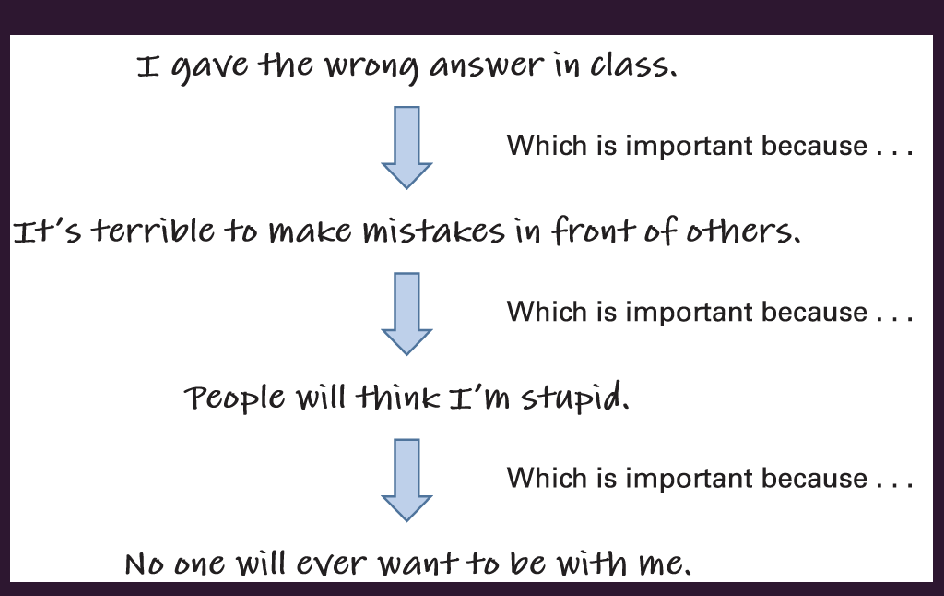
Downward arrow
dig deeper into schemas & core beliefs
Labelling cognitive dysfunctions
Cognitive restructuring
Thought records
Exercise to tie the above techniques together
Downward Arrow
Bring some attention to automatic thoughts, want to understand broad schemas & core beliefs person has about themselves
Identify activating event
Ask what event means about themselves, others, or world
Ask same question until a maladaptive belief is revealed
Review types of cognitive dysfunctions
Links automatic thoughts to schemas & core beliefs
Types of Cognitive Dysfunctions
All-or-nothing thinking
Overgeneralization
Mental filter
Jumping to conclusions
Mind reading
Catastrophizing
Emotional reasoning
“Should” & “must” statements
Examples of Dysfunctional Thoughts
Major depressive disorder:
tendency to see oneself as a failure, the future as hopeless, & to focus on neg aspects of situations
Generalized anxiety disorder:
tendency to overestimate the probability & severity of a crisis (e.g., losing a job)
OCD:
overestimates of threat & responsibility, beliefs that intrusive thoughts are highly significant & need to be controlled, & the intolerance of uncertainty & imperfection
Panic disorder:
idea that experiencing anxiety is dangerous or harmful (e.g., when my heart beats fast, I worry I’m having a heart attack)
Illness anxiety disorder:
beliefs that one is medically ill (despite a lack of evidence) & that any pain or discomfort is a sign of a serious medical problem
Cognitive Restructuring
Evaluating negative automatic thoughts or core beliefs
“Hot thoughts”
enduce a particular heightened emotion or lead to a maladaptive behavior
Considering evidence that both supports & dosen’t support the automatic thought
Exploring more helpful adaptive explanations
Developing alternative thoughts
Ex:
fails test —> “I’m worthless” —> depression (maladaptive)
fails test —> “1 test doesn’t define my ability” —> more hopeful (restructuring)
CBT Thought Record
Take all technique and package them together to help client
activating event
connect to emotions they were experiencing (consequence); how strongly felt
identify automatic thoughts
cognitive restructuring of thoughts
identify what evidence supports those thoughts (evidence for & against)
develop a new belief, alternative thoughts (more balanced, more complex)
new consequence now (new emotions and feelings) reassess
Presenting problem:
Behavioral components
Cognitive components
Panic attacks:
Interoceptive exposure
Challenge catastrophic thinking
Depression:
Behavioral activation
Increase awareness of failure schemas
Bulimia:
Self-monitoring, response prevention
Develop adaptive body-related thoughts

Treatment Mechanisms
Change in maladaptive thoughts
Increased rationality
Increased awareness of thoughts
Challenging dysfunctional thoughts
Reduction in unadaptive behaviors + Increase in adaptive behaviors
Acceptance-Based Background
3rd-wave Behavioral Therapies
Acceptance Based Approaches
Acceptance & Commitment Therapy (ACT)
Mindfulness-based cognitive therapy (MBCT)
Intensive mindfulness practice + recognizing depressive thoughts (rumination) + Behavioral activation
Dialectical Behavior Therapy (DBT)
What is “acceptance-based”?
Suffering is universal & unavoidable (inhertantly part of human experience)
We can take steps so we don’t amplify suffering (can’t avoid)
Negative thoughts & emotions are NOT the prob
How we respond to them IS the prob
Reduced focus on changing distressing thoughts & emotions
Increased focus on accepting distressing thoughts & emotions
Acceptance-Based Theory
Philosophy: based in functional-contextualism
Understanding the function a psychological processes (e.g., thoughts, emotions, behaviors) serves from the person’s learning history context (historical) & current context (situational)
What function does it serve?
What maintains it?
How can we influence it?
What is the function of alcohol use? Depends on:
Past relationship w/alcohol (historical context)
Current relationship w/alcohol (situational context)
Can we change this relationship w/alcohol in therapy?
Psychological Flexibility Model
Healthy mental functioning requires psychological flexibility
Being able to adapt & cope even during suffering
Psychological inflexibility = more mental probs in the future
Psychological flexibility characterized by 3 response styles:
Centered response style
be present in the current moment
Open response style
opening self up to new experiences; willing to learn, willing to be uncomfortable (acceptance of discomfort)
Engaged response style
knowing whats important to you, what you value; living life in way/behaving thats in line with/whats important to you
Acceptance & Commitment Therapy
Alternative to typical CBT approaches
not asking you to change anything about your thoughts'; just accept whats happening
accept discomfort
A-C-T:
Accept you reactions & be present
Choose a valued direction
Take action
6 “principles” of ACT known as the “hexaflex”
Six Core Principles of ACT
Acceptance
Defusion
Contact w/the present moment
Self-as-context
Values
Committed Action
Acceptance-Based Sources of Psychopathology
Responding to suffering w/psychological inflexability
Emotional dysregulation
heightened emotions or difficulties managing emotions
Decentering
being unable to attend to the present moment
Experiental avoidance
avoiding painful thoughts or emotions
Value/Action Misalignment
not recognizing what’s important or acting in line w/what’s important
Acceptance-Based Focus of Therapy
Increasing psychological flexibility through developing more centered, open, & engaged behavioral responding
Approach
Experiential
learning by doing
Context-focused
Teaching a set of principles & associated skills that are flexibly applied
Focused on transdiagnostic evidence-based processes
Span across a bunch of diff types of psychopathology
Treating symptoms rather than the diagnosis
E.g., emotion regulation
Reduced emphasis on DSM diagnoses
Variable, but usually less than a year
Acceptance-Based Therapeutic techniques
Mindfulness
Metaphors
Values Work
Many, many, more…
Mindfulness
Also called centering or grounding
It is:
Being non-judgmentally present & aware in current moment
It is not:
A relaxation exercise
Taking action to change your current situation
5 senses exercise
5 things you can see
4 things you can feel
3 things you can hear
2 things you can smell
1 thing you can taste
Metaphors
Clinicians use these to help clients conceptualize the ACT mode
Leaves on a stream
use a metaphor, think about thoughts as leaves that are passing slowly infront of them
allows them to slow down & take a lot of notice of the thoughts that are going through their mind
Values Bulls Eye
Identifying your values
Locating how fully youre living your values
Identifying obstacles
Values action plan
Acceptance-Based Treatment Mechanisms
Increasing psychological flexibility through developing changes in behavioral responses:
Centered response
Increased contact w/the present moment
Recognizing self-as-context
Open Response
Becoming more defused from thoughts/emotions
Greater acceptance
Engaged response
Identifying values
Engaging in committed action
Dialectical Background
Dialectical Behavior Therapy (DBT) developed to treat:
High risk forms of psychopathology
Chronic suicidality
Borderline Personality Disorder (BPD)
Difficulties related to:
Emotional dysregulation
Mood instability
Intense emotional reactivity (sensitivity to emotions)
Impulsive + Destructive behavior
E.g., substance use, risky sex, binge eating, self-harm, suicidality
Stress-induced paranoia + dissociation
Fear of abandonment
Relationship instability
Unstable sense of self
DBT more broadly applied to other types of severe emotion dysregulation
Specifically designed for BPD though
Dialectical Philosophy
“Dialectic”
Integrating & resolving two seemingly opposing ideas
Trying to find more of a middle ground; gray area instead of black & white thinking
Ongoing synthesis between alternative & even contradictory positions
I accept who I am & I need to change
They are flawed & They are valued
Radical acceptance
Notice & accept whatever discomfort experiencing
BPD marked by extreme avoidance
Fully acknowledging & embracing whatever comes up “all the way”
Accepting reality (both past & present) w/out trying to change or control it
Embracing slow change during high risk
Slow process; gonna come w/a lot of hurt & not doing a lot of these avoidance strategies
Accept elevated suffering thats gonna occur as move slow toward that change
“Dancing” w/whatever comes up in session
Anger & hostility will come up; can work w/that frustration
Dialectical Focus of Therapy
Very intensive (6 months minimum)
Team approach
Group of therapists & supervisors working together
Includes 4 components:
Group sessions for skills training
Core Mindfulness skills
Distress Tolerance skills
Emotion Regulation skills
Interpersonal Effectiveness
Individual sessions
Addressing life threatening/ therapy interfering behaviors
Focus on applying skills training on specific probs
Between-session coaching
Handling crises & advice on applying skills
Therapist consultation
Therapists meet as a team to:
Ensure treatment is being applied consistently
Manage burnout
Support therapists experiencing difficulties in their cases
Dialectical Therapeutic Techniques
Core mindfulness
Present-focused, nonjudgmental awareness to help individuals observe, describe, & participate their experiences
Ex skill: wise mind
Distress tolerance
Crisis survival strategies & acceptance skills to manage intense emotions w/out making things worse
Radical acceptace
Ex skill: TIPP
Emotion regulation
Understanding & adjusting emotions through identifying feelings & reducing intense emotional reactions
Ex skill: Opposite action
Interpersonal effectiveness
Skills for assertiveness, maintaining relationships, & self-respect
Ex skill: GIVE
Core Mindfulness
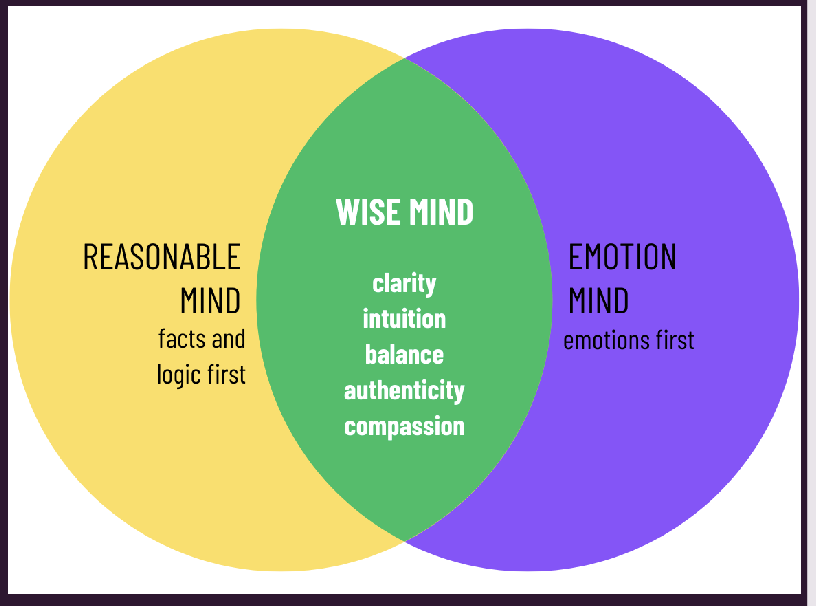
Wise Mind Skill
The “minds” are our ways of thinking & influences how we make decisions
Different kinds of minds we have
Based in logic or facts
Reasonable mind
Based in feelings
Emotion mind (rash, impulsive, based on what feeling at that time)
Focusing on 1 over the other prevents effective judgement
Need to have both of these minds on board
Be mindful when making choices
Gather facts
Activating reasonable mind
Identify & attend to emotions
What are emotions trying to tell them
Consider values/goals
Is decision inline with/goals & values
Integrate the reasonable mind & emotion mind
To try to come to wise mind decision
Distress Tolerance
TIPP or TIP Skill
Crisis prevention for moments of intense emotions
When in crisis get into fight or flight mode
Help try to bring ppl out of fight or flight mode
Temp regulation; intense exercise; paced breathing; paried muscle relaxation
Reduces extreme distress by providing concrete coping skills

Emotion Regulation
Opposite Action
Reducing intense emotional responses by:
Identifying the feeling
Identifying the common behavior associated w/the feeling
How normally reacts to experience
Behaving in the opposite way to change the feeling
Interpersonal Effectiveness Skills
Learning how to effectively communicate in relationships
Includes clear & assertive communication
GIVE
Gentle: Be nice & respectful. Avoid attacks, threats, & manipulation. Express anger & pain directly through words. Stay in the discussion even if it’s painful. Avoid eye rolling.
Interested: Listen to other points of views. Appear interested in the other person. Maintain eye contact & don’t interrupt.
Validate: Show you understand the other person’s feelings & thoughts. See the world from the other person’s point of view & say or act on what you see like “I realize this is hard for you.”
Easy Manner: Use a little humor, smile. Be political. Leave your attitude at the door.
Dialectical Stages of Therapy
Build a life worth living
Decrease life-threatening behaviors
Decrease therapy-interfering behaviors
Not showing up, not engaging, etc
Decrease quality-of-life-interfering behaviors
Increase behavioral skills
Decrease misery & increase emotional experiences (good & bad)
Emotional exposure & Acceptance techniques
Learn how to tolerate all kinds of emotions; happen in safe environment
Attain ordinary happiness
Skills in life domains like work, relationships
Improve relationships so day to day have more meaingful experiences w/others
Increase joy
Mindfulness
Increase positive emotions
Unconditioned Stimulus
Event that automatically produces a response
Unconditioned Response
Behaviors automatically produced from the event
Conditioned Stimulus
Event that becomes paired w/the UCS
Conditioned Response
Behavior produced by the CS
Subjective Units of Distress
Assessment used during exposures to track anxiety
Effective exposures should provoke high anxiety that decreases during exposure
Reflects new (inhibatory) learning
UCS ≠ CS
ABC Model
The interpretation of an event leads to the subsequent emotional response & behaviors
Not the event itself
A = activating event (relevant aspects of the situation)
situations & stimuli associated with/distress
ex: date checking phone during dinner
B = beliefs (thoughts & perceptions about “A”)
thoughts/cognitions that interpret the activating event
ex: “I’m being boring”
C = consequences (emotional & behavioral responses to the beliefs)
is the result of the beliefs not the activating event
ex: anxiety, leaving to go to bathroom

All-or-Nothing Thinking
Seeing things in either “black or white” categories
ex: “If I don’t get an A in the course, I might as well get an F”
ex: “Either youre w/me or youre against me”
Overgeneralization
Seeing a single negative event as a never-ending pattern
ex: “No one ever wants to be with me”
ex: “I can never do anything right”
Mental Filter
Exclusively focusing on a negative aspect(s) of a situation
ex: “I ruined the whole presentation bc I couldn’t answer 1 audience member’s question”
ex: “My date went really well, but the awkward hug at the end ruined it.”
Jumping to Conclusions
Making neg interpretations w/out adequate evidence
ex: “My doctor wants me to have another test, so there must be something seriously wrong with me”
ex: “My partner is home late, they must have gotten into a car accident”
Mind Reading
Assuming you know what others are thinking w/out adequate evidence
ex: “She didn’t text me back immediately, so she must be upset with me.”
ex: “She didn’t laugh at my joke, she must think I suck.”
Catastrophizing
Attributing or anticipating extremely awful consequences to events
ex: “If I get anxious & stumble over my words, my boss will fire me; then I’ll be unemployed forever”
ex: “My car is making a weird noise, it will take all of my savings to fix it.”
Emotional Reasoning
Assuming that negative emotions necessarily reflect the situational reality
ex: “I’m feeling depressed; therefore, I must be seriously flawed.”
ex: “I feel so panicked I can’t handle the pressure of college.”
Should and Must Statements
Endorsing rigid yet arbitrary rules
ex: “I must receive praise when I make an effort”
ex: “I must study 10 hours a day to be successful.”
Steps of Cognitive Restructuring
Identify the “Hot Thought”
neg automatic thoughts or core belief that are difficult for the client
Consider evidence that suports the thought
Consider evidence that doesn’t support the thought
Explore more helpful adaptive explanations
developing akternative thoughts that includes both sides of the evidence
Functional-Contextualism
Philosophy for acceptance-based approaches
To understand a client’s experiences we must understand:
What theyre experiencing:
unadaptive behavior
unadaptive thoughts
difficult emotions
The function that psychological processes serves….
why does the client experience it?
…in the historical context….
why did it develop?
…& in the current context.
why is the client still experiencing it?
Acceptance
Making room for unpleasant thoughts & feelings; allowing them to come & go w/out struggling w/them or giving them too much attention/power
ex: noticing physical anxiety symptoms occur& pass in the body
ex: allowing the feelings of anger when interacting with/supervisor
Defusion
Learning to perceive thoughts & feelings as bits of language, words, & pictures, rather than taking them as facts
ex: labelling a series of worries as a “story” instead of a likely outcome
ex: looking for Mr. Anxiety when noticing anxious thoughts
Contact with the Present Moment
Bringing full awareness to the here & now; focusing on, & engaging fully in whatever one is doing
ex: paying attention in a stressful situation & not engaging in distractions
ex: using mindful breathing when feeling sad about the past
Self-As-Context
Understanding that thoughts & feelings aren’t the essence of who we are; theyre just aspects of us that change constantly
ex: visualizing anxiety as a small section of yourself & viewing it as an outside observer
ex: watching panic symptoms in the body as a curious, outside observer
Values
Clarifying whats most important, significant, & meaningful in our lives
ex: identifying charity as an important aspect in your life
ex: recognizing freedom as an important aspect of one’s life
Committed Action
Setting goals, guided by values, & taking action to achieve them
ex: engaging in volunteer work to match your value of charity
ex: getting involved in local politics to encourage freedom