exercise physiology exam 2
 Call Kai
 Learn
 Practice Test
 Spaced Repetition
 Match
 Flashcards
 Knowt Play
1/73

There's no tags or description
Looks like no tags are added yet.
74 Terms
What is the difference between the Endocrine & nervous system?
Endocrine: hormones released into blood to circulate to tissues ( slow systemic)
Nervous: Neurotransmitter to relay message from one nerve to another ( fast localized)
What factors influence hormone concentration?
Hormone secretion rate
hormone metabolism/excretion (ex: lactate release of muscle which goes to brain or liver)
Transport protein quantity
Changes in plasma volume (as we sweat plasma decreases we can increase hormone activity)

In what ways does effect of hormones have on certain tissues?
Concentration of hormone
number of receptors on cell
Affinity of receptors for hormones (ability to bind to receptors)
What is down regulation?
decrease number of receptors in response to high concentration hormone (resistant to hormone)
What is upregulation?
increase in number of receptors to concretion of hormones (becomes more sensitive)
What is a example of up & down regulation?
Type 2 diabetes before balance diet the cells would downregulation bc constant release hormone insulin. AFTER balance diet it would be upregulation bc receptors become more sensitive to insulin hormone.
How does hormone affect cellular/ tissue function?
Activation of genes to alter proteins synthesis
Activating second messengers in the cell via G protein
Altering membrane transport
How does steroid hormones activate genes to alter protein synthesis?
can pass through membrane because they lipophilic
gets a receptor to transport to nucleus
binds to promoter region to make DNA to RNA
binds to ribosome to make proteins
How does activation of second messenger hormone affect cellular function?
hormone binds to receptor on cell membrane and via G protein
G protein signals events inside the cell (removing or adding phosphate group)
hormone never enters cell
How does membrane transport hormone affect cellular function?
binds to cell’s surface
causing changes inside of cell
adds phosphates toe tell proteins to make glycogen while moving receptors to cell
What does the growth hormone do for the body?
stimulate release of insulin-like growth factors (responsible for muscle growth)
essential growth of all tissues (amino acid uptake and protein synthesis in our cells & long bone growth)
Spares plasma glucose (opposes insulin action, reduces the use of plasma glucose, increase making of glucose, mobilizes fatty acids from adipose tissue)
GH increase after exercise need to rebuild damage
What does growth hormone response to exercise?
more GH produced will be in train individuals than untrained individuals
as work rate increase so does GH bc more repair has to be done
They longer we work the more GH we release

What does antidiuretic hormone do during exercise?
reduce by water loss and reabsorbs water at Kidney tubules which is stimulated by high plasma osmolality ( salt con. of plasma) & low plasma volume
ADH increases during exercise
What happens to T3 & T4 during exercise?
increase metabolic rate
primes the body to be more sensitive to other hormones
responsible to oxygen drift during exercise
What happens to Calcitonin during exercise?
blocks Ca release from bone ( don’t wanna give up bone strength) and stimulates excretions by kidneys
What happens to parathyroid hormone?
when stimulates ca release from bone when Ca levels are low
Does epinephrine constriction or dilation?
Depends on the Adrenergic receptors
ex: for A1 receptors it would vasoconstriction while in B2 receptors it would vasodilation
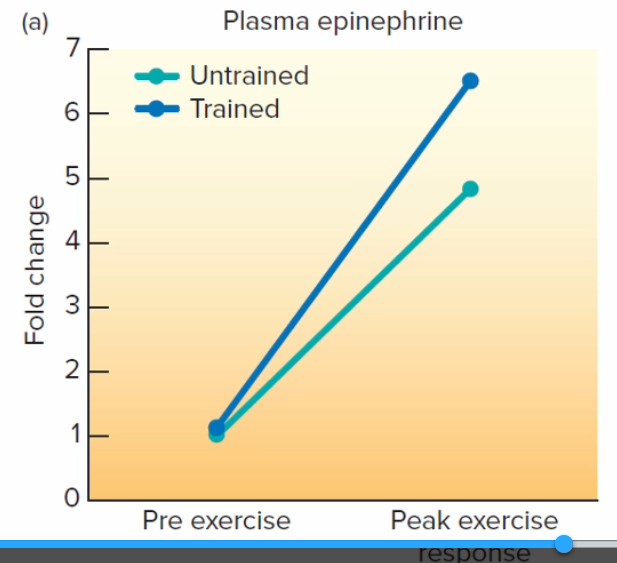
What happens to epinephrine & norepinephrine during exercise?
as you increase work rate and duration you release more epinephrine & norepinephrine

What happens to epinephrine as you train more?
release less epinephrine & norepinephrine
At maximal a trained athlete can release more epinephrine than untrained individual
is high cortisol good to have?
yes during exercise but not long-term
mobilizes tissues amino acids, mobilizes free fatty acids, stimulates making of glucose, and blocks entry into glucose into tissue
What happens to cortisol as we exercise?
increase we exercise more
goes away after exercise

Why do we about plasma glucose concentration?
helps protect the brain which uses it as its preferred source
What are four ways to protect plasma glucose concentration?
mobilize existing glucose from liver glycogen stores
mobilize FFA from adipose tissue
synthesize glucose from amino acids, glycerol, and lactate
block glucose entry into cells (anti-insulin effect)
What happens to muscle glycogen store during exercise?
as you increase intensity it decreases stores
exercise will increase glycogen utilizes

What is epinephrine role in why glycogen is utilized in exercise?
epinephrine will tell muscle to use glycogen stores so it can used for work
if give medication blocker for epinephrine what would happen?
Ca+ drives glycogenesis which would come from muscle contractions which are independent from epinephrine
if we need to glucose utilization and cortisol decreases it what happens?
local controls in muscle would stop cortisol because we can still use glycogen driven from Ca & epinephrine
What are slow hormones for glucose regulation?
T3 & T4
Cortisol
Growth hormone (decrease glucose uptake by tissue, increase FFA mobilization, increases gluconeogenesis)
What is the fasting hormone for glucose regulation?
epinephrine & norepinephrine
insulin
glucagon
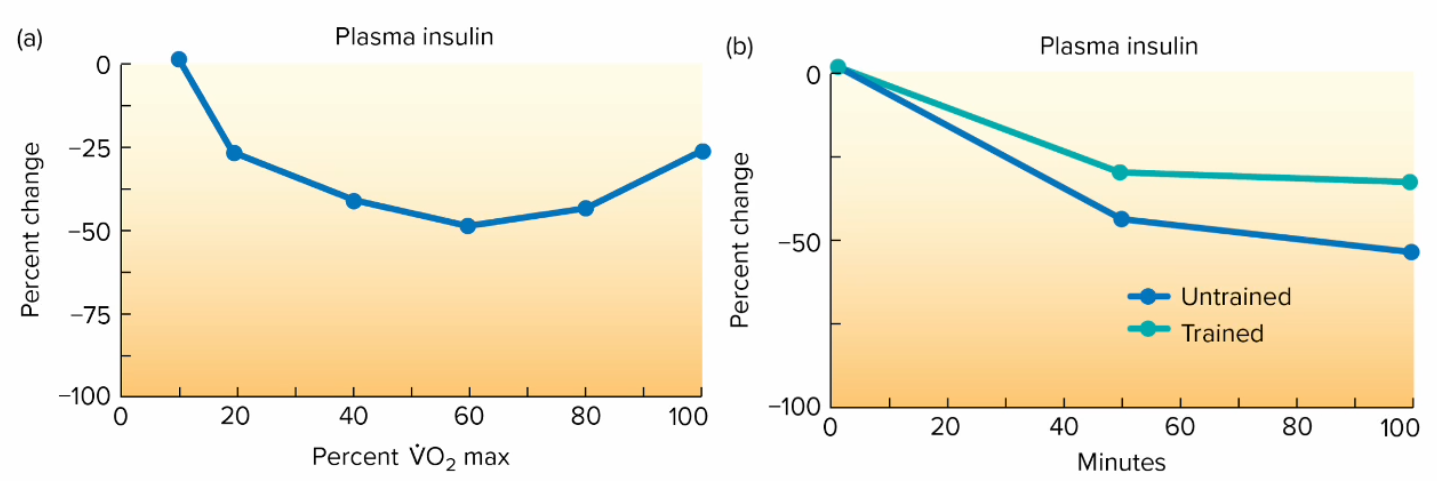
What happens to insulin during exercise?
Insulin would decrease
untrained individuals would a lower insulin because epinephrine is going to release less
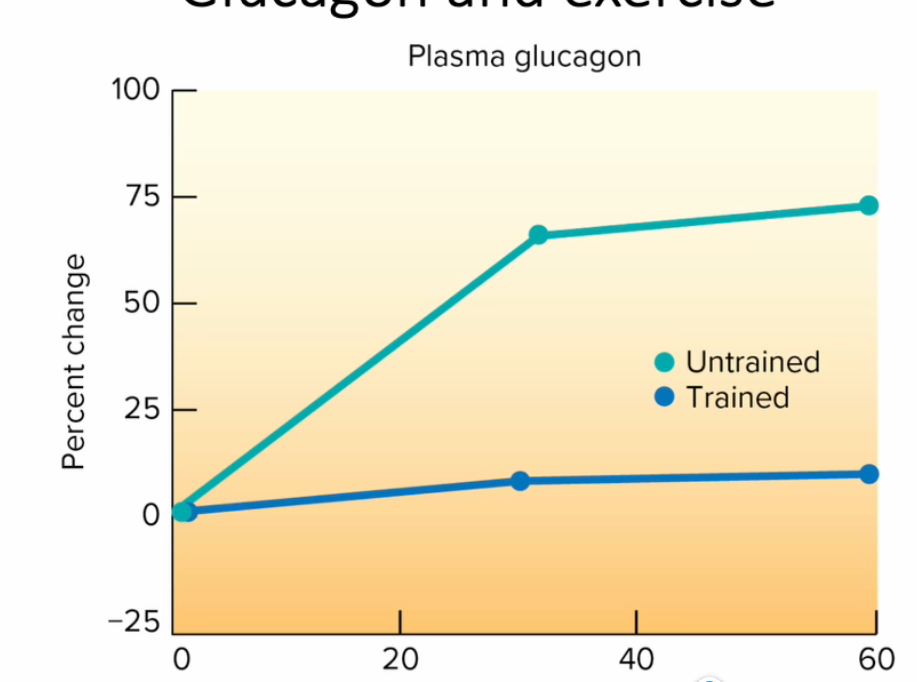
What happens to glucagon during exercise?
glucagon will increase
would be lower in trained individuals than untrained individuals
How does epinephrine regulate glucagon?
release of epinephrine would increase glucagon
How does epinephrine regulate insulin?
release of epinephrine would decrease insulin
If there’s less insulin how does muscle get glucose?
body can take glucose faster during exercise
more blood flow to deliver insulin & glucose to muscle
greater gradient (more glucose outside than inside)
muscle more sensitive to insulin
ca from muscle contractions moves dormant glucose transporter to the membrane
What is are the purposes of the cirulatory system?
Transport o2 & nutrients to tissues
removes co2 & wastes from tissues
regulates body temp
What does the pulmonary circuit do?
it has deoxygenated blood which goes to the lungs
pumps deoxygenated blood to lungs via pulmonary arteries
returns oxygenated blood to left side of the heart via pulmonary veins
What does the systemic circuit do?
left side of heart
pumps oxygebated blood to whole body via arteries
returns deoxygenated blood to right of heart via superior & inferior vena cava
What are the three layers of the heart?
Endocardium (inner protective lining)
myocardium (muscle contracts)
epicardium/ pericardium (outer covering)
What do coronary arteries do for the heart?
provide oxygenated blood to heart tissues
What is a myocardial infarction?
cut of blood flow to the heart which causes necrosis
trained individuals have a lower risk of heart attack than untrained individuals
What is heart ischemia?
decrease blood flow which causes hypoxia
whata re some features of cardiomyocytes?
intercalated dics
interdigtaing folds
mechanical junctions (helps all cell contract together
electrical junctions ( helps all cell contract together)
rely on aerobic respiration
What is the pathway that the heart contracts?
SA node (pacemaker of heart location in right atrium)
AV node (gateway to ventricles)
Bundle of His (forks into branches)
Purkinje fibers
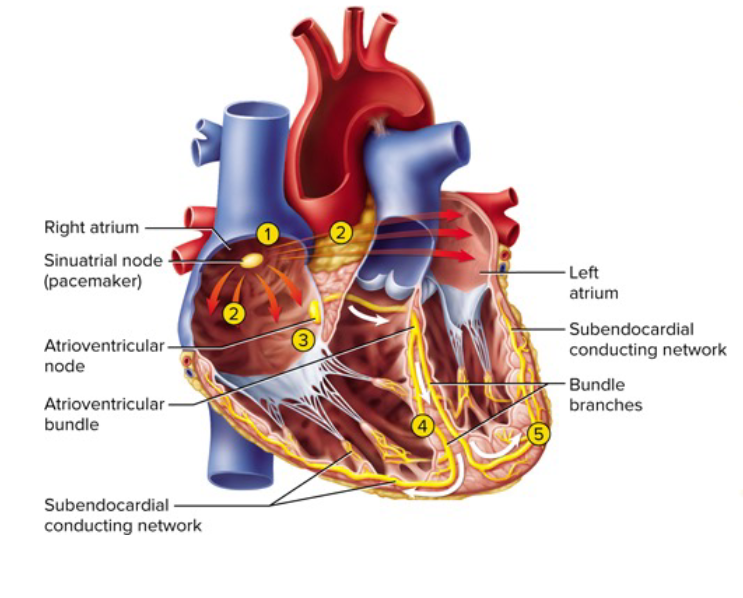
What is sinus rhythm?
normal heartbeat triggered by the SA node
heart is relax (diastole) most of the time
On a EKG what is the p-wave?
atria depolarizing (contracting)
On a EKG what is the QRS wave?
ventricle starts depolarizing until completeion
On a EKG what is the T wave?
ventricle in repolarization (relaxing)
If there volume increase what happens to the pressure?
pressure decreases
liquid or air flows IN
Gradient is always LOW TO HIGH
If there volume decrease what happens to the pressure?
pressure increases
liquid or air flows OUT
What happens to ventricles during systole?
volume decreases
blood pressure increases
pressures
Blood pushes OUT

What happens to ventricles during systole?
volume increase'
blood pressure decreases
pressure decreases
Blood comes IN

What are the five steps of the cardiac cycle?
Atria and ventricle are in diastole
atria in systole
isovolumetric ventricle contraction (same volume of blood from atria)
ventricular systole
isovolumetric ventricle relaxation (during diastole)
What is MAP?
Mean arterial pressure
Cardiac output x Total Vascular resistance
diastole blood + .33 (systole blood pressure - diastole blood pressure)
What is cardiac output?
Heart is able to push out in a given time
How is MAP affect when heart is in failure?
MAP is low bc harder to drive blood to tissues
How is MAP affect during exercise?
higher bc the ratio is high between systole & diastole since heart is more in systole
What factors increase Blood pressure?
increase HR
increase Stroke volume
increase blood volume
increase blood viscosity
increase peripheral resistance ( vasoconstriction)
How does the pumping cycle work in the left ventricle?
filling of the left ventricle (mitral valve is open, pressure is low)
mitral value closes (left ventricle begins contracting, pressure increases, this is end diastole volume)
Aortic value open due to increase pressure (equal to MAP)
pressure increase a little more but volume decreases
LOOK AT NOTES ON IPAD

How does the pumping cycle work in the left ventricle during exercise?
end systole will shift left because the increase of stroke volume
How does the pumping cycle work in the left ventricle after aerobic exercise?
increase venous return (L.V. filling would be longer)
increase stroke volume (space between E.S.V & E.D.V would be larger)

What are the components of the Fick equation?
VO2= volume of O2 consumption
Q = cardiac output (HR x Stroke volume)
a= arterial O2 concentration
V O2 = venous O2 concentration

What happens to the fick equation components during exercise?
VO2= volume of O2 consumption (Increases)
Q = cardiac output (HR x Stroke volume) (increases)
a= arterial O2 concentration (same)
V O2 = venous O2 concentration (decreases)
What happens to blood pressure during exercise?
MAP increases
systole increase
diastole stays the same

What happens to stroke volume during exercise as untrained individual?
will increase until it will hit a plateau
bc HR increase so L.V has less time to fill w/ blood

What happens to stroke volume during exercise as trained individual?
will increasing or plateau doesnt exist
bc they have the ability to do more work
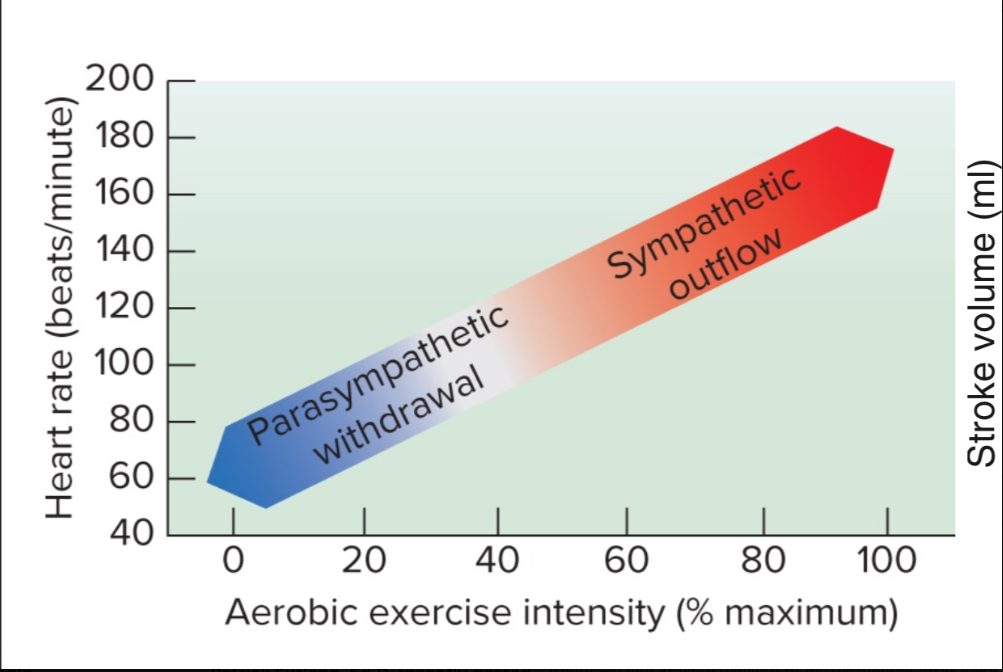
Why does does HR increase during exercise?
parasympathetic nervous system withdrawals ACH
sympathetic nervous system increase production of epinephrine and norepinephrine
What happens to