Chapter 3- Understanding Consumer Markets & Buying Behavior
 Call Kai
 Learn
Learn Practice Test
 Spaced Repetition
 Match
Match Flashcards
 Knowt Play
1/49

There's no tags or description
Looks like no tags are added yet.
Name | Mastery | Learn | Test | Matching | Spaced | Call with Kai | Chat |
|---|
No analytics yet
Send a link to your students to track their progress
50 Terms
What is consumer buying behavior?
Decisions and actions people take to buy products for personal use.
What is the consumer market?
You and all other consumers
what consumer actions Marketers seek to understand?
- Opinions & attitudes impact success
- Understand influence of what, when, where, and how
- Develop better strategies
What better developed strategies are used under consumer behavior?
Use of Psychology & sociology
What are the buyer characteristics in the Buyer's Black Box?
Beliefs
Attitudes
Motives
Perceptions
Values

What are the two things used to understand types of consumer buying behavior?
Degree of involvement and perceived differences between brands.
What types of categories fall under degree of involvement?
low - Limited problem solving
Impulse buying
Habitual decision making
Habitual Decision Making
Low involvement; buying something routinely with little or no thought.
Extended Problem Solving
High involvement; spending a lot of time researching and comparing options before buying.
What does a low difference between brands mean?
Brands are easy to substitute.
What does a high difference between brands mean?
Brands have a variety of different features.
What are the 5 steps of the consumer purchasing decision process?
Need recognition/problem awareness
Information search
Evaluation of alternatives
Purchase
Post-purchase evaluation
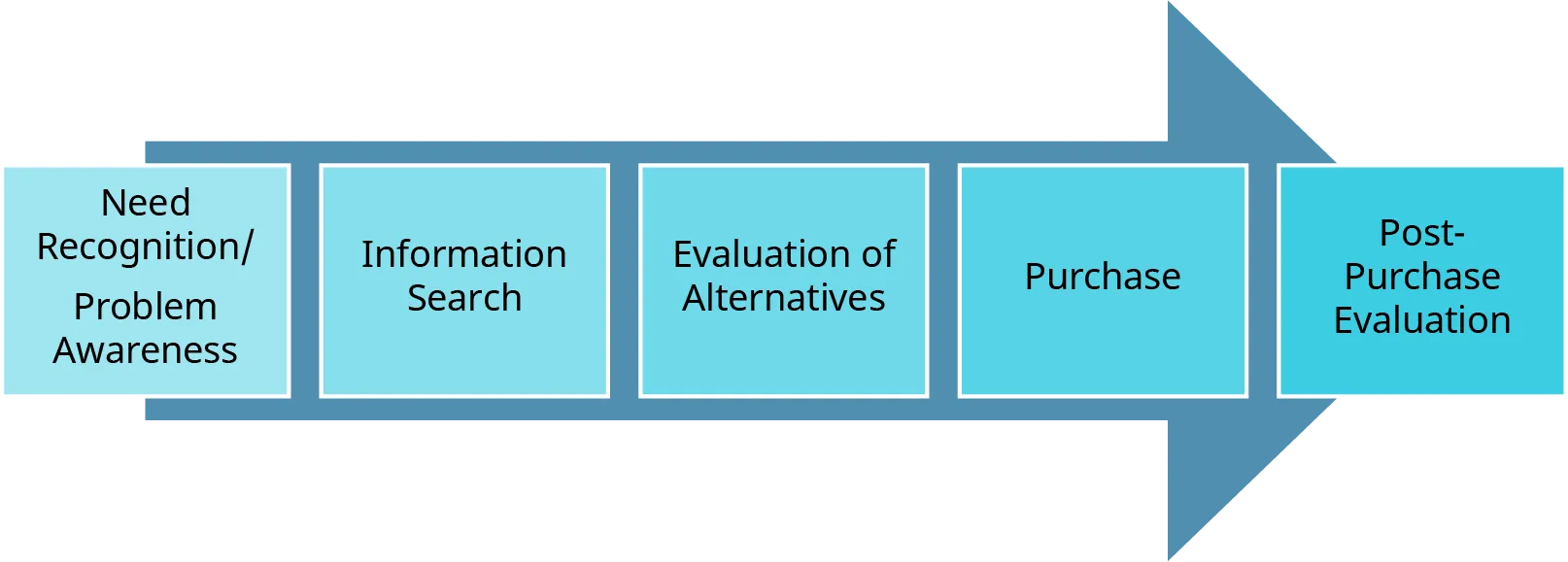
What is need recognition/problem awareness?
Recognizing a difference between your actual condition and desired state.
Can need recognition happen quickly or slowly?
Yes. It can be rapid or slow.
What can cause need rapid or slow recognition?
Internal or external stimuli.
What are the two types of stimuli?
Internal and external.
What are the two types of information search?
Heightened attention and active information search.
What factors affect information search?
Cost vs. benefit
Locus of control
Perceived risk
What are the types of perceived risk?
Performance
Financial
Social
Safety
What happens during evaluation of alternatives?
Consumers compare their choices.
What is a consideration/evoked set?
The group of choices or brands a consumer considers.
What type of brands do consumers often prefer?
Familiar brands.
What choices are made during the purchase step?
What to buy, where to buy, and how to buy.
What do consumers determine when making purchase criteria?
Attributes.
What are decision heuristics?
Shortcuts used to make purchase decisions.
What are the 3 most common decision heuristics on your exam?
⭐ Brand, Price, Packaging.
What else does the consumer consider when purchasing?
Value.
What happens during post-purchase evaluation?
· Customer satisfaction:
· Avoid post-purchase cognitive dissonance
· Customer loyalty
· Negative WOM (worth of mouth) &/or reviews
What are the 3 main factors that influence consumer buying behavior?
Psychological factors
Sociocultural factors
Situational factors
What is used to explain consumer motivation?
Maslow's Hierarchy of Needs.
What are the 5 levels of Maslow's Hierarchy of Needs?
Physiological
Safety
Social/Love
Personal/Esteem
Self-actualization
What is perception?
How you take in and use information through your senses.
What are the 3 types/processes of perception?
Selective attention
Selective distortion
Selective retention
What are the 3 parts of attitudes?
Beliefs\n- Feelings\n- Behavior
What are beliefs?
What we think is true — the head.
What are feelings?
How we feel — the heart/affect.
What is behavior in attitudes?
How a person's attitude affects what they do.
What influences consumer learning?
Experience/information, and behavior.
What falls under self-concept?
Lifestyle and personality.
What falls under sociocultural factors?
Family
Reference groups
Culture
What is associated with family?
Consumer socialization.
What are the 3 types of reference groups?
Membership
Aspirational
Dissociative
What is a membership reference group?
A group you belong to.
What is an aspirational reference group?
A group you want to be like or join.
What is a dissociative reference group?
A group you do NOT want to be like.
What falls under culture?
Subcultures and consumer misbehavior.
What are the 3 situational factors?
Shopping situation
Purchase situation
Temporal situation
What is a shopping situation?
The environment where shopping occurs.
What is a purchase situation?
The social situation, such as who you are buying for.
What is a temporal situation?
The consumer's mood/internal situation.