Vet Med Term - Ch 9
 Call Kai
 Learn
 Practice Test
 Spaced Repetition
 Match
 Flashcards
 Knowt Play
1/249

There's no tags or description
Looks like no tags are added yet.
250 Terms
Respiratory system
Body system that brings oxygen from the air into body for delivery via blood to the cells
once blood has delivered oxygen to cells, it picks up carbon dioxide and carries it back to lungs, where this waste is expelled into air
Carbon dioxide has acid properties and is also involved into maintaining body’s acid-based status
Respiration
The diffusion of gases (oxygen and carbon dioxide) between the atmosphere and the cells of body
Internal or cellular respiration
Gas exchange between the blood and the cells
External respiration
Absorption of atmospheric oxygen by the blood in lungs and the diffusion of carbon dioxide from the blood in lungs to atmospheric air
Ventilation (breathing)
Intake of fresh air
Ventilation may be natural
Normal breathing
Ventilation may be assisted
Use of a ventilator
Ventilator
Devices that aid in breathing
should NOT be called respirators
Respiratory system is divided into
Upper and lower respiratory tracts

Upper respiratory tract
The part of the respiratory system that consists of the nose, mouth, pharynx, epiglottis, and larynx

Lower respiratory tract
The part of the respiratory system that consists of the trachea and within the lungs the bronchi, bronchioles, and alveoli
Upper respiratory tract
Open to outside and are lined with mucous membranes that may or may not have cilia to filter air

Nose
Air enters and exits body through nose
Nas/o and Rhin/o
Nose
Nostrils or nares
Paired external openings of respiratory tract
In endotherms, nasal passages contain
Nasal turbinates
Endotherms
Warm-blooded animals
Nasal turbinates (conchae)
Scroll-like cartilages covered with highly vascular mucous membranes
they warm, humidify, and filter inspired air
Dorsal and ventral separate nasal cavity into passages

Meatus
Dorsal meatus
Middle meatus
Ventral meatus
Common meatus
Meat/o
Opening or passageway
Nasogastric tube
Tube that passes through nose down to stomach
placed through ventral nasal meatus
Air passes from nose through
Nasal cavity
Vestibule
Rostral part of nostrils and nasal cavity
Nasal septum
Wall of cartilage that divides nose
Sept/o
Partition
Respiratory system is lined with
Mucous membranes
Mucous membranes
Specialized form of epithelial tissue
Mucus
Slime like substance that is composed of glandular secretions, salt, cells, and leukocytes that mucous membranes secrete
helps moisten, warm, and filter air as it enters nose
Cilia
Thin hairs located inside nostrils
filter air to remove debris
Debris
Remains of something destroyed or damaged
Olfactory receptors
Responsible for sense of smell
nerve endings located in mucous membranes of nasal cavity
Olfact/o
Smell
Tonsils
Lymphatic tissue that protects nasal cavity and proximal (upper) throat
Tonsill/o
Tonsil

Sinuses
An air-filled or fluid-filled space

In respiratory system, a sinus is
An air-filled or fluid-filled space in bone
have a mucous membrane lining
Sinus/o
Sinus
Functions of sinuses in respiratory system
Provide mucous
Make bone lighter
Help to produce sound
Frontal sinus
Found in all domestic species
dorsal part of skull between nasal cavity and orbit
Maxillary sinus
Found in all domestic species
maxilla with nasal cavity on each side
Sphenoid sinus
Found in feline, bovine, equine, and swine
sphenoid bone; opens to nasal cavity
Palatine sinus
Found in ruminants, equine
palatine bone; communicates with maxillary sinus
Lacrimal sinus
Found in swine, ruminants
lacrimal bone
Conchal sinus
Found in swine, ruminants, equine
formed by enclosure of conchae

Pharynx (throat)
Common passageway for upper respiratory and GI tracts
extends from caudal part of nasal passages to larynx and connects nasal passages to larynx and the mouth to the esophagus
Air passes through nasal cavity into
Pharynx
Pharyng/o
Throat

Pharynx has 3 divisions
Nasopharynx
Oropharynx
Laryngopharynx
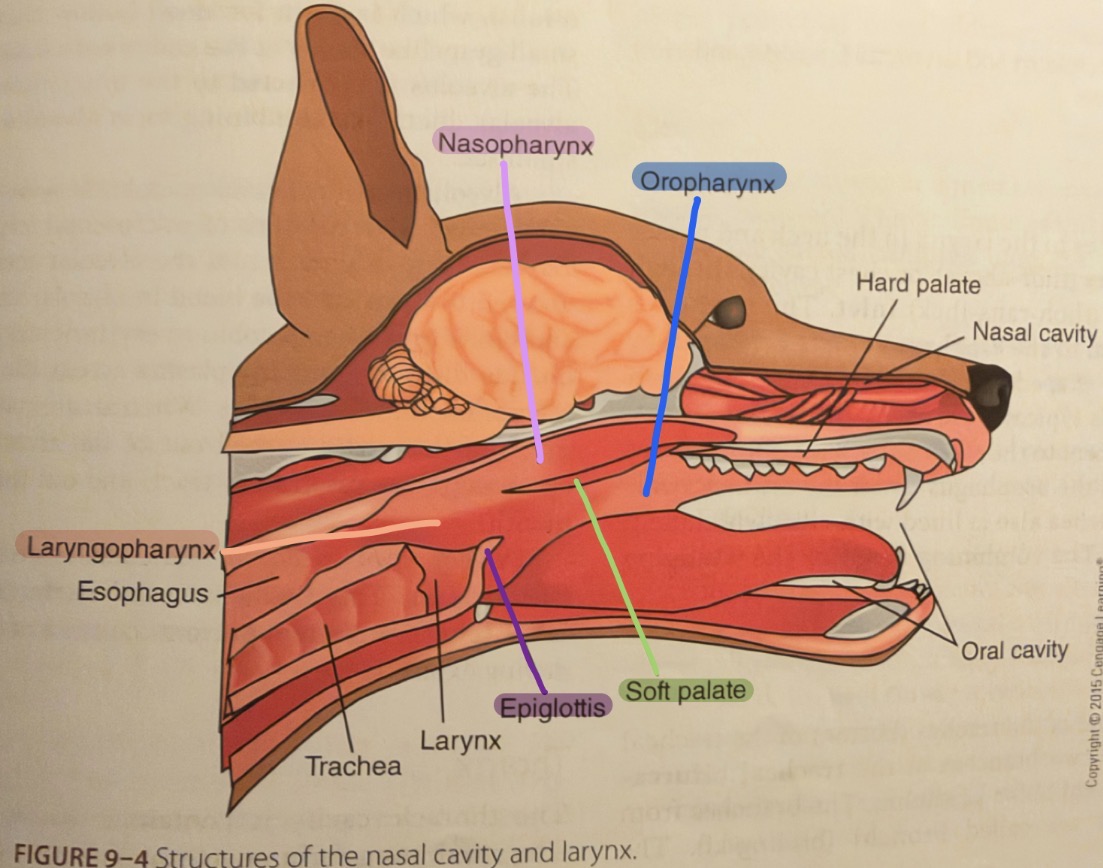
Nasopharynx
Portion of the throat posterior to nasal cavity and dorsal to (above) soft palate

Oropharynx
Portion of the throat between the soft palate and epiglottis

Laryngopharynx
Portion of the throat dorsal to larynx that opens into the voice box and esophagus
Nasopharynx is passage for air
Entering through nose
Oropharynx and laryngopharynx are passageways for
Air entering through the nose and food entering through the mouth, respectively
During swallowing, the soft palate moves dorsally and caudally to
Close off nasopharynx to prevent food rom giving into nasal cavity
Palate
Roof of mouth
Palat/o
Palate

Epiglottis acts like a lid and covers
Larynx during swallowing which also covers the opening of trachea, prevent food from possibly going into lungs
Epiglott/o
Epiglottis

Larynx (voice box)
Part of respiratory tract located between pharynx and trachea
Laryng/o
Voice box
Vocal cords
Paired membranous bands in larynx that help produce sound
Vocal apparatus is found in
Glottis
Glottis
Space between vocal cords
Glott/o
Glottis
Air passing through glottis causes
Vibration of vocal cords that produces sound
Vocal apparatus of avian is
Syrinx which is located between trachea and bronchi

Lower respiratory tract
trachea
Bronchi
Bronchioles
Alveoli
These enter or are found in thoracic cavity

Trachea (windpipe)
extends from neck to chest
Attaches to larynx in neck and passes into thorax through thoracic inlet
Located ventral to esophagus and is held open by a series of C-shaped cartilaginous rings
Lined with cilia
Air passes from larynx to
Trachea
Trache/o
Windpipe
Bottom of trachea divided into two branches at the
Tracheal bifurcation

Bronchi
Branches from trachea
Bronch/o
Bronchi

Each bronchus leads to a separate lung (right or left) and continues to divided
Appears similar to a tree and its branches
sometimes bronchi and its branches are called bronchial tree
Each bronchus leads to a separate lung called
Principal or primary bronchus (right principal or left principal bronchus)

Principal bronchi divide into small branches called
Secondary or lobar bronchi

Secondary bronchi divide into
Tertiary or segmental bronchi = bronchioles or bronchioles
Bronchiol/o
Bronchioles
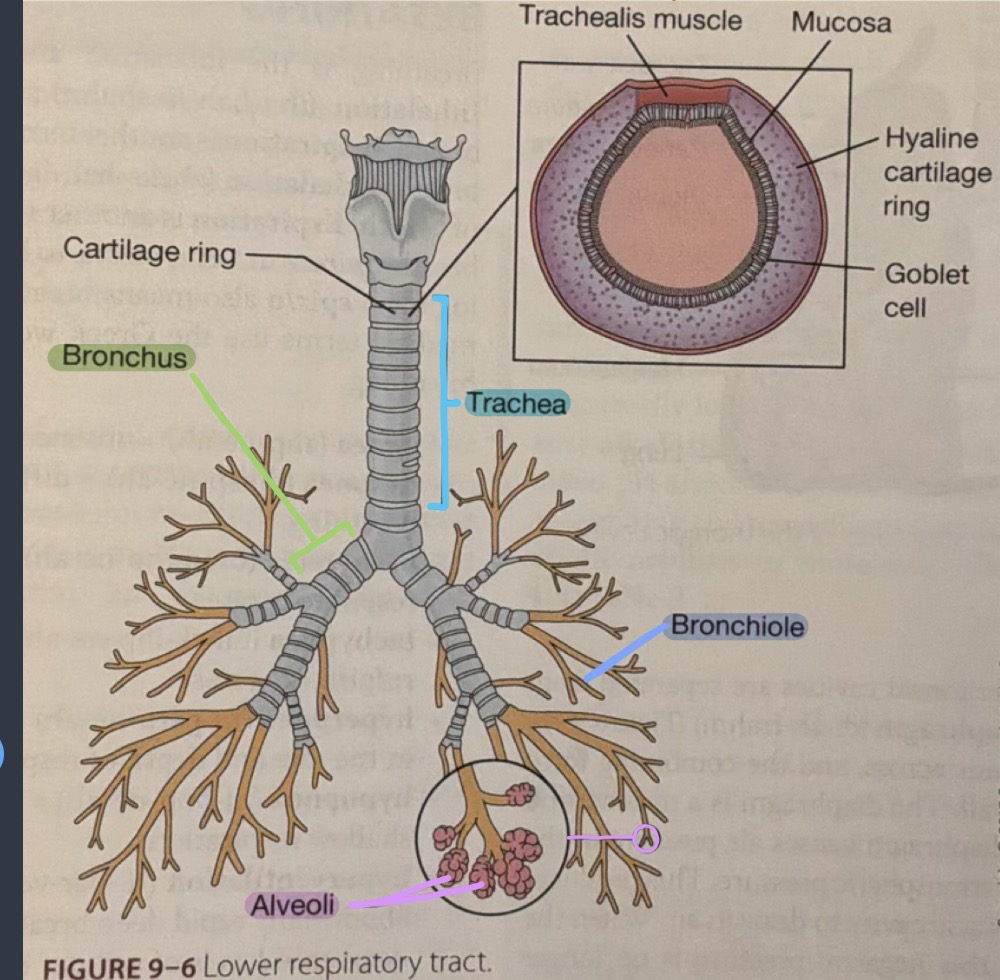
Alveoli
Air sacs in which most of the has exchange occurs
Alveolus (Latin)
Small hollow thing
small grapelike cluster at the end of each bronchiole
Alveolar duct
Connects alveolus to bronchiole
Alveol/o
Small sac
Surfactant
Liquid in alveoli that reduces alveolar surface tension and prevents collapse of alveoli during expiration
Thorax
Contained within ribs

Lungs
Main organ of respiration
Located and protected in thoracic cavity
Thorac/o and -thorax
Chest cavity or chest
Two lungs (right and left) are composed of divisions called
Lobes
Lobes
Well-defined portion of an organ and is used in describing areas in lung, liver, and other organs
Lob/o
Well-defined portion
Pneum/o, pneumon/o, pneu
Lung or air
Pulm/o and Pulmon/o
Lung
Parenchyma refers to the
Functional elements of an organ
Stroma refers to
Organ’s framework

Mediastinum
Space between lungs that houses heart, aorta, lymph nodes, esophagus, trachea, part of bronchial tubes, nerves, thoracic duct, and thymus
Pleura
Membranous sac that encase each lung
Pleur/o
Membrane surrounding lung
Pleurae
Plural form of pleura

Parietal pleura
Outer layer of membrane lining inner wall of thoracic cavity

Visceral pleura
Inner layer of membrane lining outside of lung

Pleural space
Potential space between parietal pleura and visceral pleura
contains small amount of pleural fluid