Biochemistry - Committe 2
 Call Kai
 Learn
 Practice Test
 Spaced Repetition
 Match
 Flashcards
 Knowt Play
1/121

There's no tags or description
Looks like no tags are added yet.
122 Terms
What is biochemistry?
It focuses heavily on the role, function and structure of biomolecules using physical and chemical principles to explain biology of the molecular level
Functional group for alcohol, aldehyde, ketone, carboxylic acid, thiol, amines

Functional group for Hydroxyl, acyl, carbonyl, carboxylate, sulfhydryl, amino, phosphate, phosphoryl

functional groups for ester, ether, amide, phosphate ester, phosphoanhydride
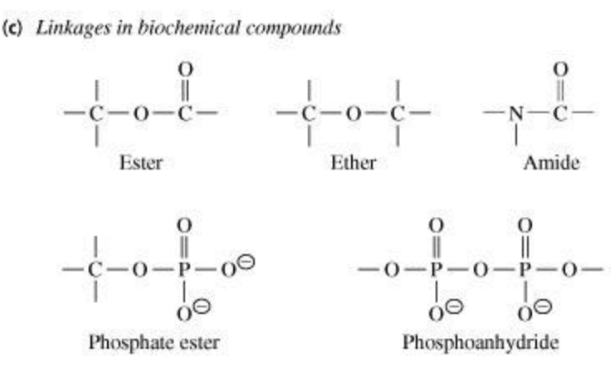
undermost biological conditions how do carbxylic acids and amines exist
carboxylate ions , ammonium ions
name the monomer, polymer and supramolecular structure of lipids
Monomer= fatty acid
Polymer = phospholipid
supramolecular structure = membrane
name the monomer, polymer and supramolecular structure of proteins
amino acid, protein subunit , protein complex
name the monomer, polymer and supramolecular structure of carbo
glucose, cellulose, cellwall
name the monomer, polymer and supramolecular structure of nucleic acid
nucleotide, DNA, chromosome
what is a monomer
a small chemical molecule that can react or bond with other similar or different small molecules
what is a polymer
this is a large molecule composed of many repeated smaller subunits called monomers bonded together in long chains or 2 dimensional models
Draw the chemical structure of a fatty acid

draw the chemical structure of a amino acid

draw the chemical structure of glucose

condensation reaction
monomers form polymers through this process and water is a product
hydrolysis reaction
polymers are broken down by the addition of water
what is an anabolic reaction
Combining smaller molecules using energy to make a large molecule
what is a catabolic reaction
splitting a large molecule into smaller molecules and it realeases energy
What are the functions of carbohydrates
1) Energy source
2)Storage form of energy
3) structural components
4)Fibres
5)Constituents of nucleotides
6)Detoxification
7)Intermediate of metabolism
4 facts of carbohydrate
1)Made from CO2 and H2O via photosynthesis
2) Named because many have the formual Cn(H20)n
3)Sizes range from as small as glyceraldehyde to as large as amylopectin
4)can be covalently linked with proteins to form glycoproteins
Classification of monosaccharides
Aldoses and ketoses
Classification of oligosaccharides
Di, Ti, Tetra-saccharides
Examples of Di-saccharides
Maltose, Lactose, Sucrose
Exampleof tri-saccharides
raffinose
Examples of tetra-saccharides
stachyose
Classification of polysaccharide
Homopoly & Hetropoly - saccharide
Examples of Homopolysaccharide
starch, dextrin, glycogen, cellulose, inulin
examples of Hetropolysaccharide
Heparin, hyaluronic acid, chondroitin sulfate, dermatan sulfate,
what is an aldose
a carbohydrate that contains an aldehyde group
what is a ketose
a carbohydrate that contains a ketone
How to spot a Fisher projection ?
1)Aldose at the top
2)Vertical lines point away into the page hosrizontal lines point toward u
3)bottom most chiral caorbon the OH must be on the right side for D-aldose and left side for L aldose
4) For ketones remeber not to incluse the C=O as a chiral compound
Name and draw a D-aldose 3 carbon
Dihydroxyacetone

What are asymmetric centers
An asymetric center is a chiral center. It is a carbon with 4 unique groups connected
How to determine the number of stereoisomers
2^n n is the number of asymmetric centers
Difference btw D-Ketose and D-aldose
D-ketonse sometimes has ulose to signify it is a ketose
What are D & L sugars
mirrors of each other
What is a hemiacetal and hemiketal
An aldehyde which reacts with an alcohol forms a hemiacetaL and a ketone which reacts with an alcohol forms a hemiketal
Reaction of aldehyde and alcohol

Reaction of ketone and alcohol

what is a distal OH
A hydrixyl group located far away from the C=O
Pentose and hexose (aldehyde/ketose) + distal OH
Cyclize and can form 6 member ring or 5 member ring
What is the name of the representation of cyclic sugars
Haworth Projections
Name of 5 member ring
furanose
name of 6 members ring
pyranose
draw the D-fructopyranose ring
a 6-member pyranose ring, by reaction of the C2
keto group with the OH on C6, or
Draw a D-fructofuranose

What are anomers
2 stereoisomers that differ at one carbon atom
What are the different sugar derivatives and how to differentiate them
Sugar alcohol = lacks aldehyde or keton ends with ol
Sugar acid = the aldehyde at C1 or OH at C6 is oxidised to a carboxylic acid ends with ic acid
Amino sugar = amino group substitutes for a hydroxyl ENDS WITH AMIINE A amino group maybe acetylated . ends with acetly+…+amine
What is acetylated?
Amine (NH2) plus Acetly (COCH3)
What are glycosidic bonds
A hydroxyl plus another anomeric hydroxyl can join together splitting out water to form a glycosidic bond . OH from anomeric hydroxyl and H from hydroxyl
How do plants store glucose?
As amylose and amylopectin which are glucose polymers collectively called starch
What is amylose
a glucose polymer with alpha(1—>4) linkages so linear not branched
What is a reducing end
The end of a polysaccharide with an anomeric C1 not involved in glycosidic bond
What is amylopectin
This a glucose polymer with maily alpha (1—>4)linkages but also has branches formed by alpha (1—>6) linkages.
Effect of branches in amylopectin
the branches produce a compact structure and provides multiple chain ends inwhich enzymatic cleavage can occur
What is glycogen
glucose storage polymer in animals which is similar in structure to amylopectin but has glucose monomers forming alpha 1→4) linked chains and branch points are alpha (1—>6) branches every 8-12 residues
Effects of the highly branched glycogen
permits rapid glucose release from glycogen stores. The ability to rapidly mobilise glucose is more essential to animals than plants
What is metabolism
sum of all chemical reactions in the cell .
breakdown of food and conversion to energy
what are the key metabolic fuels
carbohydrate, protein and fats
processes used to describe catabolism
oxidative, exergonic, convergent
processes used to describe anabolism
reductive, endergonic, divergent
What is oxidative energy
The process by which non-photosynthetic organisms obtain energy using oxidation. The more reduced the carbon is the more energy can be obtained from it
What substance is used asthe most common oxidised energy source
Carbon
How much of the human body is made of water
2/3
cause of dehydration
not drinking enough water, vomitting, diarrhea, exposure to excessive heat.
What is the equation of metabolism
Food (C,H,O) + O2 —> CO2 + H2O
What is the source of NH3
Proteins
NH3 + Water
—. NH4+
Equation to turn NH3 to Urea
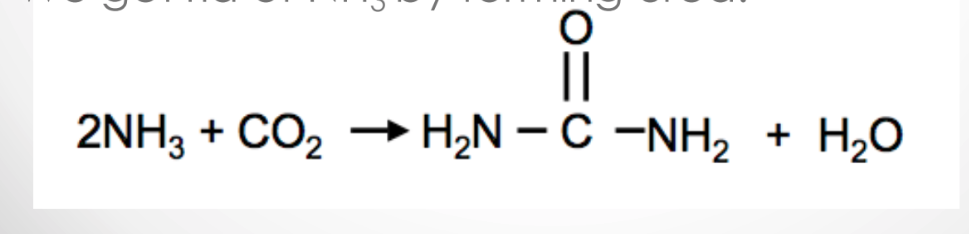
WHAT IS FAT BROKEN DOWN TO
ACETATE
example of 2 and 3 carbon compound found in the body
2 carbon compounds = Acetate
3 carbon cpompounds = Pyruvate and lactate
What are the two molecules obtained glucose
Lactate and pyruvate 3C molecules made when the body breaks glucose in half
What is glycogen
a carbohydrate stored in cells that consist of glucose groups strung together in a branched arrangement
Function of fat
major storage form of energy
chemical name of starch
triglyceride
what is triglyceride
an ester derived from 3 fatty acids an glycerol
What are fatty acids synthesized from
acetate
what is glycerol made of
3C molecule made from glucose
Equation to make a triglyceride molecule

what is in proteins
amino acid
function of amino acid sequence
determines the function of the protein
what are the 3 parts of ATP
Adenine, ribose and a phosphate groups
How much energy is in ATP
One mole coming of phosphate of ATP gives 10KCAL of energy
Why does cell need ATP
1)To keep ions in proper concentration
2)Cell division
3)To synthesize molecules
4)To move around and exercise
What substances regulate the metabolism
Enzymes
Hormones
Nervous System
what is glucagon
converts glycogen to glucose .
produced by alpha cells in the pancreas
what is insulin
hormone produce by beta cells in the pancreas that regulate how the body uses and store glucose . decreases blood sugar
what is glycogen
excess glucose is converted to glycogen which is stored in the liver and skeletal muscles
Insulin Counterregulatory Hormones
a group of hormones that work against insulin and raise the blood sugar
example of Insulin Counterregulatory Hormones
Cortisol , Glucagon, epinephrine and neoepinephrine
How is glucagon a Insulin Counterregulatory Hormones
activates gluconeogenesis and glycogenolysis in liver during fasting . Glycogen to glucose
How is epinephrine a Insulin Counterregulatory Hormones
stimulate fatty acid release from adipose
stimulate glucose production from glycogen in muscle and liver
How is cortisol a Insulin Counterregulatory Hormones
stimulate amino acid mobilisation from muscle protein
stimulate fatty acid realease from adipose
reduce insulin sensitivity over a long term
stimulate glycogeneogenesis
what is glyconeogenesis
obtain new glucose from non carbohydrate carbon sources eg: lactate, glycerol
formula for simpler carbohydrate
(CH2O)N n=/> 3

what representation is this
Haworth
differnce betwee isomers, epimers, enantiomer
isomers= same chemical formula but different structures
Epimers =isomer but differ in configuration only one carbon
Enantiomers = isomer for compound with a chiral center. tye group attached to the asymmetric carbon atom can be arranged to form 2 different isomers that are mirror images
what is cyclization of monosaccharides
carbon containing carbohydrates exist predominantly in a cyclic form. In cyclization the carbonyl carbon transforms into a new stereocenter
what is an anomeric carbon
new stereocenter after cyclization
how to locate the anomeric carbon
locate the oxygen inside the ring
look at carbons on the isde of oxygen
the carbon on the other side that is not attached to the CH2OH gropu is the anomeric carbon