Anatomy- Skeletal System
 Call Kai
 Learn
Learn Practice Test
 Spaced Repetition
 Match
Match Flashcards
 Knowt Play
1/12

There's no tags or description
Looks like no tags are added yet.
Name | Mastery | Learn | Test | Matching | Spaced | Call with Kai | Chat |
|---|
No analytics yet
Send a link to your students to track their progress
13 Terms
Four major types of bone fractures
Simple Fractures (clean breaks, don’t break through skin)
Compound Fractures (Broken bone end penetrates through the skin)
Complete Fracture (Bone splits completely into 2 or more distinct pieces)
Partial Fracture: Such as the greenstick fracture, not breaking all the way through.
Functions of skeletal system
Support
Protection
Movement (ALLOWS movement does not produce it.)
Storage
Blood cell formation
Shape and structures of four major types of bones
Long Bone (Longer than they are wide, mostly compact bone ex. femur)
Short Bone (Generally are cube-shaped, containing mostly spongey bone ex. ankle)
Flat Bone (Thin, flattened, usually curved, two layers of compact bone sandwiching a layer of spongey bone ex. ribs)
Irregular bones (bones don’t fit into any category ex. vertebrae)
Red marrow vs. yellow marrow
Red marrow: Forms blood cells and is confined to cavities of spongey bone of flat bones + epiphysis of long bones.
Yellow marrow: Storage for adipose tissue, it’s the cavity of the shaft.
Components of axial skeleton

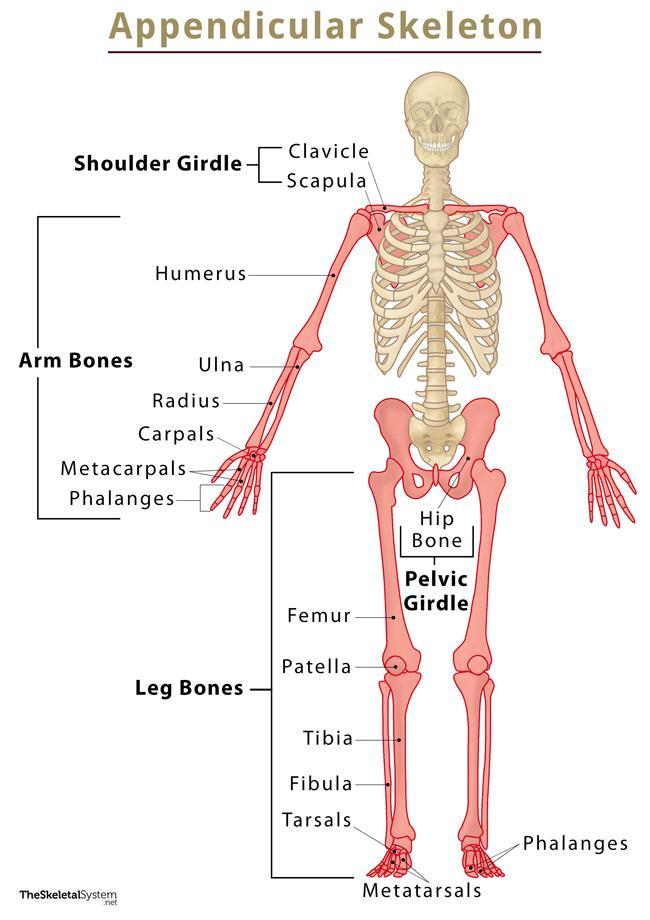
Components of appendicular skeleton
Components of the cranium bones
Frontal (Forms forehead and superior eye orbit)
Parietal (Superior and lateral walls of cranium)
Temporal (Inferior to parietal bones, joined at squamous structures)
Occipital (Most posterior bone of cranium, back of skull)
Sphenoid (Butterfly-shaped, forms the floor of cranal cavity)
Ethmoid (Anterior to sphenoid, forms roof of nasal cavity)
Components of facial bones
Maxillae (Two maxillae fuse to form upper jaw)
Zygomantic (Cheekbones)
Mandible (lower jaw)
Hyoid bone (ONLY BONE IN THE BODY THAT DOES NOT ARTICULATE WITH ANY OTHER BONE. Moveable base for tongue and attachment point for neck muscles)
Fontanels (connect to cranial bones cannot feel it)
Define foramen
A foramen is an opening, hole, or passage in a bone to let nerves and arteries pass through.
Three classifications of ribs
True ribs (First 7 pairs which attach directly to sternum by costal cartilage)
False ribs (The next 5 pairs attach indirectly to the sternum by a shared cartilage)
Floating ribs (Do not attach to the sternum at all. They are the lowest 2 pairs of false ribs)
Bones of the hands and feet
Each hand contains 14 phalanges, 3 in each finger (except the thumb has 2)
Eight carpal bones in the wrist bound by ligaments
Lateral malleolus forms the outer part of the ankle
Calcaneus is the heel bone
Talus connects the lower leg to the foot
Metatarsals
Characteristics of diseases in skeletal system
Osteoporosis: A bone-thinning disease, making bones so fragile even a sneeze can cause bone fractures.
Rickets: A disease of children in which the bones fail to calcify, usually due to a lack of calcium or vitamin D.
Arthritis: Autoiummmune disesae causing stiffness or pain in the joints.
Labelling (no word bank)
Occipital
Clavicle
Parietal
Scapula
Pelvis
Vertebrae
Humerus
Radius
Ulna
Femur
Fibula
Tibia
Patella
Calcaneus
Metatarsals
Tarsals
Frontal
Maxilla
Mandible
Sternum
Ribs
Carpals
Metacarpals
Phalanges
Sacrum
