MicroBio - Lab Practicum
 Call Kai
 Learn
 Practice Test
 Spaced Repetition
 Match
 Flashcards
 Knowt Play
1/165

There's no tags or description
Looks like no tags are added yet.
166 Terms

What gram-stain is this?
Gram Positive

What gram-stain is this?
Gram Negative
Why do Gram-positive and Gram-negative bacteria appear different colors after completing the Gram-staining procedure?
Gram-positive bacteria have a thick peptidoglycan layer that retains crystal violet, making them appear purple. Gram-negative bacteria have a thinner peptidoglycan layer and lose the crystal violet during decolorization, allowing them to absorb the pink counterstain.

What is the morphology?
Cocci

What is the morphology?
Bacilli

What is the morphology?
Spirilla

What is the morphology?
Streptococci
How can the shape and arrangement of bacterial cells help identify and classify bacteria?
Bacterial shape and arrangement provide characteristics that help distinguish different types of bacteria. Common shapes include cocci (spherical), bacilli (rod-shaped), and spirilla (spiral-shaped).
A student observes pink, rod-shaped bacteria under a microscope after performing a Gram stain. How should these bacteria be classified?
Gram-negative bacilli.
What is the purpose of endospore staining?
Endospore staining identifies bacteria capable of producing endospores. These structures help bacteria survive harsh environmental conditions and are important characteristics for bacterial identification.
Explain purpose of
Explain purpose of Gram stain
Helps classify bacteria and can guide antibiotic selection because cell wall structures influence susceptibility to certain antibiotics.
Explain purpose of Acid-fast stain
Identifies bacteria with waxy, mycolic acid-rich cell walls
Helps identify bacteria such as Mycobacterium, whose cell envelopes make them difficult to stain using ordinary methods and contribute to resistance against certain chemicals and antibiotics.
Explain purpose of Endospore stain
Helps identify endospore-forming bacteria and understand their ability to survive harsh conditions, including heat, drying, and some disinfectants.
Explain purpose of Capsule stain
Detects protective capsules surrounding bacterial cells
Capsules can protect bacteria from phagocytosis, helping them evade the immune system and potentially cause disease.
Explain purpose of Simple stain
Reveals bacterial shape, size, and arrangement
Helps distinguish bacteria based on physical characteristics, such as cocci, bacilli, and spirilla, but does not identify their cell wall type.

Identify A
Endospore
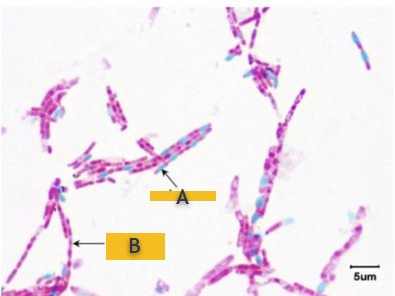
Identify B
Vegetative cell

What acid stain is this?
Non-Acid-Fast - Negative

What acid stain is this?
Acid-Fast - Positive
You observe red, rod-shaped bacteria against a blue background after acid-fast staining. What is the result?
Acid-Fast Positive bacilli
What is the purpose of carbolfuchsin in the acid-fast staining procedure?
It acts as the primary stain, coloring bacteria red or pink.
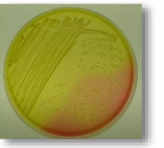
What does this mean for Mannitol Salt agar?
Positive mannitol fermentation. The bacteria fermented mannitol and produced acid.

What does this mean for Mannitol Salt agar?
Negative fermentation. The bacteria did not ferment mannitol enough to turn the agar yellow.

Identify A in the MacConkey Agar
Lactose negative

Identify B in the MacConkey Agar
Lactose positive

Identify C in the MacConkey Agar
Lactose positive
What is the purpose of MacConkey Agar?
To select for many Gram-negative bacteria and differentiate them based on lactose fermentation.
What does positive lactose fermentation on MacConkey Agar mean?
The bacteria break down lactose and produce acid, causing colonies to turn pink or red.

What type of hemolysis is this for this blood agar?
Alpha (α) Hemolysis - Greenish or brownish discoloration around bacterial colonies.

What type of hemolysis is this for this blood agar?
Beta (β) Hemolysis - Clear or transparent zone surrounding colonies.

What type of hemolysis is this for this blood agar?
Gamma hemolysis - they are not breaking down the red blood cells in the agar.

Identify A
Beta (β) Hemolysis
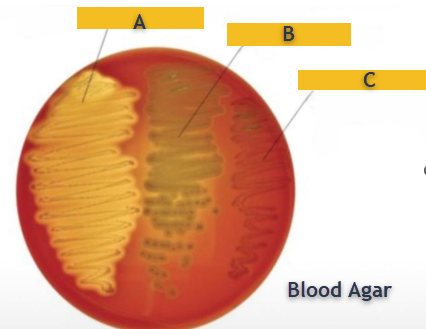
Identify B
Alpha (α) Hemolysis

Identify C
Gamma hemolysis
What does Catalase Test for?
It detects whether bacteria produce the enzyme catalase.
Catalase breaks down hydrogen peroxide (H₂O₂) into water and oxygen.

Which test is positive?
A
What does Oxidase Test for?
It detects whether bacteria produce cytochrome c oxidase, an enzyme involved in the electron transport chain
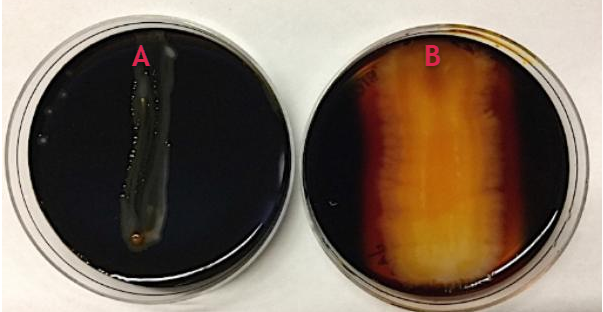
Which Starch Hydrolusis Test is positive?
B
What does Starch Hydrolusis Test for?
Determines whether bacteria produce the enzyme amylase, which breaks down starch into smaller sugars. This test helps identify bacteria that can digest starch.
What does Coagulase Test for?
Determines whether bacteria produce the enzyme coagulase, which causes plasma to clot.
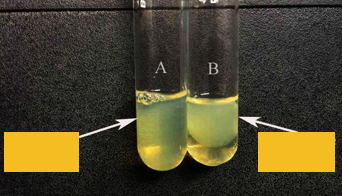
Which Coagulase Test is positive?
B
Why do Coagulase positive test clot?
Coagulase causes plasma to clot. This may help certain pathogens protect themselves from immune defenses.

Which test is positive for sulfur reduction?
B
Why does black precipitate means in Sulfer reduction?
Black precipitate means hydrogen sulfide was produced.

Which Indole test is positive?
B
What does the red ring mean in the indole test?
Red ring after Kovac's reagent means the bacteria produced indole from tryptophan.

Which Motile test is positive?
A
What does cloudy growth spreading away from the stab line indicate?
It indicates that the bacteria are motile and can move through the semisolid agar.
IMViC
IMViC is a group of four tests commonly used to help identify enteric bacteria.
SIM test
Sulfur, Indole, Motility.

Which Indole test is positive?
A
What does the red ring mean in the Indole test?
Detects breakdown of tryptophan to indole.

Which Voges-Proskauer (VP) test is positive?
B
What does a red color after adding VP-A and VP-B reagents indicate?
It indicates a positive test for acetoin production.
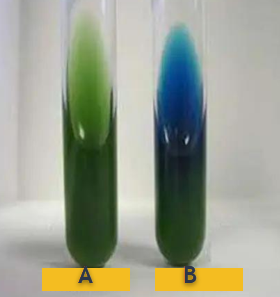
Which Citrate test is positive?
B
What does Citrate test?
The citrate test determines whether bacteria can use citrate as their sole carbon source.
A Simmons citrate tube changes from green to blue. What does this mean?
Citrate positive
An SIM tube develops a red ring after adding Kovac's reagent. What is positive?
Indole Production
A TSI tube has a red slant and yellow butt. What does this usually indicate?
Glucose fermentation only
Hydrogen peroxide is added to bacteria, and bubbles immediately appear. What is the result?
Catalase positive
A blood agar plate has a completely clear zone surrounding bacterial colonies. What type of hemolysis is present?
Mannitol fermentation
A bacterium has a clear halo surrounding it in a capsule stain. What does the halo indicate?
Capsule
A stained bacterial cell is red, with a green oval inside it. What is the green structure?
Endospore
You see pink, rod-shaped bacteria under the microscope. What are they?
Gram-negative bacilli
You see purple, round bacteria arranged in clusters. How would you describe them?
Gram-positive cocci
10x ocular and 40x objective give what total magnification?
400x
Why does a specimen appear dimmer at higher magnification?
Less light reaches the eye
What should you adjust when more light is needed?
Iris diaphragm or lamp
Why use immersion oil at 100x?
Reduce light refraction
Two nearby cells look like one. What needs improvement?
Resolution
What happens to field of view as magnification increases?
Decreases
What is working distance?
Distance from objective to specimen
What does parfocal mean?
Nearly in focus after switching objectives
At high power, why use fine focus?
Avoid crashing lens into slide
What happens to depth of field at higher magnification?
Usually decreases
What is the purpose of aseptic technique?
Minimize contamination
A pure culture contains how many species?
One
What is inoculation?
Introducing microbes into medium
Why is agar added to broth?
To solidify it
What is a broth culture?
Microbes growing in liquid medium
What is an agar slant?
Solid medium hardened at an angle
What is an agar deep?
Solid medium in a tube often inoculated by stabbing
A tube is left open near a bench. What is the risk?
Environmental contamination
What is genus in a scientific name?
First, capitalized name
Why isolate a single colony?
To help obtain a pure culture
Why make a thin smear?
See individual cells clearly
Why air-dry before heat-fixing?
Limit splatter and distortion
What is a primary stain?
First dye applied
What is a counterstain?
Secondary dye that provides contrast
A simple stain mainly shows what?
Shape and arrangement
Which is a basic dye?
Methylene blue
Why do basic dyes stain cells?
Positive dye binds negative cell surfaces
What does negative staining typically color?
Background
Why is heat fixation unsuitable for capsules?
It can distort capsules
Why is a differential stain useful?
Distinguishes cell groups by reactions
What color are Gram-positive cells after proper Gram staining?
Purple
What color are Gram-negative cells after proper Gram staining?
Pink
What is the Gram primary stain?
Crystal violet
What is the Gram mordant?
Iodine