Chapter 16: Macroeconomic Equilibrium
 Call Kai
 Learn
 Practice Test
 Spaced Repetition
 Match
 Flashcards
 Knowt Play
1/3

There's no tags or description
Looks like no tags are added yet.
4 Terms
Inflationary Gap in the short run
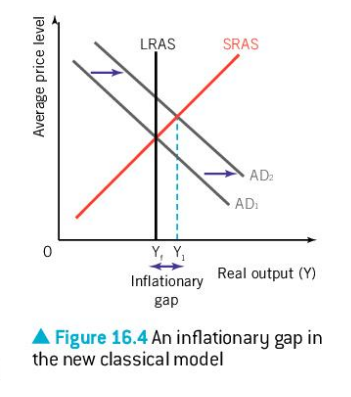
An inflationary gapis when an economy’s real GDP surpasses its potential GDP.
Initially the economy is at its long run equilibrium at Yf. If there is an increase in aggregate demand, AD1 to AD2 due to changes in any of the components of AD then in the short run there will be an increase in output from Yf to Y1. In this case the economy would be experiencing what is known as an inflationary gap, where the economy is in equilibrium at a level of output that is greater than the full employment level of output.
Inflationary gap in the long run
It is possible for output to increase in the short run by paying existing workers overtime. But as the economy is originally at the full-employment level of output there are no unemployed resources. In their effort to increase output, the firms in the economy are competing for scarce labour, leads to an increase in AD which leads to an increase in price level from P1 to P2. The increase in APL means that on average all prices in the economy have risen as the firms bid up the prices of the FoP in order to increase their output. The rise in price level means increased costs to firms. Must remember what happens to SRAS when costs rise. Results in a shift of SRAS1 to SRAS2. Although firms were willing to supply a higher level of output due to the higher prcies they were receiving in the short run, their higher costs of production result in no real gain, so they reduce output back to Yf. The final results is that output returns to its full employment level but at a higher price P3.

Deflationary gap in the short run
Deflationary gap is the difference between economy’s actual level of real GDP and its potential GDP it would produce if its resources were at maximum employment.
Originally the economy is at its long run equilibrium where AD1 intersects with SRAS1 at output Yf and price level P1. A fall in AD from AD1 to AD2 due to changes in any components of AD results in a fall in the level of output from Yf to Y1 and a decrease in the price level. In this case, the economy would be experiencing what is known as a deflationary gap, where the economy is in equilibrium at a level of output less than full-employment level of output

Deflationary gap in the long run
In the short run the economy will produce at less than full employment output, however this deflationary gap will not persist. The fall in the price level means that the price of the economy’s FoP’s have fallen. This means that firms’ costs of production fall and this results in a shift in the short run aggregate supply from SRAS1 to SRAS2. The economy returns to its long run equilibrium at the full-employment level of output, at a lower price level.
