Sensation and Perception Part 1
 Call Kai
 Learn
Learn Practice Test
 Spaced Repetition
 Match
Match Flashcards
 Knowt Play
1/54

There's no tags or description
Looks like no tags are added yet.
Name | Mastery | Learn | Test | Matching | Spaced | Call with Kai | Chat |
|---|
No analytics yet
Send a link to your students to track their progress
55 Terms
Sensation
the detection of physical stimuli and transmission to the brain
Perception
the brain’s further processing, organization, and interpretation of the sensory info
Sensation Examples
Loud sound and flashing light
Perception Examples
Police siren and pull over!
Bottom-up processing
perception based on the physical features of the stimulus
Top-down processing
how knowledge, expectations, or past experiences shape the interpretation of sensory information
Transduction
turning physical stimuli into neural impulses
Sensory receptors
receive sensory stimuli
pass info to brain via neural impulses
all info sent to/sorted in thalamus except smell!
Quality vs Quantity
the brain needs qualitative and quantitative info about a stimulus
Qualitative Information
consists of the most basic qualities of a stimulus
Quantitative Information
consists of the degree, or magnitude of those qualities
Qualitative Information- Ex. traffic light
sensory receptors respond to differences by firing in different combinations
a green light is coded by different receptors than a red light
Quantitative Information- Ex. traffic light
Sensory receptors respond to differences by firing at different rates
a bright light causes receptors to fire more rapidly (at a higher frequency) than a dim light
Psychophysics
scientific study of psychological experience of physical stimuli
researchers present subtle changes in stimuli (observe how participants respond)
Absolute threshold
the minimum intensity of stimulation that must occur before you experience a sensation
Ex: starting to use a plugin
Difference threshold
smallest noticeable difference between two stimuli
also called the “Just Noticeable Difference” or JND
Ex: increasing the plugin’s intensity
Weber’s Law
Amount of change for JND is proportional to the original stimulus
the smaller a stimulus is at the start, the less it has to change for you to notice
the larger the stimulus at the start, the more it has to change
Weber’s Law Example
lift a 5 lb. weight vs a 10 lb. weight (noticeable- 5 lb. gain is a huge % increase!)
lift a 200 lb. weight vs a 205 lb. weight (not noticeable- 5 lb. gain is a ting % increase!)
Signal detection theory (SDT)
detection of a stimulus requires a judgement
it is not an all-or-nothing process
Response bias
a participant’s tendency to report or not report detecting the signal in an ambiguous trial
Sensory adaptation
a decrease in sensitivity to a constant level of stimulation
information stops being meaningful
McGurk Effect (McGurk and MacDonald, 1976)
our perceptions often rely on multiple senses
input from one sense can confuse another sense
“ba” sound appears to be different sound “va”
Cornea
where light first passes through- focuses light
Lens
bends light further inward toward the retina- accommodation
Retina
contains sensory receptors that transduce light into neural signals
Pupil
determines how much light enters the eye
Iris
color and determines the size of the pupil
Accommodation
behind the iris, muscles change the shape of the lens
flatten lens to focus on distance objects
thicken lens to focus on closer objects
Rods
(120 million)- shape/contrast
responsive even in dark (scotopic)
Cones
(6 million) - color
responsive in daylight (photopic)
Fovea
center of retina, high density of photoreceptors
greater visual acuity/resolution
high number of cones, low number of rods
Peripheral
sides, low density of photoreceptors
poor visual acuity
high number of rods, low number of cones
Optic Nerve
(no sensory receptors)
Optic Chiasm
½ of the axons of the optic nerve cross to contralateral side
Optic Tract Projects to multiple areas
Superior Colliculus and Lateral geniculate nucleus
Superior Colliculus
processes movement
Lateral geniculate nucleus (LGN) of thalamus
relays info bound for primary visual cortex
Blind spot
where the optic nerve leaves the eye
no sensory receptors
Why don’t we notice our Blind Spot?
the brain fills in the missing info
both eyes open = uses info from other eye
one eye open = pattern completion
Secondary visual areas (the what system)
temporal lobe
identification of visual objects
occipital- temporal pathway
damage: can lead to visual agnosia
Secondary visual areas (the where system)
parietal lobe
location of visual objects and guiding of actions
occipital- parietal pathway
damage: can lead to problems with reaching for seen objects
Color Perception
See a small portion of the spectrum (400 -700 nm)
Lower (shorter) wavelengths
perceived as blue/purple
Middle wavelengths
perceived as green
Higher (longer) wavelengths
perceived as red and orange
Trichromatic Theory
Three types of cones
• Each responsible for different
wave lengths
• Activation leads to color
perception
• Some colors can mix
– EX) Yellow
• Doesn’t explain unimaginable
colors
Color Blindness
• There are two main types of color blindness, determined by the relative activity among the three types of cone receptors.
• red–green color blindness
• blue–yellow color blindness
• These genetic disorders occur in about 8 percent of males but less than 1 percent of females.
Opponent-process theory
receptor cells are linked in pairs working in opposition
opposite colors inhibit signals
• Red and green
• Yellow and blue
• Black and white
How do you perceive the car?
“unified whole”
innate principles to view sensory information as a whole
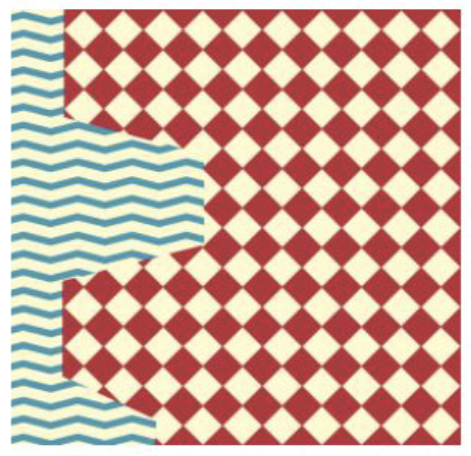
Figure and Ground
In identifying what is “figure,” the brain assigns the rest of the scene to the background.
Similarity
We tend to group figures according to how closely they resemble each other, whether in shape, color, or orientation

Proximity
The closer two figures are to each other, the more likely we are to group them and see them as the same object

Good Continuation
We tend to see the green as one rectangle rather than two rectangles

Closure
We tend to complete figures that have gaps
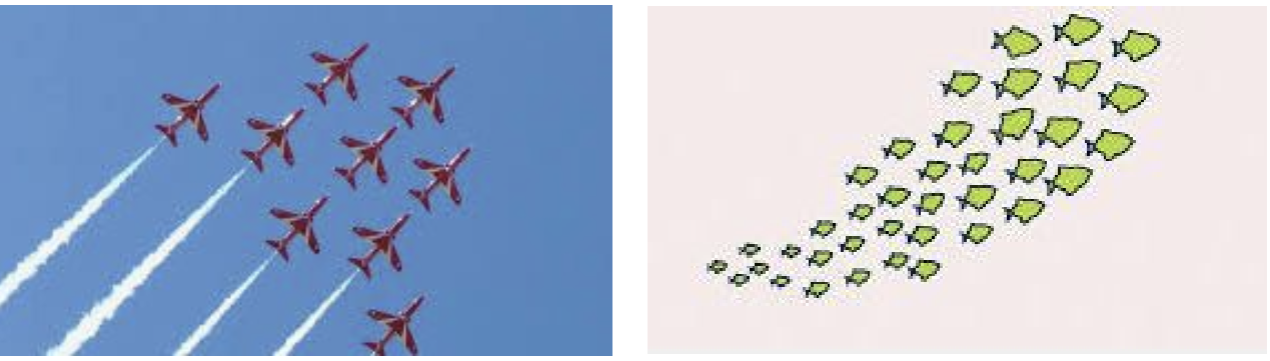
Common Fate
Grouping elements together if they move in the same direction, travel at the same speed, or change in a synchronized way