Art History 100 (Sumerians - Romans)
 Call Kai
 Learn
 Practice Test
 Spaced Repetition
 Match
 Flashcards
 Knowt Play
1/69

Earn XP
Description and Tags
Quiz 1
70 Terms
Sumerian, Nanna (Moon) Ziggurat at Ur, c. 2100 BCE
A monumental structure built in ancient Mesopotamia dedicated to the moon god Nanna, featuring a tiered design typical of Sumerian architecture and serving as a temple complex.

Sumerian, Votive statuettes from Tell Asmar, Iraq, c. 2900 BCE
Small, carved figures representing worshippers, often placed in temples as offerings to deities, reflecting the religious practices and artistic conventions of early Sumerian society.

Egyptian, Imhotep, Stepped pyramid of King Djoser, Saqqara, Egypt, c. 2600 BCE
A significant architectural advancement in ancient Egypt, the stepped pyramid was designed by Imhotep for King Djoser as a tomb, featuring a series of mastabas stacked on top of each other, symbolizing a stairway to the heavens.

Egyptian, Great Pyramids, Giza, Egypt, c. 2500 BCE
The Great Pyramids of Giza are monumental tombs built for the pharaohs, specifically Khufu, Khafre, and Menkaure, showcasing advanced engineering techniques and symbolizing the strength and authority of ancient Egypt.

Egyptian, Inner Coffin and Mask of Tutankhamen, from his tomb in the Valley of the Kings,
Thebes, Egypt, c. 1323 BCE
The Inner Coffin and Mask of Tutankhamen are ornate funerary artifacts made of gold and precious stones, designed to protect and honor the pharaoh in the afterlife, reflecting the artistry and beliefs surrounding death in ancient Egypt.

Greek, Funerary krater from the Dipylon cemetery, Athens, c. 750 BCE
A large, decorated vessel used for funerary purposes, the Funerary krater from the Dipylon cemetery features scenes depicting mourning rituals and offerings, signifying the importance of burial customs in ancient Greek society.

Greek, New York kouros, from Attica, c. 600 BCE
The New York kouros is a life-sized statue of a young male, characterized by its rigid stance and idealized anatomy, representing the notion of beauty and youth in ancient Greek culture. This work exemplifies the transition from geometric to more naturalistic forms in Greek sculpture.

Greek, The Kritios Boy, from the Acropolis at Athens, c. 470 BCE
The Kritios Boy is a life-sized statue that exemplifies the transition to a more naturalistic representation in Greek sculpture, showcasing a relaxed stance and realistic proportions. This work marks a significant advancement in the depiction of human figures, emphasizing individuality and movement.

Greek, The Charioteer of Delphi, c. 470 BCE
The Charioteer of Delphi is a bronze statue of a young charioteer, renowned for its detailed rendering and naturalistic form. It commemorates a victory in the Pythian Games and is significant for its expression of emotion and the elegance of the human figure.

Greek, Zeus of Artemision, c. 460 BC
A masterpiece of Ancient Greek sculpture dated to c. 460 BC during the Early Classical or Severe Style period. Discovered in an ancient shipwreck off the coast of Cape Artemision between 1926 and 1928, the slightly over life-sized statue (2.09 meters tall) is one of the few surviving large-scale original Greek bronzes in existence. art historians continue to debate whether the figure represents Zeus throwing a thunderbolt or Poseidon wielding a trident.

Greek, Myron, Discobolus (Discus Thrower), c. 450 BCE
A famous Classical Greek sculpture created by Myron depicting an athlete about to throw a discus. Known primarily through Roman marble copies, it is celebrated for its dynamic pose, rhythmic harmony, balance, and capture of athletic energy.

Greek, Polykleitos, The Spear Bearer (Doryphorus), c. 440 BCE
A famous High Classical Greek sculpture that established a canon of ideal human proportions based on mathematical symmetry, demonstrating the contrapposto stance.

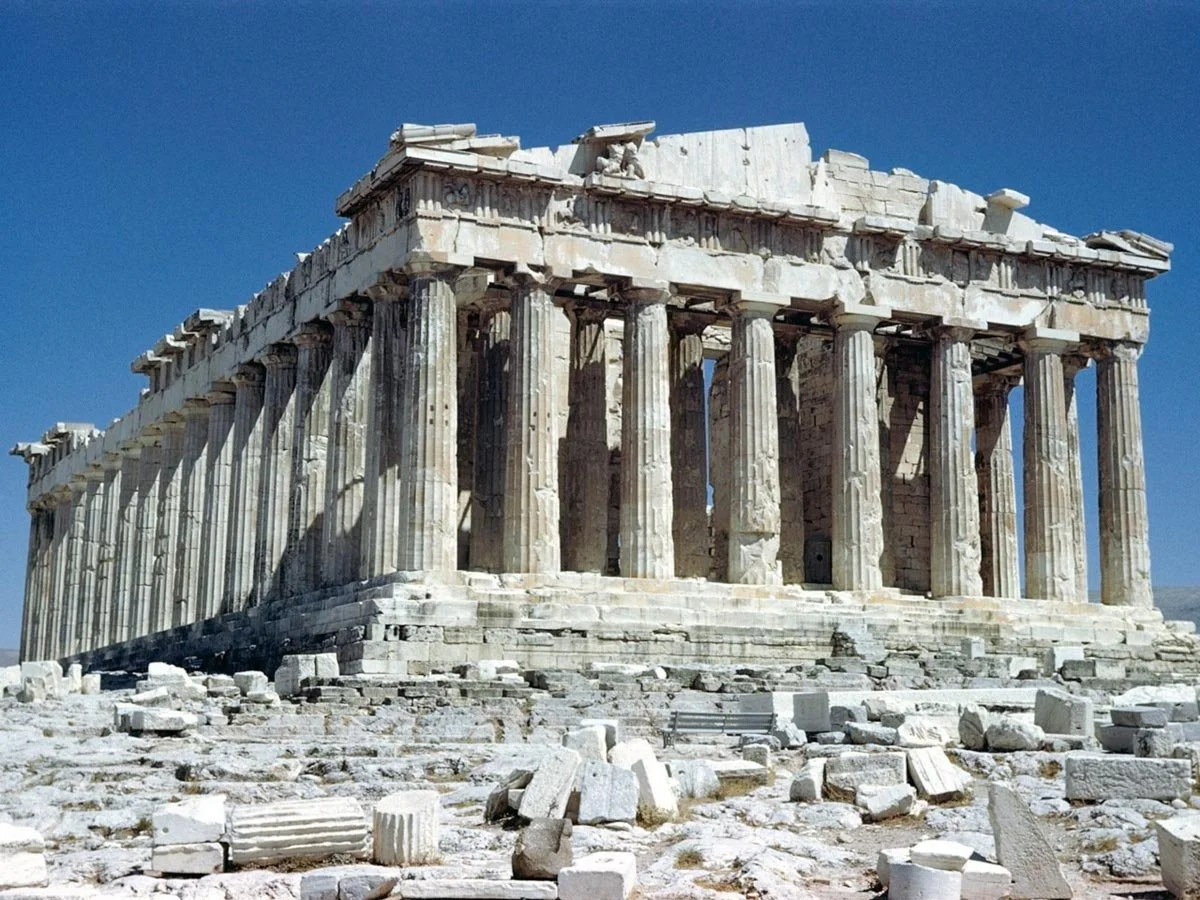
Greek, Iktinos and Kallikrates, The Parthenon, Athens, Greece, 447-432 BCE
A monumental Doric temple on the Athenian Acropolis dedicated to the goddess Athena, celebrated for its classical architecture, refined proportions, and elaborate sculptural decoration.
Greek, Reconstruction of the gold and ivory statue of Athena Parthenos, after Pheidias, 438 BCE
A colossal chryselephantine (gold and ivory) statue created by Pheidias, housed inside the Parthenon as the main cult image of Athena armed with a shield, spear, and Nike.

Roman, Temple of Portunus, Rome, Late 2nd century BCE
A well-preserved Republican Roman temple dedicated to Portunus, combining Greek Ionic order elements with traditional Etruscan architectural features like a high podium and single entrance staircase.

Roman, Pont du Gard, Nîmes (France), late 1st century BCE
A massive ancient Roman aqueduct bridge built with precise stonework and three tiers of arches, constructed to transport water across the Gardon River to the city of Nîmes.

Roman, Sanctuary of Fortuna, Palestrina, ca. 100 BCE
A massive hillside Republican Roman religious complex built using concrete, featuring terraced ramps, porticoes, and shops leading up to a tholos temple dedicated to Fortuna Primigenia.

Roman, The Colosseum, Rome, 80 CE
A grand oval amphitheater built under the Flavian dynasty, capable of seating tens of thousands for gladiatorial contests and public spectacles, constructed using concrete and complex vaulting.

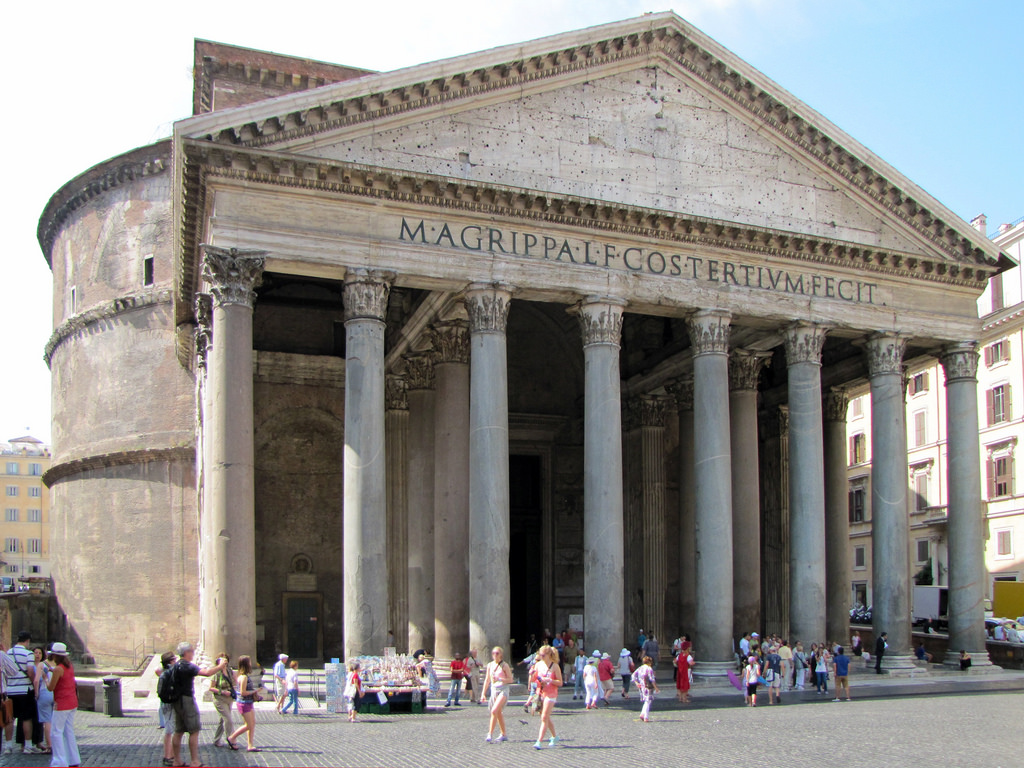
Roman, The Pantheon, Rome, 125 CE
A famous Roman temple dedicated to all the gods, famous for its massive concrete dome with a central oculus and a classical portico with Corinthian columns.
circa (or ca. or c.)
is a Latin preposition that means "around," "about," or "approximately"
Sumer
was the earliest known civilization in world history, located in the southern region of ancient Mesopotamia (present-day southern Iraq)
Ur
was a major ancient Sumerian city- state in souther Mesopotamia
Cuneiform
An ancient system of writing developed by the Sumerians in Mesopotamia, characterized by wedge-shaped impressions made on wet clay tablets using a reed stylus.

Hieroglyphics
An ancient Egyptian writing system using pictures and symbols.
Pharaoh
The ruler of ancient Egypt.Mastaba
A rectangular, flat-roofed ancient Egyptian tomb.
Imhotep
An Egyptian architect who designed Djoser's Step Pyramid.Mortise (hole) and tenon (bump)
A joint where a projecting tenon fits into a mortise hole.
construction
Used to move heavy stones and materials across land.Sledges
Used to move heavy stones and materials across land.Howard Carter
The archaeologist who discovered Tutankhamun's tomb in 1922.Geometric Period (c. 900-700 B.C.E)
Greek period known for geometric designs and patterns.Archaic Period (c. 700-480 B.C.E.)
Greek period before the Classical period.Classical Period (c. 480-323 B.C.E.)
Greek period known for idealized naturalism and balanced art.Krater
A large Greek vessel used to mix wine and water.
Frieze
A horizontal decorative band on a building.
Monumentality
A sense of great size, importance, or grandeur.Abstraction
Simplifying or changing forms rather than showing them realistically.Kouros, pl. kouroi
A Greek Archaic statue of a standing young man.
Symmetry/Asymmetry
Balanced, matching parts on opposite sides, vs a lack of equal or matching parts on opposite sides.
Gymnasium
A place for exercise, training, and education in ancient Greece.Olympia & the Olympic Games
A Greek sanctuary where athletic contests honored Zeus.Contrapposto
A pose where the weight is shifted onto one leg.
HubrisExcessive pride that challenges the gods or natural order.HumanismA focus on human abilities, experiences, and potential.AcropolisA fortified high area of an ancient Greek city.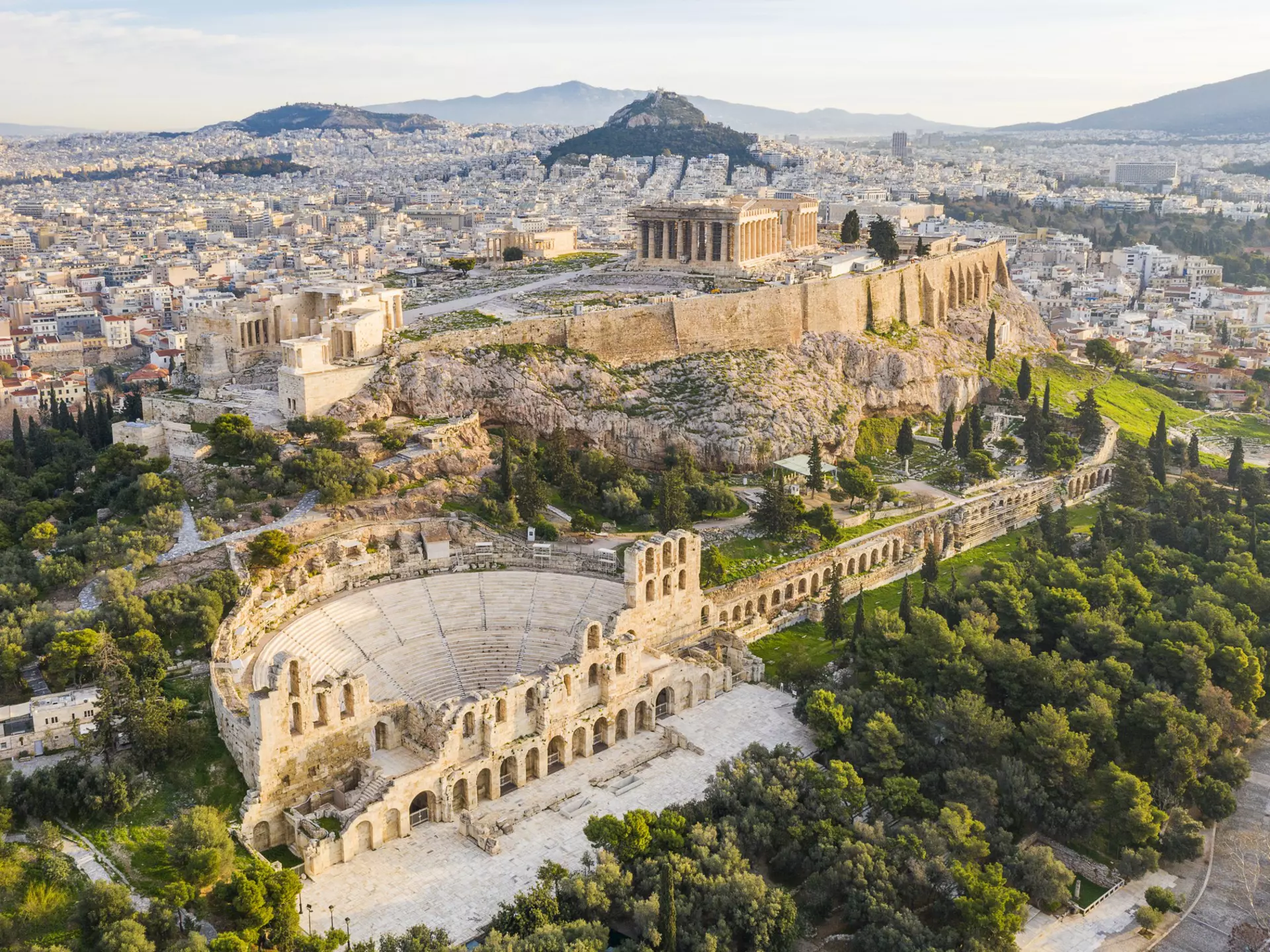
AgoraA Greek public marketplace and gathering place.PolisAn independent ancient Greek city-state.DemosThe common people or citizens of a Greek community.PericlesA major Athenian leader during the Classical period.Doric OrderA Greek architectural style with simple, sturdy columns.
Ionic OrderA Greek architectural style with scroll-like capitals.
Corinthian OrderA Greek architectural style with capitals decorated with leaves.
AnthropomorphicGiving human characteristics or forms to nonhuman things.PheidiasA famous Greek sculptor who worked on the Parthenon.PedimentA triangular area at the end of a classical building.
CurvatureThe use of slightly curved lines or surfaces in construction.FrontalityRepresenting a figure facing directly toward the viewer.AxialityOrganizing a design around a central axis or line.KeystoneThe central wedge-shaped stone that locks an arch together.
VoussoirA wedge-shaped stone that forms part of an arch.
AqueductA structure that carries water over distances.
ConcreteA durable Roman building material made from cement, water, and aggregates.Barrel vault A continuous, tunnel-like vault based on an arch.Groin vaultA vault formed where two barrel vaults intersect.AmphitheaterA large oval or circular structure with tiered seating.Flavian Emperors (Vespasian, Titus)Roman emperors who ruled during the Flavian dynasty.
ArenaThe central performance area inside an amphitheater.ClassicizingUsing or imitating features of Greek or Roman classical art.OculusA circular opening in a roof or dome.