Mental Health, Substance Use, Hyperemesis gravidarum, Thyroid Disorders, Diabetes in Pregnancy W10 (my copy)
 Call Kai
 Learn
 Practice Test
 Spaced Repetition
 Match
 Flashcards
 Knowt Play
1/76

There's no tags or description
Looks like no tags are added yet.
77 Terms
info card

ACES
adverse childhood experiences - impacts you later in life
How/who do mental health disorders impact the pregnancy?
Pregnant person
Gestational diabetes
Preeclampsia
Newborn - parent might neglect their child
Entire family - more likely to be depressed
Average cost untreated PMADS(pregnany mental health) = $31,800 per di-ad saved. Untreated people may go to jail or the baby could cost more to take care of and cost more.
PMADS
Perinatal mood and anxiety disorders
Depression (PPD)
Anxiety
Obsessive compulsive disorder
posttraumatic stress disorder PTSD
Postpartum psychosis
How to prevent mental health disorders in pregnancy?
Adequate treatment for mental health disorders before pregnancy
Access to safe, effective, affordable contraception
How often should you screen a pregnant client for mental health disorders?
Every trimester
1,2,4,6 months after birth
EDPS
IVP screening
EPDS
Edinburgh Postnatal Depression Scale
“How are things going?” How much time do you spend crying?” “Many women feel depressed after having a baby. Some feel so badly that they think about hurting themselves or their baby. Do you ever have these thoughts?”
How to treat PPD and other mental health disorders
Combination of antidepressants and cognitive behavioral therapy (CBT)
Holistic treatment – massage, rest, exercise, light, acupuncture, guided imagery, aromatherapy, community groups , accept help
Kalamazoo baby cafe
Food for clients
Speaker talks
The group talks
How do we screen PP clients for mental health disorders?
Edinburgh postnatal depression scale
S/S - regular depression + irritability or guilt
Medications for mental health. Add some you should not take too:
SSRI - prozac, zoloft, lexapro. Think puzzle or PZL
*Zuranolone = ONLY pp
Mood stabilizers
Anti-psychotics
Most medications = stay on, may increase d/t metabolism with exception of valproic acid (Depakote), some research = carbamazepine can also be bad
Zuranalone
Med made specifically for postpartum depression. SSRIs usually take 4-6 weeks to take effect. This med works within 72 hours! If someone is already on an SSRI, you can start this med too. Makes you very drowsy! Cannot drive! Can only take for 2 weeks! Think Saran Wrap, quick fix.
Potential dangers of SSRI’s for mom and baby.
Serotonin syndrome: brains gets too much serotonin. Sweaty, tachycardia, temp dysregulation.
Baby can go through withdrawal: difficulty eating, sleeping, irritability. Resolves by a week.
Know these!
Rare: pulmonary HTN in babies
How much more likely are women to have anxiety than men? Give some anxiety example types
2x more likely
Examples:
Obsessive-compulsive disorder (OCD): obsessive thoughts or actions
PTSD
Generalized anxiety disorder
Panic disorder
Agoraphobia and other phobias
How do we screen for anxiety in the PP client?
EDPS: know this one
Sometimes use the: GAD-7
>15 = severe anxiety
PP Psychosis. What is it and symptoms?
PP depression with psychotic features
Rare
Hallucinations, delusions, agitation, grandiosity (inflated sense of self)
Hallucinations and delusions definition
Not based in reality
Distortion of reality
What puts you MOST at risk for PP psychosis?
Bipolar or schizophrenia
If you discontinue antipsychotic or mood stabilizer, it could be VERY bad. Keep pregnant people on their meds.
What other factors can put you at risk for PP psychosis?
Infections
Electrolyte, nutritional deficiencies
Eclampsia
Sheehan syndrome - severe hemorrhage
Severe thyroid disorder
Substance use induced
Lack of sleep
Previous history
Resources for pregnant clients with mental issues - local and state/national
Local:
Cradle Kalamazoo – baby café’s
Family Health Center – support group
WMED – perinatal psychiatrist
Perinatal mental health – Bronson
State/national:
Postpartum support international: give healthcare providers education and training. Also has virtual services.
Pine Rest – in and outpatient: Outpatient: they take care of your babies and you get to spend time with them.
University of Michigan - Women and infant mental health program
End of Mental Health Portion!!
Yayyyyy
SLIDO: What is the most commonly abused substance during pregnancy?
Alcohol
SLIDO: Is methadone a substitute for other drug addictions?
No. Explained later.
Good and bad news in regard to substance use disorder:
Good:
Most receptive time to change lifestyle around pregnancy
Treatment works
Rx authority = expanded, more treatment available to prescribe and healthcare providers are more educated.
Bad:
Healthcare providers are source of trauma, shame
Many healthcare providers do not utilize evidence-based healthcare
Commonly abused drugs and the harm that each of them do: Know these.
Tobacco – Blood vessels spasm and shrink. Increased risk of Placenta previa, IUGR, IUFD, SIDS,
Alcohol – brain development, behavior
Marijuana – preterm birth, low birth weight, cognitive delays
Cocaine – IUGR, IUFD, ptb, ptl, placental abruption
Meth – preterm birth, abruption, lethargy, heart and brain abnormalities
Opioids – withdrawal
Rx – Wide variety, including opioids, benzos, etc.
Screening for drug use
4P’s
Parents
Partner
Past
Pregnancy
Include a questionnaire
Make sure to build up screening in a non-threatening way. Ask about OTC drugs, ask about amount, then ask about recreational drugs.

DAST
Drug abuse screening test
Biological testing:
Not recommended - biased against patients of color, low SES, not completely accurate.
What are the parts of biological testing?
Urine – only detectable for days, false negatives common
Meconium – may not have for several days, may be discarded by parents
Hair – detects for longer period of time (baby and PP person)
Umbilical cord tissue – need 6 inch sample
Should you just stop using opioids?
NO! Prescribe MOUD
What is MOUD?
Medication for opioid disorder
Do not recommend stopping opioids – withdrawal is risky, high risk of overdose when re-start
Suboxone (buprenorphine + Nalaxone) = sublingual, oral, IM – can get from most healthcare providers
Methadone = OTPs (opioid treatment programs aka “methadone clinic”) = only allowed to give methadone, usually daily
Prevents risky sex, STIs, crimes, soft tissue infection, overdose that they might otherwise do/get for drugs.
Methadone v suboxone
Methadone: full opioid agonist but in a measure dose to not deliver a high
Suboxone: partial agonist and antagonist. Has a “ceiling effect”
Difference between addiction and dependence?
Addiction: Behavioral - treatable
Dependence: Your body depends on it. Without it, you will go through withdrawal.
What is contingency management? Memorize
Clients get a gift card to come into the clinic. Reward system to promote change.
Are babies born addicted?
No, they are born dependent
Eat, sleep console modality
Treatment for mom and baby to help with substance use disorder that focuses on connection between mom and baby and non-pharm interventions.
get down on their level
be non-judgemental
Finnigan method:
Take the baby away from the mom. Shame the mom. Give babies morphine and admit them to the NICU.
End of Substance Use slides!!
Keep going!!
S/S of hyperemesis gravidarum: S/S of dehydration.
Persistent nausea/vomiting
Signs of dehydration such as: dry mouth, lips, and eyes; feeling dizzy or tired; dark or strong-smelling urine; headaches; infrequent urination; rapid heart rate; and confusion.
What is the PUQE score? Don’t memorize levels just memorize the gist.
PUQE Score: A scoring system based on client responses about nausea and vomiting.
Scores 4-6: Mild nausea and vomiting.
Scores 7-12: Moderate nausea and vomiting.
Scores 13+: Severe nausea and vomiting.

Causes:
Hormonal changes – hCG, progesterone
Genetic predisposition
Helicobacter pylori (H. pylori) : give antibiotics and a proton pump inhibitor. Test for h pylori with a breath test.
Ptyalism: excessive salivation
Risks for hyperemeissi gravidarum:
Nulliparous client
Previous history
hyperemesis gravidarum etiology
Elevated hCG due to molar or multiple gestation pregnancy
Estradiol increase due to elevated hCG
Nausea associated with motion
Normal potassium levels: on test
3.5 to 5
Electrolyte imbalances of hyperemesis gravidarum: Don’t have to memorize exact number.
Potassium 3.5 to 5 mEq/L
Sodium 136 to 145 mEq/L
Calcium 9 to 10.5 mg/dL
Glucose 74 to 106 mg/dL
How to treat hyperemesis gravidarum. Pharm, non-pharm and assessment:
Give Vitamin B6. Regulates neurotransmitters and hormones to control nausea.
Antiemetics: Zofran
Antihistamines like Benadryl
IV fluids for hydration
TPN: total parenteral nutrition - IV nu
Non-pharm strategies:
avoid triggers
ginger!
pressure points
Assess:
H-Pylori
CBC
Electrolytes
END!
Type 1 v type 2 diabetes:
Type 1 DM
Memorize: high risk of fetal abnormalities or death
Peak diagnosis in early adolescents
Highest risk for maternal and fetal morbidity and mortality
Type 2 DM
Increasing number of pregnancies affected (1% to 2% of all pregnancies)
Gestational diabetes
increased insulin resistance
more likely to deveop type 2 in future
Risk factors: memorize
BMI>25
History of GDM, family history of diabetes. Wanna know how other pregnancies were and how big their babies were.
History of A1C 5.7%-6.4%. Below 5.7% is normal
Previous LGA infant ( above 4.08 kilogram or 9 pound)
Table
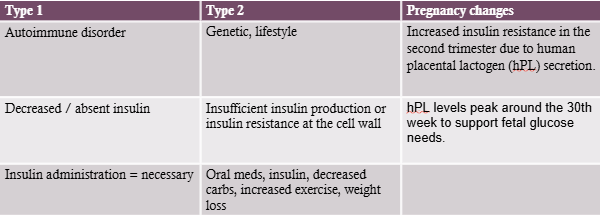
3 Ps
Polyphagia, polydipsia, polyuria
Slow wound healing, dry skin, visual disturbances, fatigue
Glucose tolerance test:
Do a 3 hour if 1 hour is unusual

What is a BPP
Looking at baby movement, tone, fluid (8-10 score is deal)
Considerations for the client and baby:
Psychosocial Impact
Anxiety or depression
Increased surveillance
Considerations
Lab work, additional visits
increased stress, employment, finances
Congenital malformations
Preterm birth
Large for gestational age (LGA) measurement
Birth Injury
Hypoglycemia 40-45 is low. May have tremors
Obesity
Health promotion for DM clients
Education:
Nutrition
Exercise
Medication
Office visits
Glucose monitoring
DM 1 management: memorize
Insulin dose decreased in 1st trimester, increased in 2nd and 3rd trimester
May add rapid acting insulin to regimen
IV infusion during labor
Preconception Care
DM 2 management:
Continue pre-pregnancy insulin regimen
Oral hypoglycemic (glyburide)
Insulin therapy
Exercise, Diet
Preconception care
Risk reduction for later
Next slideshow
yay
Hypothyroidism definition and 2 types and what they mean:
Everything slows down. Diagnosed if there is elevated TSH and decreased T4 levels.
Types:
Subclinical hypothyroidism: mildly elevated TSH with normal T4 levels.
Overt hypothyroidism: Elevated TSH with low T4 levels.
How does the thyroid change in pregnancy?
Increases in size due to pregnancy demands, with hCG and estrogen influencing thyroid hormone levels.
How is the fetus impacted by hypothyroidism?
Relies on maternal thyroid hormones and iodine for growth and thyroid development until about 20 weeks. If not properly treated, there might be IUGR, neurological delays, preterm birth or loss.
Risk factors for hypothyroidism:
Risk Factors
Female gender
African American
Surgical procedures - thyroid surgery
History of autoimmune disorder
Age
BMI
Multiparous
Iron deficiency
Impacts of hypothyroidism: memorize
Risk of pregnancy loss
Gestational diabetes
Preeclampsia
Placental abruption
Preterm labor
Postpartum hemorrhage
Neurological development of fetus
Placental dysfunction
Development of goiter(enlargement of thyroid gland)
Maternal stress
S/S of hypothyroidism. Subclinical and overt:
Subclinical hypothyroidism
Increase in serum TSH but not T4
No subjective or objective manifestations
Overt hypothyroidism
Fatigue
Constipation
Confusion
Weight gain
Amenorrhea
Bradycardia
Peripheral edema
Feeling cold
Treatment: monitor, pharm intervention - what to keep in mind with pharm intervention?
Monitor and maintain levels (check every 4-6 weeks during pregnancy)
TSH
T4
Thyroid replacement – levothyroxine
Titration of dosage dependent upon timing of diagnosis
Avoid prenatal vitamins 4 hours after dose, no food with medication. Know this!!
Should you increase pre-pregnancy levothyroxine dose?
Yes, by 30-50%.
Do you have to titrate levothyroxine levels?
Yes, titrate them throughout pregnancy to maintain TSH levels below 2.5 mIU/L
When to take prenatal vitamins in relation to levothyroxine?
Avoid taking prenatal vitamins within 4 hours of taking levothyroxine.
What is hyperthyroidism?
Decreased serum TSH
Elevated serum T4
Oposite of hypothyroidism
Most common cause for hyperthyroidism:
Graves disease - leads to elevated/excessive thyroid stimulating immunoglobulin (TSI)
Other causes of hyperthyroidism:
Thyroiditis: inflammation leads to excessive T4 release
Thyroid nodules or goiter: Tissue overgrowth causing increased T4 production.
Risks for hyperthyroidism:
MOLAR PEGNANCY - memorize
Family or personal history or thyroid and/or autoimmune disorder
Pregnancy/recent postpartum
Adrenal insufficiency
Pernicious anemia
Iodine intake
Smoking
White, Non-Hispanic
Chilbearing age women
Hyperthyroidsim symptoms
Flushing
Sweating
Anxiety
Change bowel habits
Sleep difficulty
Change in energy
Hand tremors
Racing heart
Nausea and vomiting
Impacts of hyperthyroidism on pregnancy
mom
Preeclampsia
Preterm labor
Thyroid storm: this is a hyper metabolic state that can cause death from cardiac arrest or organ failure
Mood changes
Baby
Preterm birth
Small for gestational age (SGA)
Fetal demise
Congenital malformations
Fetal tachycardia
Fetal hyperthyroidism
Fetal goiter development.
Treatment for antithyroid medications - hyperthyroidism
Propylthiouracil (PTU) can be given until the 16th week
Methimazole after 16th week with goal to maintain T4 levels at slightly elevated.
Goal is to maintain T4 level in high to expected range
Impacts of PTU and methimazole on baby
Congenital disabilities and fetal thyroid function and growth restriction