PSYCH100 Unit 1 Exam
 Call Kai
 Learn
 Practice Test
 Spaced Repetition
 Match
 Flashcards
 Knowt Play
1/274

There's no tags or description
Looks like no tags are added yet.
275 Terms
Psychology (def.)
the scientific study of behavior and mental processes (the mind)
Psyche in Latin means…
mind
Logo in Latin means…
the study of
Psychological research aims to…
describe, predict, and explain behavior
Describe the “Mind-Body Issue”.
What is the connection between consciousness/mental processes and our physical body?
Philosophical and Physiological Roots of Psychology
Describe the nativist view.
What are we born with? Are we a blank slate? Or do we come into the world with some hardwiring?
We’re undercooked, but we would have trouble birthing with big heads (come out way too early and the infant's brain doubles in size the first few months)- other mammals are not like this and cook for longer and come out bigger
Describe the nature and nurture debate.
How much of our behavior/psychology comes from our biology and how much comes from our environment? “What comes hardwired (intelligence, personality, etc.)?”
Is height mostly nature or mostly nurture?
mostly nature
Are religious beliefs mostly nature or mostly nurture?
mostly nurture
Describe Darwin’s theory of natural selection.
How and why did our species evolve to be modern day humans?
People are…
messy!!
Structuralism (def.)
(1870s) Aimed to break down mental processes into their most basic elements
Founder of structuralism
Wilhelm Wundt
Introspection (def.)
looking inward to describe experiences (describe eating an apple)
Functionalism (def.)
(1870s) Analyzed the function or purpose of behavior- why did we evolve the way we did?
Introspection is the primary method associated with…
structuralism
Founders of functionalism
William James AND Mary Calkins
Darwin developed the primary theory of evolution A.K.A…
natural selection
Why did structuralism not work?
Because we perceive the “Gestalt” (whole)- we perceive either the letter B or the #13 *context matters!!
Functionalism is now called…
evolutionary psychology
Name the early schools of thought.
structuralism (1870s) and functionalism (1870s)
What is the foundational cornerstone for functionalism?
natural selection
Biological (def.)
how the physical body affects psychology
Describe the biological school of thought.
Biochemistry, anatomy, and physiology
Also called Neuroscience (study of the brain)
Evolutionary psychology (how our adaptive evolution affects us today)
*folded into biological school of thought
Behavior genetics: twins (how much of our behavior/psychology is from our genes)
Psychodynamic (def.)
internal forces within the mind
Pioneer of psychodynamic school of thought.
Sigmund Freud
Describe the psychodynamic school of thought.
Previously called Psychoanalytic Viewpoint
The unconscious mind (ex: driving a car and not remembering the past 4 blocks)
Abnormal psychology (when things go wrong)
Family of origin/childhood issues
Behaviorism (def.)
how the environment affects psychology
Pioneers of behaviorism school of thought.
Skinner (King of Psych 1950s-60s) and Watson
Describe the behaviorism school of thought.
Focus on observable behavior
Reinforcement and punishment
Behavior modification (changing maladaptive behavior)
Cognitive (def.)
internal mental processes and capabilities
Pioneers of cognitive school of thought.
Chomsky and Neisser
Describe the cognitive school of thought.
The Revolution!
*Chomsky writes paper that contradicts Skinner as a young upstart PhD (ballsy move) and Skinner responds, and so on…
Reasoning
Memory & Intelligence
Beliefs/thoughts
*Language – our ability for language is incredibly special (can’t reason, think, have memories without language)
What happened in the 1960s?
Vietnam War, birth control -> sexual revolution, hippies, etc.
Humanism (def.)
(Late 1960s) human growth and potential
Pioneers of humanism school of thought.
Rogers (gifted therapist) and Maslow (hierarchy of needs)
Describe the humanism school of thought.
People are inherently good
Free will/Choices (don’t have to be a slave to your past)
Living a fulfilled life
Today: “Positive Psychology”
Sociocultural (def.)
(Late 1960s) how social and cultural factors influence us
Describe the sociocultural school of thought.
Culture/society
Social Psychology (how others affect our behavior)
Gender Psychology
Name the modern schools of thought.
biological, psychodynamic, behaviorism, cognitive, humanism, sociocultural
Medication is ______ enough, but can help (everyone responds differently).
never
Identifying Schools of Thought: People with OCD are consumed by anxious thoughts.
Cognitive
Identifying Schools of Thought: OCD symptoms can be brought on by hidden unconscious fears stemming from childhood experiences.
Psycho-dynamic
Identifying Schools of Thought: Compulsive behaviors are reinforced because they reduce anxiety.
Behaviorism
Identifying Schools of Thought: OCD behavior is caused by a chemical imbalance in the brain.
Biological
Identifying Schools of Thought: A national emphasis on perfection promotes OCD symptoms.
Sociocultural
Identifying Schools of Thought: OCD can manifest when we are not living a meaningful and fulfilled life.
Humanistic
Biopsychosocial Approach (def.)
integrated approach that considers biological, psychological, and social-cultural factors
Basic Psychology (def.)
“foundational”: research, publish
Applied Psychology (def.)
finding practical uses for the research
How many divisions of APA are there?
54
Specialty areas in psychology
basic psychology, applied psychology, divisions of APA
Educational Psychologist (def.)
research ways to improve educational systems
Developmental Psychologist (def.)
how we grow and change throughout the lifespan
Industrial/Organizational Psychologist (def.)
behavior in the workplace, effective business-practices
Psychometric Psychologists (def.)
design and evaluate tests (interest, personality, IQ)
School Psychologist (def.)
works with parents, teachers, students to solve problem
Clinical Psychologist (def.)
focus on understanding and treating emotional problems, abnormal, or dysfunctional behavior (do not give out meds)
Counseling Psychologist (def.)
focus on helping people with adjustment problems and helping people make career choices
Educational and school psychologists are _____________!!
different
Both clinical and counseling psychologists are…
trained therapists at the highest level
Psychologists mainly work at…
Universities and hospitals/ health services
What’s the difference between a psychologist and a psychiatrist?
Clinical Psychologist:
Ph.D. prepared (5-7yrs beyond the Bachelor’s degree)
CANNOT prescribe medication (did not attend medical school)
Focus on talk therapy
Psychiatrist:
M.D. prepared (med school with emphasis on psychiatry)
CAN prescribe medication to treat mental disorders
Can do some talk therapy, but main focus is medications
Theory (def.)
explanation of something (why?)
Hypothesis (def.)
a prediction based on a theory
Operational Definition (def.)
how what is in question will be measured (takes a long time to figure out- have to be very specific)
Examples: measure what we mean by media, drug use, aggression, bad driving
“We are only as good as our measures” means…
results are meaningless without proper measurement
The scientific method employs __________ types of methods to conduct research. Each method has __________ advantages and disadvantages. What method a researcher uses depends on what __________ he/she is trying to answer.
different; unique; questions
All research is based on…
systematic observation and rules of evidence
Descriptive Research (def.)
Describes phenomenon
Types of descriptive methods include…
case study, observational studies, formal tests/assessments, and surveys (self-report)
Case Study (def.)
detailed account of an individual being studied; (usually an individual with unique circumstances) – only one person, limited in scope
Observational Studies include…
Naturalistic Observation
Laboratory Observation
Naturalistic Observation (def.)
observing in natural setting (Jane Goodall observing chimpanzees in natural habitat)
Laboratory Observation (def.)
observing in a lab (observing a marital discussion behind a two-way mirror)
Examples of formal tests/assessments
IQ tests, ACT, SAT
Describe charactertistics of formal tests/assessments.
Standardized – uniform procedures for giving and scoring the test
Norms – established standards of high/low scores
Surveys (self-report) (def.)
asking people to report on their behavior/attitudes; widely used in psychology; gather lots of information quickly
What are some of the problems with surveys (self-report)?
People lie/distort/have poor self-knowledge
Phrasing of questions can skew results
Volunteer Bias – those who volunteer to take surveys might be different from the general population
Correlation (def.)
(a descriptive method) looks for a consistent relationship between two things
Correlation Coefficient (def.)
a number that describes the strength and direction of a relationship between two variables; can range from -1.0 to +1.0
A correlation coefficient of zero (or very close to it) means there is ______ relationship between the variables.
no
For a correlation coefficient, as the number get closer to EITHER end (-1.0 or +1.0), the relationship gets _____________.
stronger
Positive Correlation (def.)
when the variables move in the same direction
Negative Correlation (def.)
when the variables move in opposite directions
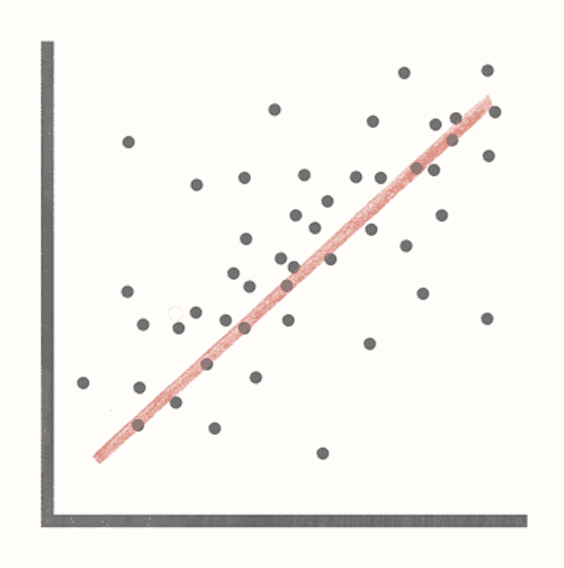
strong positive correlation

strong negative correlation

no correlation
Let’s say we have a Correlation Coefficient of +0.80 for height and weight. Interpret this value.
This means that as our height increases, our weight tends to increase (positive correlation). But there is not a “perfect” relationship (we can’t say EXACTLY how many lbs. one must gain for every inch for every person in the world).
A relationship (correlation) does _____ tell us what caused what.
not
Independent Variable (IV) (def.)
the variable that is controlled or manipulated (also called the Predictor Variable)
Dependent Variable (DV) (def.)
the variable that is being measured (to see what effect the IV has had) (also called the Outcome Variable)
Experimental Group (def.)
the group that receives the independent variable
Control Group (def.)
the group that is not exposed to the independent variable (used to compare to the experimental group)
Random Assignment (def.)
putting research participants into control and experimental groups randomly (this is SO important)!
Confounding Variables (def.)
variables that are irrelevant to the hypotheses, but can alter the research results
Placebo (def.)
a fake treatment or inactive substance (used often in medical research)
Placebo effect (def.)
groups taking a placebo WILL be affected by it!
Population (def.)
who you want to study (all)
Representative Sample (def.)
who you actually survey- must represent your population