COMM1000 M7: Small Group Communication

0.0(0)
Studied by 0 people
call kaiCall Kai
learnLearn
examPractice Test
spaced repetitionSpaced Repetition
heart puzzleMatch
flashcardsFlashcards
GameKnowt Play
Card Sorting

1/20

encourage image

There's no tags or description

Looks like no tags are added yet.

21 Terms

1
New cards

Small group communication

Group of people working interdependently to accomplish task (3-20 members)

2
New cards

Task cohesion

Extent to which everyone is working towards same objectives

3
New cards

Social cohesion

Level of positive regard that group members have for one another

  • Whether they like e/o


4
New cards

Small groups have their own ______ and ________

Identity

Distinct communication practices = slang, phrases, conflict resolution styles

5
New cards

What are the 7 functions of small groups?

  • Focus on discrete tasks

  • Evaluate and Advise

  • Create art + ideas

  • Provide service + support

  • Promote social networking

  • Compete

  • Help us Learn


6
New cards

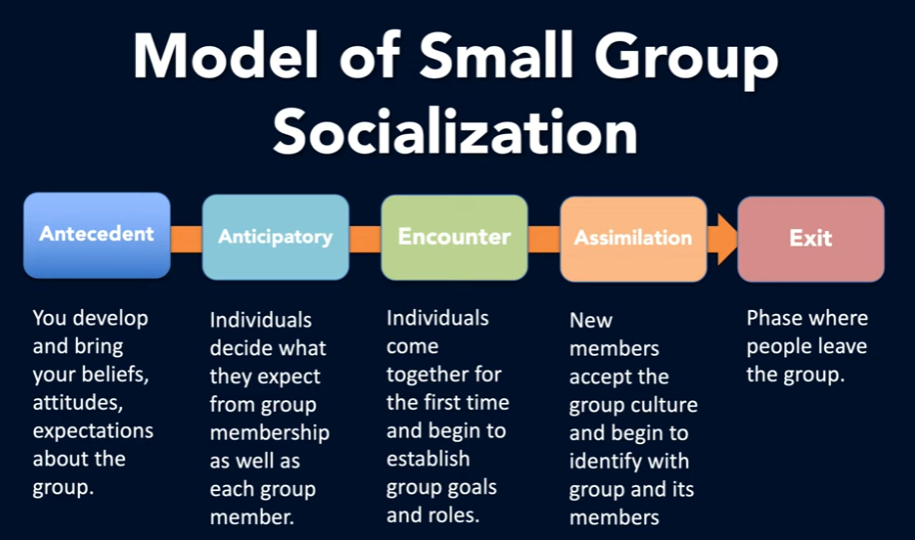
Model of Small Group Socialization: 5 phases

Describes process of becoming part of small group, being in it, and leaving it

  • Antecedent = own beliefs, attitudes, expectations

  • Anticipatory = individuals decide expectations for group

  • Encounter = individuals come together → establish group goals + roles

  • Assimilation = acceptance of group culture → identify w/ group

  • Exit = people begin leaving group


<p>Describes process of becoming part of small group, being in it, and leaving it</p><ul><li><p>Antecedent = own beliefs, attitudes, expectations</p></li><li><p>Anticipatory = individuals decide expectations for group</p></li><li><p>Encounter = individuals come together → establish group goals + roles</p></li><li><p>Assimilation = acceptance of group culture → identify w/ group</p></li><li><p>Exit = people begin leaving group</p></li></ul><p></p>
7
New cards

5 pros of groups

  • Resources

  • Decision quality

  • Synergy = whole greater than sum of its parts

  • Social facilitation = connections w/ others

  • Critical thinking = think more critically about situations, ideas, decisions


8
New cards

5 cons of groups

  • Sacrifices

  • Conflict

  • Conformity

  • Social Loafing = individuals avoid doing anything

  • Stress


<ul><li><p>Sacrifices</p></li><li><p>Conflict </p></li><li><p>Conformity</p></li><li><p>Social Loafing = individuals avoid doing anything</p></li><li><p>Stress</p></li></ul><p></p>
9
New cards

Grouphate

Past group experiences may make someone more averse to groups

  • Bad things happens in groups → people want to avoid groups

  • Prevalent in college classrooms


<p>Past group experiences may make someone more averse to groups</p><ul><li><p>Bad things happens in groups → people want to avoid groups</p></li><li><p>Prevalent in college classrooms</p></li></ul><p></p>
10
New cards

Four-Phase Model of Task Group Communication

Forming = group comes together

Storming = group struggles/tensions

Norming = group finds rhythm

Performing = group strives to achieve goals

<p>Forming = group comes together</p><p>Storming = group struggles/tensions</p><p>Norming = group finds rhythm</p><p>Performing = group strives to achieve goals</p>
11
New cards

10 group task roles

Roles to achieve task

  • Initiating-contributing

  • Information seeking/giving

  • Opinion seeking/giving

  • Elaborating

  • Coordinating

  • Orienting

  • Evaluating

  • Energizing

  • Assisting on Procedure

  • Recording


<p>Roles to achieve task</p><ul><li><p>Initiating-contributing</p></li><li><p>Information seeking/giving</p></li><li><p>Opinion seeking/giving</p></li><li><p>Elaborating</p></li><li><p>Coordinating</p></li><li><p>Orienting</p></li><li><p>Evaluating</p></li><li><p>Energizing</p></li><li><p>Assisting on Procedure</p></li><li><p>Recording</p></li></ul><p></p>
12
New cards

5 group maintenance roles

Sustaining relationships within group

  • Encouraging

  • Harmonizing = bringing people together

  • Compromising

  • Gatekeeping & Expediting = moving on from topic

  • Following


<p>Sustaining relationships within group</p><ul><li><p>Encouraging</p></li><li><p>Harmonizing = bringing people together</p></li><li><p>Compromising</p></li><li><p>Gatekeeping &amp; Expediting = moving on from topic</p></li><li><p>Following</p></li></ul><p></p>
13
New cards

8 group individual roles

Behaviors to assert oneself

  • Aggressing

  • Blocking

  • Recognition-Seeking = receive credit for contribution

  • Self-Confessing = apologizing, long day

  • Acting the Jokester

  • Dominating = take over conversation, do everything

  • Help-Seeking = always confused

  • Special-Interest Pleading = seeking what individual wants


<p>Behaviors to assert oneself</p><ul><li><p>Aggressing </p></li><li><p>Blocking</p></li><li><p>Recognition-Seeking = receive credit for contribution</p></li><li><p>Self-Confessing = apologizing, long day</p></li><li><p>Acting the Jokester</p></li><li><p>Dominating = take over conversation, do everything</p></li><li><p>Help-Seeking = always confused </p></li><li><p>Special-Interest Pleading = seeking what individual wants</p></li></ul><p></p>
14
New cards

Conformity

People try to prompt e/o to act like the group

  • Peer pressure


15
New cards

Asch Conformity Experiment

Identify which line is the same, but what happens when group members insist that it’s B?

  • Demonstrates people’s tendency to conform to majority


<p>Identify which line is the same, but what happens when group members insist that it’s B?</p><ul><li><p>Demonstrates people’s tendency to conform to majority</p></li></ul><p></p>
16
New cards

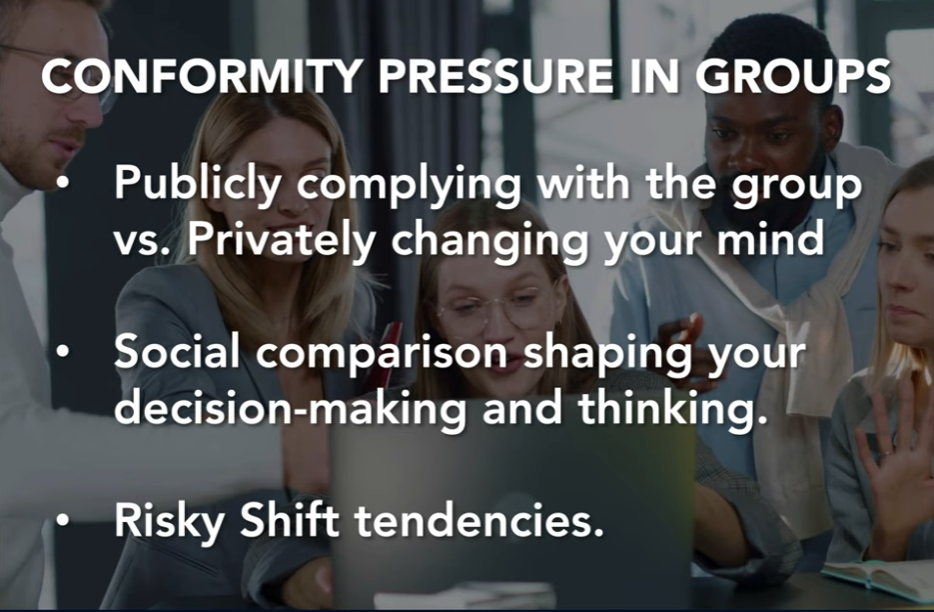
3 conformity pressures in groups

  • Publicly complying w/ group vs. Privately changing mind

  • Social comparison affecting decision-making + thinking

  • Risky Shift tendencies = group makes riskier decisions than individuals (group pressure)

<ul><li><p>Publicly complying w/ group vs. Privately changing mind</p></li><li><p>Social comparison affecting decision-making + thinking</p></li><li><p>Risky Shift tendencies = group makes riskier decisions than individuals (group pressure)</p></li></ul><p></p>
17
New cards

Groupthink

Tendency to align w/ group members while making decisions

  • Desire to agree w/ everyone


<p>Tendency to align w/ group members while making decisions</p><ul><li><p>Desire to agree w/ everyone</p></li></ul><p></p>
18
New cards

5 symptoms of groupthink

  • Illusion of invulnerability = feel safe, impossible to make mistake

  • Rationalization = insistence everything will be fine

  • Perceptions of morality in making decisions = doing “right thing”

  • Illusion of superiority = feeling of being invincible

  • Illusion of agreement = fear of breaking flow of agreement


<ul><li><p>Illusion of invulnerability = feel safe, impossible to make mistake</p></li><li><p>Rationalization = insistence everything will be fine</p></li><li><p>Perceptions of morality in making decisions = doing “right thing”</p></li><li><p>Illusion of superiority = feeling of being invincible</p></li><li><p>Illusion of agreement = fear of breaking flow of agreement</p></li></ul><p></p>
19
New cards

Challenger space shuttle = example of groupthink

January 28, 1986

  • Christa McCullough = first schoolteacher to go to space

    • Challenger exploded 73 seconds after takeoff

    • O-rings failed to seal due to low temperatures

      • Failed to contain fuel → leaked


<p>January 28, 1986</p><ul><li><p>Christa McCullough = first schoolteacher to go to space</p><ul><li><p>Challenger exploded 73 seconds after takeoff</p></li><li><p><u>O-rings failed</u> to seal due to low temperatures</p><ul><li><p>Failed to contain fuel → leaked</p></li></ul></li></ul></li></ul><p></p>
20
New cards

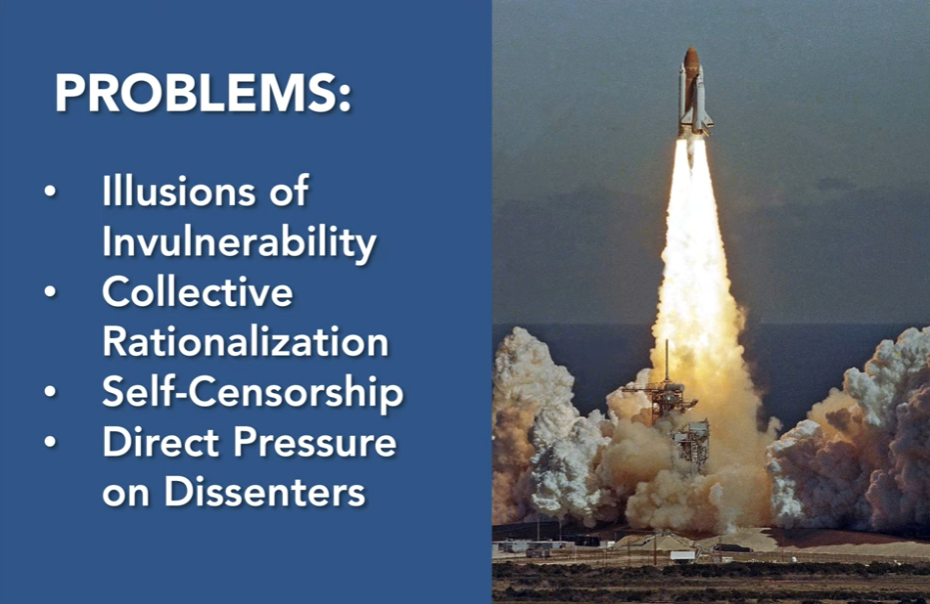
4 major problems of Challenger space shuttle

  • Illusions of Invulnerability = NASA never had a fatal accident before

  • Collective Rationalization = multiple O-rings; believed not all would fail

  • Self-Censorship = one engineer wanted to cancel launch; only voiced as recommendation, not insistence

  • Direct Pressure on Dissenters = NASA benefits from public attention

<ul><li><p>Illusions of Invulnerability = NASA never had a fatal accident before</p></li><li><p>Collective Rationalization = multiple O-rings; believed not all would fail</p></li><li><p>Self-Censorship = one engineer wanted to cancel launch; only voiced as recommendation, not insistence </p></li><li><p>Direct Pressure on Dissenters = NASA benefits from public attention</p></li></ul><p></p>
21
New cards

4 aspects of effective small group communication

  • Equal Participation

  • Consensus Decision-Making Style = ensure everyone’s on same page; establish it’s ok to disagree

  • Cooperative Conflict Style = work towards solution

  • Respectful Communication


<ul><li><p>Equal Participation</p></li><li><p>Consensus Decision-Making Style = ensure everyone’s on same page; establish it’s ok to disagree</p></li><li><p>Cooperative Conflict Style = work towards solution </p></li><li><p>Respectful Communication</p></li></ul><p></p>