L6: Avian Digestive Phyisology
 Call Kai
 Learn
Learn Practice Test
 Spaced Repetition
 Match
Match Flashcards
 Knowt Play
1/17

There's no tags or description
Looks like no tags are added yet.
Name | Mastery | Learn | Test | Matching | Spaced | Call with Kai | Chat |
|---|
No analytics yet
Send a link to your students to track their progress
18 Terms
Avian carnivores
Eat animal material
Birds of prey’ or ‘raptors’
Eat live prey or carrion
May be considered obligate scavengers (rare among vertebrates)

Avian herbivores
Eat plant material
Very rare for birds: Most are ‘opportunistic omnivores’ and supplement herbivorous diet with insects
Except... the hoatzin (aka stinkbird); Primarily folivore (leaves), some fruits, and flowers

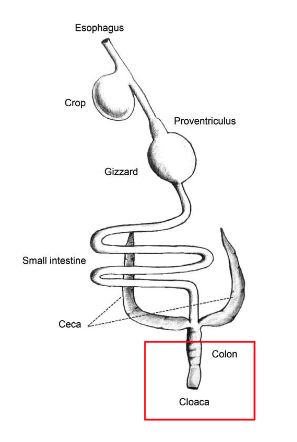
Avian digestive anatomy components
Headgut
Foregut
Midgut
Hindgut

Avian digestive physiology: Headgut
a) Oral cavity:
Beak/bill
prehension of food (grasp, tear, crush food items)
Specialized based on diet consumed; e.g. flamingos have a sieve-like bill (filter feeding)
Salivary glands
most birds only have mucus secreting glands
some species secrete an adhesive compound
e.g. woodpeckers (capture prey)
e.g. swifts (nest building)
b) Pharynx (throat)

Avian digestive physiology: Foregut composition
a) Esophagus
b) Crop
c) Proventriculus
d) Ventriculus
Avian digestive physiology: Esophagus purpose
Transfer food from pharynx to crop
allows for controlled regurgitation (some species)
e.g. regurgitate crop contents to feed young
e.g. regurgitate undigestible food

Avian digestive physiology: Crop purpose
major site of food storage for most bird species
site of microbial fermentation for the hoatzin

Avian digestive physiology: Proventriculus purpose
‘true stomach’
secretes pepsinogen + HCL - pepsin
secretes mucus

Avian digestive physiology: Ventriculus (aka gizzard) purpose
major site for trituration of food (turns it into small particles)
thick muscular walls with koilin membrane
gizzard stones (‘grit’); small ingested rocks used to help break down food
filter indigestible parts of food (mainly carnivores)
forms pellets to be egested

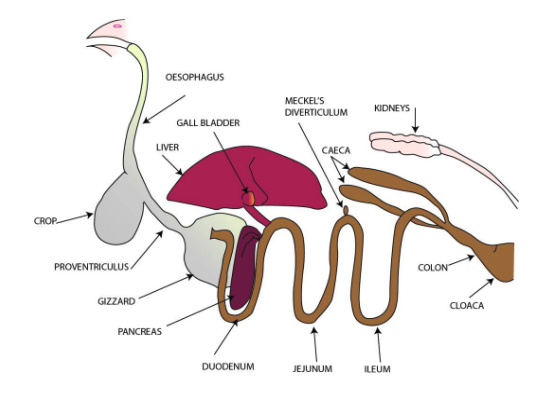
Avian digestive physiology: Midgut components
Small intestine
duodenum
jejunum
ileum

Avian digestive physiology: Duodenum purpose
Primary site of enzymatic digestion
Pancreatic/hepatic secretions
Alkaline/mucus secretions (pH balance)

Avian digestive physiology: Jejunum purpose
Primary site of nutrient absorption
Villi and microvilli present (increase absorption)

Avian digestive physiology: Ileum purpose
Vit B 12 and bile acid absorption
Avian digestive physiology: Hindgut composition
Cecum
(Colon)
Rectum
Cloaca

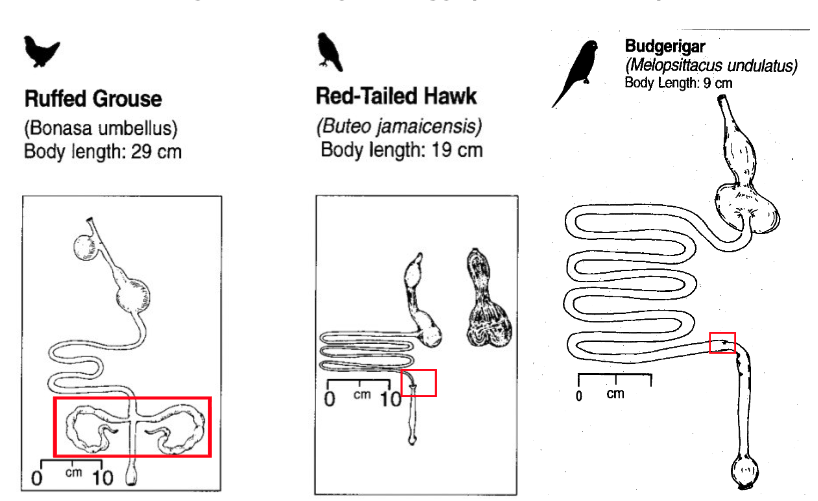
Avian digestive physiology: Cecum purpose and who has it
Site of microbial fermentation (VFA, Vit B, Vit K)
Paired (most birds) ‘ceca’
Exceptions:
Single (heron)
Functionless (most carnivores)
Absent (swifts, hummingbirds, woodpeckers, budgies; primarily because of their highly specialized, low-fiber diets and structural evolutionary adaptations for efficient flight
Avian digestive physiology: Who has a colon
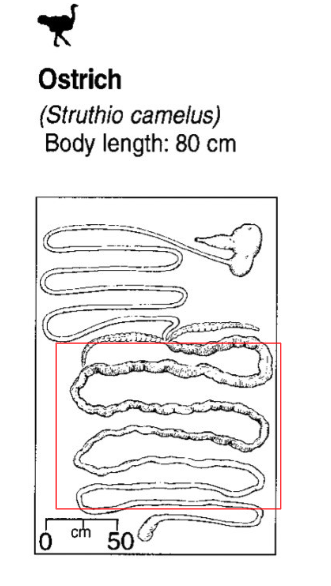
only the horned screamer and ostrich have a colon
Avian digestive physiology: Rectum purpose
short, straight remainder of the hindgut
water and mineral absorption → similar function to colon in mammals

Avian digestive physiology: Cloaca purpose
combined outlet for fecal/urinary excretion