Lab Practical: Lab 7
 Call Kai
 Learn
 Practice Test
 Spaced Repetition
 Match
 Flashcards
 Knowt Play
1/47

There's no tags or description
Looks like no tags are added yet.
48 Terms
what is the difference between an epiphyseal plate and an epiphyseal line?
The epiphyseal plate is a layer of hyaline cartilage where bone growth occurs in length during childhood and adolescence, while the epiphyseal line is the remnant of the plate in adults, indicating that growth has ceased.
Osteoblast function
Creates new bone
Osteocyte function
Standard mature bone cell
Chondrocyte
Standard mature cartilage cell
What is the periosteum?
The periosteum is a dense layer of vascular connective tissue enveloping the bones except at surfaces of the joints. It serves as a site for muscle attachment and contains nerves and blood vessels for bone nourishment.
Where is Hyaline/articular cartilage found?
At the ends of long bones, in synovial joints, in synchondrosis joints
Where is fibrocartilage found?
Fibrocartilage is found in intervertebral discs, the pubic symphysis, and in other symphysis joints
Where is elastic cartilage found?
External ear and epiglottis
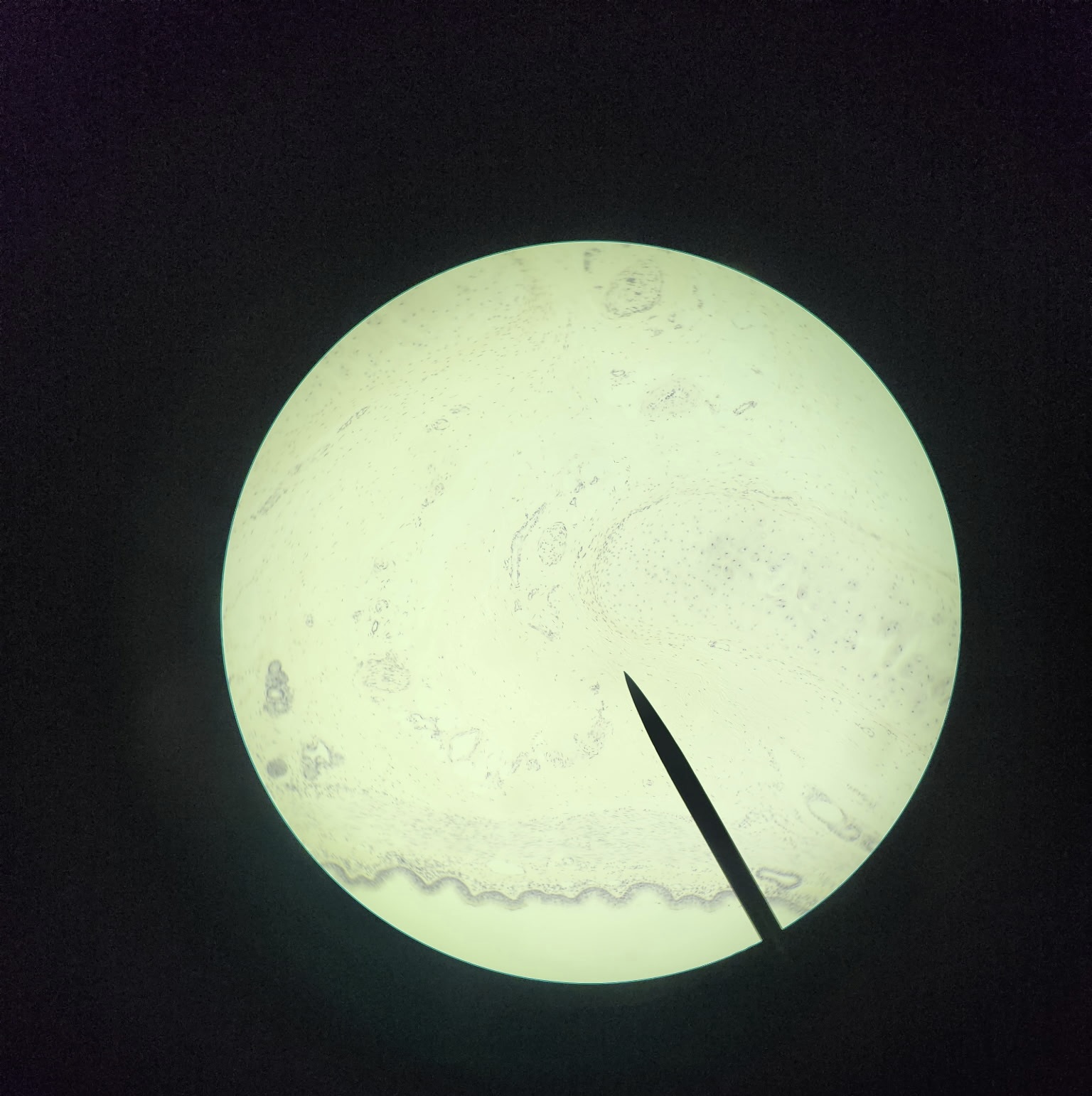
Hyaline Cartilage

fibrocartilage

elastic cartilage
Fibrous joints definition and subclasses
No joint cavity; bones connected with dense regular CT
suture
gomphosis
syndesmosis
Suture joints example & functional class
Joints connecting skull bones: synarthrosis
Gomphosis joints example & functional class
Joints between teeth and their sockets: synarthrosis
Syndesmosis joints example and functional class
Joints connected by ligaments, such as those between the radius and ulna: amphiarthrosis
Cartilaginous joints definition and subclasses
No joint cavity; bones are connected by cartilage
synchondrosis
symphysis
Synchondrosis Joints cartilage type, example, and functional class
Bones joined by hyaline cartilage
Ex: epiphyseal plate in a child’s long bone: synarthrosis
Symphysis Joints cartilage type, example, and functional class
Bones joined by fibrocartilage
Ex: pubic symphysis: ampiarthrotic
Ex. Intervertebral discs: amphiarthrotic
Synovial jointes definition and subclasses
Joint cavity with a synovial membrane producing synovial fluid
Planar
Hinge
Pivot
Condylar
Saddle
Ball-and-socket
Planar joints example and functional class
Ex: Inter carpal joints: diarthrotic
Hinge joints example and functional class
Ex: Temporomandibular joint: diarthrotic
Pivot joints example and functional class
Ex: Atlantoaxial Joint: diarthrotic
Condylar joints example and functional class
Ex. Atlantooccipital joint: diarthrotic
Saddle joints example and functional class
Ex. Carpometacarpal joints: diarthrotic
Ball-and-socket joints example and functional class
Ex: hip joint: diarthrotic
What are the two layers of the articular capsule in a synovial joint?
The outer fibrous layer and the inner synovial membrane. The fibrous layer provides stability, while the synovial membrane produces synovial fluid for lubrication.
What are the 8 cranial bones?
occipital
parietal
frontal
temporal
ethmoid
sphenoid
Which cranial bones are paired?
parietal
temporal
What are the 14 facial bones?
Nasal
vomer
lacrimal
zygomatic
palatine
maxilla
mandible
Which facial bones are paired?
Nasal
lacrimal
zygomatic
palatine
maxilla
what are the 4 suture joints to know?
Coronal suture
sagittal suture
lambdoid suture
squamous suture
What differentiates the C1 and C2 vertebra?
C1: No body, no spinous process, looks much cuter than C2
C2: Bifid spinous process, has dens
what is the other bone to know that is not a part of the skull?
The hyoid bone, supports the tongue
Origin and insertion of sternocleidomastoid muscle
Origin: manubrium of sternum
Insertion: mastoid process on temporal bone
Differentiate between compact and spongy bone.
Compact bone: dense, forms the outer layer of bones, providing strength and support
Spongy bone: lighter and made of trabeculae, found mostly at the ends of long bones and in the interiors of others.
Long Bones
Longer than they are wide
Short bones
Same length and width (nearly)
Flat bones
Flat and thin, possibly having curved surfaces
irregular bones
weird shapes
Actions at atlantooccipital joint
flexion and extension of head (nodding)
Actions at atlantoaxial joint
rotation of the head (shaking head no)
Actions at temporomandibular joint
Depression and elevation of mandible (mastication)
What special features are on the ethmoid bone?
Crista Galli
Cribriform plate
What special features are on the sphenoid bone?
Sella Turcica
Optic Canal
What muscles contribute to mastication?
masseter
temporalis
What muscles contribute to facial expression?
Frontalis
Orbicularis oris
Orbicularis occuli
Zygomaticus major
What muscles contribute to cervical movement?
Scalenes
Sternocleidomastoid
Erector Spinae
What are the three parts of erector spinae
Iliocostalis
Longissimus
spinalis