BIO CH 4-5
 Call Kai
 Learn
Learn Practice Test
 Spaced Repetition
 Match
Match Flashcards
 Knowt Play
1/114

There's no tags or description
Looks like no tags are added yet.
Name | Mastery | Learn | Test | Matching | Spaced | Call with Kai | Chat |
|---|
No analytics yet
Send a link to your students to track their progress
115 Terms
Kinetic energy
The energy of motion - molecules moving around
Potential energy
Stored energy that an object possesses because of its location or structure- energy stored in chemical bonds
Principle of conservation of energy
The physical principle stating that energy cannot be created or destroyed, only transformed from one form to another.
Heat
A type of kinetic energy contained in the random motion of atoms and molecules; it is the most randomized form of energy.
Entropy
A type of kinetic energy contained in the random motion of atoms and molecules
it is the most randomized form of energy
some energy becomes heat
Macromolecule group to which ATP belongs
Nucleic acids.
Structural component removed from ATP to release energy
The last negatively charged phosphate group.
products of cellular respiration
Carbon dioxide and water
Where does the chemical energy used to make ATP come from?
Cellular respiration harvests chemical energy from fuel molecules.
What can the energy from ATP power?
Different kinds of work in the cell. Cell Membranes & Transport
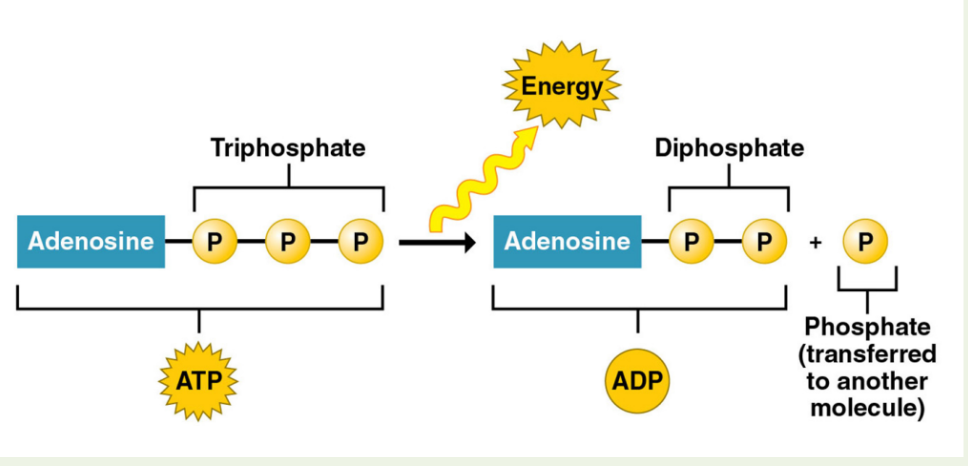
What part of this structure will be removed to release energy?
The last negatively charged phosphate, converting ATP into ADP + (P).
why is the last negatively charged phosphate removed
breaking the bond involving that phosphate releases energy that the cell can use to do work.
What type of bond connects amino acids?
Peptide bonds.
What is a polypeptide chain?
A chain of amino acids connected by peptide bonds.
What determines the order of amino acids in a protein?
DNA/genes
What are the three parts found in every amino acid?
Amino group, Carboxyl group, R group (side chain)
trypsin
a digestive enzyme
enzyme functions
ready for substrate, substrate binding, catalysis, product release
properties of enzymes
reuseable = not permantley altered by reaction
specificity= structure on active site make enzymes specific to one reaction
enzyme lowers activation energy
protein denaturation
protein loses its native three-dimensional shape and biological activity due to external stress, while its primary amino acid sequence remains intact
What type of cells are animals made of?
Eukaryotic cells
What makes a cell eukaryotic?
It has a "true nucleus" that contains the cell's DNA
What is the function of the nucleus?
It stores DNA and controls/directs many of the cell's activities
What do all cells have that surrounds the cell?
cell membrane
What is the main function of the cell membrane?
It controls what enters and leaves the cell.
What is the cell wall?
Structure + protection
plants have cell walls made of
cellulose found in prokaryotic cells
What are cilia and flagella?
Structures that some eukaryotic cells use for movement or moving substances.
What is cytoplasm?
A solution of water and nutrients that fills both eukaryotic and prokaryotic cell and provides the infrastructure for organelles
What is the cytoskeleton?
A protein-based scaffolding that reinforces/supports the cell
What do centrosomes do?
They assemble microtubules that help reinforce and support the cell
What is the endoplasmic reticulum (ER)?
A network of membranes that carries materials around the cell.
What is the main function of the rough ER?
It has ribosomes attached to its surface, helps with the synthesis and packaging of proteins.
What does the smooth ER do?
It helps make lipids, detoxify substances, and store ions
What is the function of ribosomes?
assemble amino acids into polypeptides, making proteins - found in cytoplasm or attached to nuclear envelope/rough ER
What happens to a protein after the ribosome builds it?
protein chain is pushed into the ER, and the ER can send it to the Golgi apparatus.
What is the Golgi apparatus?
organelle that processes, modifies, and packages proteins/materials for delivery.
What are vesicles?
Small sacs with phospholipid walls that transport materials around the cell or outside the cell.
function of lysosomes?
They contain enzymes that break down cellular waste and debris.
What does the nucleus contain?
DNA
What is chromatin?
A web-like substance containing DNA and proteins inside the nucleus
main function of the nucleolus?
stores the cell's DNA and helps control the cell's activities- located inside nucleus, produces ribosomal RNA (rRNA) and combines it with proteins to form the basic units of ribosomes.
What is the main function of mitochondria?
They carry out cellular respiration, converting energy from fuels into ATP
What do ALL cells have
A cell membrane
Cytoplasm
DNA
Ribosomes
Prokaryotic cells
do not have a nucleus or membrane-bound organelles.
Eukaryotic cells
do have a nucleus and membrane-bound organelles.
Which organisms are prokaryotic?
Bacteria and Archaea
Which organisms are eukaryotic?
Animals, plants, fungi, and protists

What cell is this
Prokaryotic Cell
No nucleus
No membrane-bound organelles
DNA is located in the cell's interior rather than enclosed in a nucleus

what cell is this
eukaryotic cell
A nucleus
Membrane-bound organelles such as mitochondria, ER, or Golgi
More internal compartments
Why are vesicles important to the endomembrane system
transport materials between different parts of the endomembrane system.
What is the function of the central vacuole
stores materials, including water, and helps maintain pressure and support in plant cells.
Do all plant cells have the same suite of plant-only organelles?
No. Different plant cells can have different organelles depending on their function and location - Onion lab: onion cells from the underground bulb do not receive much light, so they do not develop chloroplasts for photosynthesis

what part of the cell is this
Rough endoplasmic reticulum (ER)
= It produces proteins for export using its embedded ribosomes.

What part of the cell is this
Smooth Endoplasmic Reticulum
It produces lipids and removes toxins from the cell

what part of the cell is this
Golgi Apparatus
= It modifies, sorts, packages, and ships biomolecules (post office)
What is the endomembrane system
A group of organelles and membranes that work together to make, modify, transport, and process materials in the cell.
How are vesicles sent to the correct locations
transported by motor proteins along microtubules to their correct destination.
Lecture - What form of energy is most randomized and difficult to
put to work?
Heat
What is activation energy?
the amount of energy needed to get a chemical reaction started.
🏔 Reaction without enzyme:
You have to climb a big hill.
🏔 Reaction with enzyme:
The enzyme makes the hill smaller.
What is a substrate?
molecule that an enzyme acts on.
What is induced fit
when the substrate enters the active site, the enzyme changes its shape slightly so the substrate fits more closely.
Are enzymes consumed by a reaction
no, they help the reaction happen and then are released so they can be used again.
Are enzymes permanently changed?
No. They return to their usable shape after the reaction.
Are enzymes reusable?
Yes. The same enzyme can perform many reactions because it is not consumed during the reaction.
What is enzyme specificity?
an enzyme only works with certain substrate(s). This happens because the enzyme's active site has a specific shape and chemical properties.
Why are enzymes important?
Enzymes allow cells to carry out necessary chemical reactions efficiently. Without them many chemical reactions in cells would happen too slowly to support life
four levels of protein structure- Primary structure
Amino acid sequence
Secondary structure
Local folding such as alpha helices and beta sheets
Tertiary structure
Overall 3D shape of one protein
Quaternary structure
Multiple protein chains working together
Why does protein structure matter for enzymes?
The enzyme's 3D shape determines the shape of its active site. If the shape changes too much, the substrate may no longer fit.
What is denaturation?
protein loses its normal shape, cause the enzyme to stop working properly.
What can denature a protein?
Very high temperatures
Extreme pH
Other harsh chemical conditions
Why do enzymes work in different environments
The environment affects protein shape and therefore enzyme function.
EX: an enzyme that works in the stomach needs to function in a very acidic environment, while another enzyme might work better in the conditions of the small intestine or blood.
What is the chemical structure of the cell membrane
The cell membrane is primarily made of a phospholipid bilayer.
Phospholipids have Hydrophilic heads meaning
attracted to water
phospholipids have hydrophobic tails meaning
they avoid water
What is the cell membrane
boundary around the cell controls what enters and leaves the cell and helps maintain homeostasis.
Small, nonpolar/hydrophobic molecules - oxygen and carbon dioxide
can cross the lipid portion of the membrane relatively easily what can cross the membranes structure
Large, charged, or strongly hydrophilic substance
cannot cross the lipid bilayer easily and may need membrane proteins.
membrane proteins
transport substances and act as channels
Aquaporins
membrane proteins that allow water to cross the membrane quickly
What do small sugar chains do
Cell ID tags - Small carbohydrate/sugar chains on the outside of the membrane can function in cell recognition and identification.
What does cholesterol do
helps regulate membrane fluidity and stability- prevents the membrane from becoming too rigid or too fluid under different conditions.
What is diffusion?
movement of particles from an area of higher concentration to lower concentration - No cellular energy is required
What affects the rate of diffusion?
concentration, temperature, distance, size, properties
larger concentration gradient generally results in faster diffusion
passive transport
does NOT require cellular energy (ATP)
simple diffusion and facilitated diffusion

Simple diffusion
Substance crosses directly through the lipid bilayer.
no ATP needed
High to low concentration
small, nonpolar molecules.
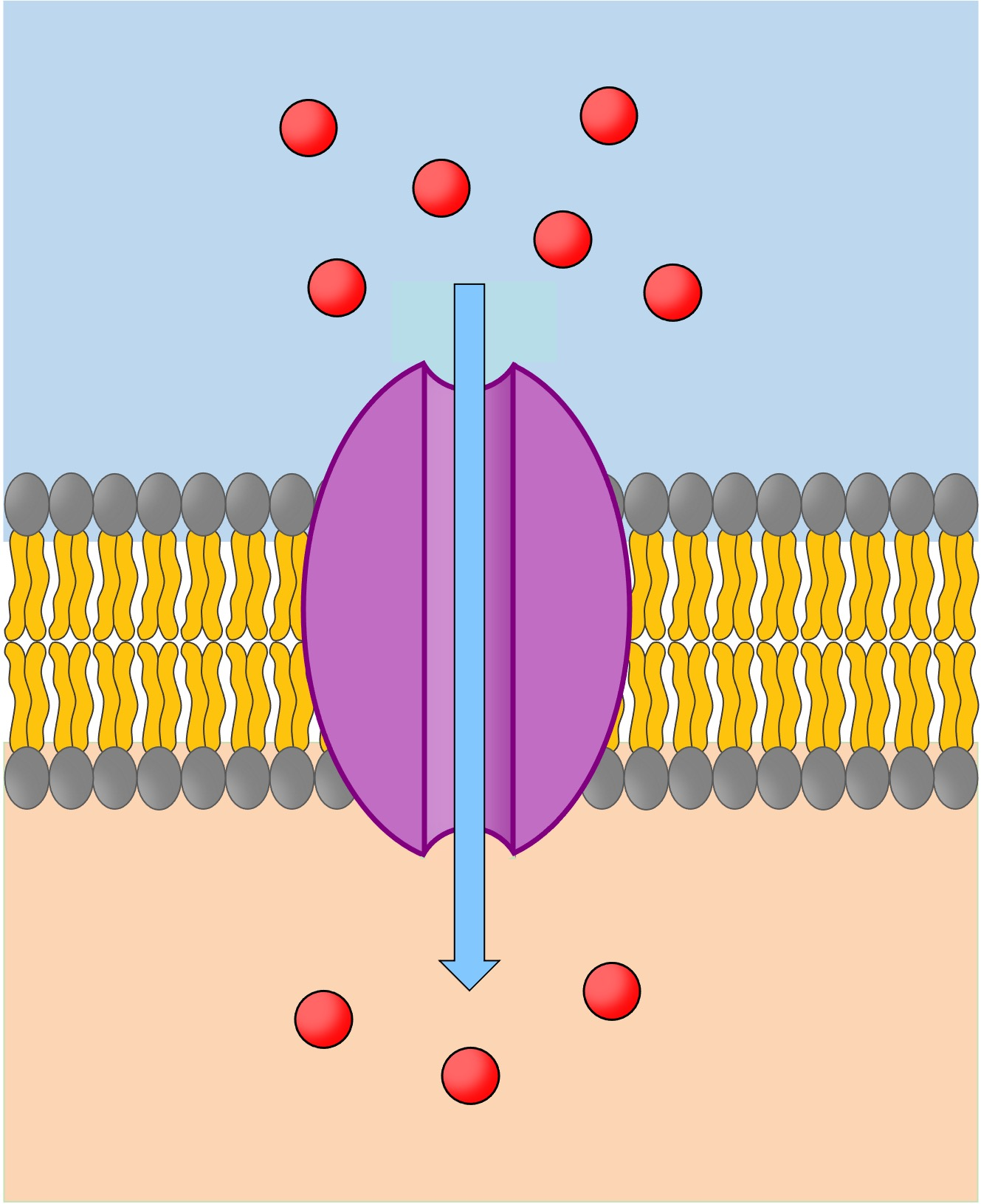
Facilitated diffusion
Substance crosses through a membrane protein.
Not ATP
high to low concentration
ions and molecules, and water through aquaporins.
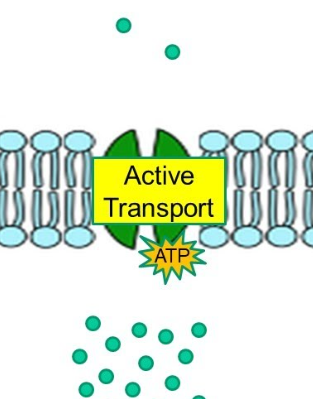
What is active transport
requires energy
Low to high = moved against their concentration gradient
What is the purpose of protein pumps
use energy to move substances against their concentration gradient.
Ex: sodium potassium pump

What is osmosis?
diffusion of water across a selectively permeable membrane - Water moves toward more solute.

What does hypertonic mean?
higher solute concentration outside the cell compared with inside
The cell loses water and becomes smaller.
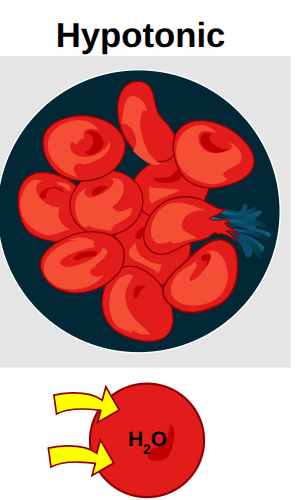
What does hypotonic mean?
lower solute concentration outside the cell compared with inside
The cell gains water and may swell.

What does isotonic mean
approximately the same solute concentration inside and outside the cell
no net movement of water.

What is exocytosis
moves materials out of the cell.
A vesicle moves to the cell membrane → fuses with the membrane → releases its contents outside.