Chem 105a Experiment 4: Flame Tests: Identification of Ions
 Call Kai
 Learn
 Practice Test
 Spaced Repetition
 Match
 Flashcards
 Knowt Play
1/24

There's no tags or description
Looks like no tags are added yet.
25 Terms
Purpose
To identify unknown ions by observing the characteristic flame colors produced when different ionic solutions are heated
Safety Table

Lab Objectives
Observe the colors of the flames produced by different aqueous ionic solutions
Understand why ionic solutions produce colored flames
Identify the composition of an unknown ionic solution
Why do elements emit colored light?
They emit colored light when they are excited by an external source, such as an electric current or heat (ex. a neon sign)
Polychromatic
An element emitting light consisting of many colors, only one of which can be perceived by the eye (the most dominant color is the line spectrum)
Spectrometer
An instrument that separates light into a spectrum.
Emission/line spectrum
The spectrum of light released from excited atoms of an element
What can emission spectrum/flame tests be used to find?
It can be used to identify the presence element depending on the color emitted
What was the wire we used composed of? What was its name?
nickel and chromium
Nichrome wire
Experiment overview
Ionic solutions, 8 known and 3 unknown, were excited by introducing them into a burner flame by heating up a nichrome wire to atomize the atomic solution into a mist of very fine droplets into the bunsen burner's air vents.
What were the 8 flame test salts?
calcium chloride, copper (II) chloride, potassium chloride, sodium chloride, copper (II) nitrate, potassium nitrate, sodium nitrate and copper (II) sulfate
What was the role of HCl in this experiment?
Used to clean the nichrome wire
How do we determine what color should be present given a frequency?
Convert frequency to wavelength
What should the flame on the bunsen burner look like for this test?
Visible light blue
What did we determine the identities of unknown A, B, and C to be?
A- KCl - Contains K potassium
B - NaCl - Contains Na sodium
C - CuSO4 - Contains Cu copper
Which element did we determine to be responsible for the green flame?
Copper
Which element did we determine to be responsible for the orange flame?
Sodium
Which element did we determine to be responsible for the purple/pink flame?
Potassium
Does the cation or anion contribute more to the color of flame observed?
Cation
Which substances burned red/orange?
Calcium Chloride
Sodium Chloride
Sodium Nitrate
CaCl2, NaCl, NaNO3
Which substances burned purple?
Potassium Chloride
Potassium Nitrate
Which substances burned green
Copper (II) Nitrate
Copper (II) Chloride Copper (I) Sulfate
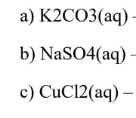
Predict the colors of

What analysis was done on the data/observations?
- grouping the known substances based on the color of the flame produced, and noticing patterns in the groupings as well as identifying what ion is responsible for producing a certain color
- analyzing whether flame tests can be used to test for the presence of cations and/or anions
- finding the molecular composition of the unknown solutions based on the color of flame produced
What were common sources of error that could have impacted this experiment?
- mostly systematic error
- ex. not cleaning the nichrome wire correctly could result in an incorrect coloration of the flame; not cleaning the watch glass could leave remnants of a past-used solution