ARTH 207 Test 2 Study Guide
 Call Kai
 Learn
 Practice Test
 Spaced Repetition
 Match
 Flashcards
 Knowt Play
1/45

There's no tags or description
Looks like no tags are added yet.
Name | Mastery | Learn | Test | Matching | Spaced | Call with Kai | Chat |
|---|
No analytics yet
Send a link to your students to track their progress
46 Terms
Futurism
An early 20th-century Italian art movement founded by F.T. Marinetti that glorified speed, technology, dynamism, and violence.
Suprematism
A 1915 abstract art movement, founded by Kazimir Malevich, that completely abandoned references to the outside world by mapping boundless space.
Kazmir claimed…
The “supremacy of pure feeling or perception of the pictorial arts,” and rejected representational painting
Dada
An anti-art satirical movement from Zurich that formed in reaction to the horror and absurdity of World War I.
“Revolted by the butchery of the 1914 World War, we in Zurich devoted ourselves to the arts. While the guns rumbled in the distance, we sang, painted, made collages, and wrote poems with all of our might.”
Hans Arp
Readymade
An ordinary manufactured object from material culture transformed into an artwork through the artist's selection
Surrealism
A 20th-century literary, philosophical, and artistic movement that explored the unconscious mind and championed the irrational.
Automatism
A surrealist form of making art in the 1920’s that came from the unconscious mind without conscious control
Automatism…
Allowed the hand to flow freely across a surface, embracing chance and accidental mark
Exquisite Corpse
“Cadacre exquis,” A surrealist collective of media that is collectively assembled
The result of the Exquisite Corpse
Final result believed to exhibit collective unconscious
Paranoiac critical method
A surrealist technique by Salvador Dalí in the early 1930s that created multiple shifting images within a single scene.
The Paranoiac Critical Method allowed…
artists to tap into their subconscious through systematic irrational thought and a self
De Stijl
“The Style,” a peaceful movement led by Piet Mondrian that rejected nature and embraced plastic art rooted in geometry, horizontals, primary colors, and universal beauty
Bauhaus
A revolutionary art school, established in Weimar, Germany, in 1919 by Walter Gropius, sought to bring art back into contact with everyday life.
What does Bauhaus mean?
A combination of German words building (bau) and house (haus), invoking guild and fraternity
Umberto Boccioni
Italian Supremacist Flagship artist of the Futurist movement that believed Italy should be looking forward to the machine rather than to war or the past, with the Renaissance
Kazimir Malevich
Created Suprematism in 1915 and rejected representational painting, claiming his art form as pure feeling
Hannah Höch
Devout feminist and the queen of photo montage, even though people considered her artwork as lesser
What did Hannah Höch’s work do?
Point out faults of the German government, mostly sexism and corruption within politics
Salvador Dali
A classically trained Master of surrealism whose goal was to be as surreal as possible while still being sober
Who was Dali a fan of?
Hieronymus Bosch
Ren é Magritte
A straightforward, classically trained commercial artist with a deep dislike for formal education
How did Ren é Magritte approach surrealism
His form of surrealism was so real that small discrepancies were exacerbated because he believed that paintings were not real depictions of things, just the artist’s interpretation
Frida Kahlo
A self-taught artist who explored themes of identity, pain, and the human body after her bus accident. Her paintings are surrealist, but she doesn’t consider herself one. A feminist
Why are Frida Kahlo’s paintings mostly self portraits and small?
Because she was constantly alone and bedridden because of the pain
Piet Mondrian
Believed that art should be a universal language, so stripped represnetations of what he deemed unnecessary
Josef Albers
An elementary school teacher turned Bauhaus professor turned Black Mountain College professor that taught color theory and foundations
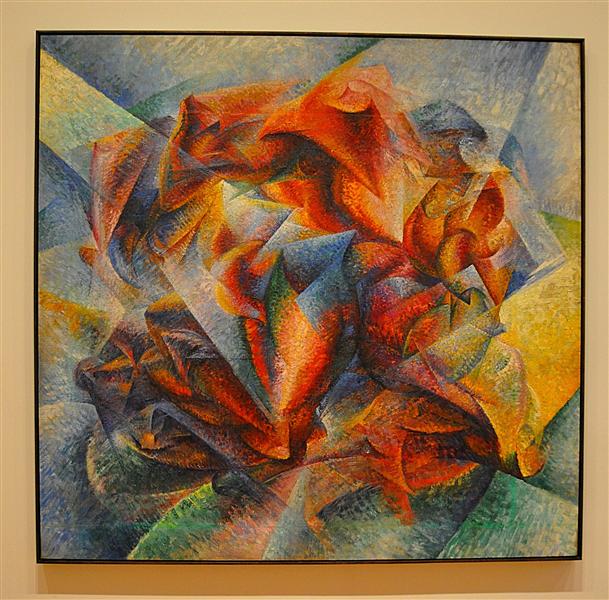
Umberto Boccioni, “Dynamism of a Soccer Player,” 1913
A massive Italian futurist work featuring the dynamism of a soccer player glorifying Italian nationalism and their athletic skills
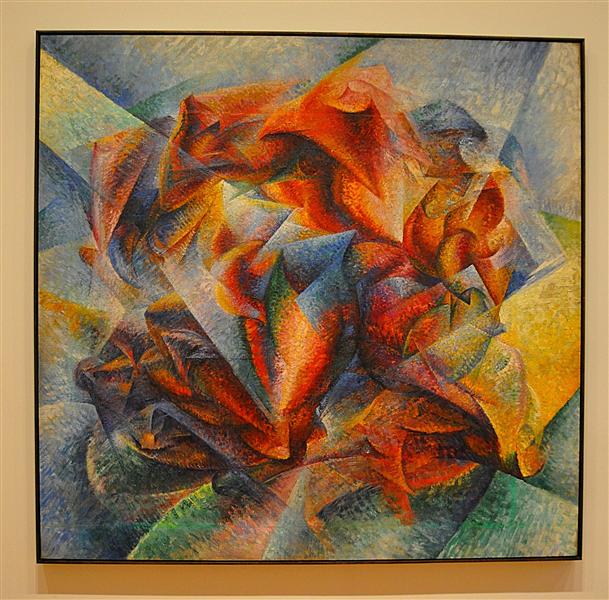
How does “Dynamism of a Soccer Player,” differentiate itself from Cubist works?
It uses color and texture where cubist works wanted people to focus on the subject matter. It also uses force lines to signify action.

Kasimir Malevich, “Black Square,” 1915
Suprematist Artwork that served as the emblem of anti-monarchy. It was featured in a blasphemous exhibition where it replaced where religious portraits would be in the household, defining suprematism as a new religion.
What play did Kasimir do stage backgrounds for that inspired Black Square?
Victor of the Sun, an antimonarchy play about capturing the sun, or the monarchy.
Zaum
an experimental poetic language that stripped words of conventional meaning and focused on sound and rhythm
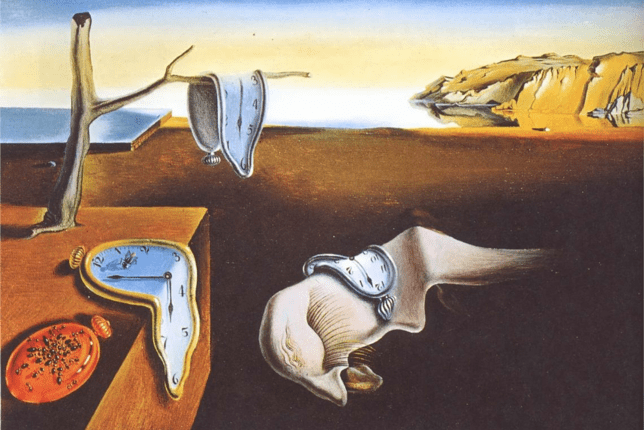
Salvador Dalí, “The Persistence of Memory,” 1931
He was incredibly afraid of ants after an incident with a dead bat when he was young; the eye is a self-portrait of himself sleeping, the painting could be interpreted as a way of healing
Where did Dali grow up? It is featured in The Persistence of Memory.
The Cap de Creus in Spain
What do the melting clocks in The Persistence of Memory represent?
They are a metaphor for time, but also when he ha a bad dream after he saw melting cheese at a party with a fly on it.
Andre Breton
A medical student interested in psychiatry that insisted that healing occured through dreams
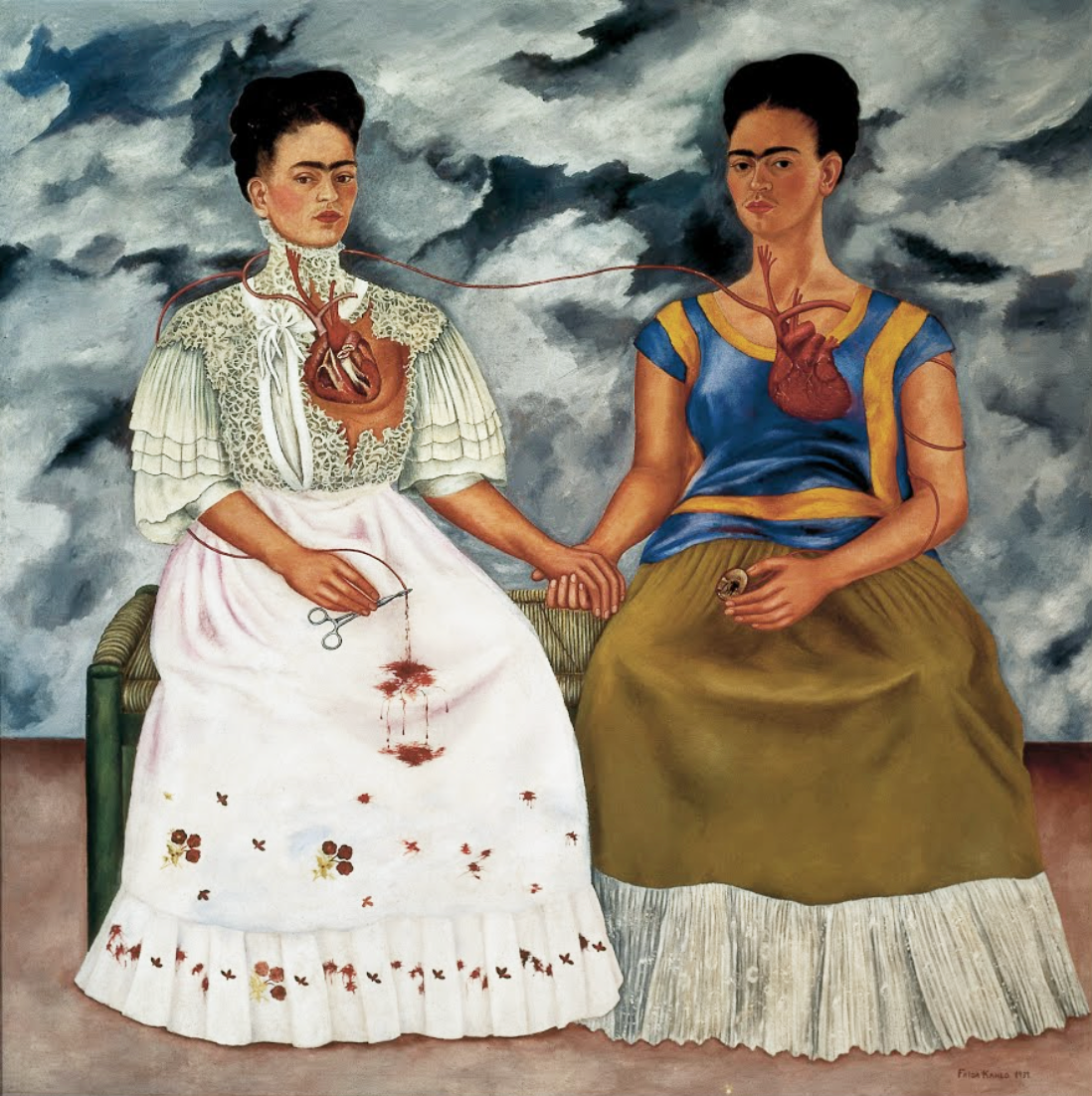
Frida Kahlo, “The Two Fridas,” 1939
Representative of her two identities; German side with the lighter skin and the white dress and her Mexican side which caused discourse between her and her husband
What does Frida have in her hand?
A locket with a portrait of her ex-husband, Diego Rivera, as a child; she considered him her other half
Why is the painting so large?
Because she was actually able to stand while making it
What is the purpose of the surgical clamp on her heart?
Representative of her severe medical trauma; she had polio when she was young and was later in a bus accident.

*Piet Mondrian, “Composition with Yellow, Red, and Blue,” 1927
Craved stability and structure after WWI and rejected nature because it was too chaotic. He created his style as a way of life and order was all humanity needed.
The artist can be a creator only when the forms in his picture have nothing in common with nature…
Kasimir Malevich, “From Cubism and Futurism to Suprematism: New Painterly Realism”
The futurist manifesto
F.T. Marinetti, wrote in the French paper Le Figaro, branded traditional culture, museums, libraries, and schools as cemeteries. Later became a part of facism during Mussolini’s regime
Technical Manifesto of Futurist Painting
Written by Umberto Boccioni and assisted by Giancomo Balla, it insisted that movement was continuous, even in painting. It favors pointilism and rejects academic formalism. based on the manifesto of futurism