CHEM 1311/1111: Exam 1 - Ch. 1 - Phases and Classification of Matter
 Call Kai
 Learn
Learn Practice Test
 Spaced Repetition
 Match
Match Flashcards
 Knowt Play
1/43

There's no tags or description
Looks like no tags are added yet.
Name | Mastery | Learn | Test | Matching | Spaced | Call with Kai | Chat |
|---|
No analytics yet
Send a link to your students to track their progress
44 Terms
The Scientific Method
A method of acquiring knowledge and testing it.
Hypothesis
A tentative explanation of observations that act as a guide for gathering and checking information.
Law
A summary of a large number of experimental observations.
Theory
An explanation of observations that can be tested and it’s well substantiated.
Hypothesis - A testable, educated prediction about what might happen.
ex) If I increase the temperature of a gas, then its pressure will increase.
Law - A description of a pattern in nature that consistently occurs, often expressed mathematically.
ex) Newton’s Law of Gravitation describes how objects attract each other.
Theory - A well-supported explanation for why or how something happens, backed by lots of evidence.
ex) Cell Theory explains that all living things are made of cells.
AN EASY WAY TO REMEMBER:
Hypothesis = “What do I think will happen?”
Law = “What happens?”
Theory = “Why/how does it happen?”
What is the difference between a hypothesis, law, and theory?
NOTES
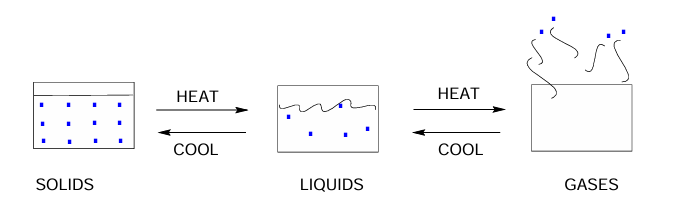
Solids
Densely packed, close contact between the molecules, little to no movement. Mostly vibrational motion. Molecules are stuck in place.
Liquids
Dense, but less dense than solids. More movement between the molecules. Molecules are free to move around past each other.
Gases
Are not dense at all, with mostly “empty” space. Atoms and molecules expand to fill the available space. Molecules and atoms in the gas phase bounce off of each other.
Matter
A substance that has mass and takes up space by having volume.
Mass
How much of a substance there is.
Volume
The amount of space that a substance has. As on the cube below, height (h), times width (w), times depth (d)

Matter
________ can’t be created or destroyed. This is called the Law of Conservation of Mass.
Atoms (or elements)
The basic chemical unit of matter. Indivisible without changing the nature of the element.
Molecules
Atoms connected through a “chemical bond” (such as covalent or ionic). These could be atoms of the same element or different elements. For example, H2, H2O, O2, H2O2.
-The chemical bond is made up of electrons.
Compounds
Similar to molecules but made up of different elements. For example, H2O, CO2, CO, NaCl.
Heterogeneous
Composition varies through the mixture.
Example) Salt and sugar mixed as solids.
Homogeneous
Composition is the same throughout the mixture.
Example) Salt in water or Sugar in water
NOTES
Characteristic properties of a substance can be observed and measured, such as color, phase at a given temperature, boiling point, melting point, density.
Density
The amount of mass in a given volume.
Extensive properties
Depend on the amount of substance.
Example) Mass (grams), volume (in liters), etc.
Intensive Properties
Do NOT depend on amount of substance.
Example) Temperature, density, boiling point, freezing point, color.
Basic Unit: Meter (m)
Property: Length
Basic Unit: Grams (g)
Property: Mass
Basic Unit: Seconds (s)
Property: Time
Basic Unit: Kelvin (K), also Fahrenheit (F) and Celsius (C)
Property: Temperature
Basic Unit: Liter (L)
Property: Volume
1 kilometer (Km)
1,000m = ________________
1 decimeter (dm)
0.1m = ___________________
1 centimeter (cm)
0.01m = __________________
1 millimeter (mm)
0.001m = _________________
1 micrometer (µm)
0.000001m = _____________________
NOTES
Another form of expressing volume is cubic centimeters (cm^3).
As on the example above of a cube in which the height, width, and depth are multiplied, if these are measured in cm, the answer will be in units of cm^3.
Therefore, 1 cm^3 = 1 mL
NOTES
Density (d) - The amount of mass in a given volume. (D=M/V)
For example, if a cube is 30 mL in volume and its mass is 25 grams, its density would be 0.833 g/mL.
25/30 = 0.833
All substances have their characteristic densities:
H2O: 1 g/mL
Iron: 7.9 g/mL
Copper: 9.0 g/mL
Since densities are ratio values, they can be used in calculations as conversion factors.
NOTES
°C = [°F – 32 °F][5 °C/9 °F]
°F = [9 °F/5 °C][°C] + 32 °F
K = °C + 273.15 (could also use 273)
Significant Figures
These figures tell the certainty of a measurement.
For example:
You place a substance on a balance to measure its mass, and it gives you a reading of 2.134419 g.
Not all numbers will be of value. To what certainty do you want the value to be represented?
The number could be rewritten as: 2.1, 2.13, 2.134, 2.1344, etc. depending on how many digits you want the accuracy of the number to be.
Rules for Determining Significant Figures in a number
• Any non-zero digit is significant.
• Zeros between non-zero digits are significant.
• Zeros to the left of non-zero digits are not significant.
• “Trailing” zeros at the end of a number are significant when the number is written showing a decimal point.
NOTES
Rounding up Numbers
If a measured number is 2.13765483, but you want to represent it with fewer significant figures, you may need to round up the number.
To properly do this, we look at the digit to the right of the last number we want to keep. If the digit to the right is less than 5, no changes are made. If the digit is 5 or larger, the last number we want to keep gets changed to the next higher number.
For example: 2.13765483
• Rounding up to two significant figures: 2.1
• Rounding up to three significant figures: 2.14
• Rounding up to four significant figures: 2.138
• Rounding up to five significant figures: 2.1377
NOTES
Scientific Notation
A specific way of writing numbers, especially for very large or very small numbers.
For small numbers:
Rewrite the number 0.0000000000213432 in scientific notation, rounding it up to four significant figures: 2.134 x 10⁻¹¹
For large numbers:
Rewrite the number 5,014,387,917 in scientific notation rounding it up to four significant figures: 5.014 x 10⁹
NOTES
IMPORTANT: THE ‘x’ DOES NOT REPRESENT A MULTIPLICATION!
The same rules for significant figures that we learned earlier apply to scientific notation, for the numbers that are to the left of the “x.”
Scientific notation can also be used for rewriting numbers with an ambiguous number of significant figures to rewrite them with accurate significant figures.
Example: 2,000 is ambiguous with its significant figures. We can rewrite it (as below) to represent sig. figs. better.
2.000 x 10^3 ← Now it has four significant figures.
2.00 x 10^3 ← Now it has three significant figures.
2.0 x 10^3 ← Now it has two significant figures.
NOTES
For addition and subtraction, the number of digits beyond the decimal point dictates the number of sig. figs.
ex) 12, 343.2 g + 0.1893 g = 12,343.3893 g
Answer with correct sig. figs.: 12,343.4 g
NOTES
For multiplication and division, we look at the whole number, and the number with the fewer digits dictates where to round up.
ex) 24,368.1 m x 55.384 m = 1,349,602.85 m2
Answer with correct sig. figs.: 1.3496 x 10⁶ m2
Positive
Moving the decimal point to the left when converting a standard number to scientific notation makes the exponent __________.
Negative
Moving the decimal point to the right when converting a standard number to scientific notation makes the exponent __________.