bio review practice
 Call Kai
 Learn
 Practice Test
 Spaced Repetition
 Match
 Flashcards
 Knowt Play
1/59

There's no tags or description
Looks like no tags are added yet.
60 Terms
1 main function of cell/plasma membrane.
Boundary between outside environment and inside the cell. Keeps the shape of the cell.
2 main function of cell/plasma membrane.
Controls the transport of nutrients and water into the cell and out the cell.
3 main function of cell/plasma membrane.
Part of the immune system that recognizes viruses and bacteria and keeps them from entering the cell.
4 main function of cell/plasma membrane.
Communication between the cell, its environment, and other cells.
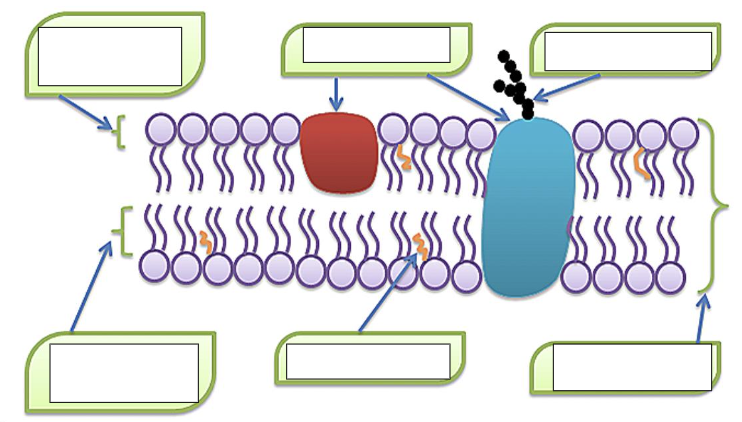
fill blank spaces of the plasma membrane from top left to right.
heads of phosphate groups, protein molecules, carbohydrates, tails of hydrocarbon chains, cholesterol molecules, phospholipid bilayer.
Fluid Mosaic Model
Describes that the structure of the plasma membrane is able to flow and change position, while maintaining the base shape of the membrane.
Phospholipid bilayer
Acts as a barrier to the passage of molecules and ions and controls what comes into and out of the cell.
Head of phosphate groups.
Hydrophilic heads that attract water into the cell membrane.
Tails of the hydrocarbon chain.
Hydrophobic water repelling helps keep substances inside the cell being selectively permeable.
Protein
Make up channels and pumps to transport substances across the cell membrane.
Carbohydrates
Helps cells communicate between each other and provides protection against foreign pathogens (immune system).
Cholesterol
Acts to stabilize the cell membrane and maintain fluidity.
Selective Permeability
Some substances are able to pass through the cell membrane while other substances are not able to pass through. ex. screen door keeps bugs out like cell membrane to foreign pathogens.
Glycolysis
Means glucose splitting and what happens during the first step of cellular respiration.
Purpose of glycolysis
To make the sugar molecule smaller so that it can enter the Citric Acid Cycle.
What happens in glycolysis.
A 6 carbon glucose molecule is split in half to make two 3 carbon pyruvate molecules. During this splitting some energy (2 ATP) is made.
Where does glycolysis take place
In the cytoplasm of the cell.
Cellular respiration
The process by which organisms use oxygen to break down food molecules to get chemical energy (ATP) for cell functions. Molecules produced at the end of glycolysis are transported into mitochondria, which is the site of cellular respiration.
1 main step of cellular respiration
Glycolysis, splits glucose into 2 pyruvate and 2 ATP.
2 main step of cellular respiration
Pyruvate changes to Acetyl Coenzyme A.
3 main step of cellular respiration
The Citric acid (Krebs) Cycle, generates electrons and protons for the electron transport chain and makes CO2, NADH, FADH2, and 2 ATP.
4 main step of cellular respiration
Electron Transport Chain, energy carrier enzymes deliver electrons and hydrogen to the proton pump. 32 ATP are synthesized.

fill blank spaces of cellular respiration from left to right.
Glycolysis, Pyruvate, Acetyl Coenzyme A, The Citric Acid Cycle, Electron Transport and Chemiosmosis, 32 ATP.
Two types of cellular respiration
Aerobic and Anaerobic Respiration.
Aerobic Respiration
Takes place in the presence of oxygen.
Anaerobic Respiration
Takes place in the absence of oxygen.

fill blank spaces of the plasma membrane from left to right.
Glycolysis and Link Reaction and The Krebs Cycle and Oxidative Phosphorylation, High about 36, Low 2, Cytoplasm and Mitochondria, Cytoplasm.
Citric Acid/ Krebs Cycle
The main function is to produce Co2 waste and generate protons and electrons for the Electron Transport Chain.
1 step of the Electron Transport Chain
The transfer of electrons and protons by NADH and FADH2 transport enzymes to complex.
2 step of the Electron Transport Chain
Hydrogen form an electrochemical gradient called the proton pumping.
3 step of the Electron Transport Chain
Splitting of oxygen molecule to form water.
4 step of the Electron Transport Chain
Hydrogen go from high concentration to low concentration through ATP synthase.
5 step of the Electron Transport Chain
Generation of 32 ATP molecules for one Glucose molecule.
6 step of the Electron Transport Chain
Takes place in mitochondrial membrane.
When does anaerobic fermentation/ respiration begin
Generate energy in absence of oxygen.
Lactic Acid Fermentation
Lactic acid and 2 ATP are formed. Occurs in bacteria and human muscle cells.
Alcohol Fermentation
Ethyl alcohol and ATP are produced. Occur in yeast and some bacteria.
When does the human body go into lactic acid fermentation
During long term exercise muscle cells become fatigued. The cells do not have enough oxygen to continue Aerobic Respiration, they revert to lactic acid fermentation which is a shortcut to quick ATP. This lactic acid build up causes muscle stiffness and fatigue.
ATP
Bodies currency to allow cells to have energy for chemical reactions. By breaking off a phosphate large amounts of energy are released. Most are created in the Electron Transport Chain during Cellular Respiration.
First Law of Thermodynamics
energy cannot be created or destroyed but can be transferred from one state to another.
Autotroph
An organism that can produce its own food using light, water, carbon dioxide, or other chemicals. ex. plants, algae, protists, bacteria
Heterotroph
Organisms that consume other organisms for energy. They have to “head” out to get food. ex. deer eating grass
1 Stage of Photosynthesis
Light dependent reaction, involves water and sunlight electrons become excited and split a water molecule. Oxygen is produced as a by product.
2 Stage of Photosynthesis
Dark side reaction, Calvin cycle fixes Co2 into a 6 carbon glucose molecule.
Role of Sunlight in Photosynthesis
The sun provides the initial energy that starts the cycle of photosynthesis. The energy from the light causes a chemical reaction in the chlorophyll that split water and generate hydrogen protons for the Calvin cycle.
1 Step of Calvin Cycle
Fixing atmospheric carbon Co2 to organic carbon 6 carbon PGA.
2 Step of Calvin Cycle
Reduction, NADPH donates hydrogen and electrons to the Calvin Cycle.
3 Step of Calvin Cycle
Regeneration of RuBP for the next spin of the Calvin Cycle.

Fill blank spaces of the Calvin Cycle in order of the arrows.
Stage 1 carbon fixation, stage 2 reduction, stage 3 regeneration of RuBP.
Why do plants need photosynthesis and cellular respiration
During photosynthesis plants use water and CO2 to make glucose and oxygen. This glucose will be used in the plants own cellular respiration done in the mitochondria to produce ATP. This allows the plant to grow.
Anabolic Reaction
Builds large complex molecules from simpler molecules and requires a net input of energy.
Catabolic Reaction
Breaks large molecules into simpler molecules and releases energy.
Formula of Photosynthesis
Co2 + H2O -> C6H12O6 + O2
What kind of reaction is cellular respiration.
Catabolic Reaction
Formula for Cellular Respiration
C6H12O6 + 6O2 -> 6Co2 + 6H2O + ATP
Activation Energy
The minimum energy required to cause a chemical process to occur in the body.
Catalyst
Substance that speeds up a chemical reaction and reduces the energy needed for the reaction.
Role of enzyme in the body
Speed up (catalyze) chemical reactions in cells.
How are Enzymes catalysts
They reduce the activation energy, thereby increasing the rate of the reaction.
Enzymes and Substrates
Substrates bind to the active sites of enzymes. They are specific in shape and function like a lock and key. This allows the cell to turn on and off how much of a product is made.