dental materials - unit 7A
 Call Kai
 Learn
 Practice Test
 Spaced Repetition
 Match
 Flashcards
 Knowt Play
1/33

Earn XP
Description and Tags
gypsum
34 Terms

What is a Model (aka study casts / study models)?
An accurate positive 3D reproduction of teeth and surrounding soft tissues of the maxillary and mandibular arch
What is a Model created from?
irreversible hydrocolloid (preliminary/alginate impression)
What are Models used for?
Case studies or diagnostic purposes

What is a Cast-Working Model?
Strong, abrasion-resistant made working model of a quadrant or arch.
(dentulous / edentulous)
Define dentulous (cast)
Some teeth present
Define edentulous (cast)
No teeth present
What are Casts used for?
Used to fabricate an appliance or restoration

What is a Die?
Replica of one or more teeth, which is usually a removable portion of the cast
Made in a lab
What mineral is gypsum mined from?
Calcium sulfate dihydrate
What happens during manufacturing gypsum?
Water is lost to convert calcium sulfate dihydrates into hemihydrates of calcium sulfate
which creates the unique physical and chemical qualitiesof plaster, stone, and improved stone.
What are Gypsum products extensively used for in dentistry?
To make dental models
How does gypsum react when you ADD water?
Hardening and releases heat (EXOTHERMIC REACTION) which sets the gypsum material
What 3 factors of particles determines the amount of water needed?
Shape
Size
Porosity
What are the 3 types of gypsum products?
Model plaster
Dental stone
Improved stone

Describe Model Plaster (Plaster of Paris): colour, particles, W/P ratio and strength
White
Large, irregular, porous crystals
Requiring most water (45–50 ml water : 100 g powder)
Produces a weaker cast
What is Model Plaster used for?
Pouring preliminary impressions
Diagnostic models
Case presentations
Orthodontics

Describe Dental Stone (Lab stone): colour, particles, W/P ratio and strength
Yellow
more uniform, less porous crystals
requiring less water (30–32 ml water : 100 g powder)
Produces a stronger and denser cast
What is Dental Stone used for?
When durable casts is required
Working model in making dentures
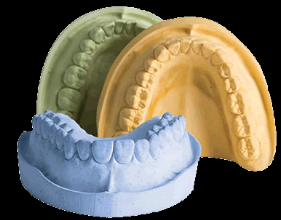
Describe Improved Stone (High-density stone): colour, particles, W/P ratio and strength
Coloured (green, blue, pink)
smoothest, densest crystals
requiring the least water (19–24 ml water : 100 g powder)
Highest strength, hardness, and accuracy
What is Improved Stone used for?
Create dies for crowns, bridges, and indirect restorations
What is Initial Setting Time?
Time to mix and manipulate the material (working time)
8–10 minutes from when powder and water are first mixed
Viscosity increases so the material can no longer flow or be manipulated
What is Final Setting Time?
Time reached when material is hard enough to remove the impression material of the model
45-60 minutes after manipulation started
Complete when feels cool and dry
Exothermic reaction occurs
Why are accuracy and dimensional stability critical in gypsum products?
Excessive dimensional change causes a poorly fitting restoration
Too much expansion = oversized restoration
Too much shrinkage = undersized restoration
The amount of water is related to 2 things:
Compressive strength
Density of the material
How does too much water in a mix affect the reaction of the final gypsum product?
Decreases strength
How does increased spatulation time or rate affect the reaction of the final gypsum product?
Setting time is shortened, and setting expansion is effected
How does hot / cold water temperatures affect the reaction of the final gypsum product?
Too hot = runny mix that sets too quickly
Too cold = takes a long time to set

What are the two parts of a poured model and their proportions?
Anatomical portion (teeth/tissue from the alginate impression = 2/3 of the model)
Art portion (base = 1/3 of the model)

Describe the Double Pour Method
pour the anatomic portion first with a mechanical lock
then make a second mix for the art portion/base (hand-formed or rubber mold (Takes too much time)

Describe the Box and Pour Method
surround the impression with a wax "box"
pour gypsum in small increments until full
The impression is not inverted
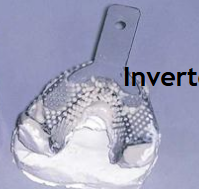
Describe the Inverted Pour Method**
pour gypsum into the impression in small increments until the anatomical portion is full
immediately invert it onto a hand-formed base.
Method used in lab
Why rinse impressions with cold water before pouring or disinfecting?
Removes blood, saliva, and food without causing dimensional change or loss of accuracy
How do you disinfect a gypsum model if the impression wasn't disinfected first?
Spray or soak the separated gypsum cast in an iodophor disinfectant, or use 1:20 sodium hypochlorite
What do you do before trimming, and which model do you trim first?
Soak models in cool water for at least 5 minutes
Always start with the maxillary model.