MARK3000 Test 3
 Call Kai
 Learn
 Practice Test
 Spaced Repetition
 Match
 Flashcards
 Knowt Play
1/102

There's no tags or description
Looks like no tags are added yet.
103 Terms
Core customer value (product components)
Marketers involved with development, design, and sale of products think of them in an interrelated fashion.
At the center is the core customer value which defined basic problem-solving benefits that customers are seeking, next is the actual product, followed by associated services
Actual and associated (product components)
Actual product- brand name, quality level, packaging, features/design (physical)
Associated services- financing, product warranty, product support. Also know as augmented product, include nonphysical aspects of product, such as warranties, financing, product support, and after sale services (nonphysical)
Specialty products
Those for which customers express such strong preference, expend considerable effort to search for best suppliers
Specialty products are typically high prices, buyer do not use much time to compare against other products- buyers spend more effort in buying
Purchased less frequently
Shopping products
products or services for which consumers spend a fair amnt of time comparing alternatives. Require personal selling and advertising and in fewer outlets (compared to convenience products)
Consumers compare attributes of shopping products such as quality, price, and style between other products
Convenience products
Products/services for which consumer not willing to expend any effort to evaluate prior to purchase
Bought most frequently
Bought immediately and without great comparison between options
Typically low priced, not differentiated among products, placed in locations where consumers easily purchase them, widely distributed and mass promoted
Unsought products
Products or services that consumers either do not normally think of buying, do not know about, or not buy under normal circumstances
Not type of mind with consumers, dont buy unless need
Product mix and product line
Complete set of all products offered called product mix. consists of various product lines, which are gorups of associated items consumers tend to use together or think as part of group of similar products
Product mix- breadth represents count of num. product lines offered
Product line- depth, equals numbers of products within line
Breadth: number of product lines in product mix→ may be too costly to maintain
Depth: num of products/brands within product line→ may cannibalize brands
Key biz considerations
Increase product mix breadth to capture new or evolving markets and increase sales
Decreasing mix breadth might be due to changing market conditions or internal strategic priorities
Primary advantage to increase product line depth is to increase overall sales and profits. But at the same time, adding competing products can cannibalize, or take sales from, curretn brands
Firms must determine the net effect on sales and overall impact on competitive products.
To address changing consumer preferences or preempt competitors while boosting sales, to realign resources
Brand
Product is an item or service produced and offered by co. for sale in market
A brand is entity like logo, symbol or name used by co. to make products identifiable among other prodcuts in marketplace
Branding
Process of creating a strong, positive perception of company, and product delivered, in your customer’s mind. Increases awareness and provides ways to differentiate
Elements of brand
Brand name, URLs, Logos, and symbols, characters, slogans, jingles or sounds
Value: facilitate purchases, establish loyalty, protect from competition, price competition, assets,
Brand equity
Consumer perception of brand name of a product or service, not a direct reflection on product itself
Cuts both ways: customers dislike some brands b/c firms actions or their negative perceptions
Brand awareness (brand equity)
How many consumers familiar
More awareness, higher chance of purchase
Familiarity matter for products that bought w/o much thought
Perceived value (brand equity)
Relationship between benefits and its costs
Own perception of product merit and desirability to them, in comparison to competition
Measure by price public willing to pay for good
Brand association (brand equity)
Mental and emotional links consumers make between brand and attributes, such as logo, color, slogan, famous personality
Brand associations often result of firm’s advertising and promotional efforts
Brand loyalty (brand equity)
Occurs when consumers buy same brand’s product or service repeatedly
Important source of value for firms
Consumers less sensitive to price
Marketing costs much lower
Firms insulated from competition
Branding strategies
Firms institute a variety from brand of brand-related strategies to create and manage key brand assets
Decision surrounding strats include:
Whether to use manufacturer brands or retailer/store brands
How to name brands and product lines
Whether or not to extend brand name to other products and markets
Should brand name be used with another firm or licensed to another firm
Whether or not brand should be repositioned
Brand ownership
Few brands achieved high quality status and are often considered inferior to manufacturer or national brands
Exceptions include:
Costco/kirkland
Trader Joe’s
Manufacturer or national brand: kraft, nike, coke
Retailers/store brands (private label brands): kroger, costco, traderjoes
Family vs individual brand names
Family brands: corp name used across brands and product lines
Ex: kraft cheese, Heinz, Del monte
Individual brands: products havce individual identifiers
Ex: kraft owns velveeta, classico, jello
Detergents are good examples of individual brands: tide, bold, gain and surf
Brand and line extensions
Brand extensions: same brand name in different product lie. Coke branded chapstick
Line extensions: same brand name within same product line. Coke, diet coke, coke zero
Advantages of brand extension:
Co. can spend less on brand awareness
Positive consumer acceptance will spread to new prodcut and synergy exists between two products
Brand dilution
Not all brand extensions successful:
Evaluate fit between core brand and extension
Evaluate consumer perception of attributes of core brand and seek out extensions with similar attributes
Refrain from extending brand name to too many products
Is brand extension distanced enough from core brand
Co-branding
Marketing two or more brands together
Can enhance perception of quality through links between brands
Attracting consumers of one brand to the other brand
Brand licensing
Common for toys, apparel, accessories, and entertainment products such as video games
NBA licenses products like these New Orleans Pelicans hats to manufactuerer to exchange for negotiated fee (called royalty payments)
Brand repositioning (rebranding)
Changing a brand’s focus for new markets
Primary package
Container the consumer actually uses
Secondary package
exterior carton containing primary; provides UPC (universal product code) for scanners
Packaging functions
Protects product, provides convenience (storage/use) and acts as communication/promotion tool
Sustainable packaging
packaging designed to have less environmental impact
Labeling (general)
identifies product/brand; provides for needs, purchase decisions, and consumption
Labeling (regulations)
Determined by regulations that vary by state and country
Labeling (meaning tests)
terms like “natural”, “organic”, or made in “USA” must meet certain tests/standards before placed on label
Innovation
transforming ideas into new products/services
Improving biz relationships
weight waters+ wonder natural foods= co-branded innovation
Changing customer needs
Product development: coke→ diet coke→ coke zero→ coke life
Consumers wanted diet option→diet coke
Men dont like diet→ coke zero
Cal counts and no high fructose corn syrup→ coke life
Market saturations
Jeni’s splendid ice cream brand grows as ice cream category becomes crowded and mature
Co. must expand distribution, differentiate heavily, find new customer touchpoints
What Jeni does:
Premium pricing
Exclusive varieties
90 shops and grocery distrubution
Franchise value on community
Diversity
General Mills diversifying portfolio across flavors, national formats, and consumer segments
Protects from shofting preferences, competition, stagnation
Innovation pioneer
Pioneers change comp and consumer preferences by introducing new-to-the-world product
Are first to create market or product category and become readily recognizable to consumers and establish a commanding and early market share lead
Can command greater market share over a longer period than later entrants can
Diffusion of innovation
Process by which use of an innovation- whether product, service, process- spreads through market group, over time and across various categories of adopters, referred to diffusion of innovation
Failed pioneers
Not all succeed. Many cases, imitators capitalize on weaknesses of pioneers and gain advantage in marker
Google Glass
Sony Betamax- JVC launched VHS a year later
- Apple newton- ahead of its time (jumped over by Blackberry)
Diffusion of innovation curve
Number of users of an innovative product or service spreads through the population over a period of time and follows bell-shaped curve
Few people buy product at first, then more buy, finally fewer people buy as degree of diffusion slows
Purchases can be divided into 5 groups according to how soon buy product after it has been introduced: innovators, early adopters, early majority, late majority, laggards
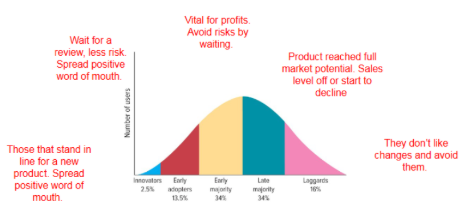
Diffusion of innovation theory
Firms can predict which types of customers will buy their product immediately after its intro, as well as later as product gets more accepted by market
Firm can develop effective promotion, pricing, and other strategies to push acceptance among each customer group
Using diffusion of innovation theory
Different products diffuse at different rates
Marketers work to understand curve for each new product and service, as well as the characteristics of target customers in each state of diffusion
Various factors increase speed of diffusion:
Relative advantage
Compatibility
Observability
Complexity and Trialability
Four factors that impact diffusion rate
Relative advantage- if product is perceived to be better than substitutes, then diffusion will be relatively quick
Compatibility- higher the level of compatibility, quicker the diffusion; and lower compatibility, slower diffusion. product will diffuse more quickly if it does not require consumers to change their values, norms, lifestyles, cultures and daily behaviors
Observability- when products easily observed, benefits or uses are easily communicated to others, which enhances diffusion process
Complexity and trial ability- products are relatively less complex and are also relatively easy to try. products will diffuse more quickly than those that are not so easy to try
Product development process
idea generation
concept testing
product development
market testing
product launch
evaluation of results
Source of new product ideas (product development process)
Firms constantly scan environment looking for new product ideas
depending on co. strats, they use different sources of ideas
Internal research and development (sources of product ideas)
Larger firms maintain own R&D department and rely on to generate new product that will lead market
High product development costs
Often source of tech products
Often source of breakthrough products
R&D consortia (sources of product ideas)
Develop new product ideas, more firms been joining an R&D consortia, or groups of other firms, possibly including gov and educational institutions, to explore new ideas or obtain solutions for developing new products
Lower costs and risks
Benefits spread to all firms
Example: pharmaceutical/food research
Licensing (sources of product ideas)
Firms license use of new products, tech, processes. Small biotech firms license their inventions to larger pharmaceutical firms
Brainstorming (sources of product ideas)
Groups work together to generate ideas
No idea is immediately accepted or dismissed
Members vote on best idea or combination of ideas
Outsourcing (sources of product ideas)
In some cases, co. have trouble moving through these steps alone, which prompts them to turn to outside firms
Hiring outside firm to generate ideas and develop products
Design firms help clients generate new product and service ideas in industries such as health care, toys, computers
Competitors products (source of product ideas)
Products with patents or other proprietary protections cannot be copied, so reverse engineered products must be substantially different from source product
Customer input (sources of product ideas)
Listening is essential for successful idea generation and throughout the product development process
Can be done in both B2B and B2C markets
Another particularly successful customer input approach is to analyze lead users. if lead users customize a firm’s products, other customers might wish to do so as well
innovative product users who modify existing products according to their own specific needs
Concept testing (product development process)
concepts are presented to potential buyers or users to gauge reactions
A concept is brief, written description of product
Concept testing is process in which concept is presented to potential buyers or users to obtain reactions
Triggers marketing research process
Customer reactions to concept determine whether it goes forward
Product development process (product development process)
Engineering team develops product prototype based on research findings from previous concept testing step as well as their own knowledge about mats and tech
Product development or design entails process of balancing various engineering, manufacturing, marketing, and economic considerations to develop a product’s form and features or service’s features
Prototype- allows customers to interact with product physically. Some prototypes never actually go into production
Alpha testing- firm attempts to determine whether product will perform according to design and whether will perform according to design and satisfies need for which intended
Beta testing- uses potential consumers who examine prototype in a real-use setting to determine functionality, performance, problems, and toher issues specific to use
Market testing (product development process)
Premarket product test:
customers exposed
Customers surveyed
Sales estimated
firm makes decision
Market testing:
Mini product launch
More expensive than premarket test
Market demand is estimated
Five types of market testing
Beta testing (for digital products): in case of software or apps, beta testing involves releasing a pre-launch version of product to a select group of users. These users, often referred to as beta testers, provide feedback on product’s functionality, usability, and performance.
Does software work? identify bugs then fix before launch!
Is UX (user experience) easy to understand or confusing
Test markets (for physical products): Business often use a test market strategy. This involves launching product in limited geographic area or market segment to assess consumer reactions
By analyzing performance in test market, co. make adjustments before expanding to wider audience
A/B testing: A/B testing commonly used for digital products, websites, and marketing campaigns. Involves testing two different versions of a product or ad campaign to see which performs better
Often used for package designs, product features or pricing strats
Focus group: some cases, co. conduct focus groups where small, diverse group of consumers brought together to discuss impressions of product. Qualitative approach provides insights to customer perceptions, preferences and potential barriers to purchase
Pilot programs: Small scale trial run of product in real world environment For example, a co. launching new line of smart home devices might offer product to small group of tech savvy users
Evaluate test results (Market testing)
During market testing phase, biz must carefully analyze data they collect. Could include sales figures, customer feedback, user engagement metrics, comp comparisons
Key questions to consider:
Does product meet expectations?
There any issues need to be addressed?
How product compare to competition?
Is pricing model resonating with customers?
What marketing channels drive most interest and sales?
Based on results of market testing phase, biz can make necessary adjustments before proceeding to full scale launch
product development process: product launch
if marketing testing returns positive results, firm ready to introduce product to entire market. Most critical step in new product intro
Requires tremendous financial resources and extensive coordination of all aspects of marketing mix
Firm confirms its target markets, decides how product will be positioned, finalizes remaining marketing mix variables, and determines marketing budget
Timing of launch may be critical
Product launches are part ART and SCIENCE
Many tech co. use events to launch new product
Co. need to communicate product characteristics and key benefits to convince purchase
Launch strategy:
Key message
Target audience
Market selection:
Digital or traditional- TV, Radio, Search, Social, Newspaper
Sales channel selection:
E-Com vs retail partnership
Supply chain and distribution:
Inventory, supplier relationships
Customer support and after sales service
Product development process: evaluation of results
Marketers cannot celebrate success but must understand failure. Question of why product fails is important as to why other succeeded
Underperforming product may require further development
Satisfaction of technical requirements
Degree of customer acceptance
Satisfaction to firms financial requirements
Product lifecycle stage 1- Intro
The intro stage is characterized by initial losses to firm due to its high start-up cost and low levels of sales revenues as the product begins to take off
New-to-the-world products and services not only have high manufacturing costs, but high marketing expenditures because you must educate all consumers to your product, how it works, and the consumer benefits
Innovators are the ones to try the new product
Product lifecycle stage 2- growth
The growth stage is marked by a growing number of product adopters (early adopters), rapid growth in industry sales, and increased in number of competitors and number of available product versions
There is a tipping point- the transition between intro and growth when the product either gains market acceptance or must exit the market
Most new products fail at this point
Product lifecycle stage 3- maturity
The maturity stage of product life cycle is characterized by the adoption of the product by the lat majority and intense competition for market share among firms.
Firms pursue various strats during this stage to increase their customer base and/or defend their market share
In the maturity stage firms face intense comp on price as the avg price of product falls substantially compared with the shifts during the previous two stages of the life cycle
Lower prices and increased marketing costs begin to erod the profit margins for many firms.
In the later phases of maturity stage, market has become quite saturated, and practically all potential customers for product have already adopted the product
Product lifecycle stage 4- decline
Firms with products in the decline stage either position themselves for a niche segment of die-hard consumers or those with special needs or they completely exit the market
The few laggards who have not yet tried the product or service enter the market at this stage
Limitations of product life cycle
Understanding where product is on PLC is difficult
Each curve could be different, and managers do not know exactly what shapre their product’s life cycle will take
Each product or service has its own shape
Challenging to know precisely stage of PLC
Poor decision making can make a self-fulfilling prophecy
Situation: product experiences several seasons of declining sales
Task/action: manager may determine it has moved from growth stage to decline and so stops promoting product
Result: as result of market budget cut, sales decline further
The manager then believes he or she made right decision because product continues to follow a predetermined life cycle
But what if…
The OG sales decline was due to a poor strat or increased comp- issues that could have been addressed with positive marketing support
In this case, product life cycle decision became a self-fulfilling prophecy, and a growth product was doomed to an unnecessary decline
Service definition
Intangible offerings that involve an effort and performance that cannot be physically possessed
By providing good custoemr service, firms add vcalue to products and services
Service-product continuum
Illustrates continuum from a pure service to a pure good. Most offerings lie somewhere in middle and include some service and some good (hybrid)
Hard to separate co. that fall within product-service continuum
Doctor→ hotel→ dry cleaner→ restaurant→ grocery store
Marketing Myopia
Product we buy is valuable but service makes product more valuable
Services marketing differs from product marketing
Factors differentiating products from services:
Intangible
Inseparable
Heterogeneous
Perishable
Intangible
Service can’t be touchers, tasted, seen
Requires using cues to aid customers
Furnishing quality, location quality
Atmosphere is important to convey value
Peaceful, luxurious
Show happy families
Images used to convey benefit of value
Ex: property, homes, resorts
Inseparable
Production and consumption are simultaneous (hotel, restaurant)
Little opportunity for consumer to test service before use. After service performed can’t be returned (hair cut, doctor visit)
Lower risk by offering guarantees or warranties (hotel satisfaction guarantee)
Heterogeneous
More humans are needed to provide a service, more likely there is to be a difference or variability in service’s quality
Solutions:
Techniology
Training
Automation
Perishable
Services are perishable in that they cannot be stored for use in future
Ski areas, airlines, cruise ships, movies, restaurants must find ways to deal with challeges of perishability
Empty seats mean permanent unrealized revenue
Which room/seating capacity is needed (supply) to hangle audience needs on per firlm basis (demand)
Economic importance of service
Service account for nearly 80% of US GDP
As economic, technological, sociocultural environments change, so does demand for services. Developed countries increasing service oriented econ→ production cheper in other countries, high value placed on leisure/convenience, people demanding more specialized services
Developing service strategy using seven P’s
Product, price, place, promotion
Additional 3 P’s:
Presentation- can have an impact on consumer judgement of service quality
Personnel- in person transactions, more important for services than for goods
Processes- describe the actions required to get good or service to customer
Providing a good service
Ensure alignment between actual and perceived quality of service(s)
Understand customer expectations for service quality→ knowledge gap→ management perceptions of consumer expectations
Management perceptions of consumer expectations→ standard gap→ standards specifying how service should be delivered
Standards specifying how service should be delivered→ delivery gap→how service is actually delivered
How service is actually delivered→ communications gap (say and can’t deliver)→ prvide comms about service quality
Evaluation of service quality: five dimensions
How do customers measure quality?
Reliability: ability to perform service accurately
Responsiveness: willingness to help customers/prompt service
Assurance: employees ability, knowledge, trust, etc.
Empathy: expect provider to care about customers
Tangibles: appearance of firm’s physical facilities
Management perception of service quality
Reliability: give accurate time of service
Responsiveness: bathroom dirty? Quick apologize/take action
Assurance: server is able to address situations like wrong meal delivered
Empathy: address guests by name
Tangibles: rooms updated with latest tech
Marketing research: understanding customers
Marketing research provides means to better understand consumers’ service expectations and perceptions of service quality
Research can be extensive and expensive, or can be integrated into firm’s everyday interactions with customers
Voice of customer (VOC) program: collects customer inputs and integrates them into managerial decisions
Zone of tolerance: refers to area between customers’ expectations regarding desired service and min level of acceptable service
Zone of tolerance
Measure how well firms perform on five service quality dimensions
Have range of acceptable outcomes
Airline ex:
Prefer aisle seat
Will accept window seat
Won’t accept unassigned seating (middle seat)
Service quality, customer satisfaction, and loyalty
Good service quality leads to satisfied and loyal customers
Post-purchase evaluation leads to satisfaction, dissonance, or loyalty
Satisfaction leads to loyalty!
Dissonance leads to poor reviews and lost customer
However dissonance could just be passing emotion and could be overcome
Listening to customers and involving them in service recovery
Customers caxn get emotional service failure
Often customers just want someone to listen
Finding fair solution
Distributive fairness: pertains to customer’s perception fo the benefits he or she received compared with costs (inconvenience or loss)
Procedural fairness: refers to perceived fairness of process used to resolve them
Even if they receive solutions that seems fair, when consumers must work hard to achieve it, their low procedural fairness perceptions may cause them to believe they are being punished for receiving bad service
5 Cs of pricing
Company objectives, customers, costs, competition, channel members
Four pricing orientation (company objectives)
Profit orientation: goals should spill down to price strategy, pricing should support firm to reach goals. Do not use values as considerations but focus on generating set level of profit from each sale
Risk: does not take into consideration value customers have for product
Target return: company wants 44% profit margin on product sold
Target profit: company wants to deliver $30k/month in profits
Max profits: co. wants to deliver max profits possible
Sales orientation: focus on increasing sales, not profit margin. Premium pricing may be pursued. More concerned with overall market share. Adopted to establish position in market by getting most price sensitive consumers to change brands
Competitor orientation: common among smaller firms that lack experience in setting prices. Non-market leader firms also use it to signal are similar to market leader
Competitive parity: prices similar to competitors
Status quo pricing: only changes price to meet competitors’ prices
Value not directly part of pricing strategy
Customer orientation: how firm can add value to tis products/services. Match prices to customer expectations. ‘No haggle’ prcing seeks to set fair price representing costumer’s perceived value
Customers
How many units will a customer demand during a specific period of time at different prices?
Based on assumptions that everything else remain unchanged
Knowing demand curve enables you to see relationship between price and demand
Price elasticity of demand (customers)
Measures how changes in price affect quantity of product demanded. It is ratio of percentage change in quantity demanded to percent change in price
Elastic (price sensitive products)
Inelastic (price insensitive products)
Consumers less sensitive to price increases for necessities
Price elasticity of demand=% change in quant demanded/% change in price
Dynamic pricing (individualized pricing)→ customers
Also called real-time or surge pricing, an approach to setting costs for product or service that is highly flexible
Goal of dynamic pricing is to allow co. that sells goods or services to adjust prices on fly in response to market demands
Factors influencing price elasticity of demand (customers)
Varies across different products and different points along demand curve, as well as change overtime
Income effect- people’s income decreases/increase their spending behavior change
Substitution effect- consumer ability to sub other products for normal brand
Cross-price elasticity- price change of product A that was demanded is dependent on a price change in dependent Product B (ex: you buy printer on sale, but now forced to buy expensive ink)
Costs
Price must cover cost of item
Variable cost: vary with production volume
Fixed cost: unaffected by production volume
Total cost: sum of variable and fixed costs
Breakeven analysis and decision making (costs)
Total variable costs= variable cost per unit * quant
Total cost=fixed costs+total variable cost
Total rev=price*quant
Profit margin=total rev-total costs
Break even point=fixed costs/ contribution per unit
Break-even point in units= fixed costs/ (selling price per unit-variable cost per unit)
Competition
Examples:
Monopoly- one firm control market (public utilities) → less price comp, fewer firms
Oligopolistic comp: handful of firms control market (Cable TV firms)→ more price comp, fewer firms
Monopolistic comp: many firms sell differentiated products at different prices (watch manufacturers) → less price comp, many firms
Pure competition: many firms sell commodities for same price (any consumer package good)→ more price comp, many firms
Channel members
Channel members- manufacturers, wholesalers, retailers- have different perspectives when it comes to setting price strats
Developing price that allows channel members to earn requisite profits requires careful planning
Pricing strategies
Long-term appraoch to setting prices broadly in an intergrative effort based on five c’s of pricing
Commonly used:
Everyday low pricing
High/low pricing
New product strategies
Everyday low pricing (EDLP)
Promises to consumers a low price without need to wait for sale price events or comparison shopping
Consumers: reduces search costs
Adds value
Firms: saves effort and expense needed to mark down prices
Can be done to skip middleman or distributor
High/low pricing
Relies on promotion of sales
Appealing to biz cause start attract two different segments:
Price insensitive customers (when price is high)
Price sensitive customers (when price low)
New product pricing strategies
Penetration pricing: set initial price low for intro of new product or service. Good if cost of production will decrease with quant produced (economies of sales)
Pros: creates customer base quickly, builds market share, quick profits, discourages competitor from entering market
Cons: sacrifices higher profits (low margins), firm has to keep up with high demand, signaling problem: low price a low quality- may not create loyal customer base
Price skimming: set a higher price to appeal to those segments of consumers who are willing to pay a premium price to ahve the innovation firm
At first high prices→ target consumers willing to pay premium to have innovation first
When market saturated: lower (skim) prices, target most price sensitive segments
Additional pricing tactics
Consumer (B2C) oriented:
Markdowns, quant discounts, seasonal discounts, coupons, rebates, leasing to purchase, price bundling, leader pricing
Business (B2B) oriented:
Seasonal discounts, cash discounts, off-invoice allowances, quantity discounts
Deceptive or illegal price advertising
If merch is placed on retail floor and immediately put on sale, it is considered to be deceptive because merch was never sold at higher price, but consumers expected to believe they are receiving significant discount
Deceptive references prices, loss-leader pricing, bait and switch
Predatory pricing
Prices set low with intent to drive competitor out of biz→ illegal, difficult to prove
Would need to set records that show intent or have interviews of those who can verify itnent
In addition, must show taht co. charged prices lower than avg costs
Illegal under Sherman Antitrust Act and Federal Trade Commission Act
Price discrimination
The Robinson-Patman Act does not apply to sales to end consumers, at which point many forms of price discrimination occur
Not always illegal, different rules in B2B and B2C markets, fed law does not apply to sales to end consumers
Ex:different prices based on age, sec