Chapter 6 Business Law and Practise
 Call Kai
 Learn
Learn Practice Test
 Spaced Repetition
 Match
Match Flashcards
 Knowt Play
1/24

There's no tags or description
Looks like no tags are added yet.
Name | Mastery | Learn | Test | Matching | Spaced | Call with Kai | Chat |
|---|
No analytics yet
Send a link to your students to track their progress
25 Terms
6.2 What is a Partnership
Under s 1 PA 1890, a partnership comes into existence when two or more persons are
‘carrying on a business in common with a view of profit’.Often partners are unaware they are in a partnership - because they do mot know they are acting under a new legal definition
Partnerships do not have a separate legal personality (Unincorporated business)
s 2 PA 1980 gives the rules for determining whether there is a partnership, but the guidelines are not conclusive
Factors that help determine whether two or more people are ‘carrying on a business in common’ are;
Do the individuals all take part in decision-making?
Whose names are on the title deeds of any property?
How are profits shared?
No one factor will determine whether there is a partnership - must look at overall facts
6.3 Partnership Act 1980
PA 1980 provides a default contract for partnerships
This default contract will apply to the partner relationship unless they have agreed to other specific terms (which usually override the default)
Agreement between partners does NOT have to be written, can be oral agreement or implied by conduct
Some sections of the PA 1890 cannot be overridden by agreement, e.g
ss 1 and 2 which govern when a partnership has been formed
ss 5-18 which cover the relationship between partners and third parties and liability for debts
6.4 Why operate as a partnership?
Can be started with no formalities
Not heavily regulated - like companies are
Some tax advantages depending on the type of partnership and the partner’s individual circumstances
However,
Partners do not have limited liability
6.5 Starting a Partnership
No formalities required to start a partnership
However still beneficial to seek legal advice when starting a partnership
Partners should be aware of the default terms that apply to their relationship through PA 1890
Partners will likely want a written agreement with contractual terms to ensure fair distribution of the the partnership’s wealth (fairer than the PA 1890 provides for)
6.6 The partnership of agreement - Whats Included
Name
The partnership needs a name - good to put on the partnership agreement
Partnerhsip names cannot;
Include limited, ltd, limited liability partnership, LLP, public limited company or plc,
Be offensive
Be the same as an existing trademark, or
Contain a sensitive word or expression, or suggest a connection with government or local authorities without permission
Place and nature of business
Need a place of business, which would be set out in the agreement
Should agree area of geographical operation and nature of the business
Commencement and duration
A partnership commences when the definition in s1 PA 1890 is satisfied, not when the parties decide it has commences
However some still choose to include a commencement date in the partnership agreement - this makes it clear when rights and responsibilities apply
Though if business starts before this date the partnership may come into existence before the states commencement date
If so, the default PA terms will apply until the commencement date, then the individually agreed terms will apply
Some partnerships are fixed term so will have a clear end date on the contract
Or fixed term until a specific aim is achieved rather than date specific
If the partnership ends in agreement but they continue to practice together again anyway - the partnership is treat as having the same terms as before
Work Input
Partnership agreement should set out the partner’s agreed working hours - as their roles are not definite
Should also set out holiday entitlement, sickness and maternity and paternity provisions - because there is no default provisions for these in the PA 1890
Roles
Set out each partner’s roles - full scope of duties and responsibilities
May be restrictions on what each partner is able to do
If these things are not abided by a partner could be in breach of the partnership agreement (could result in expulsion from the partnership
Decision Making
All decisions in a partnership must be taken by majority, except decisions about;
Changing the nature of the business,
Introducing a new partner
Changing the terms of the partnership agreement
These three exceptions can only be decided unanimously
Some types of decisions will be delegated to different partners
Partners in making their partnership agreement can decide that there are more decisions that require unanimous vote
Financial Input
Partnerships need money to begin operating e.g for renting their premises or bills
Partners may take out loans - if so each partner’s capital contributions should be noted in the agreement (and whether they must contribute in the future)
Shares in income and capital profits and losses
s 24(1) PA 1890 states partners share equally in the capital and profits of the business
Initial Capital = The money the partners contribute to the business
Capital Profits = one-off gains (not from day-to-day business e.g an owned property value going up)
Income profits = recurring gains that come from the business actions
Equal shares may not be fair though, or what the parties have agreed as they can provide for unequal division amongst partners if states in their own partnership agreement
Should also be a provision in the partnership agreement of what should happen if the partnership makes a loss
Under the PA 1890, the partners will share losses equally
Drawings and Salaries
Partners own the business, they are not employees
Income profits which partners receive are known as ‘drawings’
Partnership agreement should set out how much each partner is allowed to ‘draw down’ in a given period
6.6 The partnership of agreement - Whats included pt 2
Ownership of Assets
Partnership agreement should set out how the assets used by the partnership are owned
What is owner property and what is partnership property has to be made explicit
Issue sometimes with this when calculating tax
Expulsion
Under the default provisions of the PA 1890, no majority of partners may expel another
partner unless the partners have expressly agreed to this (usually in a written partnership
agreement) (s 25)Basically impossible to expel another partner unless there is an express agreement allowing the other partners to do this
Many agreements will have an expulsion clause allowing partners to expel another if they have acted in a certain way
Dissolution
Dissolution is the end of the partnership - however this does not mean the partners will stop trading, just means the contractual relationship between those partners will end
The PA 1890 states that any partner may end the partnership at any time by providing notice of intention to do so to all parties
Known as Partnerships at Will
No requirement for length of time for notice
No requirement for notice in writing (unless partnership agreement is a deed)
However to have more control most partnerships will set out the circumstances a partner can retire or when a partnership can end in their original agreement
Under the PA 1890, a partnership is dissolved;
When a partner retires, unless their agreement states the other partners can carry on without them) (s26)
On expiry if a fixed term partnership (s32)
By death or bankruptcy of any of the partners (s33)
If the partners give notice of dissolution to a partner who has by court been granted a charge over their share of partnership property (s33)
sections 32 and 33 can be disapplied by the partnership agreement
Partnerships also dissolve automatically if it becomes unlawful for the business of the firm to continue
Partners can apply to the court (s35) for an order that the partnership is dissolved if ;
A partner becomes permanently incapable of performing their part of the agreement
A partner’s conducted is considered to be prejudicial to the business
A partner wilfully or persistently breached the agreement
The partnership can only continue at a loss,
The court thinks that for other reasons it is just and equitable to dissolve
The effect of dissolution
Automatic dissolution means the partnership must end and all partnership assets must be sold
Therefore it is important that the agreement includes a clause that partners can continue the business even if one leaves
When a partner leaves (outgoing partner), if the agreement does not address their payment for leaving they will be by default entitled to either interest at 5% per annum of the value of the partnership share or whatever sum the court may order representing the share of profits attributable to the use of their share
Goodwill
= a business’s reputation and value of its clients and contacts
If a business is sold, part of the purchase price will be to reflect the business’s goodwill
Difficult to value but typically judged as being two years profit
If partnership assets are sold separately, goodwill will not be considered
Distribution of proceeds of sale
Under s 44 PA 1890, when a partnership business is sold - the proceeds of sale of the business or its assets are given as such; (unless decided otherwise in partnership agreement)
1. Creditors of the firm must be paid in full (if this cannot be done partners must make up the rest from private assets)
2. Partners who have lent the partnership money must be repaid in full, including interest
3. Partners must be paid the share of the partnership’s capital they are entitled to
4. Any excess is shared between partners as their partnership agreement provides for
Restraint of Trade
Most partnership agreements will have a restraint of trade clause which restricts outgoing partners in their business dealings once they have left the partnerships
No restraint of trade clause in PA 1890
Restraint of trade clause will only be enforceable if it protects a legitimate business interest and as long as it is no wider than needed (geographical area and scope)
Includes;
non-compete clauses - seek to prevent former partners from competing with the partnerships business
non-solicitation clauses - prevent former partners from soliciting business from the partnerships clients or offering employment to partnership employees (but they can approach the partner)
non-dealing clauses - basically stricter version of a non-solicitation clause as the outgoing partner cannot be involved with employees or clients of the partnership even if they are not the one approaching them
Dispute Resolution
It is useful to include a provision stating that in the event of a dispute between the partners,
the partners must use arbitration or another form of alternative dispute resolution rather than
more formal court methods to resolve certain matters
6.7 Partners’ responsibilities under the PA 1890
Common Law - partners owe a duty of utmost fairness and good faith towards each other
Specific duties under this principle are (ss 28 and 30);
Must be completely open with one another regarding info relevant to the partnership,
Must account to the firm for any private profits they’ve made without the other partners’ consent from any partnership transaction
Must not compete with the firm
s 24 also provides that partners must;
Bear a share of any loss made by the business, in accordance with the terms of their partnership agreement and
Indemnify fellow partners who have taken on more than their share of liability or expense to do with the partnership
6.8 When is the firm liable to third parties?
Contracts
Liable for any contracts made by all partners or just one partner
Actual Authority
Under s6 PA 1890 the firm is bound by any contract or deed entered into by partners or employees in the firm’s name (provided this was authorised by partners)
Ways this may be authorised;
Partners may have acted jointly in making the contract
Express Actual Authority: partners may have expressly given for one partner to enter into a particular contract on behalf of the firm
Implied Actual Authority: partners may have impliedly accepted that one or more partners have the authority to represent the firm in a particular type of transaction
Apparent Authority
Firm may be liable for actions which were not actually authorised but which may have appeared to an outsider as authorised
4-PART APPARANT AUTHORITY TEST —
Even if amongst partners there is an express or implied limitation on the partner’s authority, the firm will be liable to third parties under s 5 PA when;
the transaction is one which relates to business of the kind carried on by the firm
the transaction is one for which a partner in such a firm would usually be expected to have the authority to act
the other party to the transaction did not know that the partner did not have authority to act;
the other party deals with a person whom they know or believe to be a partner
6.9 Personal Liability - Liability in Tort
Sometimes the firm (as well as the partner in question) is liable for a partner’s act which
is tortious in nature, for example, negligenceUnder s 10 PA 1890, the firm is liable for any
wrongful act or omission of a partner who acts in the ordinary course of the firm’s business or
with the authority of their partners.Vicarious Liability
6.9 Personal Liability - Partners’ liability for partnership debts
Partners have unlimited liability - important to note in what circumstances they may be unexpectedly liable or where they can escape liability
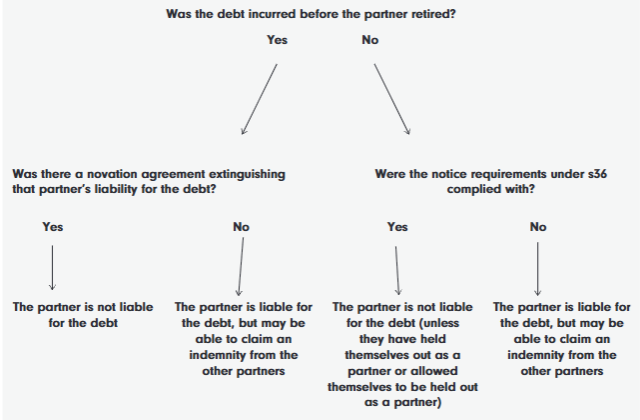
This will depend on when the debt was incurred
Before leaving the partnership
Each partner is liable jointly with the other partners for debts incurred by the partnership while
they were a partner (s 9 and s 17 PA 1890)Partners are jointly and severably liable for partnership’s debts - a claimant can sue any or all partners and collect total damages from any or all
Civil Liability (Contribution) Act 1978 means the court can order someone to contribute to the debt of another
And that recovering a sum from one person does not stop the claimant from suing another person who is jointly liable for the same damage
Novation Agreements
= the retiring partner will be released from an existing debt by entering into an agreement with the creditor and other partners
This releases original partners from their liability and the firm will take over the liability (usually goes to incoming partner)
If there is no incoming partner to take over liability, for the novation agreement to be binding there must be consideration
After leaving the partnership
Even after leaving, a partner will remain liable for debts incurred whilst they were a partner (unless there is a novation agreement)
However no liability for debts entered into after they had left the partnership as long as they comply with s 36 PA 1890
Anyone who the firm has dealt with before must be given actual notice of the partner leaving
Anyone who has not had dealings with the firm must also be notified of the partner’s retirement (e.g through London/Edinburgh/Belfast Gazette)
Holding Out
When a creditor of a partnership has relied on a representation that a particular person was
a partner in the firm (known as ‘holding out’), they may be able to hold that person liable
for the firm’s debt (s 14 PA 1890)Possible even if the person had never been a partner or had retired before the contract was made
6.10 Enforcing the firm’s liabilities
When enforcing liability, important to know who you can actually sue:
Claimant can sue the partner or partners with whom they made contact with because there is privity of contract between them
Claimant can sue anyone who was a partner at the time when the debt was incurred (that partner can then claim indemnity from their other partners to share liability)
Claimant can sue the firm in the firms name (basically just suing all the partners or anyone who was a partner at the time the debt was incurred)
Clearly the best option is to sue all of the partners in a firm rather than just one partner
Judgement can be enforced against partnership assets and if needed personal assets
6.11 - Insolvency
Although a partnership is not a legal person in its own right, an insolvent partnership may use
the rescue procedures available to companies, such as a voluntary arrangement with creditors
or an administration order of the courtThe individual partners may be made bankrupt if an
obligation is enforced against their personal assets and there is still not enough to meet the
partners’ liabilities
6.12 Tax
Partners may need to pay VAT, National Insurance and either income or corporation tax - depending on whether the partner is an individual or a company
6.13 Liability between partners
The partnership agreement, if there is one, should set out a mechanism for valuing an
outgoing partner’s shareUsually, when a partner leaves the partnership, they will ‘leave in’ the partnership bank account a sum of money to pay their share of any outstanding debts.
If the remaining partners and the outgoing partner are sued by a creditor in respect of a debt incurred before the partner left the partnership, the outgoing partner may have to pay the third party
However, they may have a contractual right to be reimbursed by the remaining partners, if such a right is included in the agreement.
Alternatively, they could try to claim an indemnity under s 24(2) of the PA 1890 on the basis that they have incurred liabilities in the ordinary and proper conduct of the business
6.14 When a partner cannot pay
If a partner cannot pay a judgment debt owed to a third party, the third party can enforce the debt by obtaining a charge over the partner’s property or
properties, and then applying for an order for sale of those properties in order to satisfy the
outstanding debt.Alternatively, the third party may seize assets belonging to the partner.
If a partner cannot pay their fellow partners, the other partners have the same enforcement
options as a third party.There may also be other consequences. For example, the partnership agreement may give the other partners the right to expel that partner.
6.16 Legal Requirements - Limited Liability Partnerships
Members (Shareholders)
LLP must have at least two members on incorporation
Requirement to have at least 2 designation members who are responsible for filing documents at Companies House
The designated members can be swapped at any time
If at any time the number of members reduces to one, and this carries on for more than six
months, that person is jointly and severally liable for any of the LLP’s debts incurred during the
period from the six-month point onwards.
Incorporation
An LLP is started by filing form LL IN01 at Companies House, along with the applicable fee.
Companies House will then issue a certificate of registration
Name
The LLP’s name must end ‘LLP’, ‘limited liability partnership’ or the Welsh equivalents.
The LLP must have its name on the outside of its place of business and its stationery must state its
name, place of registration and registration number (and the address of the registered office).Under the LLP Regulations 2001, an LLP can change its name at any time, with the consent of all of the members.
Alternatively, the procedure for change of name can be set out in the partnership agreement.
6.17 Registered Office and Email Address
An LLP must have a registered office, which is its address for service of official documents,
and the registered office address must appear on its stationeryUnder ECCTA 2023, LLPs must also have an ‘appropriate email address’
6.18 Designated Members
Designated members have powers similar to directors in a company, and also have duties and responsibilities as members of the LLP.
Under the LLPA 2000, CA 2006 and Insolvency Act 1986, designated members are responsible for various administrative and legal matters, including:
signing and filing the annual accounts with the Registrar;
appointing, removing and remunerating the auditors;
filing the annual confirmation statement;
sending notices to the Registrar of Companies, or example concerning a member leaving or joining the LLP; or
winding up the LLP.
Designated members owe a duty of reasonable care and skill to the LLP
6.19 Effect of Limited Liability
If an LLP is insolvent, the company liquidation regime under the Insolvency Act 1986 applies
to both the LLP and its members.This means that members may be liable for misfeasance, fraudulent trading or wrongful trading and may be required to contribute to the assets of the insolvent LLP.
The Company Directors Disqualification Act 1986 applies to members of an LLP as well as to company directors, so, depending on their conduct, a member of an LLP could be disqualified from being a director or a member of an LLP in the future
6.20 Duties and responsibilities of members
The LLPA 2000 provides that the mutual rights and duties of the LLP’s members are governed
by agreement between members or between the LLP and its members.If there is any matter which the parties have not agreed, the LLP Regulations 2001 will apply.
Members also owe fiduciary duties to the LLP, as its agents.
They include a duty of good
faith, a duty to account for any money received on behalf of the LLP and a duty to the other
members to render true accounts and full information on matters concerning the LLP.
6.21 Authority of Members
Members of an LLP are agents of the LLP, under s 6 LLPA 2000.
Limitations can be placed on a partner’s actual authority in the partnership agreement, or orally.
However, LLPs may still be liable to a third party, even if a partner has acted without actual authority, because of the
principle of apparent authority, in the same way as in a general partnership.
6.22 Owning property and granting charges
Limited liability partnerships can own property and the LLP itself is the legal owner, rather
than the individual members (because it is an incorporated business)They can also issue debentures and grant both fixed and floating charges, just like companies
Contrasts general partnerships which can only grant fixed charges
Limited liability partnerships must keep a register of charges, along with a copy of every charge requiring registration, at its registered office.
The register should include all charges affecting the LLP’s property and floating charges.
Any creditor or member of the LLP must be allowed to inspect the register without paying a fee.
Limited liability partnerships are required to register charges with the Registrar of Companies, and which form to use depends on the nature of the charge
6.23 Change in Membership
Whether a new member can join an LLP, and the mechanism for agreeing to a new member
joining, is governed by the LLP agreementIf a new member joins an LLP, the LLP must deliver a notice to the Registrar of Companies,
notifying them of the new member, within 14 days of appointmentCan be done by filing form LL AP01 for an individual member
Can be done by filing form LLAP02 for a corporate member
It requires the member to give both a service address and a residential address, along with full name, former names and date of birth.
When a member leaves an LLP, the LLP is required to file form LL TM01 at Companies House
within 14 days.
6.24 The LLP Agreement
The LLP Regulations 2001 provide a set of default rules
Written partnership agreements can overturn most of the default rules
Common terms found in LLP agreements;
Capital and Profits
The default position under the LLP Regulations 2001 is that the members of the LLP share
equally in the capital and profits of the LLPNo default provision regarding losses
Not personally liable so all that members of an LLP risk financially is losing their capital contributions, and, if they have loaned any money to the LLP, not being repaid
Management and Decision-Making
The default rules in the LLP Regulations 2001 provide that every member may take part in the
management of the LLP.They also state that members are not entitled to payment for taking part in management.
Often this is changed in individual partner agreement to create a better suited management model
Leaving the LLP
Under the LLP Regulations 2001, members can leave the LLP by giving reasonable notice to the other members
Members cannot be expelled, so, if the members wish there to be a right of expulsion, this must be included in the LLP agreement.
If a member is disqualified from being a company director, they are not allowed to be a member of an LLP.
When a member leaves an LLP, the LLP must notify Companies House on form LL TM01 within
14 days of the member leaving.
6.25 Advantages and Disadvantages of an LLP
Advantage
Members have limited liability for debts of the LLP
Able to grant fixed and floating charges over their assets
Leeway on management structure
They can appoint an administrator
Disadvantage
Administrative and Accounting requirements - must file accounts with the Registrar of Companies and must file other information such as notice of termination of membership with companies house
These documents are also available for public inspection
Limited liability partnerships are also
subject to potential clawback provisions on insolvency