L06 - Digital Signals
 Call Kai
 Learn
 Practice Test
 Spaced Repetition
 Match
 Flashcards
 Knowt Play
1/24

There's no tags or description
Looks like no tags are added yet.
25 Terms
What is the difference between an analogue signal x(t) and a digital signal x[n]?
x(t) is continuous in time and amplitude; x[n] is a sequence of samples with discrete amplitude levels.
What is the difference between sampling and quantisation?
Sampling makes time discrete; quantisation makes amplitude discrete.
Sampling a continuous signal gives x[n] = ____.
x(nTs): the signal's value at time n × Ts.
Telephone speech is sampled at 8 kHz. What is the sampling period?
125 µs, because Ts = 1/fs.
What does the Nyquist-Shannon sampling theorem require for perfect reconstruction?
Sample faster than twice the highest frequency present: fs > 2fmax.
A system samples at 16 kHz. What is the highest frequency it can represent without aliasing?
8 kHz, the Nyquist frequency (fs/2).
A microphone signal contains energy up to 7 kHz. What is the minimum sampling rate?
Above 14 kHz, so 16 kHz wide-band systems are suitable.
Why is 8 kHz a reasonable sampling rate for telephone speech?
Most speech intelligibility lies below about 4 kHz, so 8 kHz captures it while saving bandwidth.
What is aliasing?
A frequency above fs/2 appears as a false, lower frequency after sampling.
What rule gives the apparent frequency of an aliased tone?
The distance from the true frequency to the nearest multiple of fs.
Sampled at 10 Hz, why can a 7 Hz tone and a 13 Hz tone not be told apart?
Both fold to 3 Hz, so they produce identical samples.
Why do the samples on the right trace a slow wave that is not in the original signal? [IMAGE: Slide 11, hide both plot titles and the bottom caption]
fs = 6 Hz is below 2 × 5 Hz, so the 5 Hz tone aliases to 1 Hz.
How is aliasing prevented in practice?
An anti-aliasing filter removes frequencies above fs/2 before sampling.

What frequency marks the first peak of this folding graph, and what happens above it? [IMAGE: Slide 24, hide the "Nyquist frequency fs/2" label]
The Nyquist frequency (fs/2 = 5 Hz); higher frequencies fold back to lower apparent frequencies.
A quantiser using B bits has ____ amplitude levels.
2^B.
Bit depth is doubled from 8 to 16 bits. What happens to the number of amplitude levels?
It is squared, from 256 to 65,536, because each extra bit doubles the levels.
What is quantisation error, and what causes it?
The difference between the true and stored amplitude, caused by rounding to the nearest level.
Signal-to-quantisation-noise ratio for B bits is approximately SQNR ≈ ____ dB.
6.02B + 1.76.
Roughly how much does each extra bit of resolution improve SQNR, and at what cost?
About 6 dB per bit, at the cost of more storage and bandwidth per sample.
What does the Fourier series say about a periodic signal?
Any well-behaved periodic signal is a weighted sum of sinusoids at its fundamental and harmonics.
A voiced speech segment repeats every 8 ms. What are f0 and the next two harmonics?
f0 = 125 Hz; harmonics at 250 Hz and 375 Hz.
Which harmonics make up an odd symmetric square wave, and how do their amplitudes behave?
Only odd harmonics, with amplitude 4/(kπ), so they fall as 1/k.
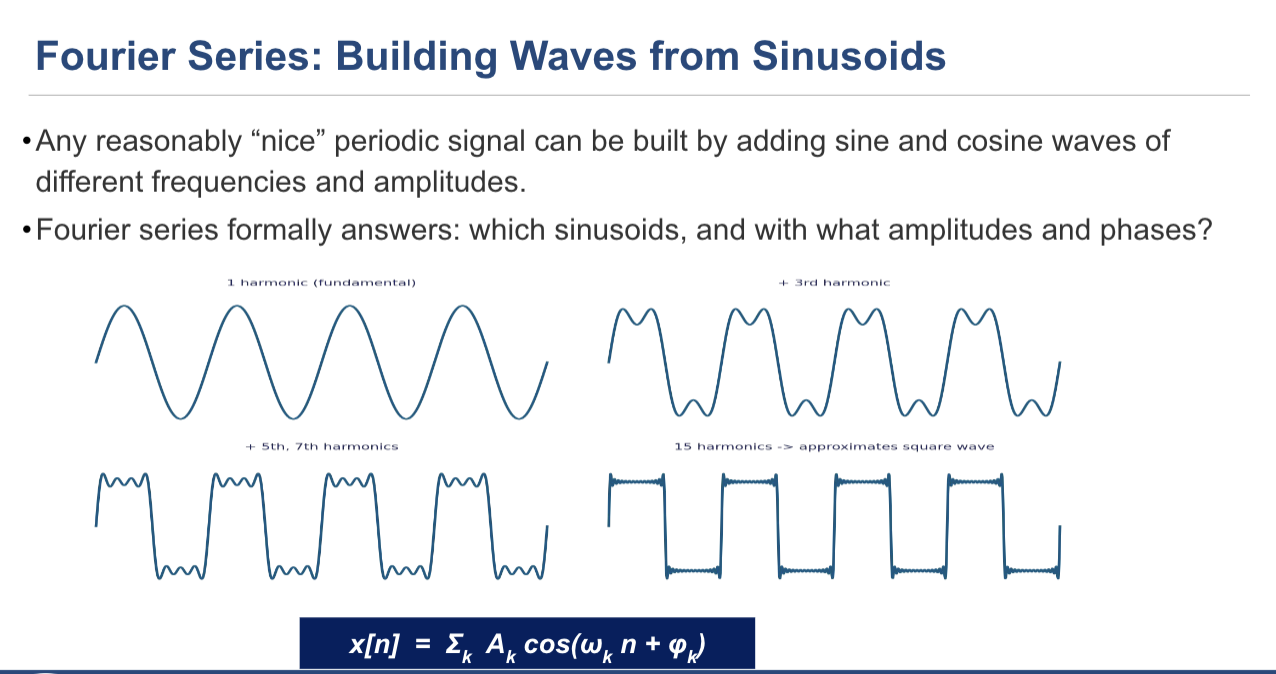
What happens to this waveform as more odd harmonics are added? [IMAGE: Slide 17, hide the four panel titles]
It approaches a square wave, with each added harmonic giving a smaller correction.
What is the difference between the Fourier series and the Fourier transform?
Series: periodic signal gives discrete harmonics. Transform: aperiodic signal gives a continuous spectrum.
How does ideal sinc interpolation rebuild x(t) from its samples?
Each sample contributes one sinc pulse; summing them recovers x(t) exactly if fs > 2fmax.