AP Psychology Unit 2: Perception
 Note
 Call Kai
 Learn
 Practice Test
 Spaced Repetition
 Match
 Flashcards
 Knowt Play
1/26

There's no tags or description
Looks like no tags are added yet.
27 Terms
Perception
The process by which our brain organizes and interprets sensory information, transforming it into meaningful objects and events.

Selective Attention
The process of focusing on a specific aspect of information while ignoring others.
Allows us to prioritize sensory information that is most relevant to our current goals or tasks, playing a key role in how we perceive and interact with our environment.

Cocktail Party Effect
Our ability to focus on a single conversation in a noisy environment, like a crowded party, while tuning out other stimuli.
Our perception can be directed to what we find most relevant or interesting
Specific example of selective attention in an auditory context

Change Blindness
The failure to notice large changes in one's environment when the change occurs while we’re focused on something else.
Illustrates the limits of our visual perception and attention, showing that our awareness of changes in our surroundings is often less acute than we might assume.

Inattentional Blindness
When an individual fails to notice an unexpected stimulus in their visual field when their attention is focused on something else.
It highlights the limits of our perceptual and cognitive processing, demonstrating that we can miss significant information in our environment when we are not directly paying attention to it.

Bottom-up processing
Data-driven, starting with the sensory data that is detected, converted, and sent to your brain.
Details build up to a complete perception
No prior knowledge influences this process
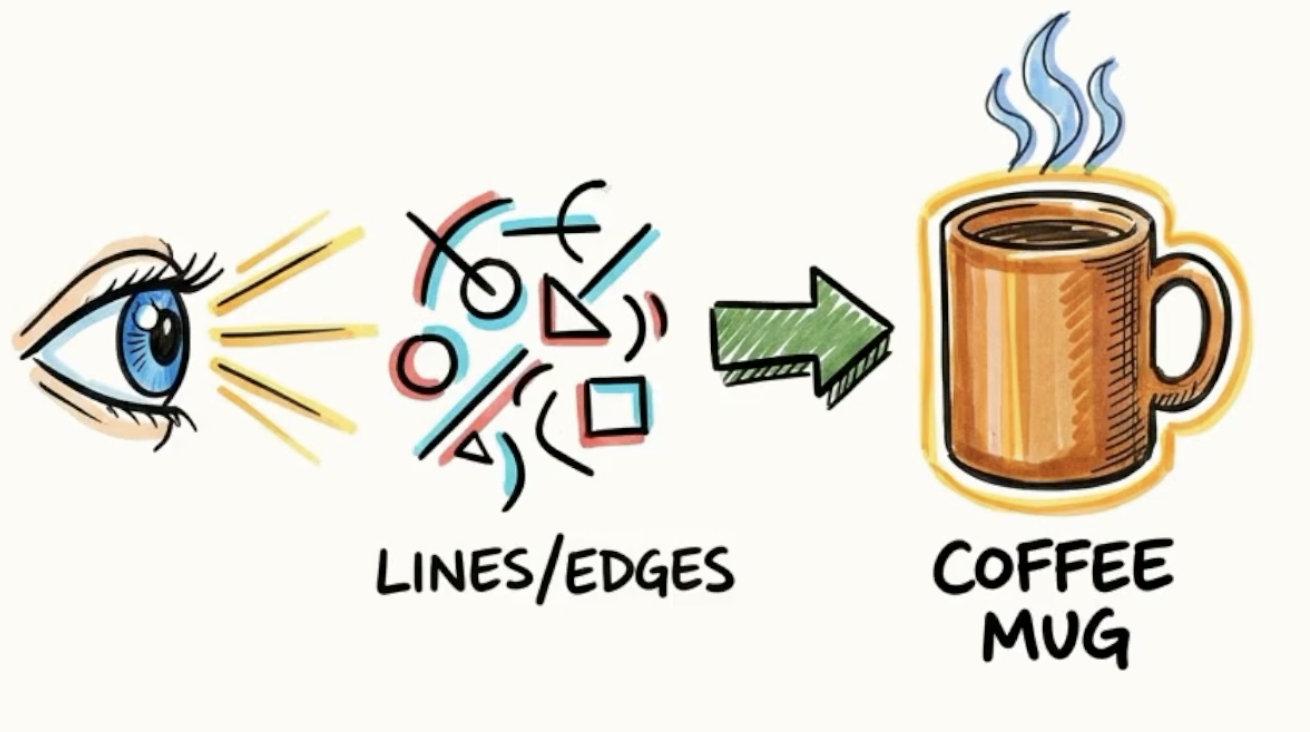
Top-down processing
Uses past knowledge to interpret new information.
Past experiences, expectations, and context guide perception

Perceptual Set
A temporary predisposition to perceive certain objects or events rather than others.
Predisposition in perception means a person's readiness to perceive a stimulus in a particular way based on prior experiences, expectations, motivations, or cultural background.
Ex: Filling in s_ _ p as soap instead of soup because you just washed your hands

Prosopagnosia
A disorder that makes it difficult to recognize faces.
Also called face blindness

Proximity
We perceive objects which are close to one another as a group.

Similarity
We perceive objects that look alike (color, shape, size) as a group.

Closure
We fill in the gaps to perceive complete shapes.
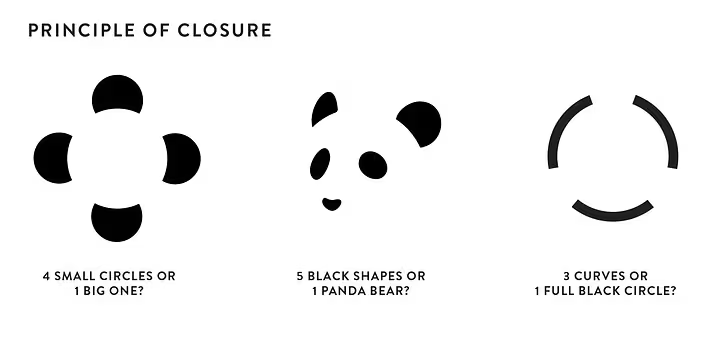
Figure-ground
We separate an image into a figure (main object of focus) and a “background.”

Depth Perception
The ability to perceive the world in three dimensions (3D) and to judge the distance of objects

Monocular Cues
Cues that can be used for depth perception that involve using only one eye. How we form 3D from 2D.
Closing one eye makes it harder to judge depth, but you’re still able to detect how near/far objects are in relation to your position.

Linear perspective
A depth cue where parallel lines appear to converge in the distance, helping the brain perceive depth.

Relative Size
If two objects are roughly the same size in reality, the one that casts a smaller image on your retina is perceived as being farther away.

Relative Clarity
We perceive hazy objects as farther away than sharp, clear objects
Distant objects appear hazier, blurrier, and less distinct because of atmospheric effects

Texture Gradient
A continuous surface (like a field of grass or a cobblestone street) shows a gradual change in detail and pattern spacing as it recedes into the distance.

Interposition
Occurs when one object overlaps another, leading us to perceive the overlapping object as closer.
This simple visual cue helps us understand the arrangement of objects in space, contributing to our depth perception.

Binocular Cues
Cues that require the use of both eyes (integrated by the brain) in order for us to perceive depth or distance
Allow us to gain a 3D interpretation of the world and allow us to navigate through it effortlessly.

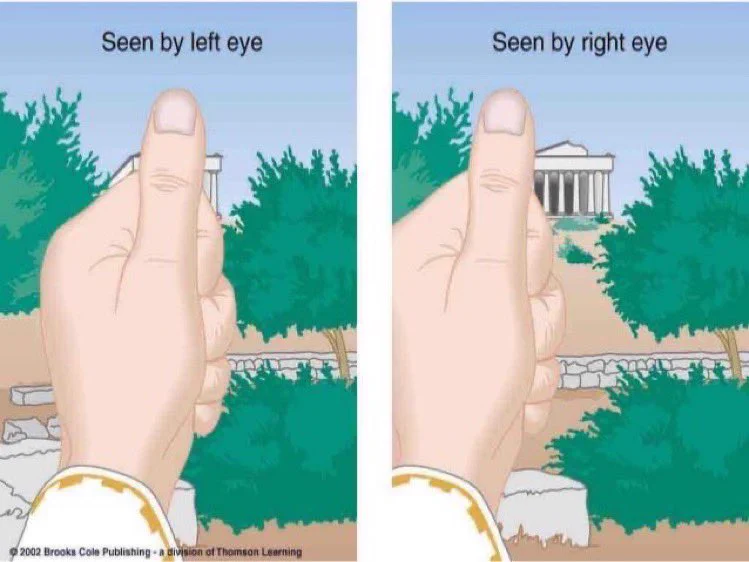
Retinal Disparity
Each eye sees a slightly different image - the brain compares them to judge depth and distance.
Ex: floating sausage illusion
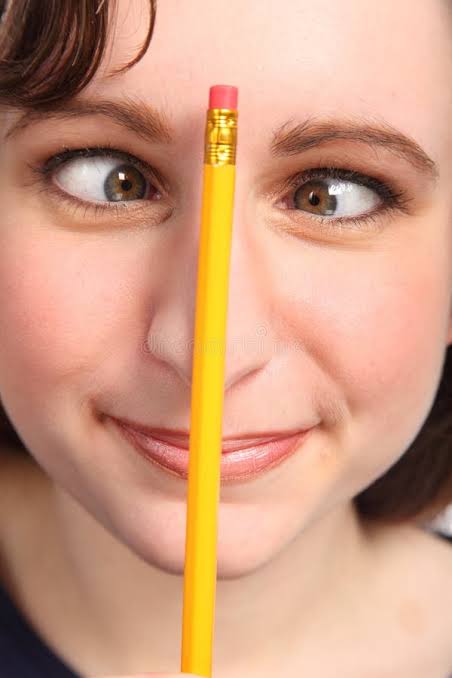
Convergence
When your eyes turn slightly inward to focus on something close to you.
Your brain monitors how much your eye muscles turn. The amount of inward turning tells your brain how close an object is.
More convergence = closer
Less convergence = farther away
Perceptual Constancies
Our brain's ability to see objects as unchanging, even when the image on our retina (like size, shape, or color) changes.
This helps us recognize objects under different conditions, maintaining a stable perception of the world.

Color Constancy
The ability to perceive the intrinsic color of an object as remaining relatively stable.

Shape constancy
The ability to perceive an object as retaining its shape despite changes in our viewing angle or distance, enabling us to recognize objects from any perspective.

Size Constancy
Our perception that an object remains the same size, even when its distance from us changes
