W7: Intelligence
 Call Kai
 Learn
 Practice Test
 Spaced Repetition
 Match
 Flashcards
 Knowt Play
1/39

There's no tags or description
Looks like no tags are added yet.
40 Terms
What is intelligence? (Binet and Simon, 1905)
The ability to judge, understand and reason well
What is intelligence? (Wechsler, 1939)
The aggregate capacity of the individual to act purposefully, think rationally and deal effectively with the environment
What does Gottfredson et al. distinguish in the most recent definition of intelligence?
Intelligence is not merely book learning, academic skill, or test-taking smarts but reflects a broader and deeper capability for comprehending our surroundings — “catching on”, “making sense” of things or “figuring out” what to do
Who are the 5 historical figures and their contribution towards intelligence assessment?
Binet - prediction for school success
Terman - giftedness and IQ formula
Spearman - general (g) and specific (s) intelligence
Wechsler - intelligence scale
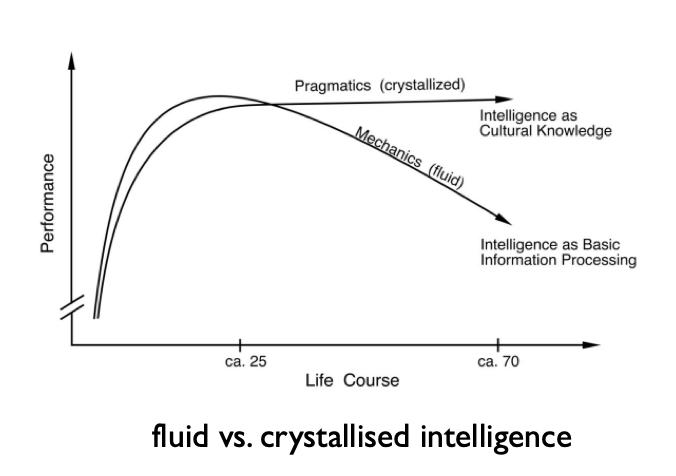
Cattell - fluid vs crystallised intelligence
How does fluid vs crystallised intelligence change after ~25 y/o?
Fluid intelligence (basic information processing) declines
Crystallised intelligence (cultural knowledge) stagnates
What are the two main intelligence tests?
Stanford-Binet 5 (SB-5)
Weschler Adult Intelligence Scale IV (WAIS-IV)
What are the two categories of IQ being tested in the SB-5?
Verbal IQ
Nonverbal IQ
What are the 5 domains in the SB-5? (FKQVW)
Fluid reasoning
Knowledge
Quantitative reasoning
Visual/spatial reasoning
Working memory

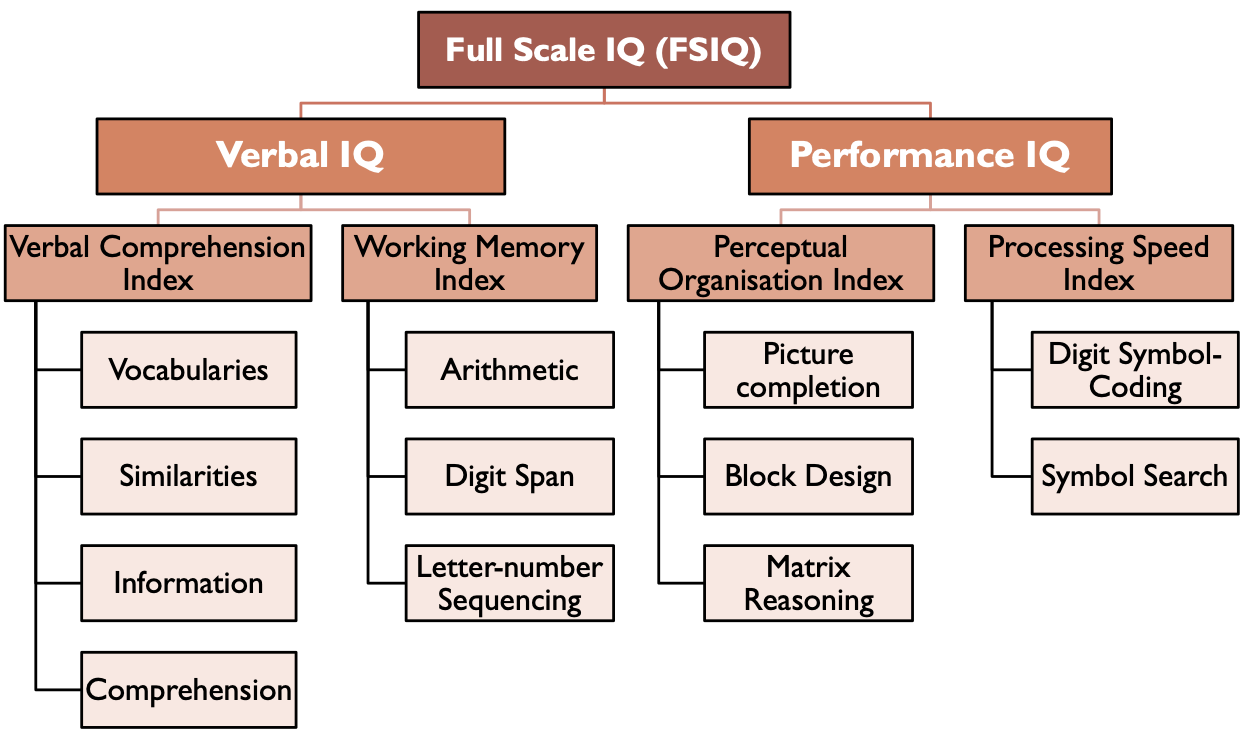
What are the two categories of IQ being tested in the WAIS-IV?
Verbal IQ
Performance IQ
What are the 4 index under verbal and performance IQ? (VWPP)
Verbal
Verbal comprehension index
Working memory index
Performance
Perceptual organisation index
Processing speed index
How is the reliability like for these two tests?
High reliability (internal, test-retest, interrater)
How is the validity like for these two tests?
High concurrent validity (correlation with prior versions and other tests) but
Moderate predictive validity
Why is predictive validity lower?
Future academic/occupational success does not solely depend on intelligence
What are the 3 controversies of intelligence assessment? (OMH)
Only assess one portion of intelligence
Misuse of tests in consequential decisions (e.g. educational, forensic and employment settings)
Historically used to substantiate claims about genetic differences between groups (e.g., ethnicities) and act as the basis of exclusion and mistreatment
What are the 3 benefits/promises of intelligence assessment? (ITS)
Identify children who might benefit from extra education
Track efforts to rectify differences in social disadvantage (on the basis that people from low SES perform poorer)
Selection of candidates in employment contexts

What are 2 explanations as to why there is an IQ gap between African Americans and White Americans?
Differences reflect a gene-environment interaction (e.g. access to formal education, SES)
Differences reflect a biased test
What is test bias?
Whether test score differences reflect true differences in intelligence
Which type of validity is test bias related to?
Differential validity
What is differential validity?
When conclusions are appropriate for one subgroup, but not for others
How do we assess differential validity/test bias?
Measure for bias in predictive and construct validity
In what case would there be a bias in predictive validity?
When a test or subscale of a test results in incorrect inferences about the future performance of a particular group
In what case would there be a bias in construct validity?
When a test or subscale of a test measures different constructs for members of different groups
What are the 3 approaches to measure bias in construct validity? (FRC)
Inconsistency in:
Factor analysis
Rank ordering of difficulty
Convergent/divergent validity
What would inconsistency in factor analysis look like?
Different scoring across groups (groups 1 & 2 vs 3)

What would inconsistency in rank ordering of difficult items look like?
Different ranking across groups (groups 1 & 2 vs 3)
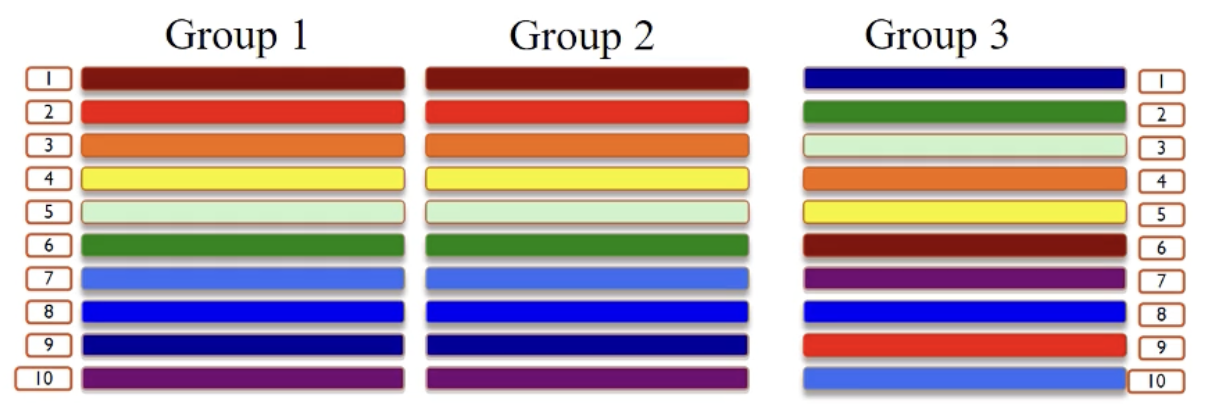
How would inconsistency of convergent/discriminant validity look like?
Different correlation of tests between groups (groups 1 & 2 vs 3)

How do the 2 intelligence tests score in terms of differential validity?
High differential validity; there is no test bias
Going back to the intelligence gap, which explanation is now more accurate?
The gene-environment interaction
What are the differences in the conceptualisation of intelligence between western, eastern and african cultures?
Western: intelligence as a means for individuals to devise categories and to engage in rational debate
Eastern: intelligence as a way for members of a community to recognise contradiction and complexity and to play their social roles successfully
African: intelligence as a blend of cognitive competencies and social responsibilities
If you import a western-based test to participants belonging to another cultural context, what would arise?
Cultural bias
What is a “culture-free” intelligence test?
Non-verbal (linguistic) test e.g. raven’s matrices - pattern recognition

What is a limitation of it?
Arguably the most culture-bound types of IQ test
e.g. matrix logic is widespread in some cultures but non-existent in others
According to twin studies, how much of variance in intelligence was heritable?
Majority (70%)
What is one caveat for this result?
This is only the case in high SES contexts
in low SES contexts, genetics only accounts for 8%
How much does genome-wide sequences influence variance in intelligence, and how does education affect this?
GWS explain 4% of variance, but raises to 10% when education years are accounted for
What are the 4 methods to improve intelligence? (TMPW)
The mozart effect (listening to music)
Music training (learning an instrument)
Playing chess
Working memory training (WMT)
What did results show for WMT?
Very good at increasing working memory (through training effects on trained tasks), but not the most reliable route in increasing broader fluid intelligence
What about brain training?
Same results: found to improve performance on trained tasks, and less on distantly-related tasks or everyday cognitive performance
What could improve cognitive ability performance?
Physical exercise (in both adults and children)
What did Hogan et al. (2013) find on the effect of physical exercise on cognitive ability performance?
Adults who engaged in moderatelyintense exercise had quicker reaction time on cognitive tasks, especially older adults