Org Behavior Exam 2
 Call Kai
 Learn
 Practice Test
 Spaced Repetition
 Match
 Flashcards
 Knowt Play
1/94

There's no tags or description
Looks like no tags are added yet.
95 Terms
Conflict
Process through which one party perceives its interests are opposed or negatively affected by another party
Task Conflict
Also called constructive conflict
Discussion focused on the issue/work
People demonstrate respect for others with different points of view
Relationship Conflict
Also called destructive conflict
Discussion focused on people/personalities
Sources of conflict
Incompatible goals, differentiation, task interdependence, scarce resources, ambiguous rules, communication problems
Conflict handling styles
assertiveness and cooperativeness
Assertiveness
degree to which party prioritizes own interests
cooperativeness
degree to which party prioritizes others’ interests
5 Conflict handling styles
forcing, problem solving, compromising, avoiding, yielding

Forcing is effective when…
Need quick solution
Other party would take advantage
Your position is the ethical one
Problem solving is effective when
Parties’ interests not totally opposed
Parties trust each other and have time to share information
Compromising is effective when…
Parties have equal amounts of power
Limited time to resolve the conflict
Parties lack trust/openness
Avoiding is effective when…
Conflict is too emotionally-charged
Cost of trying not worth it
Yielding is effective when…
Other party has a lot more power
Issue is less important to you
Negotiation
deciding what each party will “give” and “take” in an exchange
The Negotiation process
a structured back-and-forth communication and decision-making process where two or more parties with shared and opposing interests attempt to reach a mutually beneficial agreement

Congruent negotiation
Parties share same preferences

Distributive negotiation
Parties have different preferences

Bargaining zone
Area of potential agreement
BATNA
Best Alternative To a Negotiated Agreement
Power
The capacity of a person, team, or organization to influence others
Influence
Any behavior that attempts to alter someone’s behavior or attitudes
Power comes from perceptions of … on
somebody else
dependance
Dependence revolves around access to …
resources
5 sources of Power
Legitimate, Reward, Coercive, Expert, Referent

Legitimate power
Agreement that people in certain roles can request certain behaviors of others
Reward power
Ability to control the allocation of rewards valued by others and to remove negative sanctions

Coercive power
Ability to apply punishment
Expert power
Possessing knowledge or skills that others value and do not have
Referent power
Occurs when others identify with, like, or respect the person

Hard Influence tactics
Siletn authority, Assertiveness, Information control, coalition formation, upward appeal
Soft Influence tactics
Ingratiation and impression management, persuasion, exchange
Consequences of Influence tactics
Resistance, compliance, commitment
Resistance
People refuse to do what the influencer asks of them
Compliance
People implement what the influencer asks, but minimally, and only for instrumental reasons
Commitment
People identify (agree) with what the influencer asks and are highly motivated to do it
Leadership
Influencing/motivating and enabling others to contribute to the effectiveness of the organization
Motivating
energizing people through communication and influence tactics
Enabling
creating an environment in which people can do their work more easily
Perspectives on leadership
Personal Attributes, Implicit, Tranformational, Managerial, Situational
Personal Attributes
Leaders succeed if they have certain traits
Implicit
Leader success depends on followers’ perceptions
Tranformational
Leaders succeed by acting as “change agents”
Managerial
Leaders succeed by acting as “everyday” managers
Situational
Leaders succeed if they adapt to the situation
Why is Situational Theories the best
They emphasize that different leadership approaches
(styles) are best suited to different situations
Path-goal leadership model
a contingency leadership framework stating that a leader's behavior directly impacts the motivation, satisfaction, and performance of their subordinates

Directive leadership
The leader clarifies performance goals and performance standards. Uses rewards and disciplinary practices.

Supportive leadership
Leader provides psychological support. Shows respect and concern for employee needs and well-being.

Participative leadership
Leader encourages employee involvement. Asks employees for and considers input
Achievement-Oriented leadership
Leader helps employees reach peak performance. Sets challenging goals and shows confidence in employees’ abilities
Organizational Culture
The basic pattern of shared values and assumptions that shape how people within an organization think and act
Shared values
Evaluative beliefs people use to determine which types of behaviors, situations, and outcomes are desirable or undesirable
Individual values
Own beliefs, may differ from another employee’s beliefs (in same organization)
Shared assumptions
Taken-for granted, nonconscious ideas about the “right” way to behave and think
Espoused values
stated values of an organization
Enacted values
values actually exhibited by people in an organization
Artificats in organizations
Observable signs and symbols of an organization’s culture
Model of Organizational culture
a structural framework used to define, analyze, and diagnose the shared values, basic assumptions, artifacts, and behavioral norms that shape how people think, feel, and act within a company

4 categories of artifacts
physical structures, language, rituals/ceremonies, stories/legends,
Organizational subcultures
Based on department/unit/function, role, generation, etc.
Values can enhance or oppose dominant culture
Functions of opposing countercultures:
Provide surveillance and critique of dominant view
Source of emerging values that keep organization aligned with its environment
Culture strength
How widely/deeply employees “hold” organization’s values and assumptions
Strong cultures
Most employees understand and embrace dominant values and assumptions
Weak cultures
Dominant values and assumptions held only by a few people (at top of organization)
Benefits of Strong Cultures
Social control, social glue, improves sense-making
Mechanisms of Cultural “fit”
Attraction, Selection, Attrition, Socialization
Attraction
Organization tries to make culture known/clear so applicants share similar values
Selection
Organization tries to hire people who seem to share same values
Attrition
Organization expects people whose values clash will leave (quit)
Socialization
Process through which newcomers learn culture
Dangers of selecting for “fit”
Supposed to be about selecting candidates with values that align with organizational culture, BUT can lead to only hiring people who are personally similar to interviewers
Risks of selecting for “fit”
inadvertent discrimination, less diversity, missing out on top performing candidates
Organizational structure
The pattern of roles, relationships, and procedures that enable coordinated action by people in an organization
Division of labor
Divide up labor into distinct, manageable tasks that individuals/teams can do
coordination
Integrate labor across individuals/teams to accomplish common goals
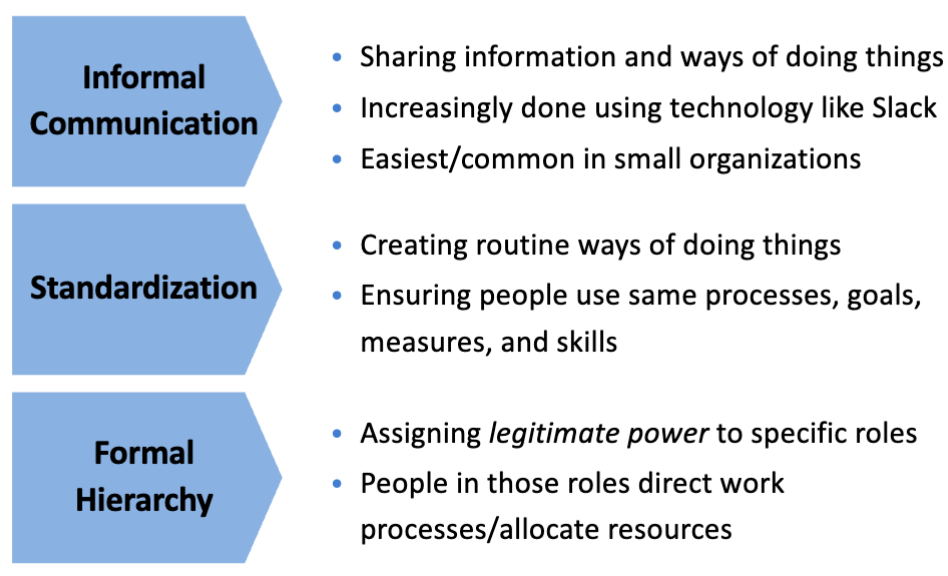
Ways of coordinating work activities
informal communication, standardization, formal hierarchy
Span of control
Number of people who report to next level in hierarchy
Centralization
Formal decision making authority is held by a few people, usually at the top
Decentralization
Decision making authority is dispersed throughout the organization
Formalization
Degree to which behavior is standardized through rules, procedures, training, etc.
Mechanistic structure
Narrow span of control
High centralization
High formalization
Promotes predictable and accountable behavior
Better for organizations operating in stable environments
Organic Structures
Wide span of control
Decentralization
Low formalization
Promotes flexibility and adaptation
Better for organizations operating in stable environments
Departmentalization
Organizes people (and their work activities) into clear groups (e.g., departments, units)
• Evolves over time as companies grow
Functional structure
Organizing based on specialized knowledge and resources
Divisional structure
Organized based on geography, products/services, or clients
Matrix structure
Combines functional and divisional approaches
“Dual reporting relationships”: Division and function managers have equal authority, and employees report to both of them
Two bosses!

Team-based structure
Self-directed work teams
Organized around work processes and outputs (e.g., building a product, designing an app)
Highly decentralized (day-to-day decisions made by teams)
Little formalization (few rules) or supervision
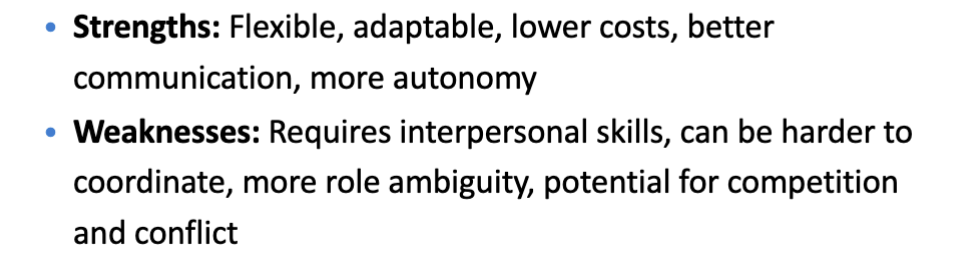
Lewin’s force field analysis model
a change management and decision-making model that evaluates the competing forces acting on an organizational or situational change
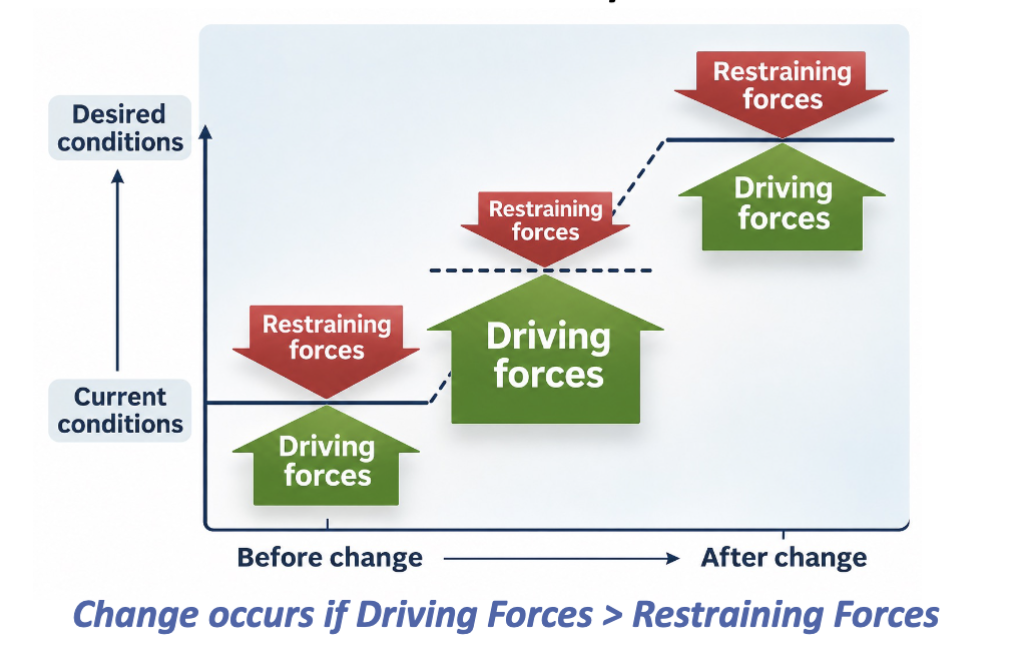
driving forces
Push organizations toward new state of affairs
Trigger/engine for change
Include external and leader-created forces
External: New competitors or technologies, other environmental changes
Leader-created: Higher standards, better practices
Restraining forces
Counteract driving forces
Maintain the status quo
Represent resistance to change
Result in stability when are equal to driving forces
6 reasons employees resist change
negative valence of change, fear of the unknown, non-invented-here syndrome, breaking routines, incongruent team dynamics, incongruent organizational systems
6 strategies to reducing employee resistance
communication, learning, employee involvement, stress management, negotiation, coercion
Work-life balance
Preferred allocation of time between…
- Work (career, professional ambitions)
- Life (family, hobbies, exercise, etc.)
Work-life conflict
Work ambitions and life goals are not necessarily in opposition to one another…
…BUT many people experience conflict between
work and life demands
Balance-supportive employer benefits
On-site childcare, child-care subsidies, parental and adoption leave, elder care subsidy and/or referral services, family sick days
balance-supportive arrangements
part-time jobs, job sharing, flextime, remote or hyprid options