Elbow Kinesiology
 Call Kai
 Learn
 Practice Test
 Spaced Repetition
 Match
 Flashcards
 Knowt Play
1/62

There's no tags or description
Looks like no tags are added yet.
63 Terms
carrying angle (normal cubitus valgus)
frontal plane alignment of humerus to radius/ulna
population average: 13 degrees, 6 degree SD
females generally > males
dominant > non-dominant
carrying angle
shifts the medial to lateral axis of rotation superiorly for elbow flexion and extension
articulations of the elbow/forearm complex
humero-ulnar joint
humero-radial joint
proximal radio-ulnar joint
distal radio-ulnar joint
elbow flexion/extension
actions of humero-ulnar and humero-radial joints
forearm pronation/supination
actions of proximal radio-ulnar joint and distal radio-ulnar joint
humeroulnar and humeroradial joints
modified hinge joint
minimal axial rotation and ABD/ADD of ulna during flexion/extension movements
humeroulnar joint
relatively tight fit
trochlea of humerus and trochlear groove of ulna
most of passive stability from joint congruency
humeroradial joint
minimal bony stability
capitulum of humerus and cuplike fovea of radial head
minimal sagittal plane stability
important for resistance to valgus forces on the elbow
articular capsule
surrounds humeroulnar, humeroradial and proximal radioulnar joints
thin, some anterior thickening
medial (ulnar) collateral ligament
resist valgus forces
anterior, posterior, transverse bands
lateral (radial) collateral ligament
resist varus forces
two bands: radius and ulna
muscle active stability of humeroulnar and humeroradial joints
medial common flexor tendon to medial epicondyle
lateral common extensor tendon to lateral epicondyle
anterior stabilization from elbow flexor group
medial common flexor tendon to medial epicondyle
wrist flexor/pronator muscles
assist with stabilization against valgus forces
lateral common extensor tendon to lateral epicondyle
wrist extensor/supinator muscles
humeroulnar arthrokinematics open chain
concave trochlear notch of ulna moving on convex trochlea of humerus
humeroulnar flexion
anterior roll, anterior glide
concave trochlear notch of ulna moving on convex trochlea of humerus
humeroulnar extension
posterior roll, posterior slide
concave trochlear notch of ulna moving on convex trochlea of humerus
humeroradial arthrokinematics open chain
concave radial head fovea moving on convex capitulum of humerus
humeroradial flexion
anterior roll, anterior glide
concave radial head fovea moving on convex capitulum of humerus
humeroradial extension
posterior roll, posterior glide
concave radial head fovea moving on convex capitulum of humerus
proximal and distal radioulnar joints
allow for pronation and supination
plane: transverse/horizontal
axis: oblique axis from radial head to ulnar head
bisects both
radius moving around a stable ulna (OKC)
proximal radioulnar joint periarticular connective tissue
annular ligament (75% coverage) and radial notch (25% coverage) support radial head
within joint capsule with humero-ulnar and humeroradial joints
distal radioulnar joint periarticular connective tissue
articular disc of triangular fibrocartilage complex (TFCC)
continuous with anterior and posterior radioulnar ligaments
includes ulnar collateral ligaments of wrist
minimal bone congruency stability
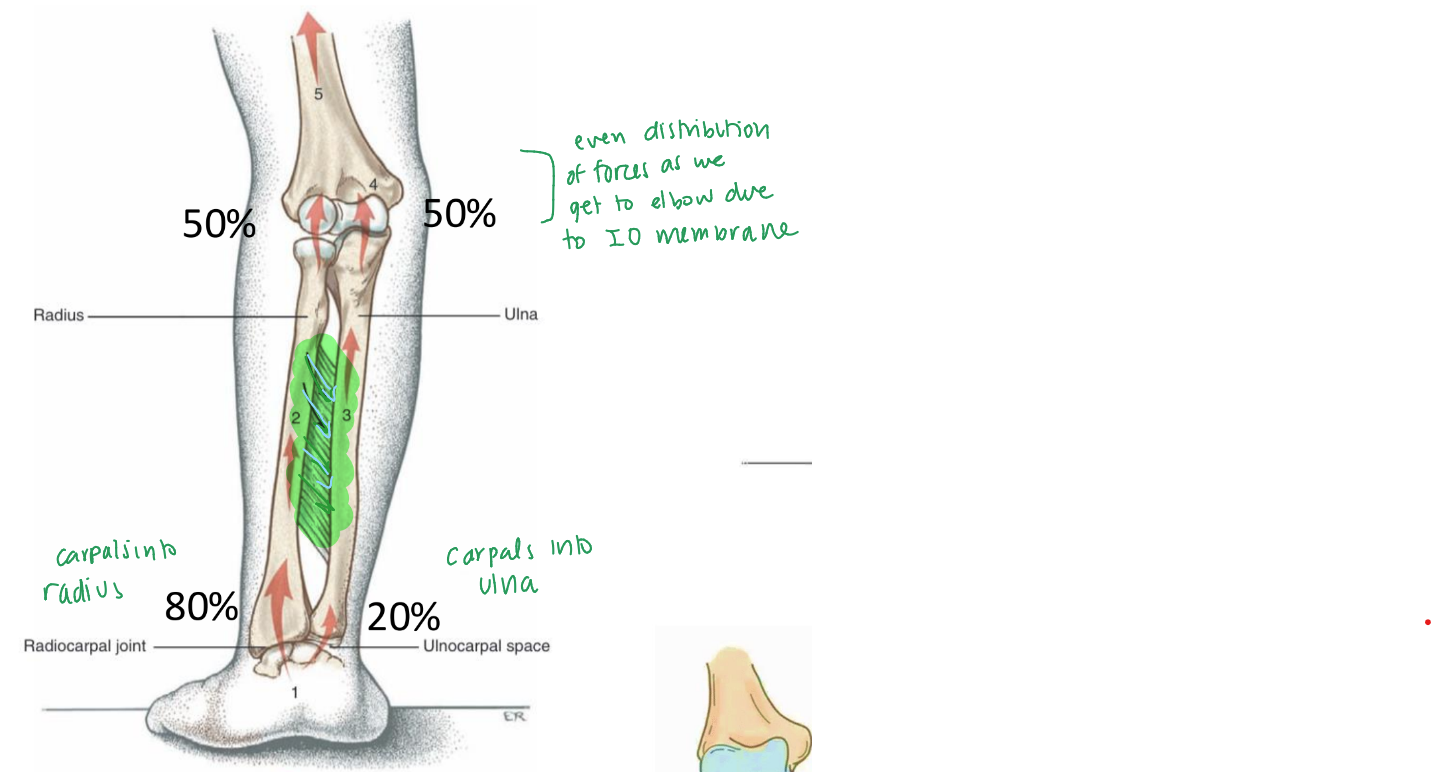
interosseous membrane
supports radius and ulna along shaft
inferior direction radius to ulna
transmits compression forces
unable to assist with distraction forces
radial head subluxation (nursemaid’s elbow)
compression force on the forearm
pronator teres, supinator
proximal radioulnar joint muscles active stability
generally, common flexor and extensor groups proximally
pronator quadratus
distal radioulnar joint muscles active stability
generally, wrist flexor/extensor tendons
simultaneously
in pronation and supination, proximal and distal radioulnar joints must work ___________
spin
pronation and supination requires a ______ of the fovea of radial head on the capitulum of humerus
stabilizes radial head on capitulum with pronation > supination
PRUJ OKC arthrokinematics
convex radial head moving on concave radial notch of ulna
PRUJ pronation
anterior roll, posterior glide
convex radial head moving on concave radial notch of ulna
PRUJ supination
posterior roll, anterior glide
convex radial head moving on concave radial notch of ulna
DRUJ OKC arthrokinematics
concave ulnar notch of radius moving on convex head of ulna
DRUJ pronation
anterior roll, anterior glide
limited by dorsal carpal ligaments
concave ulnar notch of radius moving on convex head of ulna
DRUJ supination
posterior roll, posterior glide
limited by palmar carpal ligaments
concave ulnar notch of radius moving on convex head of ulna
PRUJ/DRUJ CKC pronation and supination
occur with a fixed hand/radius
requires rotation of ulna → humerus → GHJ
through stable humeroulnar joint
NOT TESTED ON THIS

musculocutaneous nerve
innervation of biceps brachii, brachialis
radial nerve
brachioradialis innervation
median nerve
pronator teres innervation
radial nerve
triceps brachii and anconeus innervation
elbow flexion primary muscles
biceps brachii, brachialis, brachioradialis, pronator teres
flexion torque
approximately 70% greater than extension torque
90 degrees of elbow flexion
flexion torque is maximal at approximately
supination, pronation
flexion torque is 25% greater in _________ compared to __________
brachialis
largest muscle crossing the elbow
distally attaches to ulna
functions regardless of pronation/supination position
biceps brachii
physiologic advantage to combining elbow flexion with shoulder extension
attaches scapula to radius
posterior deltoid + biceps brachii
increases biceps elbow flexion torque
flexion torque
decreased concentric contraction velocity increases
biceps length-tension relationship
same 90 degree elbow flexion position
2 cm shortening difference based on shoulder position

triceps brachii and anconeus
elbow extension primary muscles
shoulder extension
long-head of triceps to infraglenoid tubercle of scapula
sequence of elbow extension activation
with increasing force demand
anconeus → medial head → lateral head → long head
extension torque
increasing moment arm with increasing extension
maximal __________ ________ at approximately 90 degrees flexion (when anatomic GHJ position)
greater influence from length-tension of triceps vs moment arm
triceps brachii function
static stability in UE weight bearing
isometric, low-velocity eccentric to stabilize a fixed elbow
prevents buckling
generate large dynamic extensor torque
standing from chair, pushing open door, throwing ball
typically combined with shoulder flexion
maintains length-tension, avoids active insufficiency
anterior deltoid
opposes shoulder extension torque
forearm pronation/supination muscles must
attach on both sides of axis of rotation (humerus/ulnar to radius)
produce force acting with internal moment arm around axis of rotation
forearm pronation/supination
more perpendicular to the axis of rotation the better
pronator quadratus
is closest to perpendicular to axis of rotation
supinators, pronators
_______ produce 25% greater torque than ________
R hand vs L hand dominance example!
forearm pronation/supination
functionally works with shoulder ER/IR for nearly 360 degrees of hand rotation
supinator
recruited first for low-power supination activities at all elbow flexion angles
biceps brachii
recruited for high-power supination activities
ideally with elbow flexed close to 90 degrees
need co-contraction of triceps to prevention elbow flexion
pronator quadratus
more consistently recruited for all pronation movements
line of pull assists with distal radioulnar joint stability and arthrokinematics
pronator teres
recruited more for high-power pronation activities
triceps co-contraction required to isometrically resist elbow flexion