Bio Lab Exam 2
 Call Kai
 Learn
 Practice Test
 Spaced Repetition
 Match
 Flashcards
 Knowt Play
1/79

There's no tags or description
Looks like no tags are added yet.
80 Terms
Photosynthesis
Process of using light energy to produce glucose.
Paper chromatography
Technique used to separate different pigments.
Retention factor (Rf)
Ratio of the distance a pigment traveled to the distance the solvent front traveled.
Hexane
Nonpolar solvent.
Acetone
Polar solvent.
Pigment
A substance that absorbs certain wavelengths of light and reflects others.
Wavelength
A property of light that determines its color, commonly measured in nanometers (nm).
How do you calculate Rf?
Distance traveled by the pigment ÷ distance traveled by the solvent front.
What is the significance of Rf values?
They help identify pigments by comparing experimental Rf values with standard values under the same conditions.
What procedure was used to separate pigments from spinach leaves?
Paper chromatography.
Why were hexane and acetone used together?
To dissolve and separate pigments with different polarities.
Why do pigments separate into different bands?
They differ in their solubility in the solvent and attraction to the chromatography paper.
Which pigments travel farther up the chromatography paper in our experiment?
Nonpolar pigments.
Which pigments remain closer to the bottom of the chromatography paper?
Polar pigments.
What would happen if a different solvent were used?
The relative positions of the pigment bands and their Rf values could change.
What wavelengths of visible light does sunlight contain?
All wavelengths of visible light.
What determines the color of light?
Its wavelength.
What determines the color of a pigment that we see?
The wavelengths of light that it reflects.
Why does chlorophyll appear green?
It reflects green wavelengths of light while absorbing other wavelengths more strongly.
Why are other pigments not readily visible in spinach leaves?
The abundant chlorophyll masks the colors of other pigments.
Cellular respiration
The process by which cells break down organic molecules to produce ATP.
Glycolysis
The breakdown of glucose into two pyruvate molecules.
Citric acid cycle
A cyclic pathway that oxidizes acetyl-CoA and produces electron carriers.
Oxidative phosphorylation
The production of ATP through the electron transport chain and chemiosmosis.
ATP
Adenosine triphosphate; the primary energy-transfer molecule used for cellular activities.
What are the three major stages of cellular respiration?
Glycolysis, citric acid cycle, and oxidative phosphorylation.
What are three processes in plants that require ATP?
Active transport, protein synthesis, and cell division.
What is the general premise of aerobic cellular respiration?
Cells use oxygen to break down glucose, releasing energy used to produce ATP for cellular activities.
How can you distinguish plant cells from animal cells under a microscope?
Plant cells are typically rectangular with rigid cell walls, while animal cells are often round or irregular.
Where are chromosomes located during interphase?
Nucleus
What does S stand for in S-phase?
Synthesis
What does G stand for G1,G2 Phase?
Growth or gap.
Interphase (Longest Phase)
The period consisting of G1, S, and G2 phases. Where DNA and Organelles are duplicated but mitosis has not yet begun.
G1 phase
The cell grows and performs normal functions.
S phase
DNA is replicated, duplicating the chromosomes.
G2 phase
The cell continues to grow, checks DNA, and prepares for mitosis.
Mitotic phase (M phase)
Consists of mitosis and cytokinesis.
Mitosis
Nuclear division producing two genetically identical daughter nuclei with the same chromosome number.
Cytokinesis
Division of the cytoplasm into two daughter cells.
What is the correct order of the cell cycle?
G1, S, G2, and M phase

Interphase

Prophase
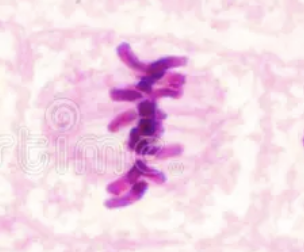
Metaphase
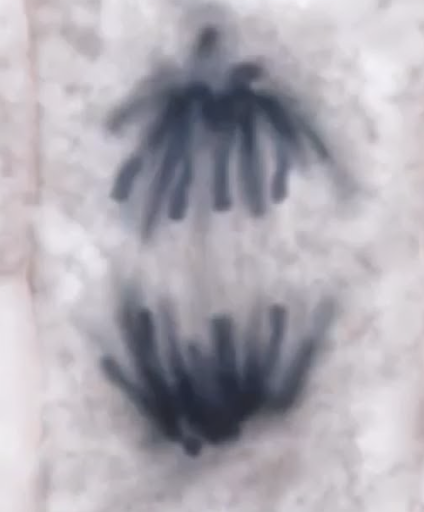
Anaphase
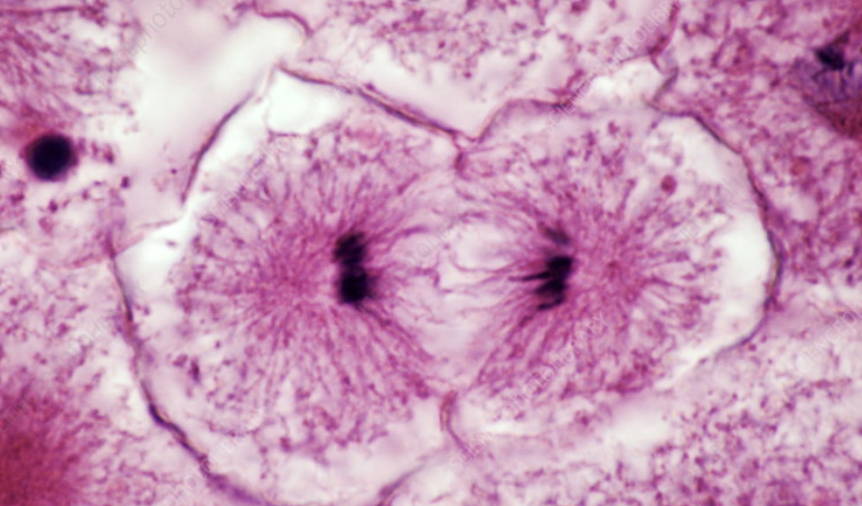
Telophase
What are the four stages of mitosis in order?
Prophase, metaphase, anaphase, and telophase.
Prophase
Chromosomes condense and become visible, and the nuclear envelope breaks down.
Metaphase
Spindle fibers attach at the centromeres through kinetochores, and chromosomes align in the middle of the cell.
Anaphase
Separase cleaves cohesins. Sister chromatids separate and migrate toward opposite poles of the cell.
Telophase
Daughter nuclei form.
Cell plate
A structure that forms between daughter cells during plant cytokinesis.
Cleavage furrow
An indentation that pinches an animal cell into two daughter cells.
Tropism
Directional growth in response to a stimulus.
Kinesis
Nondirectional change in movement in response to a stimulus.
Taxis
Directional movement toward or away from a stimulus.
Positive tropism
Growth toward a stimulus.
Negative tropism
Growth away from a stimulus.
Positive taxis
Movement toward a stimulus.
Negative taxis
Movement away from a stimulus.
Tropho and Anemo
Food, and Wind and air movement
Regeneration
The process of repairing or replacing damaged or missing body parts.
Neoblasts
Special undifferentiated stem cells found in planarians.
How do neoblasts enable regeneration?
They divide through mitosis and differentiate into specialized cells.
What stimuli were tested in the planarian experiment?
Egg yolk (food), salt, light, and air.
Null hypothesis
Predicts no effect, difference, or relationship.
Alternative hypothesis
Predicts an effect, difference, or relationship.
Replication
Using multiple independent experimental units or repeating an experiment to improve reliability.
Independent variable
The variable deliberately manipulated by the researcher.
Dependent variable
The variable measured by the researcher.
How do you write a figure legend?
Include the figure number, what was measured, treatments, relevant experimental conditions, sample size (n), and what the error bars represent, if applicable.
How to Interpret Data
Identify the overall trend, compare the results between groups, and explain what the results indicate using evidence from the data.
Why were hexane and acetone used together?
Hexane is nonpolar and dissolves nonpolar pigments, while acetone is polar and helps dissolve polar pigments, allowing the pigments to separate.
Photo-
Light
Gravi-
Gravity
Rheo-
Water Current
Thermo-
Temperature
Chemo-
Chemical
Geo-
Earth or gravity
Why is replication important?
It reduces the influence of random variation and increases the reliability of experimental results.
Where should a figure legend be placed?
Below the figure.